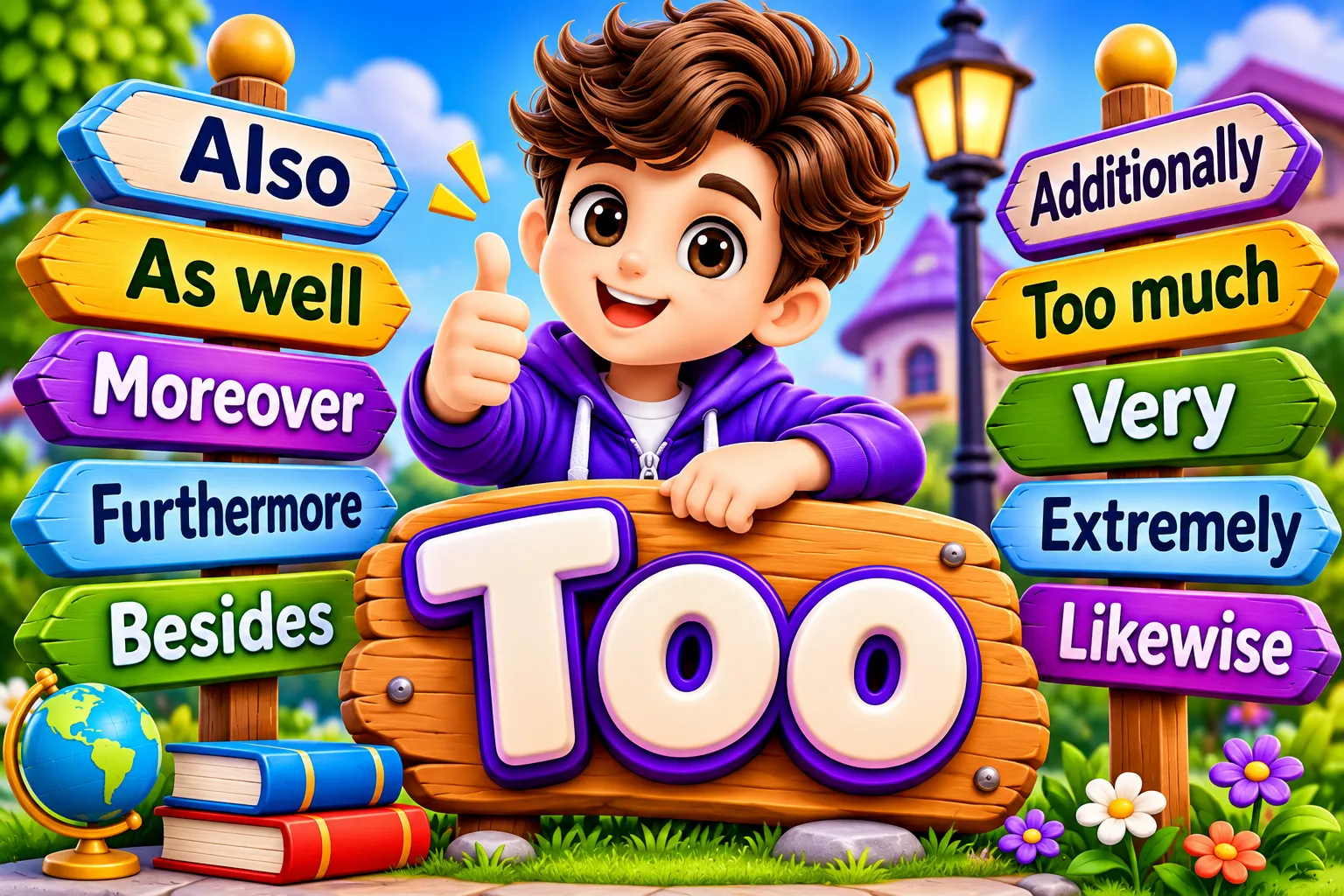
Synonyms for too include also, as well, likewise, additionally, moreover, furthermore, overly, excessively, extremely, very, highly, and exceptionally. “Too” means “also” or “more than necessary,” depending on the context. Use also or as well to show addition, and overly or excessively to express excess.
The word too is a common word in English. It can mean “also” or “more than needed.” For example, you might say, “I want to come too,” when you wish to join a friend. You may also say, “This bag is too heavy,” when it is hard to carry.
These uses make too an important word in daily speech and writing.Learning synonyms for too helps English learners and writers use words with more care. It also makes sentences clear and less repetitive.
In this guide, we will explore the meaning, history, pronunciation, grammar, and 22 useful synonyms of too. Each word will include a simple meaning and examples. You will also learn how to group these words by meaning so you can choose the right one for each sentence.
Meaning of Too
Definition
Too (Adverb):
The word too is an adverb that means “also” or “more than is needed, wanted, or suitable.”
Examples
- I want to learn English too.
- The coffee is too hot to drink.
Connotative Meaning
(Connotation: the feeling or idea a word suggests beyond its basic meaning.)
- Positive tone: Too can show inclusion or agreement, as in “I love this song too.”
- Negative tone: It can show excess, as in “The room is too small.”
- Neutral tone: It can simply mean “also,” as in “She came too.”
Etymology of Too
| Language Period | Origin and Meaning |
| Old English (450–1100) | The word too comes from Old English tō, meaning “to” or “toward.” Related forms expressed direction or extent. |
| Middle English (1100–1500) | The spelling and meaning developed. Too began to mean “also,” “in addition,” and “more than necessary.” |
| Modern English (1500–Present) | Too is mainly used to mean “also” or “more than necessary.” Its meaning depends on the context. |
Pronunciation (IPA)
- IPA: /tuː/
- Syllables: Too (1 syllable)
Affixation Pattern of Too
- Root: Too is a simple adverb.
- Prefix: None.
- Suffix: None.
- Word formations:
- Too: Adverb
- Too much: Adverbial phrase
- Too many: Determiner phrase
- Too little: Adverbial phrase or determiner phrase
- Too often: Adverbial phrase
- Too soon: Adverbial phrase
The word too does not usually form new words through prefixes or suffixes. It is mainly used in phrases to express addition or excess.
22 Synonyms of Too With Meaning & Examples
Note: The best synonym depends on whether too means “also” or “more than necessary.” Some alternatives work only in certain sentences.
1. Also (Adverb)
Meaning: In addition to someone or something.
Examples:
- I also enjoy reading books.
- She also wants to join the class.
2. As well (Adverbial phrase)
Meaning: In addition to what has already been mentioned.
Examples:
- He speaks French as well.
- I will attend the meeting as well.
3. Likewise (Adverb)
Meaning: In the same way or also.
Examples:
- I enjoyed the movie, and my friend did likewise.
- She is kind, and her sister is likewise helpful.
4. Additionally (Adverb)
Meaning: In addition to something else.
Examples:
- Additionally, we need more time.
- The school additionally offers free classes.
5. Moreover (Adverb)
Meaning: Used to add more information.
Examples:
- The book is useful; moreover, it is easy to read.
- He is smart; moreover, he is hardworking.
6. Furthermore (Adverb)
Meaning: In addition to what has already been said.
Examples:
- Furthermore, the plan will save money.
- The course is helpful; furthermore, it is affordable.
7. Besides (Adverb)
Meaning: In addition to something already mentioned.
Examples:
- I like tea. Besides, it is easy to make.
- Besides, we have enough food for everyone.
8. In Addition (Adverbial phrase)
Meaning: Along with something else.
Examples:
- In addition, she teaches English.
- In addition, we need a new computer.
9. Equally (Adverb)
Meaning: To the same degree or in the same way.
Examples:
- I equally enjoy music and art.
- Both students are equally talented.
10. Overly (Adverb)
Meaning: More than is suitable or necessary.
Examples:
- The room is overly crowded.
- She is overly worried about the test.
11. Excessively (Adverb)
Meaning: To a greater degree than is needed or acceptable.
Examples:
- The soup is excessively salty.
- He spends excessively on clothes.
12. Unduly (Adverb)
Meaning: More than is proper, fair, or necessary.
Examples:
- Do not worry unduly about the result.
- The delay was unduly long.
13. Extremely (Adverb)
Meaning: To a very high degree.
Examples:
- The weather is extremely cold.
- This book is extremely useful.
14. Very (Adverb)
Meaning: To a high degree.
Examples:
- The test was very difficult.
- She is very happy today.
15. Highly (Adverb)
Meaning: To a great degree.
Examples:
- He is highly skilled.
- This topic is highly important.
16. Exceptionally (Adverb)
Meaning: To a degree that is unusual or greater than normal.
Examples:
- The student is exceptionally bright.
- The weather is exceptionally warm today.
17. Remarkably (Adverb)
Meaning: To a degree that attracts attention.
Examples:
- The child is remarkably clever.
- The building is remarkably tall.
18. Incredibly (Adverb)
Meaning: To an extremely high degree.
Examples:
- The movie was incredibly exciting.
- She is incredibly fast.
19. Particularly (Adverb)
Meaning: More than usual or especially.
Examples:
- I am particularly interested in science.
- This task is particularly hard.
20. Especially (Adverb)
Meaning: More than others or to a greater degree.
Examples:
- I love fruits, especially apples.
- The lesson is especially useful for beginners.
21. So (Adverb)
Meaning: To a high degree.
Examples:
- The water is so cold.
- She is so kind to everyone.
22. Quite (Adverb)
Meaning: To a certain or considerable degree.
Examples:
- The room is quite large.
- The lesson was quite easy.
Prototype Meaning
The most common meanings of too are “also” and “more than necessary.” When people hear the word, they often think of adding something to an idea or showing that something is excessive. For example, “I want to go too” shows addition, while “The food is too spicy” shows excess. The meaning depends on how the word is used in a sentence.
Prototype Categorization
The synonyms of too can be divided into meaningful semantic categories. These groups help writers choose the right word based on meaning, tone, and context.
| Semantic Category | Synonyms | Description |
| Addition and Inclusion | Also, as well, likewise, additionally, moreover, furthermore, besides, in addition | These words add information or show that something is included. |
| Similarity and Equal Degree | Equally, likewise | These words show that two things share a similar quality or action. |
| Excess and Overuse | Overly, excessively, unduly, overmuch, inordinately, immoderately | These words describe something that goes beyond a suitable limit. |
| High Degree and Intensity | Extremely, very, highly, exceptionally, remarkably, incredibly, particularly, especially, so, quite, awfully, terribly, unusually | These words show that something has a strong or noticeable quality. |
| Unnecessary Addition | Superfluously | This word describes information or actions that are not needed. |
| Excessive Quantity | Excess | This noun describes an amount that is greater than necessary. |
This categorization helps writers avoid repetition and select synonyms that fit the meaning, tone, and grammar of a sentence.
Antonyms of Too
The antonyms of too depend on its meaning. When too means “also,” it has no exact opposite. When it means “more than necessary,” the following words can express the opposite idea.
1. Enough (Adverb / Determiner)
Meaning: As much or as many as needed.
- The water is warm enough to drink.
- We have enough food for everyone.
2. Sufficiently (Adverb)
Meaning: To the degree that is needed.
- The room is sufficiently large.
- She is sufficiently prepared for the exam.
3. Moderately (Adverb)
Meaning: To a reasonable or limited degree.
- The weather is moderately warm.
- He exercises moderately every day.
4. Appropriately (Adverb)
Meaning: In a way that is suitable or proper.
- She dressed appropriately for the event.
- The teacher responded appropriately.
5. Slightly (Adverb)
Meaning: To a small degree.
- The tea is slightly warm.
- The price is slightly higher.
6. Just (Adverb)
Meaning: Exactly or only as much as needed.
- The bag is just heavy enough.
- The room is just right for us.
Short Questions and Answers
What does too mean?
Too is an adverb that means “also” or “more than necessary.” It can show addition or excess.
When should too be used?
Use too when adding information or describing something that exceeds a suitable limit. For example, “I want to come too” or “The coffee is too hot.”
Is too positive or negative?
The word too can be positive, negative, or neutral. It depends on the sentence. It can show inclusion or excess.
How is too different from similar words?
Too can mean “also” or “more than necessary.” Also mainly means “in addition,” while overly and excessively mainly express excess.
Conclusion
Learning too and its synonyms can help you improve your English vocabulary. These words make writing and speaking more clear, natural, and interesting. Words such as also, as well, and likewise help you add ideas. Words such as overly, excessively, and extremely help you describe the degree of something.
Understanding the meaning and use of each synonym can also help you avoid repetition. It allows you to choose words that fit the sentence and its tone. English learners, students, and content writers can benefit from practicing these words every day.
Read simple texts, write short sentences, and use new words in daily conversations. With regular practice, you can build stronger vocabulary and gain more confidence in English.
Read More:
Synonyms for Principle: 29 Powerful Alternatives to Know

I’m Noor Fatima, an English content writer at SameSynonyms.com, specializing in synonyms, antonyms, word meanings, and English vocabulary. I create clear, well-researched content with practical examples to help readers understand word usage, expand their vocabulary, and communicate more effectively.










1 thought on “Synonyms for Too: 22 Useful Alternatives to improve vocabulary”