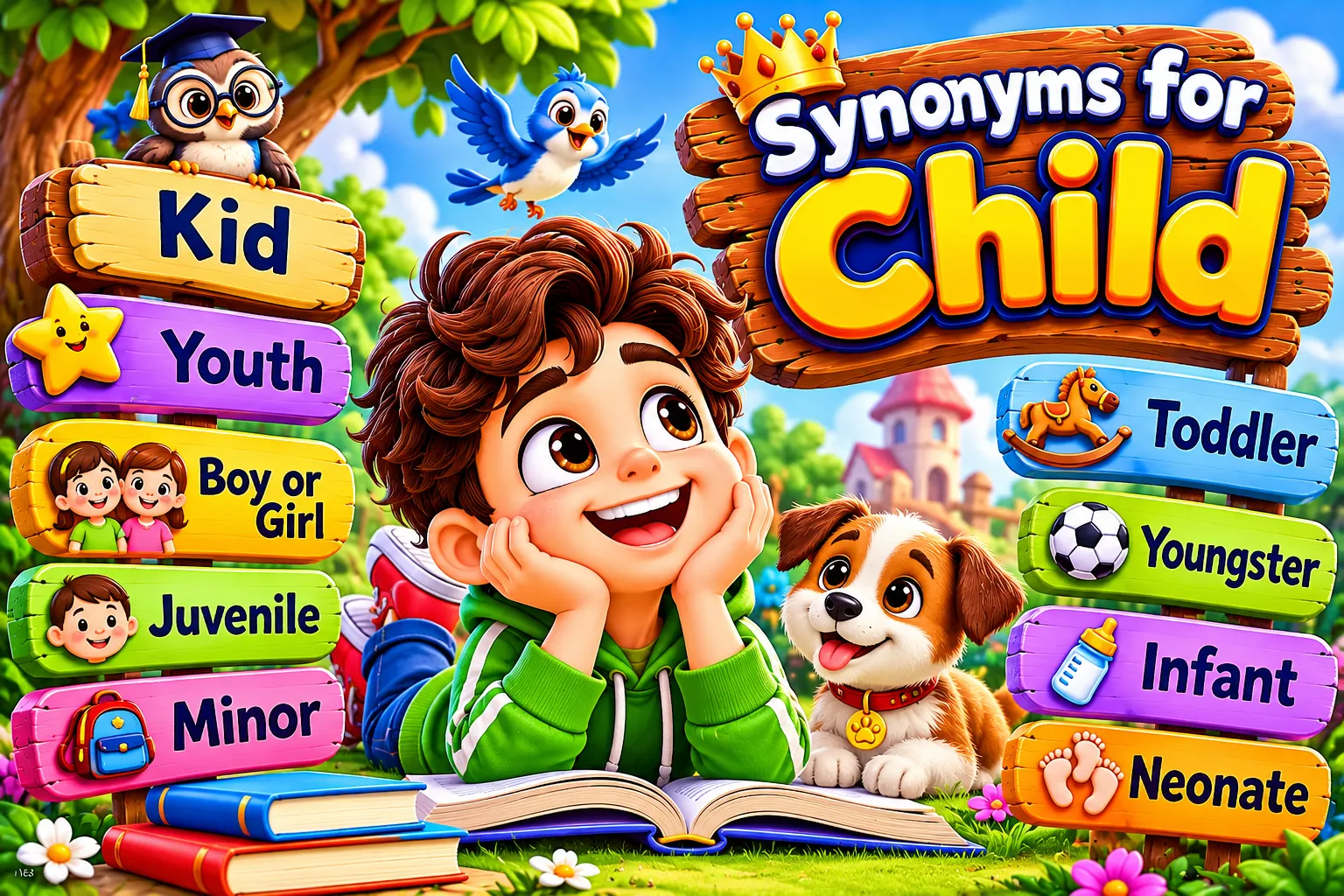
Synonyms for child include kid, youngster, little one, baby, infant, toddler, youngster, juvenile, minor, preschooler, schoolchild, offspring, tot, tyke, and teenager. These words describe young people at different ages or in different contexts. Some are informal, while others are formal or age-specific.
A child is a young person who has not yet reached adulthood. We use this word every day when talking about family, school, learning, and growing up. For example, a parent may say, “My child loves reading stories,” or a teacher may talk about the children in a class.
The word is simple and common, but using it too often can make writing sound repetitive. Learning synonyms for child helps English learners, students, and content writers express ideas in different ways.
Some alternatives describe age, while others show family roles, stages of growth, or relationships. This guide explores the meaning, history, pronunciation, and grammar of child. It also shares 25 related words with clear meanings and examples to help you choose the right word for each situation.
Meaning of Child
Definition
Child (Noun): A young human being who is not yet an adult.
Examples
- Every child deserves a safe place to learn and grow.
- The child enjoyed playing with building blocks.
Connotative Meaning
(Connotation: the feeling or idea that a word suggests beyond its basic meaning.)
- Positive tone: Can suggest innocence, curiosity, joy, and new beginnings.
- Negative tone: In some contexts, it may suggest immaturity or a lack of experience.
- Neutral tone: Simply refers to a young person who has not reached adulthood.
Etymology
The word child has Germanic roots and has been part of English for many centuries.
| Period | Origin and Development |
| Old English (450–1100) | Cild referred to a baby, young person, or offspring. |
| Middle English (1100–1500) | The word developed into forms such as child and childe. Its meaning continued to refer to a young person. |
| Modern English (1500–Present) | Child became the standard spelling and refers to a young person, especially someone below the age of adulthood. |
Pronunciation (IPA)
- IPA: /tʃaɪld/
- Syllables: Child (1 syllable)
Affixation Pattern of Child
- Root: Child
- Prefix: None
- Suffix: None in the basic word.
- Word formations:
- Childhood (Noun): The period of life when someone is a child.
- Childish (Adjective): Showing behavior often linked with a young child; it can sound negative.
- Childlike (Adjective): Having qualities such as wonder, trust, or openness often linked with children.
- Childless (Adjective): Having no children.
- Childfree (Adjective): Choosing not to have children.
- Childcare (Noun): The care of children.
- Childbirth (Noun): The process of giving birth.
- Childproof (Adjective/Verb): Designed or made safer for children.
- Children (Plural Noun): More than one child.
25 Synonyms of Child With Meaning & Examples
Note: These words are related alternatives, not exact substitutes in every sentence. Choose one that fits the child’s age, relationship, or context.
1. Kid (Noun)
Meaning: An informal word for a child or young person.
Examples:
- The kid asked many questions during the lesson.
- Each kid received a small gift.
2. Youngster (Noun)
Meaning: A young person, often a child or teenager.
Examples:
- The youngster learned to ride a bicycle.
- A group of youngsters played in the park.
3. Minor (Noun)
Meaning: A person who is below the legal age of adulthood.
Examples:
- A minor must have permission to join the trip.
- The law provides special protections for minors.
4. Juvenile (Noun)
Meaning: A young person who is not yet an adult, often used in legal or formal contexts.
Examples:
- The program supports juvenile education.
- The center provides guidance to young juveniles.
5. Little One (Noun)
Meaning: An affectionate way to refer to a young child.
Examples:
- The little one fell asleep during the journey.
- She read a bedtime story to her little one.
6. Baby (Noun)
Meaning: A very young child, especially one who has not started walking or talking.
Examples:
- The baby smiled at the colorful toy.
- They welcomed a new baby into their family.
7. Infant (Noun)
Meaning: A very young baby, especially during the first year of life.
Examples:
- The infant slept peacefully in the crib.
- The clinic offers care for infants.
8. Toddler (Noun)
Meaning: A young child who is learning to walk.
Examples:
- The toddler took a few steps across the room.
- Her toddler enjoys stacking colorful blocks.
9. Preschooler (Noun)
Meaning: A young child who is old enough for preschool but not yet in regular primary school.
Examples:
- The preschooler enjoyed painting pictures.
- Each preschooler joined the group activity.
10. Schoolchild (Noun)
Meaning: A child who attends school.
Examples:
- Every schoolchild needs time to read and play.
- The schoolchild carried books in a small bag.
11. Pupil (Noun)
Meaning: A student, especially a young person who attends school.
Examples:
- The pupil completed the reading task.
- Each pupil received feedback from the teacher.
12. Student (Noun)
Meaning: A person who studies at a school, college, or other learning center.
Examples:
- The student asked for help with the assignment.
- Every student took part in the science activity.
13. Offspring (Noun)
Meaning: A person’s or animal’s child or children; often used in formal or biological contexts.
Examples:
- The parents worked together to support their offspring.
- The bird protects its offspring from danger.
14. Descendant (Noun)
Meaning: A person who comes from a particular family or ancestor.
Examples:
- She is a descendant of a well-known family.
- The family shared stories with younger descendants.
15. Son (Noun)
Meaning: A male child in relation to their parent or parents.
Examples:
- Their son enjoys playing football.
- He helped his son with a school project.
16. Daughter (Noun)
Meaning: A female child in relation to their parent or parents.
Examples:
- Her daughter loves drawing animals.
- They attended their daughter’s school event.
17. Sibling (Noun)
Meaning: A person’s brother or sister.
Examples:
- The child shared the toy with a sibling.
- Each sibling had a different favorite book.
18. Brother (Noun)
Meaning: A male sibling who shares one or both parents with another person.
Examples:
- Her younger brother joined the game.
- The brothers built a model house together.
19. Sister (Noun)
Meaning: A female sibling who shares one or both parents with another person.
Examples:
- His little sister enjoys music.
- The sisters read stories together.
20. Newborn (Noun)
Meaning: A baby who has been born very recently.
Examples:
- The newborn slept in a warm blanket.
- The family welcomed their newborn home.
21. Babe (Noun)
Meaning: An informal or affectionate word for a baby or very young child.
Examples:
- The parents gently held their babe.
- The old song tells a story about a sleeping babe.
22. Tot (Noun)
Meaning: An informal word for a very young child.
Examples:
- The tot played with colorful blocks.
- A small tot waved at the visitors.
23. Tike (Noun)
Meaning: An informal word for a small child.
Examples:
- The little tike ran toward the playground.
- A cheerful tike asked to hear another story.
24. Tyke (Noun)
Meaning: An informal word for a child, often a lively or playful one.
Examples:
- The tyke laughed while playing in the garden.
- That curious tyke wanted to explore everything.
25. Rugrat (Noun)
Meaning: A humorous, informal word for a young child.
Examples:
- The rugrat covered the table with crayons.
- Their energetic rugrat kept everyone smiling.
Prototype Meaning
The most common meaning of child is a young human being who has not yet reached adulthood. When people hear this word, they often imagine a young person learning, playing, asking questions, and growing. The word can refer to a baby, toddler, school-age child, or young person, depending on the context. It can also describe someone’s relationship to a parent, as in “their child.”
Prototype Categorization
The 25 alternatives to child can be grouped by age, family relationships, social roles, and context. These categories help writers choose a word that gives the right meaning.
| Semantic Category | Synonyms | Description |
| General and Informal Terms | Kid, youngster, little one, tot, tike, tyke, rugrat, babe | Common or informal words for a young child. Some are affectionate, while others are humorous. |
| Babies and Early Childhood | Baby, infant, newborn, toddler, preschooler | Words that describe babies and children in their early years. |
| School and Learning | Schoolchild, pupil, student | Terms for young people who take part in education. |
| Age and Legal Status | Minor, juvenile, adolescent, teenager | Words that describe a person’s age or legal stage of development. |
| Family and Relationships | Son, daughter, sibling, brother, sister | Words that explain a child’s relationship with family members. |
| Family Lineage and Biology | Offspring, descendant | More formal terms connected with family lines and parent-child relationships. |
| Care and Family Circumstances | Ward, orphan | Words used for specific family, guardianship, or care situations. |
| Behavior and Personality | Brat | An informal, negative term for a child who behaves badly. |
Antonyms of Child
There is no perfect opposite of child, but these words contrast with it by age or life stage.
- Adult (Noun): A fully grown person who has reached the age of adulthood.
- Grown-up (Noun): An informal term for an adult.
- Elder (Noun): An older person, often respected for age or experience.
- Senior (Noun): An older person, especially someone in a later stage of life.
- Mature person (Noun): Someone who has reached adulthood or shows mature behavior.
Short Questions and Answers
What does child mean?
A child is a young human being who has not yet reached adulthood.
When should child be used?
Use child when referring to a young person, especially in family, school, health, and everyday situations.
Is child positive or negative?
The word child is usually neutral. Its emotional meaning depends on the sentence and context.
How is child different from similar words?
Child is a general term. Baby and infant refer to very young children, toddler describes a child learning to walk, and teenager refers to someone aged 13 to 19. Informal words such as kid and tot are common in casual speech.
Conclusion
Learning the word child and its synonyms can make your English clearer and more interesting. Words such as baby, toddler, youngster, and teenager describe different ages, while son, daughter, and offspring show family relationships.
Other words, such as pupil and minor, fit school or legal settings. Choosing the right alternative helps you avoid repetition and express your ideas with care. It also improves your writing, speaking, and reading skills.
Try learning a few new words each day and using them in your own sentences. With regular practice, you can build a stronger vocabulary and feel more confident when using English.
Read More:
Synonyms for Desperation: 30 Powerful Alternatives

I’m Rubab, a content specialist at SameSynonym, focused on synonyms, antonyms, word meanings, and English vocabulary.
I create clear, well-researched content with accurate definitions and practical examples.
My goal is to help readers improve their vocabulary and writing with confidence.




1 thought on “Synonyms for Child: 25 Useful Alternatives to Know”