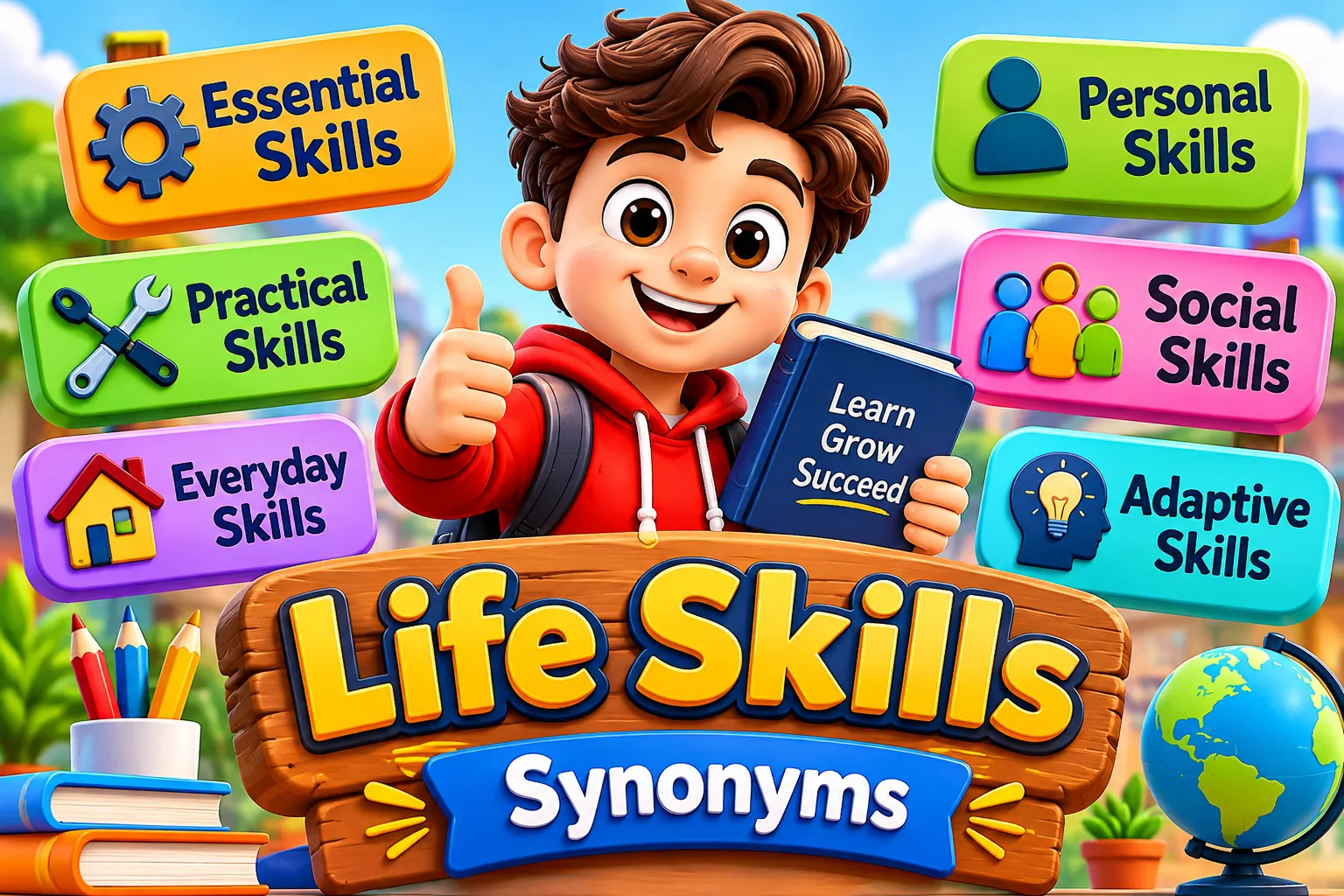
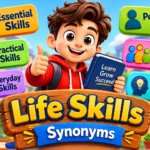
Synonyms for life skills include practical skills, essential skills, daily living skills, social skills, coping skills, communication skills, problem-solving skills, decision-making skills, interpersonal skills, functional skills, soft skills, and self-management skills. These terms describe abilities that help people manage daily tasks, solve problems, build relationships, and become independent.
Life skills are the abilities that help people manage daily tasks, solve problems, and make good choices. For example, a student who plans a study schedule, talks with friends, and handles stress uses life skills every day. These skills help people succeed at school, work, and home.
The term life skills is common in education, personal growth, and career development. Learning its synonyms can help English learners build better vocabulary. It also helps content writers create clear, engaging, and varied content. Some words focus on daily tasks, while others highlight social skills, emotional control, or practical knowledge.
In this article, we will explore the meaning of life skills, its 23 useful synonyms, examples, pronunciation, word history, grammar, and semantic categories. These simple explanations will help you choose the right words for speaking and writing.
Meaning of Life Skills
Definition
Life skills (Plural Noun): Life skills are the abilities and knowledge people use to handle daily challenges, make decisions, solve problems, and live well.
Examples
- Good life skills help children become more independent.
- Communication and problem-solving are important life skills.
Connotative Meaning
- Positive tone: Suggests confidence, independence, growth, and success.
- Negative tone: May suggest a lack of basic abilities when someone struggles with daily tasks.
- Neutral tone: Refers to abilities used in everyday life.
(Connotation: The feelings or ideas connected to a word beyond its basic meaning.)
Etymology
| Period | Word Origin | Meaning and Development |
| Old English (450–1100) | Līf (life) and Old Norse skil (skill) | Līf meant existence or living. Skil meant distinction or understanding. |
| Middle English (1100–1500) | Life and skill | Life developed from Old English. Skill gained meanings related to knowledge, ability, and practical understanding. |
| Modern English (1500–Present) | Life skills | The phrase refers to abilities needed for daily living, personal growth, social interaction, and work. |
Pronunciation (IPA)
- IPA: /ˈlaɪf skɪlz/
- Syllables: Life skills (1 + 1 syllable)
Affixation Pattern of Life Skills
- Root: Life + skill
- Prefix: None
- Suffix: -s in skills, marking the plural noun.
Word Formations
- Life (Noun): The state of being alive.
- Skill (Noun): The ability to do something well.
- Skills (Plural Noun): Abilities to perform tasks.
- Skilled (Adjective): Having the ability or training to do something well.
- Skillful (Adjective): Showing good ability or talent.
- Skillfully (Adverb): In a way that shows skill.
- Skillfulness (Noun): The quality of being skillful.
- Skilling (Noun/Verb): The process of developing skills.
- Lifelong (Adjective): Lasting throughout a person’s life.
- Lifespan (Noun): The length of a person’s life.
23 Synonyms of Life Skills With Meaning & Examples
The following alternatives are related to life skills. Some are close synonyms, while others describe specific abilities or broader concepts.
1. Practical Skills (Noun Phrase)
Meaning: Abilities used to complete real-world tasks.
Examples:
- Practical skills help people manage daily work.
- Cooking is one of the useful practical skills.
2. Essential Skills (Noun Phrase)
Meaning: Basic abilities needed for daily life and success.
Examples:
- Reading and writing are essential skills.
- Essential skills help students prepare for work.
3. Survival Skills (Noun Phrase)
Meaning: Abilities needed to stay safe and meet basic needs.
Examples:
- Survival skills can help people in emergencies.
- Learning first aid is a useful survival skill.
4. Daily Living Skills (Noun Phrase)
Meaning: Abilities used to manage everyday activities.
Examples:
- Daily living skills help people become independent.
- Children learn daily living skills at home.
5. Coping Skills (Noun Phrase)
Meaning: Abilities used to handle stress and difficult situations.
Examples:
- Coping skills help people manage stress.
- Deep breathing is a helpful coping skill.
6. Social Skills (Noun Phrase)
Meaning: Abilities used to communicate and interact with others.
Examples:
- Social skills help children make friends.
- Good social skills improve teamwork.
7. Communication Skills (Noun Phrase)
Meaning: Abilities used to share ideas and understand others.
Examples:
- Communication skills are useful at work.
- Good communication skills prevent confusion.
8. Problem-Solving Skills (Noun Phrase)
Meaning: Abilities used to find solutions to problems.
Examples:
- Problem-solving skills help students face challenges.
- Strong problem-solving skills support good decisions.
9. Decision-Making Skills (Noun Phrase)
Meaning: Abilities used to choose the best option.
Examples:
- Decision-making skills help people plan their future.
- Good decision-making skills reduce mistakes.
10. Interpersonal Skills (Noun Phrase)
Meaning: Abilities used to build and maintain relationships.
Examples:
- Interpersonal skills are important for leaders.
- Good interpersonal skills help teams work together.
11. Emotional Intelligence (Noun Phrase)
Meaning: The ability to understand and manage emotions.
Examples:
- Emotional intelligence helps people handle conflict.
- Leaders need emotional intelligence to support teams.
12. Self-Management Skills (Noun Phrase)
Meaning: Abilities used to control behavior, time, and personal tasks.
Examples:
- Self-management skills help students stay focused.
- Strong self-management skills improve productivity.
13. Organizational Skills (Noun Phrase)
Meaning: Abilities used to arrange tasks, resources, and time.
Examples:
- Organizational skills help workers meet deadlines.
- Good organizational skills keep a home tidy.
14. Time Management Skills (Noun Phrase)
Meaning: Abilities used to plan and use time well.
Examples:
- Time management skills help students finish homework.
- Good time management skills reduce stress.
15. Critical Thinking Skills (Noun Phrase)
Meaning: Abilities used to examine information and judge it carefully.
Examples:
- Critical thinking skills help people solve problems.
- Students use critical thinking skills in class.
16. Adaptability Skills (Noun Phrase)
Meaning: Abilities used to adjust to new situations.
Examples:
- Adaptability skills help workers face change.
- Good adaptability skills make learning easier.
17. Independence Skills (Noun Phrase)
Meaning: Abilities used to perform tasks without constant help.
Examples:
- Independence skills help young adults live alone.
- Children develop independence skills through practice.
18. Self-Help Skills (Noun Phrase)
Meaning: Abilities used to care for one’s own needs.
Examples:
- Self-help skills include dressing and eating.
- Children learn self-help skills as they grow.
19. Personal Development Skills (Noun Phrase)
Meaning: Abilities that support personal growth and improvement.
Examples:
- Personal development skills build confidence.
- Reading can improve personal development skills.
20. Workplace Skills (Noun Phrase)
Meaning: Abilities needed to perform well in a job.
Examples:
- Workplace skills help people succeed in their careers.
- Teamwork is one of the important workplace skills.
21. Employability Skills (Noun Phrase)
Meaning: Abilities that help people get and keep a job.
Examples:
- Employability skills make job seekers more prepared.
- Employers value strong employability skills.
22. Functional Skills (Noun Phrase)
Meaning: Abilities used to perform useful everyday tasks.
Examples:
- Functional skills help people manage daily activities.
- Math and reading are important functional skills.
23. Competencies (Plural Noun)
Meaning: Abilities and knowledge needed to perform tasks effectively.
Examples:
- Leadership competencies help managers guide teams.
- The course develops important life competencies.
Prototype Meaning
The typical meaning of life skills refers to the practical abilities people need to manage everyday life. When people hear this phrase, they often imagine communication, problem-solving, decision-making, time management, and self-care. These skills help people become independent, build relationships, and handle challenges. Life skills are useful at home, in school, at work, and in society. They support personal growth and help people make better choices.
Prototype Categorization
The 23 synonyms of life skills can be grouped into meaningful semantic categories. These categories help writers choose the best synonym for each context.
| Semantic Category | Synonyms | Description |
| Daily Tasks and Practical Abilities | Practical skills, essential skills, daily living skills, functional skills, survival skills, self-help skills | Describe abilities used to manage everyday needs and tasks. |
| Communication and Relationships | Social skills, communication skills, interpersonal skills, human skills | Focus on talking, listening, and building relationships. |
| Personal Growth and Emotional Control | Coping skills, emotional intelligence, personal development skills, personal skills, resilience | Describe emotional strength, self-improvement, and handling challenges. |
| Planning and Organization | Self-management skills, organizational skills, time management skills, decision-making skills | Help people manage tasks, organize time, and make good choices. |
| Thinking and Problem-Solving | Problem-solving skills, critical thinking skills, resourcefulness | Focus on finding solutions and thinking clearly. |
| Independence and Self-Reliance | Independence skills, self-reliance | Describe the ability to manage life without constant support. |
| Career and Professional Abilities | Workplace skills, employability skills, soft skills, competencies, competence | Refer to abilities useful in education, job applications, and professional settings. |
| Adapting to Change | Adaptability skills | Describe the ability to adjust to new situations. |
This categorization helps writers avoid repetition and select words that match their intended meaning. For example, communication skills is suitable for relationships, while employability skills is better for career-related writing.
.
Antonyms of Life Skills
Life skills do not have one exact opposite. However, the following terms describe a lack of ability, independence, or useful skills.
1. Incompetence (Noun)
Meaning: A lack of ability to perform a task well.
2. Helplessness (Noun)
Meaning: The state of being unable to manage a situation without help.
3. Inability (Noun)
Meaning: The lack of power or skill to do something.
4. Dependence (Noun)
Meaning: The state of relying on others for support.
5. Ineptitude (Noun)
Meaning: A lack of skill or ability in performing tasks.
6. Unpreparedness (Noun)
Meaning: The state of not being ready to handle a situation.
7. Weakness (Noun)
Meaning: A lack of strength or ability in a particular area.
8. Inexperience (Noun)
Meaning: A lack of knowledge or practice in a task.
Short Questions and Answers
What does life skills mean?
Life skills are abilities that help people manage daily activities, solve problems, make decisions, and handle challenges.
When should life skills be used?
The phrase life skills is used in education, personal development, career training, and everyday discussions about useful abilities.
Is life skills positive or negative?
Life skills usually has a positive or neutral tone. It often refers to abilities that support independence, confidence, and personal growth.
How is life skills different from similar words?
Life skills is a broad term for abilities needed in daily life. Practical skills focus on real-world tasks, soft skills focus on social behavior, and coping skills focus on handling stress.
Conclusion
Learning life skills and their synonyms can improve your English vocabulary and help you express ideas clearly. Words such as practical skills, social skills, and problem-solving skills describe different abilities used in everyday life. These alternatives also help writers avoid repetition and make their content more engaging.
Life skills are useful for students, workers, parents, and people of all ages. They help build independence, improve communication, and support better decision-making. Understanding the differences between related words allows you to choose the right term for each situation.
You can improve your vocabulary by reading, writing, and using new words in daily conversations. Practice a few synonyms each day to strengthen your English speaking and writing skills. With regular practice, you can build confidence and communicate your ideas more effectively.
Read More:
Synonyms for Trained: 28 Powerful Alternatives

I’m Rubab, a content specialist at SameSynonym, focused on synonyms, antonyms, word meanings, and English vocabulary.
I create clear, well-researched content with accurate definitions and practical examples.
My goal is to help readers improve their vocabulary and writing with confidence.



1 thought on “Synonyms for Life Skills: 23 Useful Alternatives to Know”