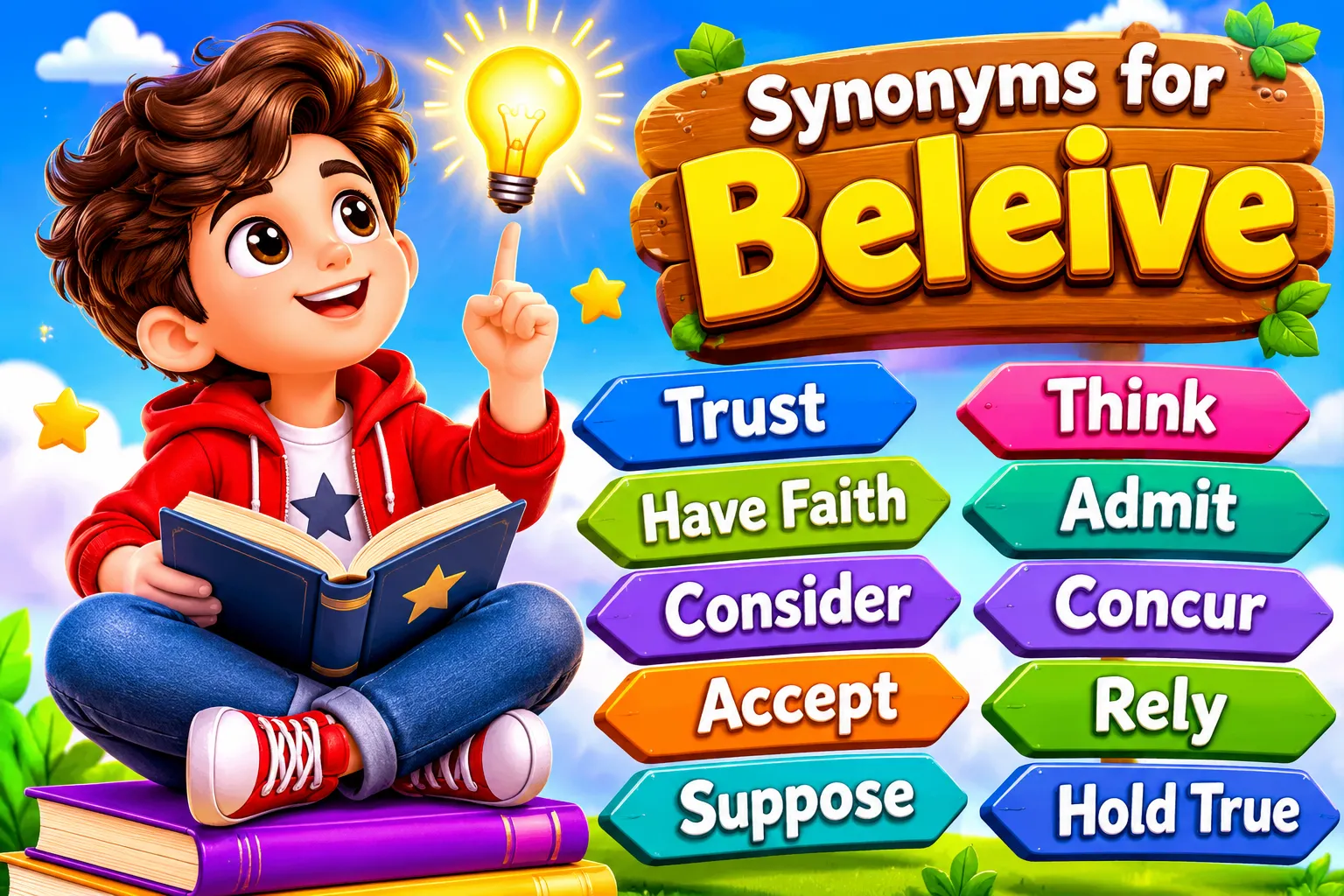
Synonyms for believe include trust, accept, think, suppose, assume, consider, expect, presume, rely on, have faith in, be convinced, and regard as true.
The word believe means to think that something is true or to trust someone or something. Imagine your friend tells you that she passed an important exam. You may believe her because you trust her.
People use this word every day when they share ideas, talk about facts, or express trust.Learning synonyms for believe helps English learners and writers express their thoughts in many ways. Words such as trust, accept, and consider can make sentences more clear and natural.
These words may have similar meanings, but they do not always fit the same context. In this guide, we will explore the meaning, history, pronunciation, grammar, and 24 synonyms of believe. Simple meanings and examples will help you understand each word and use it with confidence.
Meaning of Believe
Definition
Believe (Verb):
To think that something is true, accept something as real, or trust someone or something.
Examples
- I believe that she is telling the truth.
- We believe in the power of hard work.
Connotative Meaning
(Connotation: the feeling or idea a word suggests beyond its basic meaning.)
- Positive tone: Believe can show trust, hope, or confidence. Example: “I believe in you.”
- Negative tone: It may show doubt or a mistaken view when someone believes something false.
- Neutral tone: It can simply mean accepting something as true. Example: “I believe the meeting starts at nine.”
Etymology of Believe
| Period | Etymology and Meaning |
| Old English (450–1100) | The word believe is linked to Old English belȳfan or gelȳfan, meaning “to believe” or “to trust.” |
| Middle English (1100–1500) | The word developed through forms such as bileven and beleven. It continued to mean trusting or accepting something as true. |
| Modern English (1500–Present) | Believe is used to express trust, faith, acceptance, or an opinion about what is true. |
Pronunciation (IPA)
- IPA: /bɪˈliːv/
- Syllables: be-lieve (2 syllables)
Affixation Pattern of Believe
- Root: Believe
- Prefix: None in the modern word.
- Suffix: None in the base form.
Word Formations
- Believe : Verb
- Belief : Noun
- Believer : Noun
- Believable : Adjective
- Unbelievable : Adjective
- Believably : Adverb
- Unbelievably : Adverb
- Disbelief : Noun
- Disbelieve : Verb
- Disbeliever : Noun
24 Synonyms of Believe With Meaning & Examples
1. Trust (Verb)
Meaning: To feel sure that someone or something is honest, safe, or reliable.
Examples:
- I trust my best friend.
- You can trust her advice.
2. Accept (Verb)
Meaning: To agree that something is true or real.
Examples:
- I accept that he was right.
- She accepted the facts.
3. Think (Verb)
Meaning: To have an idea or opinion about something.
Examples:
- I think this answer is correct.
- We think he is a good person.
4. Consider (Verb)
Meaning: To think of something as true or possible.
Examples:
- I consider her a great teacher.
- They consider the plan useful.
5. Suppose (Verb)
Meaning: To think that something is likely to be true.
Examples:
- I suppose he is at home.
- We suppose the train is late.
6. Assume (Verb)
Meaning: To accept something as true without proof.
Examples:
- I assume you are ready.
- Do not assume that everyone agrees.
7. Have Faith (Verb phrase)
Meaning: To trust or feel sure about someone or something.
Examples:
- I have faith in my team.
- She has faith in her dreams.
8. Regard (Verb)
Meaning: To think of someone or something in a certain way.
Examples:
- I regard him as a good leader.
- They regard the rule as fair.
9. Be Convinced (Verb phrase)
Meaning: To feel certain that something is true.
Examples:
- I am convinced that she is honest.
- He is convinced that the idea will work.
10. Hold (Verb)
Meaning: To have a belief, opinion, or view.
Examples:
- She holds strong beliefs about education.
- They hold the view that everyone deserves respect.
11. Maintain (Verb)
Meaning: To continue to say that something is true.
Examples:
- He maintains that he did nothing wrong.
- She maintains that the plan is fair.
12. Assert (Verb)
Meaning: To state something firmly as true.
Examples:
- He asserts that he is innocent.
- The writer asserts that education is vital.
13. Claim (Verb)
Meaning: To say that something is true, often without proof.
Examples:
- He claims that he saw the accident.
- They claim the product is safe.
14. Suspect (Verb)
Meaning: To think that something may be true, often without proof.
Examples:
- I suspect that he is hiding something.
- She suspects that the answer is wrong.
15. Presume (Verb)
Meaning: To believe something is true based on what seems likely.
Examples:
- I presume you have finished your work.
- We presume that the road is open.
16. Infer (Verb)
Meaning: To reach a belief or conclusion from facts or clues.
Examples:
- I infer that she is upset from her silence.
- We inferred that the meeting was canceled.
17. Conclude (Verb)
Meaning: To decide that something is true after thinking about the facts.
Examples:
- I conclude that the answer is correct.
- They concluded that he was honest.
18. Credit (Verb)
Meaning: To believe that someone has a quality or has done something.
Examples:
- I credit her with great courage.
- They credit him with the success.
19. Confide (Verb)
Meaning: To trust someone with private information.
Examples:
- I confide in my sister.
- She confided her worries to a friend.
20. Rely (Verb)
Meaning: To depend on someone or something with trust.
Examples:
- I rely on my parents for support.
- You can rely on his word.
21. Endorse (Verb)
Meaning: To publicly support or approve an idea or statement.
Examples:
- I endorse this proposal.
- The teacher endorsed the student’s idea.
22. Acknowledge (Verb)
Meaning: To accept or recognize that something is true.
Examples:
- I acknowledge that I made a mistake.
- She acknowledged the facts.
23. Recognize (Verb)
Meaning: To accept or understand something as true or important.
Examples:
- I recognize the value of education.
- He recognizes that the task is difficult.
24. Agree (Verb)
Meaning: To share the same opinion or accept an idea.
Examples:
- I agree with your opinion.
- She agrees that the plan is useful.
Prototype Meaning
The most typical meaning of believe is to accept something as true or to feel sure about a person, idea, or fact. When people hear this word, they often think of trust, faith, or confidence. For example, believing a friend means trusting what the friend says. Believing in yourself means having confidence in your skills and abilities. The word can also express an opinion or a thought about a situation. Its meaning depends on the context in which it is used.
Prototype Categorization
The 24 synonyms of believe can be divided into meaningful semantic categories. These groups help writers choose the right word based on the type of belief, trust, or opinion they want to express.
| Semantic Category | Synonyms | Description |
| Trust and Confidence | Trust, have faith, rely, confide, faith, be sure | These words express confidence in a person, idea, or thing. |
| Acceptance of Truth | Accept, acknowledge, recognize, agree | These words show that someone accepts something as true or valid. |
| Opinion and Judgment | Think, consider, regard, be of the opinion | These words express personal views or judgments. |
| Assumption and Possibility | Suppose, assume, presume, suspect | These words express beliefs that may not be fully proven. |
| Certainty and Conviction | Be convinced, be certain, conclude, infer | These words show confidence in a belief or conclusion. |
| Strong Statements and Claims | Assert, claim, maintain, hold | These words describe expressing or keeping a belief or opinion. |
| Support and Approval | Endorse, subscribe, uphold, credit | These words show support for ideas, principles, or people. |
This categorization helps writers avoid repetition and choose words that fit the meaning, tone, and context of a sentence.
Antonyms of Believe
1. Doubt (Verb)
Meaning: To feel unsure about whether something is true.
- I doubt his story.
- She doubts that the plan will work.
2. Disbelieve (Verb)
Meaning: To refuse to accept something as true.
- I disbelieve his claim.
- They disbelieve the report.
3. Distrust (Verb)
Meaning: To lack confidence in someone or something.
- I distrust his promises.
- She distrusts the company.
4. Reject (Verb)
Meaning: To refuse to accept an idea or statement.
- He rejected the theory.
- They rejected the claim.
5. Deny (Verb)
Meaning: To say that something is not true.
- She denied the accusation.
- He denied the statement.
6. Question (Verb)
Meaning: To express doubt about whether something is true.
- I question his decision.
- The students questioned the claim.
Short Questions and Answers
What does believe mean?
Believe means to accept something as true or to trust someone or something.
When should believe be used?
Use believe when expressing trust, faith, or an opinion about something. For example, “I believe in your ability.”
Is believe positive or negative?
Believe is usually neutral, but it can have a positive or negative tone depending on the context. It may show trust, hope, or acceptance of a false idea.
How is believe different from similar words?
Believe means to accept something as true. Trust focuses on confidence in someone or something. Assume means to accept something without proof, while doubt means to feel unsure.
Conclusion
Learning believe and its synonyms can help you build a stronger English vocabulary. Words such as trust, accept, consider, and assume allow you to express ideas in different ways. They can make your writing and speaking more clear and natural.
Understanding each synonym also helps you avoid repetition and select the right word for the right situation. Some words show trust, while others express opinions, assumptions, or strong beliefs.
English learners, students, and content writers can use these words to improve their communication skills. Practice using new synonyms in daily conversations, reading, and writing. With regular practice, you can improve your vocabulary, express your thoughts with greater accuracy, and build confidence in English.
Read More;
Synonyms for Too: 22 Useful Alternatives to improve vocabulary

I’m Rubab, a content specialist at SameSynonym, focused on synonyms, antonyms, word meanings, and English vocabulary.
I create clear, well-researched content with accurate definitions and practical examples.
My goal is to help readers improve their vocabulary and writing with confidence.











1 thought on “Synonyms for Believe: 24 Powerful Alternatives to Know”