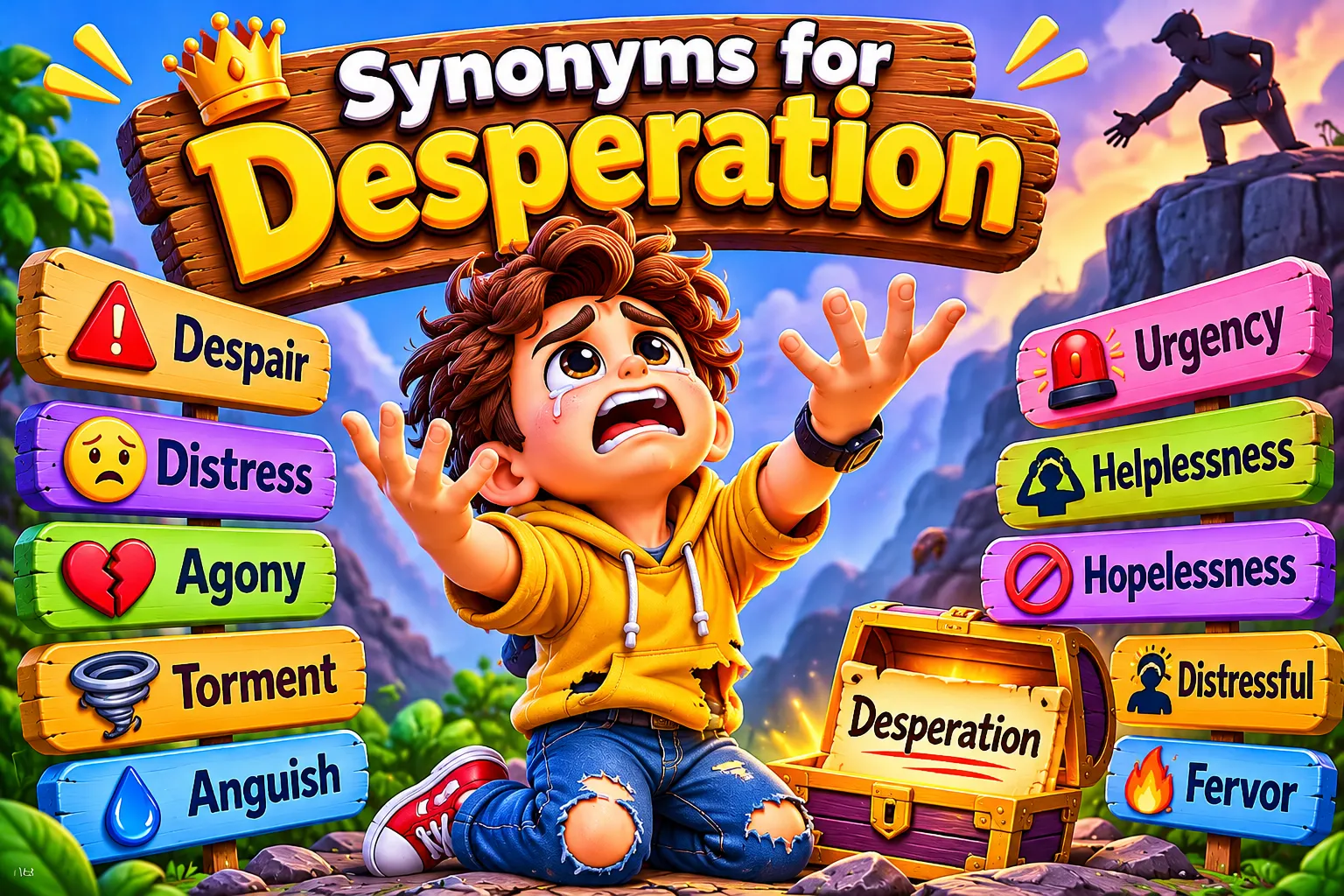
Synonyms for desperation include despair, hopelessness, distress, anguish, panic, anxiety, helplessness, misery, urgency, and despondency. These words describe intense feelings of fear, worry, suffering, or urgent need when someone faces a difficult situation and feels they have limited options.
Desperation is a strong feeling of fear, worry, or hopelessness that can arise when life becomes difficult. Imagine losing your job, running out of money, or searching for help with no clear solution. In such moments, a person may act out of desperation.
This word is common in everyday English because it describes intense emotions and urgent situations. Learning synonyms for desperation helps you express these feelings in different ways without repeating the same word.
It also helps English learners build vocabulary and allows content writers to make their work more clear and engaging. In this guide, you will explore the meaning, examples, history, pronunciation, and 30 useful synonyms for desperation, along with their semantic categories and antonyms.
Meaning of Desperation
Definition
Desperation (Noun): Desperation is an extreme feeling of fear, worry, or hopelessness that makes someone feel an urgent need to act or find a solution to a difficult situation.
Examples
- She searched desperately for a new job after losing her previous one.
- His desperation grew when he could not find a solution to the problem.
Connotative Meaning
(Connotation: the feeling or emotion a word suggests beyond its basic meaning.)
- Positive tone: In some situations, desperation can suggest a strong determination to survive, overcome a challenge, or achieve an important goal.
- Negative tone: It often suggests fear, panic, hopelessness, or emotional suffering.
- Neutral tone: It can describe an urgent need to act without judging the person experiencing it.
Etymology
The word desperation comes from Latin through Old French. It entered English in the Middle Ages and originally referred to a loss of hope.
| Period | Origin and Development |
|---|---|
| Old English (450–1100) | The word desperation was not used in Old English. Similar ideas were expressed through words related to despair, fear, and loss of hope. |
| Middle English (1100–1500) | The word entered English through Old French desesperacion, from Latin desperatio, meaning “loss of hope.” |
| Modern English (1500–Present) | Desperation developed to describe extreme hopelessness, emotional distress, and an urgent need to change a difficult situation. |
Pronunciation (IPA)
- IPA: /ˌdes.pəˈreɪ.ʃən/
- Syllables: des-per-a-tion (4 syllables)
Affixation Pattern of Desperation
- Root: Sper related to Latin sperare, meaning “to hope.”
- Prefix: De- a Latin prefix that can express removal or reversal.
- Suffix: -ation forms nouns that describe a state, process, or action.
Word formations:
- Despair (Noun/Verb): A complete loss of hope; to lose hope.
- Desperate (Adjective): Feeling or showing an extreme need for something.
- Desperately (Adverb): In a way that shows great need, fear, or urgency.
- Desperation (Noun): A state of extreme hopelessness or urgent need.
30 Synonyms of Desperation With Meaning & Examples
1. Despair (Noun)
Meaning: A deep feeling of having no hope.
Examples:
- He felt despair after receiving the disappointing news.
- She struggled to overcome her despair.
2. Hopelessness (Noun)
Meaning: The feeling that a situation will not improve.
Examples:
- Hopelessness grew after several unsuccessful attempts.
- Support from friends helped her overcome her hopelessness.
3. Distress (Noun)
Meaning: Great emotional pain, worry, or suffering.
Examples:
- The family experienced distress after the unexpected event.
- Her voice showed signs of emotional distress.
4. Despondency (Noun)
Meaning: A state of low spirits and loss of hope.
Examples:
- He experienced despondency after repeated setbacks.
- Her despondency slowly faded with time.
5. Anguish (Noun)
Meaning: Severe emotional pain or suffering.
Examples:
- She cried out in anguish after hearing the news.
- The difficult decision caused him great anguish.
6. Panic (Noun)
Meaning: A sudden feeling of extreme fear that makes it difficult to think clearly.
Examples:
- She felt panic when she could not find her child.
- Panic spread through the crowd during the emergency.
7. Anxiety (Noun)
Meaning: A strong feeling of worry or fear about something that may happen.
Examples:
- His anxiety increased before the important interview.
- She tried to manage her anxiety through deep breathing.
8. Helplessness (Noun)
Meaning: The feeling of being unable to change or control a situation.
Examples:
- He felt helplessness when he could not solve the problem.
- Her sense of helplessness made her seek support.
9. Urgency (Noun)
Meaning: The need to act quickly because something is important or serious.
Examples:
- There was urgency in her voice.
- The team understood the urgency of the situation.
10. Misery (Noun)
Meaning: Great unhappiness, pain, or suffering.
Examples:
- The long period of uncertainty caused great misery.
- He wanted to find a way out of his misery.
11. Agony (Noun)
Meaning: Extreme physical or emotional pain.
Examples:
- She was in agony after hearing the heartbreaking news.
- Waiting for the final decision felt like agony.
12. Turmoil (Noun)
Meaning: A state of great confusion, worry, or emotional trouble.
Examples:
- His mind was in turmoil after the disagreement.
- The unexpected change caused emotional turmoil.
13. Alarm (Noun)
Meaning: A sudden feeling of fear or worry about possible danger.
Examples:
- The strange noise caused alarm.
- Her face showed alarm when she noticed the smoke.
14. Fear (Noun)
Meaning: An unpleasant feeling caused by danger or the possibility of harm.
Examples:
- Fear made him hesitate before taking action.
- She faced her fear and spoke confidently.
15. Frustration (Noun)
Meaning: Annoyance or upset caused by being unable to achieve something.
Examples:
- He sighed in frustration after trying several times.
- Her frustration grew when the problem remained unsolved.
16. Desolation (Noun)
Meaning: A deep feeling of sadness, loneliness, or emptiness.
Examples:
- She felt desolation after moving away from her loved ones.
- The loss left him with a sense of desolation.
17. Agitation (Noun)
Meaning: A state of nervousness, worry, or emotional upset.
Examples:
- His agitation was clear during the discussion.
- She showed signs of agitation before the important meeting.
18. Trepidation (Noun)
Meaning: A feeling of fear or nervousness about something that may happen.
Examples:
- He entered the room with trepidation.
- She felt trepidation before making the difficult decision.
19. Suffering (Noun)
Meaning: The experience of physical or emotional pain.
Examples:
- The community received support during its time of suffering.
- Her suffering encouraged her to seek help.
20. Need (Noun)
Meaning: A situation in which someone lacks something important or necessary.
Examples:
- The family was in need of temporary support.
- She asked for help during a time of need.
21. Predicament (Noun)
Meaning: A difficult or unpleasant situation that is hard to escape.
Examples:
- He found himself in a difficult predicament.
- They worked together to find a way out of their predicament.
22. Plight (Noun)
Meaning: A difficult or troubling situation.
Examples:
- The report highlighted the plight of families affected by the disaster.
- Her friends wanted to help improve her difficult plight.
23. Wretchedness (Noun)
Meaning: A state of extreme unhappiness or suffering.
Examples:
- He could no longer hide his wretchedness.
- The difficult circumstances caused a feeling of wretchedness.
24. Restlessness (Noun)
Meaning: The inability to stay calm, still, or relaxed.
Examples:
- Her restlessness increased while she waited for an answer.
- He showed signs of restlessness during the long delay.
25. Disquiet (Noun)
Meaning: A feeling of worry, unease, or lack of peace.
Examples:
- The sudden announcement caused disquiet among the staff.
- She felt disquiet about the uncertain future.
26. Desperateness (Noun)
Meaning: The state of feeling extremely worried or urgently needing a solution.
Examples:
- The desperateness of the situation was clear.
- His desperateness increased as time ran out.
27. Apprehension (Noun)
Meaning: A feeling of worry or fear about something that may happen.
Examples:
- She felt apprehension before receiving the results.
- His apprehension grew as the deadline approached.
28. Consternation (Noun)
Meaning: A strong feeling of shock, worry, or confusion.
Examples:
- The unexpected announcement caused consternation.
- She looked at the news in consternation.
29. Dread (Noun)
Meaning: A strong feeling of fear about something unpleasant that may happen.
Examples:
- He felt dread as the difficult conversation approached.
- The thought of another delay filled her with dread.
30. Powerlessness (Noun)
Meaning: The feeling of having no control or ability to change a situation.
Examples:
- She felt powerlessness when the decision was beyond her control.
- His sense of powerlessness made him seek advice.
Prototype Meaning
The most typical meaning of desperation is an intense feeling of hopelessness, fear, or urgent need. People usually imagine someone facing a serious challenge with very few choices available. This feeling may lead a person to take quick action, ask for support, or make difficult decisions. For example, someone who has lost an important source of income may feel desperate while searching for another opportunity. The word often describes a situation in which a person feels that time is running out and a solution is urgently needed.
Prototype Categorization
The 30 synonyms of desperation can be grouped into meaningful semantic categories based on their emotional tone and use.
| Semantic Category | Synonyms | Description |
|---|---|---|
| Hopelessness and Loss of Hope | Despair, hopelessness, despondency, desolation, wretchedness | Describe a deep loss of hope, happiness, or belief that things will improve. |
| Emotional Pain and Suffering | Anguish, agony, misery, suffering, distress | Focus on intense emotional or physical pain. |
| Fear and Nervousness | Panic, anxiety, fear, trepidation, alarm, apprehension, dread | Describe worry, nervousness, or fear during difficult situations. |
| Urgency and Immediate Need | Urgency, need, desperateness | Highlight a strong need to act quickly or find a solution. |
| Confusion and Emotional Upset | Turmoil, agitation, frustration, restlessness, disquiet, consternation | Describe an unsettled, confused, or troubled state of mind. |
| Difficult Situations and Powerlessness | Helplessness, predicament, plight, powerlessness | Focus on having few choices or little control over a situation. |
This categorization helps writers choose words that match the exact feeling or situation. For example, panic suits sudden fear, while despair describes a deep loss of hope. Similarly, urgency highlights the need to act quickly, while anguish focuses on intense emotional pain.
Antonyms of Desperation
- Hope (Noun): A feeling that something good may happen.
- Confidence (Noun): A belief in your ability to succeed.
- Calmness (Noun): A peaceful state without worry or fear.
- Contentment (Noun): A feeling of happiness with your situation.
- Peace (Noun): A state of freedom from worry or trouble.
- Optimism (Noun): The belief that good things may happen.
- Reassurance (Noun): Words or actions that help someone feel less worried.
- Serenity (Noun): A state of deep peace and calm.
- Hopefulness (Noun): The feeling that things can improve.
- Security (Noun): A feeling of safety and protection.
Short Questions and Answers
What does desperation mean?
Desperation means an extreme feeling of hopelessness, fear, or urgent need when someone faces a difficult situation.
When should desperation be used?
Use desperation when someone feels they have very few choices and urgently needs to solve a serious problem.
Is desperation positive or negative?
Desperation usually has a negative meaning because it suggests fear, hopelessness, or distress. However, it can sometimes show how strongly someone wants to overcome a challenge or achieve a goal.
How is desperation different from similar words?
Desperation describes an extreme state of urgent need or hopelessness. Despair focuses more on losing hope, while panic describes sudden and intense fear. Distress refers more broadly to pain, worry, or suffering.
Conclusion
Learning the meaning of desperation and its synonyms can make your English stronger. Words such as despair, panic, anguish, and helplessness help you describe different feelings with greater accuracy. They also make your writing more natural and clear.
Instead of using the same word again and again, you can choose an alternative that best fits the situation. These words are useful in daily conversations, schoolwork, stories, and professional writing. Try to learn a few new synonyms each day and use them in your own sentences.
With regular practice, you can build a richer vocabulary, improve your speaking and writing, and gain more confidence in English.
Read More:
Synonyms for Clash: 27 Strong Alternatives to Use

I’m Noor Fatima, an English content writer at SameSynonyms.com, specializing in synonyms, antonyms, word meanings, and English vocabulary. I create clear, well-researched content with practical examples to help readers understand word usage, expand their vocabulary, and communicate more effectively.











1 thought on “Synonyms for Desperation: 30 Powerful Alternatives”