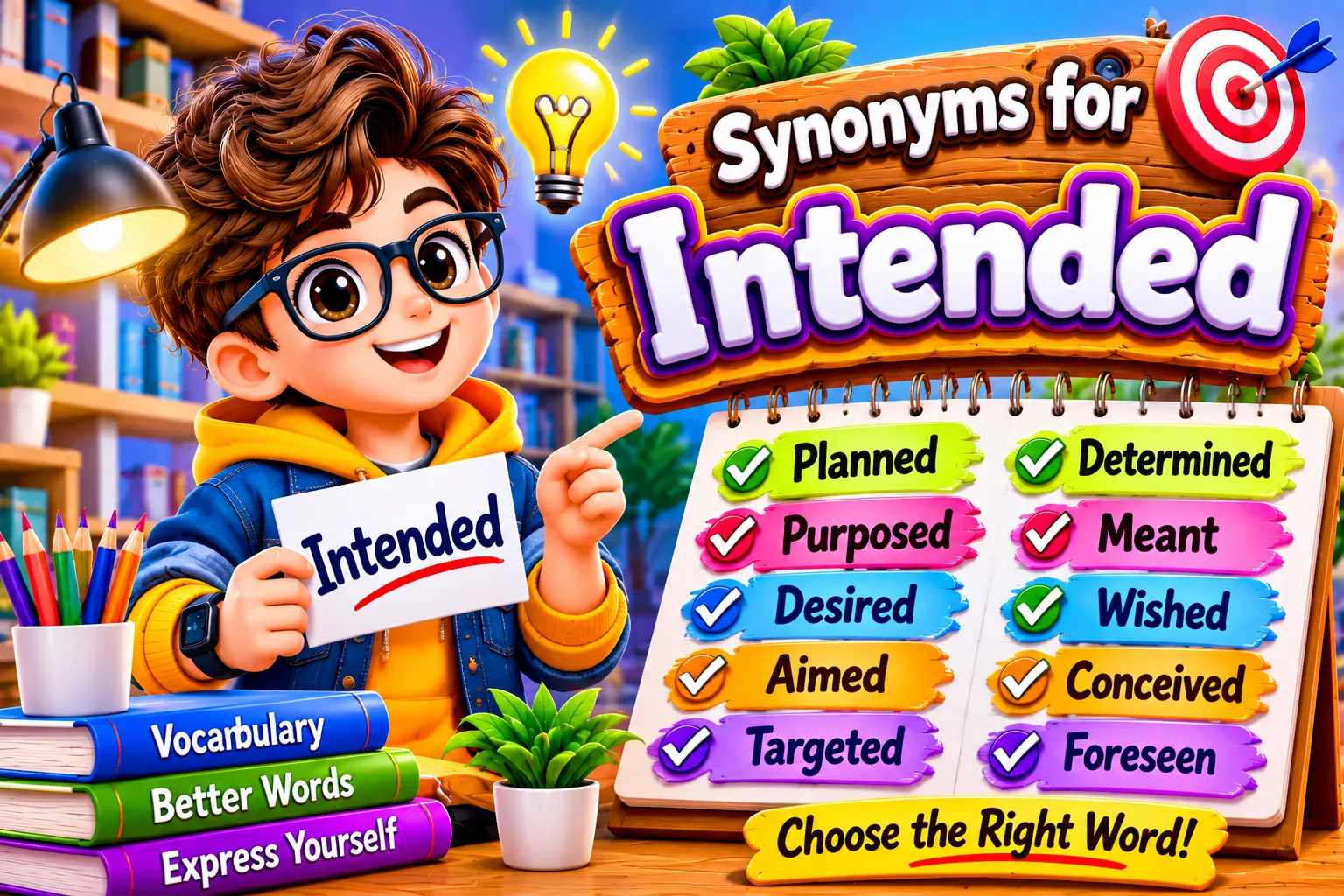
Synonyms for Intended: 27 Useful Alternatives to Know
Synonyms for intended include planned, meant, purposeful, deliberate, intentional, designed, proposed, scheduled, expected, desired, wanted, aimed, targeted, assigned, allocated, designated, specified, prescribed, projected, foreseen, prearranged, predetermined, consciously chosen, purpose-built, and deliberately chosen.
The word intended means planned, meant, or designed for a particular purpose. For example, a gift bought for your friend is intended for them. The word can also describe an action you plan to take, such as calling someone or completing a task.
However, using the same word too often can make your writing sound repetitive. Learning synonyms for intended helps you express your ideas in different ways. It also makes it easier to choose words that match the meaning of each sentence.
In this guide, you will learn the meaning, pronunciation, history, and grammar of intended. You will also explore 27 alternatives with simple definitions and examples. These words can help students, English learners, and content writers build their vocabulary and communicate more clearly.
Meaning of Intended
Definition
Intended (Adjective): Planned, meant, or designed for a particular person, purpose, or result.
Intended (Verb – Past Tense/Past Participle): The past form of intend, meaning to plan or have a purpose.
Examples
- This gift is intended for my sister.
- I intended to call you yesterday.
Connotative Meaning
Connotation refers to the feeling or idea a word suggests beyond its basic meaning.
- Positive tone: Suggests a clear purpose, careful planning, or good intentions.
- Negative tone: Can describe an unwanted result or an action that does not go as planned.
- Neutral tone: Simply describes what someone planned, meant, or designed to do.
Etymology of Intended
The word intended comes from the verb intend, which has Latin roots. Its meaning developed over time.
| Period | Origin and Development |
|---|---|
| Old English (450–1100) | The modern word intend was not used in Old English. Similar ideas were expressed through words related to planning, aiming, and directing thoughts. |
| Middle English (1100–1500) | Intend entered English through Old French entendre, from Latin intendere. The Latin word meant to stretch toward, direct, or aim at something. |
| Modern English (1500–Present) | Intended developed as the past tense and past participle of intend. It is also used as an adjective for something planned or meant for a particular purpose. |
Pronunciation (IPA)
- IPA: /ɪnˈtendɪd/
- Syllables: In-tend-ed (3 syllables)
Affixation Pattern of Intended
The word intended comes from the verb intend with the addition of the suffix -ed.
- Root: Tend comes from Latin tendere, meaning to stretch or aim.
- Prefix: In- is part of the historical formation of intend.
- Suffix: -ed forms the past tense and past participle.
Word Formations
| Word | Part of Speech | Meaning |
|---|---|---|
| Intend | Verb | To plan or have a purpose. |
| Intends | Verb | The third-person singular form of intend. |
| Intending | Verb | Planning or having a purpose. |
| Intended | Verb/Adjective | Planned or meant for a purpose. |
| Intention | Noun | A plan or purpose. |
| Intent | Noun/Adjective | A purpose or strong focus. |
| Intentional | Adjective | Done on purpose. |
| Intentionally | Adverb | In a planned or deliberate way. |
| Intentionality | Noun | The quality of acting with purpose. |
27 Synonyms of Intended With Meanings and Examples
The best synonym for intended depends on the sentence. Some alternatives describe plans, while others focus on goals, choices, or specific uses.
1. Planned (Adjective)
Meaning: Arranged or decided before something happens.
Examples:
- The planned event will take place tomorrow.
- We followed the planned route.
2. Meant (Adjective)
Meaning: Designed or intended for a particular person or purpose.
Examples:
- This message is meant for you.
- The gift was meant for my brother.
3. Purposeful (Adjective)
Meaning: Done with a clear aim or reason.
Examples:
- She made a purposeful effort to improve.
- His purposeful actions helped the team.
4. Deliberate (Adjective)
Meaning: Done carefully and on purpose.
Examples:
- It was a deliberate choice.
- She made a deliberate effort to arrive early.
5. Intentional (Adjective)
Meaning: Done on purpose rather than by accident.
Examples:
- The change was intentional.
- He made an intentional decision to help.
6. Designed (Adjective)
Meaning: Created or planned for a specific use.
Examples:
- This tool is designed for beginners.
- The room was designed for children.
7. Planned-for (Adjective Phrase)
Meaning: Expected or prepared for in advance.
Examples:
- The planned-for changes are now ready.
- We made arrangements for the planned-for event.
8. Proposed (Adjective)
Meaning: Suggested or put forward for consideration.
Examples:
- The proposed plan needs approval.
- They discussed the proposed changes.
9. Scheduled (Adjective)
Meaning: Arranged to happen at a particular time.
Examples:
- The scheduled meeting starts at noon.
- The scheduled flight was delayed.
10. Expected (Adjective)
Meaning: Thought or believed likely to happen.
Examples:
- The expected result was positive.
- We received the expected response.
11. Desired (Adjective)
Meaning: Wanted or wished for.
Examples:
- They achieved their desired result.
- She received the desired answer.
12. Wanted (Adjective)
Meaning: Wished for or needed by someone.
Examples:
- He finally got the position he wanted.
- The team found the solution they wanted.
13. Aimed (Adjective)
Meaning: Directed toward a particular goal or result.
Examples:
- The campaign was aimed at young people.
- Their efforts were aimed at improving safety.
14. Targeted (Adjective)
Meaning: Directed toward a specific person, group, or goal.
Examples:
- The program is targeted at new students.
- The advertisement was targeted at families.
15. Assigned (Adjective)
Meaning: Given to someone for a particular task or purpose.
Examples:
- This room is assigned to the new manager.
- The assigned work must be completed today.
16. Allocated (Adjective)
Meaning: Set aside or given for a particular purpose.
Examples:
- The allocated funds will support the project.
- Each student received an allocated amount of time.
17. Designated (Adjective)
Meaning: Officially chosen or set apart for a specific use.
Examples:
- This area is designated for visitors.
- The designated leader will guide the group.
18. Specified (Adjective)
Meaning: Clearly stated or identified.
Examples:
- Please use the specified format.
- The work must meet the specified standards.
19. Prescribed (Adjective)
Meaning: Set or recommended by an authority, rule, or professional.
Examples:
- Follow the prescribed steps.
- The medicine should be taken at the prescribed time.
20. Projected (Adjective)
Meaning: Estimated or expected to happen in the future.
Examples:
- The projected costs are higher than expected.
- The project has a projected completion date.
21. Foreseen (Adjective)
Meaning: Expected or predicted before something happens.
Examples:
- The problems were not foreseen.
- We prepared for the foreseen risks.
22. Intended-for (Adjective Phrase)
Meaning: Made or planned for a particular person or group.
Examples:
- The book is intended for young readers.
- This service is intended for small businesses.
23. Prearranged (Adjective)
Meaning: Organized or agreed upon in advance.
Examples:
- They met at a prearranged location.
- We followed the prearranged schedule.
24. Predetermined (Adjective)
Meaning: Decided or established before something happens.
Examples:
- The winner was not predetermined.
- The task must be completed within the predetermined time.
25. Consciously Chosen (Phrase)
Meaning: Selected with awareness and careful thought.
Examples:
- The colors were consciously chosen.
- Every word was consciously chosen for the speech.
26. Purpose-built (Adjective)
Meaning: Made for one specific use or function.
Examples:
- The school has a purpose-built science lab.
- They work in a purpose-built office.
27. Deliberately Chosen (Phrase)
Meaning: Selected carefully and on purpose.
Examples:
- The words were deliberately chosen.
- She wore a deliberately chosen outfit for the event.
Prototype Meaning of Intended
The central meaning of intended is something planned, meant, or designed for a particular purpose. It often refers to a person’s plan, goal, or reason for doing something.
For example, a gift intended for a friend is chosen for that person. Similarly, a tool intended for a specific job is made to perform that task. The word can describe actions, objects, messages, plans, and expected results.
Prototype Categorization of Intended
The 27 alternatives to intended can be grouped into semantic categories based on their meanings. These groups help writers choose the most suitable word for each situation.
| Semantic Category | Synonyms | Description |
|---|---|---|
| Planning and Preparation | Planned, scheduled, prearranged, predetermined, proposed | Describe something arranged, decided, or prepared in advance. |
| Purpose and Intention | Meant, purposeful, deliberate, intentional, consciously chosen, deliberately chosen | Describe actions or choices made with a clear purpose. |
| Design and Function | Designed, purpose-built, intended-for | Describe something created or meant for a particular use. |
| Goals and Direction | Aimed, targeted, desired, wanted | Describe something directed toward a goal or something someone wishes to achieve. |
| Assignment and Allocation | Assigned, allocated, designated, specified, prescribed | Describe something given, selected, or set for a particular purpose. |
| Expectation and Prediction | Expected, projected, foreseen | Describe something believed or predicted to happen. |
Choosing a word from the right category helps you express your meaning more accurately. For example, use planned for an arranged event, intentional for an action done on purpose, and designated for an officially selected place.
Antonyms of Intended
Antonyms are words with opposite or contrasting meanings. Here are some common antonyms of intended:
- Accidental (Adjective): Happening by chance rather than by plan.
- Unplanned (Adjective): Not arranged or decided in advance.
- Unintentional (Adjective): Not done on purpose.
- Unplanned-for (Adjective): Not expected or prepared for.
- Unwanted (Adjective): Not wished for or desired.
- Unexpected (Adjective): Happening without being predicted.
- Random (Adjective): Happening without a clear plan or purpose.
- Unforeseen (Adjective): Not expected before it happens.
- Spontaneous (Adjective): Happening naturally without prior planning.
- Aimless (Adjective): Having no clear goal or direction.
Short Questions and Answers
What does intended mean?
Intended means planned, meant, or designed for a particular person, purpose, or result.
When should intended be used?
Use intended when describing a plan, purpose, goal, or object made for a specific use. For example: “This book is intended for beginners.”
Is intended positive or negative?
It is usually neutral. Its tone depends on the context. It can describe good plans, unwanted outcomes, or actions done on purpose.
How is it different from similar words?
Intended describes what someone plans or means to do. Planned focuses on preparation, deliberate emphasizes a conscious choice, and designed focuses on a specific use or function.
Conclusion
Learning the meaning of intended and its synonyms can improve your English vocabulary. Words such as planned, deliberate, purposeful, and designed help you express different types of plans and intentions.
These alternatives can also make your writing clearer and more interesting. Choosing the right word reduces repetition and helps you explain your ideas with confidence. You can use these words in school assignments, professional documents, and everyday conversations.
Try learning a few synonyms each day and using them in your own sentences. With regular practice, you will become more confident in choosing the right word for each situation.
Read More:
Synonyms for Neat: 28 Smart Alternatives to Improve Vocabulary

I’m Rubab, a content specialist at SameSynonym, focused on synonyms, antonyms, word meanings, and English vocabulary.
I create clear, well-researched content with accurate definitions and practical examples.
My goal is to help readers improve their vocabulary and writing with confidence.










