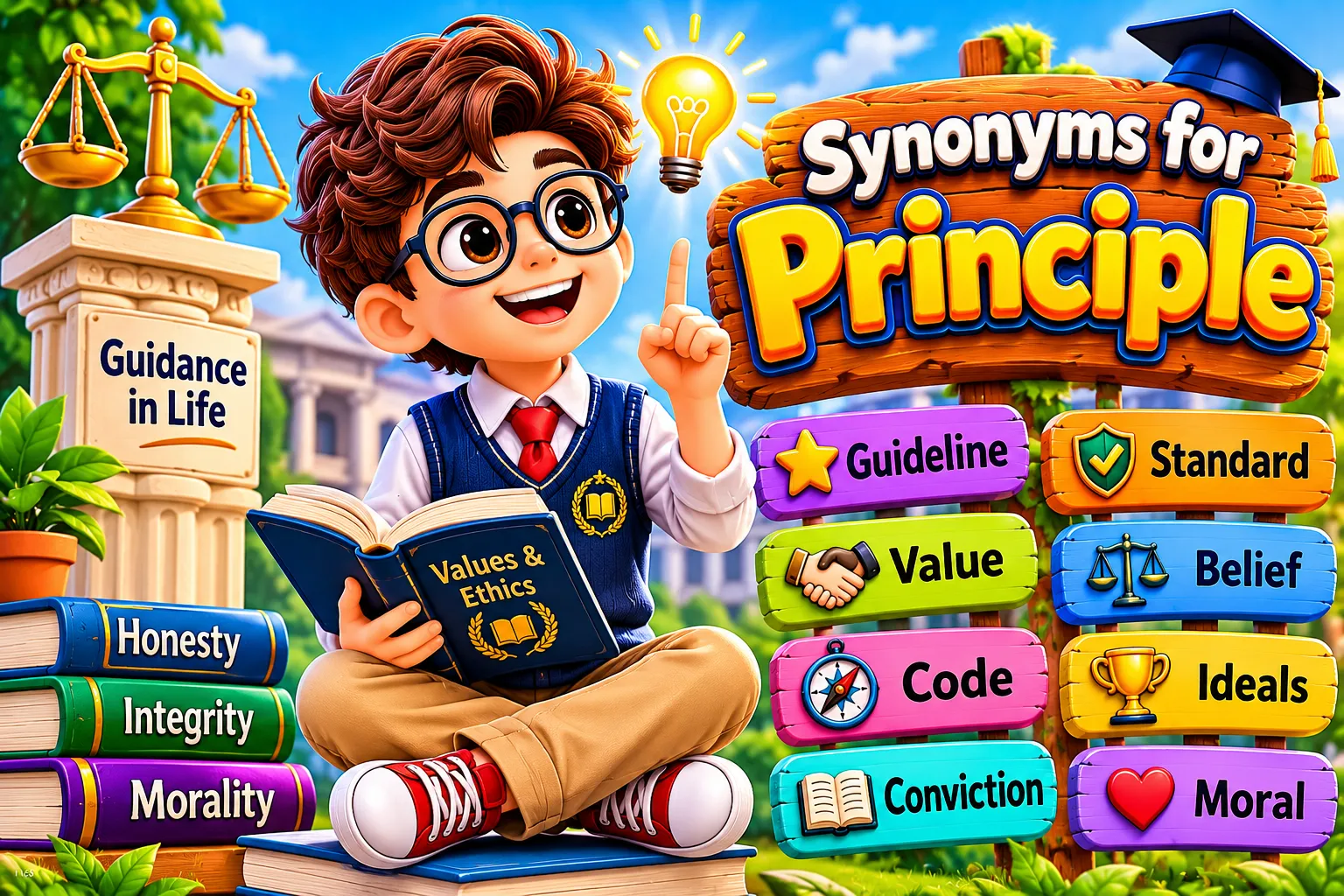
Synonyms for principle include rule, belief, value, standard, guideline, precept, tenet, doctrine, philosophy, ethic, ideal, conviction, policy, code, axiom, maxim, truth, foundation, and basis. These words describe basic rules, beliefs, values, or ideas that guide people’s actions and decisions.
A principle is a basic rule, belief, or idea that guides how people think and act. For example, a teacher may follow the principle of fairness by treating every student with respect. People use this word in daily life, education, business, science, and moral discussions.
It helps explain the values and rules that guide decisions. However, repeating the same word can make writing less engaging. Learning synonyms for principle helps English learners and content writers express ideas more clearly and naturally.
Some alternatives focus on moral beliefs, while others describe rules, standards, or basic truths. This guide explores the meaning, history, pronunciation, and grammar of principle. It also presents 30 related words with simple meanings and examples.
Meaning of Principle
Definition
Principle (Noun): A basic rule, belief, or idea that guides a person’s actions, decisions, or understanding of something.
Examples
- Honesty is an important principle in every strong relationship.
- The company follows the principle of equal treatment.
Connotative Meaning
(Connotation: the feeling or idea that a word suggests beyond its basic meaning.)
- Positive tone: Suggests honesty, fairness, strong values, and good judgment.
- Negative tone: Can suggest a strict or inflexible belief when someone refuses to consider other views.
- Neutral tone: Refers to a basic rule, idea, or truth that guides actions or explains how something works.
Etymology
The word principle comes from Latin and has a long history in English.
| Period | Origin and Development |
| Old English (450–1100) | The modern word principle was not used in Old English. Related ideas were expressed through words meaning rule, custom, law, or beginning. |
| Middle English (1100–1500) | Principle entered English through Old French principe, from Latin principium, meaning beginning, origin, or foundation. |
| Modern English (1500–Present) | The word developed to describe basic truths, rules, beliefs, and standards that guide behavior or explain systems. |
Pronunciation (IPA)
- IPA: /ˈprɪn.sə.pəl/
- Syllables: Prin-ci-ple (3 syllables)
Affixation Pattern of Principle
- Root: Principle
- Prefix: None.
- Suffix: None in the basic word.
- Word formations:
- Principled (Adjective): Guided by strong moral beliefs.
- Unprincipled (Adjective): Not guided by moral rules or values.
- Principledness (Noun): The quality of acting according to strong values.
- Principle-based (Adjective): Guided by a set of basic rules or beliefs.
- Principle-driven (Adjective): Motivated by strong beliefs or guiding values.
29 Synonyms of Principle With Meaning & Examples
Note: These words are related alternatives, but they are not interchangeable in every sentence. Some refer to moral beliefs, while others describe rules, standards, or basic truths.
1. Rule (Noun)
Meaning: A direction or instruction that tells people what they should or should not do.
Examples:
- Every student must follow the school rules.
- The main rule is to treat others with respect.
2. Belief (Noun)
Meaning: An idea that a person accepts as true or important.
Examples:
- Her belief in fairness guides her decisions.
- Everyone has the right to express their beliefs.
3. Value (Noun)
Meaning: A belief about what is important or worth following.
Examples:
- Respect is one of the family’s main values.
- The organization promotes honesty and trust as core values.
4. Standard (Noun)
Meaning: A level of quality or behavior that people are expected to meet.
Examples:
- The school maintains high standards of education.
- Fair treatment should be a basic standard in every workplace.
5. Guideline (Noun)
Meaning: Advice or a general rule that helps people make decisions.
Examples:
- The teacher shared guidelines for the project.
- These guidelines help staff make fair choices.
6. Precept (Noun)
Meaning: A rule or lesson that guides someone’s behavior.
Examples:
- Kindness is a central precept of the community.
- The students discussed a precept about honesty.
7. Tenet (Noun)
Meaning: A belief or idea that is an important part of a system or group.
Examples:
- Equality is a key tenet of the organization.
- Respect for others is a central tenet of the program.
8. Doctrine (Noun)
Meaning: A set of beliefs or teachings held by a group or institution.
Examples:
- The book explains the basic doctrine of the movement.
- The students studied the doctrine in their history class.
9. Philosophy (Noun)
Meaning: A set of beliefs or ideas that guides how someone thinks or lives.
Examples:
- Her philosophy is to learn from every experience.
- The company follows a philosophy of teamwork and respect.
10. Ethic (Noun)
Meaning: A moral belief or rule about what is right and wrong.
Examples:
- Honesty is an important work ethic.
- The team follows a strong ethic of responsibility.
11. Ideal (Noun)
Meaning: A belief or standard that someone hopes to achieve.
Examples:
- Equality is an ideal worth supporting.
- The group works toward the ideal of a fair society.
12. Conviction (Noun)
Meaning: A strong belief that someone holds firmly.
Examples:
- She spoke with conviction about equal rights.
- His conviction in the value of education guided his work.
13. Precedent (Noun)
Meaning: An earlier action or decision that can guide future decisions.
Examples:
- The court used an earlier decision as a precedent.
- The agreement set a precedent for future projects.
14. Policy (Noun)
Meaning: An official plan or rule that guides decisions and actions.
Examples:
- The school has a clear policy on student safety.
- The company introduced a policy of equal opportunity.
15. Code (Noun)
Meaning: A set of rules or standards that guide behavior.
Examples:
- Doctors follow a professional code of conduct.
- The team agreed to follow a code of fairness.
16. Law (Noun)
Meaning: An official rule made by a government or authority.
Examples:
- Everyone must follow the law.
- The law protects people’s basic rights.
17. Axiom (Noun)
Meaning: A statement or idea accepted as true without needing proof.
Examples:
- The lesson began with a simple mathematical axiom.
- The idea became an axiom in the field.
18. Maxim (Noun)
Meaning: A short statement that expresses a general truth or useful rule.
Examples:
- “Practice makes progress” is a useful maxim.
- The teacher shared a maxim about patience.
19. Preceptorship (Noun)
Meaning: A system of learning or training under the guidance of an experienced person.
Examples:
- The nursing program includes a period of preceptorship.
- Her preceptorship helped her gain practical skills.
20. Proposition (Noun)
Meaning: A statement or idea that is presented for consideration or discussion.
Examples:
- The researcher tested the main proposition.
- The proposal began with a simple proposition.
21. Truth (Noun)
Meaning: A fact or idea that is accepted as real or correct.
Examples:
- The search for truth is central to scientific work.
- She believed that honesty was an important truth in life.
22. Foundation (Noun)
Meaning: A basic idea or support on which something is built.
Examples:
- Trust is the foundation of a strong friendship.
- Education provides a foundation for future success.
23. Basis (Noun)
Meaning: The main reason, fact, or idea on which something is built.
Examples:
- Respect is the basis of good communication.
- The decision was made on the basis of clear evidence.
24. Concept (Noun)
Meaning: A general idea or understanding of something.
Examples:
- Fairness is an important concept in education.
- The lesson introduced a new concept in science.
25. Rule of Thumb (Noun)
Meaning: A simple and practical guide based on experience.
Examples:
- A useful rule of thumb is to check your work twice.
- As a rule of thumb, save a copy of important files.
26. Criterion (Noun)
Meaning: A standard used to judge or decide something.
Examples:
- Accuracy is an important criterion for the research.
- Each applicant must meet the main criterion.
27. Moral (Noun)
Meaning: A lesson about right and wrong behavior.
Examples:
- The story teaches a moral about kindness.
- The moral of the tale is to keep your promises.
28. Ethos (Noun)
Meaning: The main beliefs, values, or character of a person or group.
Examples:
- Respect is part of the school’s ethos.
- The organization has an ethos of honesty and teamwork.
29. Code of Ethics (Noun)
Meaning: A set of moral rules that guides behavior in a profession or group.
Examples:
- The doctors follow a strict code of ethics.
- Every employee must understand the company’s code of ethics.
Prototype Meaning
The most common meaning of principle is a basic rule, belief, or truth that guides how people act or understand the world. When people hear this word, they often think of values such as honesty, fairness, and respect. It can also refer to a basic idea behind a subject, such as a scientific or mathematical principle. The exact meaning depends on the context in which the word is used.
Prototype Categorization
The 29 alternatives to principle can be grouped into meaningful categories. These groups help writers choose a word that matches the intended meaning and context.
| Semantic Category | Synonyms | Description |
| Rules and Guidance | Rule, guideline, precept, policy, code, law, rule of thumb | These words describe instructions or standards that guide actions and decisions. |
| Beliefs and Moral Values | Belief, value, tenet, ethic, conviction, ideal, ethos | These words focus on personal or shared beliefs about what matters and how people should behave. |
| Systems of Thought | Doctrine, philosophy, concept | These terms describe organized ideas or ways of thinking. |
| Basic Truths and Foundations | Axiom, maxim, truth, foundation, basis, fundamental | These words refer to essential ideas or truths that support knowledge and decisions. |
| Standards and Judgments | Standard, criterion, precedent | These terms describe measures or earlier decisions used to guide or judge actions. |
| Statements and Lessons | Proposition, moral | These words refer to an idea presented for discussion or a lesson about behavior. |
| Professional Conduct | Code of ethics | This phrase describes moral rules that guide people in a profession. |
| Learning and Training | Preceptorship | This word refers to guided practical learning under an experienced person. |
Antonyms of Principle
There is no single perfect antonym for principle. The opposite depends on whether the word refers to a moral belief, a rule, or a basic truth.
- Disorder (Noun): A lack of order or organization.
- Chaos (Noun): A state of confusion without clear order.
- Inconsistency (Noun): A lack of agreement or steady behavior.
- Dishonesty (Noun): The act of lying or not telling the truth.
- Unprincipled behavior (Noun Phrase): Actions that are not guided by moral values.
- Arbitrariness (Noun): Decisions made without a clear rule or reason.
- Corruption (Noun): Dishonest or illegal behavior, often involving the misuse of power.
Short Questions and Answers
What does principle mean?
A principle is a basic rule, belief, or idea that guides someone’s actions, decisions, or understanding.
When should principle be used?
Use principle when discussing moral values, basic rules, important beliefs, or fundamental ideas behind a subject or system.
Is principle positive or negative?
Principle is usually neutral, but it often has a positive tone when linked to honesty, fairness, and strong values. It may sound negative when someone follows a belief too rigidly.
How is principle different from similar words?
A principle is a basic belief or rule. A guideline gives advice, a policy is an official plan, a value describes what someone considers important, and a doctrine is a set of beliefs held by a group.
Conclusion
Learning the word principle and its synonyms can improve your English vocabulary and make your writing more effective. Words such as belief, value, rule, tenet, and guideline help express different ideas with greater accuracy.
Some alternatives describe moral values, while others refer to rules, standards, or basic truths. Choosing the right word helps you avoid repetition and share your thoughts clearly. It also makes your speaking and writing more natural.
Try learning a few new words each day and using them in your own sentences. With regular practice, you can build confidence and become a stronger English communicator.
Read More:
Synonyms for Child: 25 Useful Alternatives to Know

I’m Falak Naaz, an SEO writer at SameSynonyms.com with 10 years of experience creating clear, engaging, and search-friendly English content. I specialize in synonyms, antonyms, vocabulary, and word usage. Through careful research and practical examples, I help readers choose the right words and improve their English with confidence.










1 thought on “Synonyms for Principle: 29 Powerful Alternatives to Know”