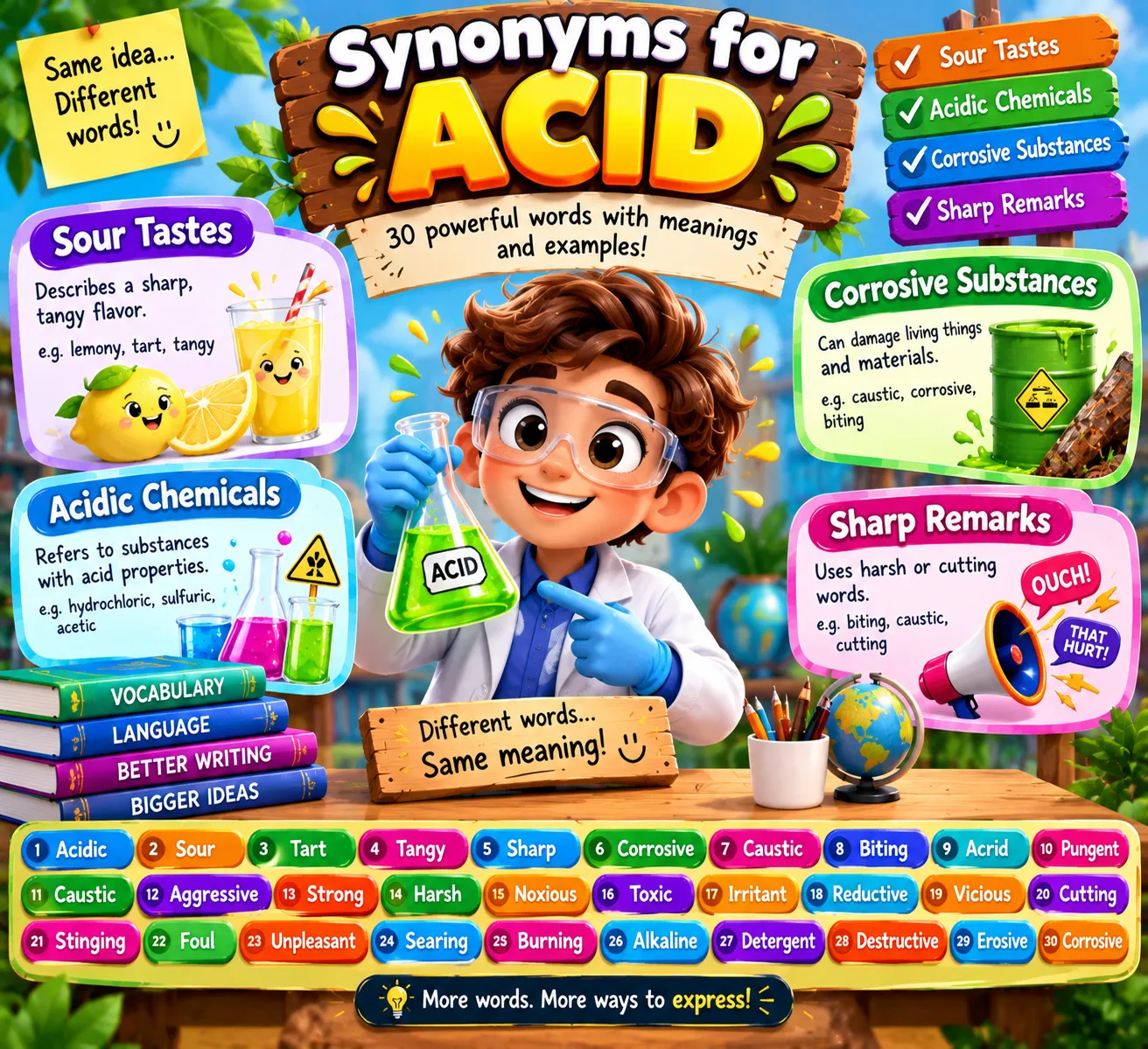
Synonyms for acid include corrosive, sour, acidic, sharp, biting, caustic, tart, acrid, and harsh. The best choice depends on whether you mean a chemical substance, a sour taste, or sharp and cutting words.
Acid is a word we use when talking about chemistry, food, and even people’s words. For example, lemon juice has an acidic taste, while some strong chemicals can damage skin or metal. We may also describe a person’s comments as acidic when they sound harsh or hurtful.
Learning synonyms for acid helps you choose the right word for each situation. English learners can use these words to build vocabulary, while students and content writers can make their writing clearer and more varied. However, not every synonym has the same meaning. Sour often describes taste, corrosive describes something that wears away materials, and caustic can describe both chemicals and hurtful remarks.
This guide explains the meaning, history, pronunciation, grammar, and 30 alternatives to acid, with simple definitions and examples to help you use each word correctly.
Meaning of Acid
Definition
Acid (noun): A chemical substance that can donate hydrogen ions or increase their concentration in water.
Acid (adjective): Having the properties of an acid, tasting sour, or sounding sharp and cutting.
Examples
- Lemon juice contains acid that gives it a sour taste.
- The scientist used an acid to test the sample.
- She made an acid remark about his mistake.
Connotative Meaning
(Connotation: the feelings or ideas that a word brings to mind beyond its basic meaning.)
- Positive tone: Acid is not usually positive, but an “acid test” can mean a useful or decisive test of quality.
- Negative tone: It can suggest danger, damage, sourness, or hurtful speech.
- Neutral tone: In science, acid is a standard term for a group of chemical substances.
Etymology of Acid
The word acid comes from Latin acidus, meaning “sour” or “sharp-tasting.” It is related to the Latin verb acēre, meaning “to be sour.”
- Old English (450–1100): Acid was not a common native English word. People used words such as sūr to describe sour tastes.
- Middle English (1100–1500): The word acid was not yet widely used in everyday English. Latin and French influenced the development of scientific vocabulary.
- Modern English (1500–present): Acid entered English through French and Latin. It became common in chemistry and later developed figurative uses for sharp or biting speech.
Pronunciation (IPA)
- IPA: /ˈæs.ɪd/
- Syllables: ac-id (2 syllables)
- Stress: The first syllable.
Affixation Pattern of Acid
| Category | Word | Grammatical Category | Meaning |
| Root | Acid | Noun, Adjective | From Latin acidus, meaning “sour.” |
| Prefix | None | — | The base word has no prefix. |
| Suffix | -id | Part of the borrowed word | Not a productive English suffix in acid. |
| Word Formation | Acidic | Adjective | Containing or resembling an acid. |
| Word Formation | Acidity | Noun | The quality or level of being acidic. |
| Word Formation | Acidify | Verb | To make something more acidic. |
| Word Formation | Acidification | Noun | The process of becoming or making something acidic. |
| Word Formation | Acidified | Adjective / Verb | Made acidic; the past tense of acidify. |
| Word Formation | Acidifying | Verb / Adjective | Making something more acidic. |
| Word Formation | Acidifier | Noun | A substance or agent that increases acidity. |
| Word Formation | Acidulous | Adjective | Slightly sour or acidic. |
| Word Formation | Antacid | Noun / Adjective | A substance or product that neutralizes stomach acid. |
30 Synonyms of Acid With Meaning and Examples
Note: These alternatives are not all interchangeable. Some describe chemical properties, some describe taste, and others describe sharp or hurtful speech.
1. Acidic (Adjective)
Meaning: Having the properties of an acid or a low pH.
Examples:
- The soil is too acidic for these plants.
- Acidic water can affect aquatic life.
2. Sour (Adjective)
Meaning: Having a sharp, unpleasant taste like lemon juice or vinegar.
Examples:
- The milk tasted sour.
- She added lemon juice for a sour flavor.
3. Corrosive (Adjective)
Meaning: Able to wear away or damage materials through chemical action.
Examples:
- The factory stores corrosive chemicals safely.
- Corrosive liquids can damage metal pipes.
4. Caustic (Adjective)
Meaning: Able to burn or damage tissue, or sharply critical in speech.
Examples:
- The label warned us about the caustic liquid.
- His caustic comment upset the team.
5. Acrid (Adjective)
Meaning: Having a strong, bitter, and unpleasant smell or taste.
Examples:
- Acrid smoke filled the room.
- The chemical gave off an acrid odor.
6. Tart (Adjective)
Meaning: Having a sharp, sour taste.
Examples:
- The green apple tasted tart.
- She made a tart sauce for the meal.
7. Sharp (Adjective)
Meaning: Strong and noticeable in taste, smell, or tone.
Examples:
- The cheese has a sharp flavor.
- He answered in a sharp voice.
8. Biting (Adjective)
Meaning: Very sharp, harsh, or critical in speech.
Examples:
- She made a biting comment about his work.
- His biting humor made the audience laugh.
9. Harsh (Adjective)
Meaning: Rough, severe, or unpleasant in effect or tone.
Examples:
- The cleaner has a harsh chemical smell.
- He used harsh words during the argument.
10. Bitter (Adjective)
Meaning: Having a sharp, unpleasant taste or showing anger and resentment.
Examples:
- The medicine left a bitter taste.
- She made a bitter remark about the decision.
11. Pungent (Adjective)
Meaning: Having a strong, sharp smell or taste.
Examples:
- The pungent smell came from the laboratory.
- The cheese has a pungent flavor.
12. Acrimonious (Adjective)
Meaning: Angry and bitter in speech or disagreement.
Examples:
- The meeting ended in an acrimonious debate.
- They exchanged acrimonious remarks.
13. Cutting (Adjective)
Meaning: Hurtful or sharply critical in speech.
Examples:
- His cutting words hurt her feelings.
- She gave a cutting reply to the rude question.
14. Scathing (Adjective)
Meaning: Showing very strong criticism or disapproval.
Examples:
- The reviewer wrote a scathing report.
- His scathing criticism shocked the group.
15. Sardonic (Adjective)
Meaning: Showing mocking or cynical humor.
Examples:
- He gave a sardonic smile.
- Her sardonic remark made the room go quiet.
16. Caustically (Adverb)
Meaning: In a sharply critical or hurtful way.
Examples:
- He spoke caustically about the plan.
- She caustically questioned their decision.
17. Vinegary (Adjective)
Meaning: Having a taste or smell like vinegar.
Examples:
- The dressing had a vinegary taste.
- A vinegary smell came from the bottle.
18. Acetic (Adjective)
Meaning: Relating to acetic acid, the acid found in vinegar.
Examples:
- Acetic acid gives vinegar its sour taste.
- The lab measured the acetic acid in the sample.
19. Acidulated (Adjective)
Meaning: Made slightly sour by adding an acid.
Examples:
- The chef used acidulated water to keep the fruit fresh.
- Acidulated liquid helped prevent the sliced fruit from browning.
20. Acidulous (Adjective)
Meaning: Slightly sour in taste or sharp in manner.
Examples:
- The drink had an acidulous flavor.
- He answered with an acidulous wit.
21. Sourish (Adjective)
Meaning: Somewhat sour in taste.
Examples:
- The sauce had a sourish flavor.
- The fruit tasted sourish rather than sweet.
22. Tangy (Adjective)
Meaning: Having a strong, lively, slightly sour taste.
Examples:
- The yogurt had a tangy flavor.
- She made a tangy lemon dressing.
23. Acritude (Noun)
Meaning: A sharp or bitter quality, especially in speech or feeling.
Examples:
- Acritude crept into their discussion.
- He spoke with acritude after the dispute.
24. Acerbic (Adjective)
Meaning: Sharp, bitter, or cutting in tone or style.
Examples:
- The journalist wrote an acerbic review.
- Her acerbic wit was well known.
25. Vitriolic (Adjective)
Meaning: Filled with intense anger or harsh criticism.
Examples:
- The debate turned into a vitriolic argument.
- He received a vitriolic online message.
26. Causticity (Noun)
Meaning: The quality of being chemically burning or sharply critical.
Examples:
- The causticity of the solution required special care.
- The causticity of his remarks offended the audience.
27. Antiseptic (Adjective)
Meaning: Preventing the growth of germs; sometimes used to describe a cold or overly clinical style.
Examples:
- The nurse cleaned the wound with an antiseptic solution.
- The room had an antiseptic smell.
28. Acidifying (Adjective)
Meaning: Making something more acidic or lowering its pH.
Examples:
- Acidifying agents can change the soil’s pH.
- The researchers studied the acidifying effect of the substance.
29. Acid forming (Adjective)
Meaning: Producing acid or tending to increase acidity.
Examples:
- Some fertilizers have an acid forming effect on soil.
- The study examined acid forming compounds in the water.
30. Sour tasting (Adjective)
Meaning: Having a taste that is sharp or acidic.
Examples:
- The sour tasting fruit was not yet ripe.
- She avoided the sour tasting drink.
Prototype Meaning
The most typical meaning of acid is a chemical substance with acidic properties. People often imagine a liquid that can react with other substances, has a low pH, or may cause damage if it is strong enough. In everyday life, the word can also bring to mind the sour taste of lemons and vinegar. In figurative language, acid may describe sharp, bitter, or hurtful words. The intended meaning depends on the sentence and context.
Prototype Categorization
| Semantic Category | Synonyms | Meaning and Usage |
| Chemical Properties | Acidic, corrosive, caustic, acetic, acidulated, acidifying, acid-forming | Used to describe acids, chemical reactions, materials, soil, and scientific processes. |
| Sour Tastes and Flavors | Sour, tart, vinegary, sourish, tangy, sour-tasting, acidulous | Used to describe sharp or sour flavors in food and drinks. |
| Strong Smells and Sensations | Acrid, pungent, sharp, antiseptic | Used to describe strong odors or sharp sensory impressions. Antiseptic is related by context, not a direct synonym for acid. |
| Harsh or Critical Speech | Biting, harsh, bitter, acrimonious, cutting, scathing, sardonic, acerbic, vitriolic, caustically | Used to describe sharp criticism, bitter remarks, mocking humor, or hostile communication. |
| Chemical Strength and Related Qualities | Causticity, acritude, acidity, acidulous, acid-forming | Used to describe chemical properties, levels of acidity, or qualities related to sourness and sharpness. Some are related terms rather than direct synonyms. |
Choosing synonyms by category makes your writing more precise. For example, use corrosive for a damaging chemical, tart for a sour flavor, and acerbic for a sharply critical comment.
Antonyms of Acid
The best opposite depends on the meaning of acid. In chemistry, a base or alkaline substance can neutralize an acid. In descriptions of taste or speech, different opposites are more suitable.
- Alkaline (Adjective): Having a pH above 7 in water-based solutions. Example: The soil is alkaline.
- Basic (Adjective): Having the chemical properties of a base. Example: The solution is basic rather than acidic.
- Neutral (Adjective): Neither acidic nor alkaline; a neutral aqueous solution has a pH of about 7 at 25°C. Example: The water has a neutral pH.
- Sweet (Adjective): Having a sugary taste, often the opposite of sour. Example: The ripe peach tastes sweet.
- Mild (Adjective): Not strong, harsh, or sharp. Example: The cleaner is mild and gentle.
- Gentle (Adjective): Kind or not harsh in manner. Example: She gave a gentle reply.
- Pleasant (Adjective): Giving enjoyment or a positive feeling. Example: The fruit has a pleasant flavor.
- Kind (Adjective): Caring and considerate rather than hurtful. Example: He offered kind words instead of acidic criticism.
Short Questions and Answers
What does acid mean?
Acid usually refers to a chemical substance with acidic properties. It can also describe a sour taste or sharp, critical speech.
When should acid be used?
Use acid in chemistry and science, when describing sour tastes, or when referring to harsh comments. Choose the meaning that fits your context.
Is acid positive or negative?
It is usually neutral in scientific writing. It may suggest danger or harm when describing chemicals and negativity when describing speech.
How is acid different from similar words?
Acid often names a chemical substance or describes a general quality. Corrosive focuses on damage, sour describes taste, caustic can describe burning chemicals or harsh remarks, and acerbic usually describes sharp criticism.
Conclusion
Learning synonyms for acid helps you express ideas with greater accuracy. Words such as corrosive, sour, tart, and acerbic may seem similar, but each has its own use. Some describe chemical reactions, while others describe taste, smell, or speech.
Understanding these differences helps English learners build vocabulary and helps writers avoid repeating the same word. It also makes explanations, essays, stories, and everyday conversations clearer.
Try learning a few alternatives each day and writing your own sentences with them. Check the context before replacing acid with another word, especially in science. With regular practice, you can choose better words, communicate more clearly, and feel more confident in English.
Read More:
Synonyms for Exponentially: 30 Powerful Alternatives

I’m Falak Naaz, an SEO writer at SameSynonyms.com with 10 years of experience creating clear, engaging, and search-friendly English content. I specialize in synonyms, antonyms, vocabulary, and word usage. Through careful research and practical examples, I help readers choose the right words and improve their English with confidence.










