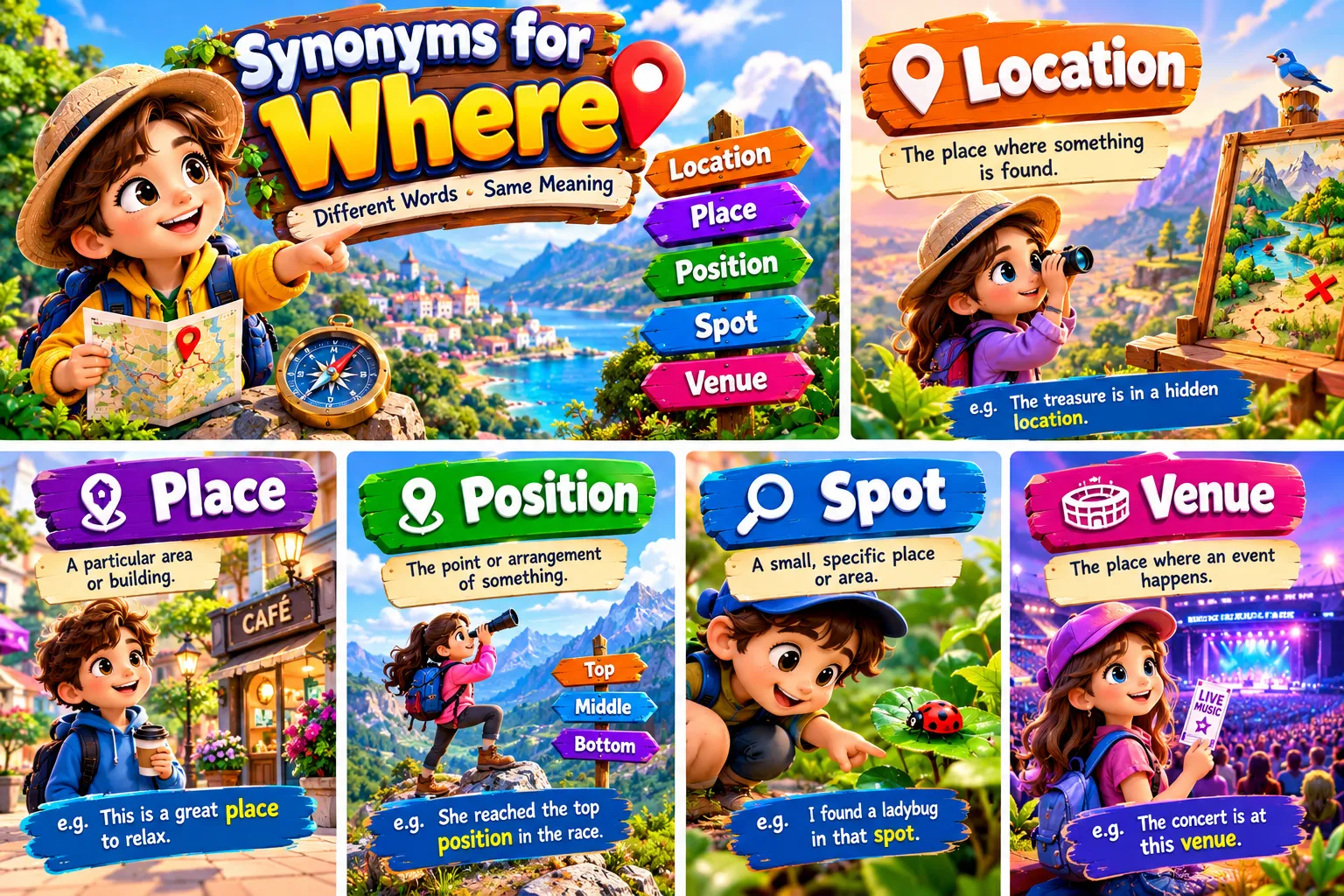
Synonyms for where include in which, at which, wherever, anywhere, somewhere, everywhere, and at what place. These words and phrases help ask about locations, identify places, and describe where something happens. The best alternative depends on the sentence and its meaning.
Where is a common English word used to ask about a place or location. I use it when asking questions such as “Where do you live?” or “Where is my book?” It also helps connect ideas in sentences, as in “This is the house where I grew up.” Because where has several uses, learning its alternatives can help you write and speak more clearly.
Synonyms for where depend on the sentence and its meaning. Words and phrases such as in which, at which, wherever, and to what place may work in certain contexts, but they are not always interchangeable.
Knowing these differences helps English learners avoid grammar mistakes and gives content writers more ways to express ideas. In this guide, you will learn the meaning of where, its history, pronunciation, word forms, 30 alternatives, and useful semantic categories with clear examples.
Meaning of Where
Definition
Where (Adverb, Conjunction, or Relative Adverb): A word used to ask about a place, show the location of something, or connect a clause to a place.
Examples
- Where do you want to go?
- This is the park where we first met.
Connotative Meaning
(Connotation means the feeling or idea a word suggests beyond its basic meaning.)
- Positive tone: Can suggest discovery or curiosity, as in “Where can we find new opportunities?”
- Negative tone: Can suggest confusion or concern, as in “Where did everything go wrong?”
- Neutral tone: Simply asks about or identifies a place, as in “Where is the station?”
Etymology of Where
| Period | Origin and Development |
| Old English (450–1100) | Where developed from Old English hwǣr, meaning “at what place” or “in what place.” |
| Middle English (1100–1500) | The word appeared in forms such as wher and where, gradually developing its modern spelling. |
| Modern English (1500–Present) | Where became the standard spelling and continued to serve as a question word and a word that links clauses about places. |
Origin: Where comes from Old English hwǣr, from the Germanic language family. It is related to words such as German wo and Dutch waar, which also refer to place.
Pronunciation (IPA)
- IPA: /wɛər/ (common British pronunciation); /wer/ (common American pronunciation)
- Syllables: where one syllable
Affixation Pattern of Where
- Root: where
- Prefix: None
- Suffix: None
Word Formations
- Whereabouts (noun/adverb): The place where someone or something is.
- Whereby (adverb): By which; through which.
- Whereas (conjunction): While or in contrast.
- Wherein (adverb): In which.
- Whereof (adverb): Of which.
- Whereupon (adverb): Immediately after which or as a result of which.
- Wherever (adverb/conjunction): At or to any place that.
- Wherefrom (adverb): From which place; less common.
- Wherefore (adverb): For what reason; often literary or formal.
These words contain where, but many have meanings beyond location and cannot replace where in every sentence.
26 Synonyms of Where With Meanings and Examples
Note: English has no single synonym for where that fits every sentence. The alternatives below are words and phrases that work in specific location-related contexts.
1. In Which (Prepositional Phrase)
Meaning: Used to identify the place or situation in which something happens.
Examples:
- This is the room in which we studied.
- She found the box in which the letters were kept.
2. At Which (Prepositional Phrase)
Meaning: Refers to a particular place or point where something happens.
Examples:
- This is the station at which we met.
- They reached the point at which the road ends.
3. On Which (Prepositional Phrase)
Meaning: Refers to a surface or place where something is located.
Examples:
- This is the table on which I left my keys.
- The hill on which the castle stands is steep.
4. To Which (Prepositional Phrase)
Meaning: Refers to a place that someone or something moves toward.
Examples:
- This is the town to which we are moving.
- She showed me the office to which I should go.
5. From Which (Prepositional Phrase)
Meaning: Identifies the place where something begins or comes from.
Examples:
- This is the village from which my family came.
- He pointed to the shelf from which he took the book.
6. Wherever (Adverb/Conjunction)
Meaning: At or to any place that.
Examples:
- You can sit wherever you like.
- Wherever she goes, she makes new friends.
7. Anywhere (Adverb)
Meaning: In, at, or to any place.
Examples:
- You can work anywhere with internet access.
- Is there anywhere we can park?
8. Everywhere (Adverb)
Meaning: In or to all places.
Examples:
- We looked everywhere for the missing keys.
- Flowers were growing everywhere in the garden.
9. Somewhere (Adverb)
Meaning: In or to a place that is not known or named.
Examples:
- I left my phone somewhere in the house.
- Let’s meet somewhere quiet.
10. Nowhere (Adverb)
Meaning: Not in or to any place.
Examples:
- There was nowhere to sit.
- The lost dog was nowhere to be found.
11. At What Place (Phrase)
Meaning: A formal or emphatic way to ask about a location.
Examples:
- At what place did the event occur?
- At what place should we meet?
12. In What Place (Phrase)
Meaning: A phrase that asks about the exact location of something.
Examples:
- In what place did you find the wallet?
- In what place was the agreement signed?
13. To What Place (Phrase)
Meaning: Asks about a destination or the place someone is going to.
Examples:
- To what place are you traveling?
- To what place should I send the package?
14. At the Location Where (Phrase)
Meaning: Identifies the exact location of an event or action.
Examples:
- Meet us at the location where the road meets the river.
- The team gathered at the location where the accident happened.
15. In the Place Where (Phrase)
Meaning: Refers to a specific place in which something happens.
Examples:
- We sat in the place where the sunlight came through.
- They built a school in the place where the old house stood.
16. The Place Where (Phrase)
Meaning: Identifies a particular location.
Examples:
- This is the place where we first spoke.
- I remember the place where I lost my bag.
17. The Point At Which (Phrase)
Meaning: Refers to a specific point, stage, or location.
Examples:
- We reached the point at which the path splits.
- That was the point at which the plan changed.
18. The Spot Where (Phrase)
Meaning: Refers to an exact or familiar spot.
Examples:
- This is the spot where we took the photo.
- Mark the spot where the pipe is leaking.
19. The Area Where (Phrase)
Meaning: Identifies a general region or area.
Examples:
- This is the area where wild birds gather.
- They searched the area where the car was last seen.
20. The Site Where (Phrase)
Meaning: Refers to a specific place where an event or activity occurs.
Examples:
- We visited the site where the building once stood.
- The police examined the site where the fire began.
21. The Region Where (Phrase)
Meaning: Identifies a larger geographical area.
Examples:
- This is the region where tea is grown.
- They traveled to the region where the river begins.
22. The Setting In Which (Phrase)
Meaning: Refers to the place or environment in which something happens.
Examples:
- The story takes place in a setting in which magic is common.
- The study examined the setting in which children learn.
23. The Environment In Which (Phrase)
Meaning: Identifies the surroundings or conditions where something occurs.
Examples:
- Children learn best in an environment in which they feel safe.
- The experiment took place in an environment in which temperature was controlled.
24. The Context In Which (Phrase)
Meaning: Refers to the situation or circumstances in which something occurs, rather than a physical location.
Examples:
- We need to understand the context in which the phrase was used.
- The meaning changes with the context in which the word appears.
25. The Situation In Which (Phrase)
Meaning: Identifies the circumstances surrounding an event or action.
Examples:
- She explained the situation in which the mistake happened.
- The rules describe the situation in which help is available.
26. Wherein (Adverb)
Meaning: A formal word meaning “in which”; often used in writing.
Examples:
- The report describes a system wherein each member has a role.
- They created a process wherein users can submit requests online.
Prototype Meaning
The most common meaning of where is “at, in, or to what place.” People usually use it to ask about a location, such as where someone lives, where an object is, or where an event will happen. It can also connect two parts of a sentence by referring to a place already mentioned. The exact meaning depends on how the word is used.
Prototype Categorization
The alternatives to where can be grouped by their main functions. These categories help writers choose the best phrase for each context.
| Semantic Category | Synonyms and Alternatives | Description |
| Asking About a Location | At what place, in what place, which place | Used to ask questions about a specific location. |
| Referring to a Specific Location | In which, at which, the place where, the spot where | Identifies the exact place where something happens. |
| Showing Direction or Origin | To which, from which, to what place | Describes a destination or the place something comes from. |
| Referring to Any or an Unknown Place | Wherever, anywhere, somewhere, everywhere, nowhere | Refers to any place, an unknown place, all places, or no place. |
| Describing a Wider Area | The area where, the region where, the site where | Identifies a broader geographical area or a particular site. |
| Describing a Situation or Environment | The setting in which, the environment in which, the context in which, the situation in which | Describes the surroundings or circumstances in which something happens. |
| Formal or Specialized Alternatives | Wherein, the point at which, the location where | Often used in formal, academic, or technical writing. |
| Flexible Phrases | Any place, wherever possible, whereabouts | Expresses an available location, a possible place, or someone’s location. |
Choosing the right category helps you avoid awkward wording. For example, anywhere works when a location is not limited to one specific place, while at which can refer to a particular point in more formal writing.
Antonyms of Where
Where does not have a direct antonym because it is a question and linking word, not a word that describes a quality with an opposite. However, some words and phrases express contrasting ideas about location.
1. Here (Adverb)
Meaning: In or at this place.
– Example: Please come here.
2. There (Adverb)
Meaning: In or at that place.
– Example: Your bag is there.
3. Elsewhere (Adverb)
Meaning: In or at another place.
– Example: We decided to meet elsewhere.
4. Away (Adverb)
Meaning: At a distance from a particular place.
– Example: The school is far away.
5. Absent (Adjective)
Meaning: Not present in a particular place.
– Example: He was absent from the meeting.
These are related location words, not exact antonyms of where.
Short Questions and Answers
What does where mean?
Where asks about a place or location. It can also connect a clause to a place mentioned in a sentence.
When should where be used?
Use where to ask about a location, identify a place, or connect ideas about a place. For example, “Where is the library?” asks for a location.
Is where positive or negative?
Where is generally neutral. The feeling depends on the sentence, such as curiosity in “Where can we explore?” or worry in “Where did my keys go?”
How is where different from similar words?
Where asks about or identifies a place. Wherever means “at any place that,” while anywhere means “in or to any place.” Phrases such as in which and at which can replace where in some formal sentences, but the grammar must fit.
Conclusion
Learning where and its alternatives can improve your English vocabulary and make your writing clearer. Words and phrases such as wherever, anywhere, in which, and at which can help you describe places, ask questions, and connect ideas without repeating the same structure.
However, these alternatives do not all have the same meaning, so it is important to choose one that fits the sentence.Practicing these words in daily conversations, schoolwork, and professional writing can strengthen both speaking and writing skills.
Try making a few sentences each day using different location phrases. Over time, you will learn which alternatives sound natural in each context and build greater confidence in English.
Read More:
Synonyms for Pursuing: 25 Useful Alternatives

I’m Falak Naaz, an SEO writer at SameSynonyms.com with 10 years of experience creating clear, engaging, and search-friendly English content. I specialize in synonyms, antonyms, vocabulary, and word usage. Through careful research and practical examples, I help readers choose the right words and improve their English with confidence.










1 thought on “Synonyms for Where: 26 Helpful Alternatives to Learn”