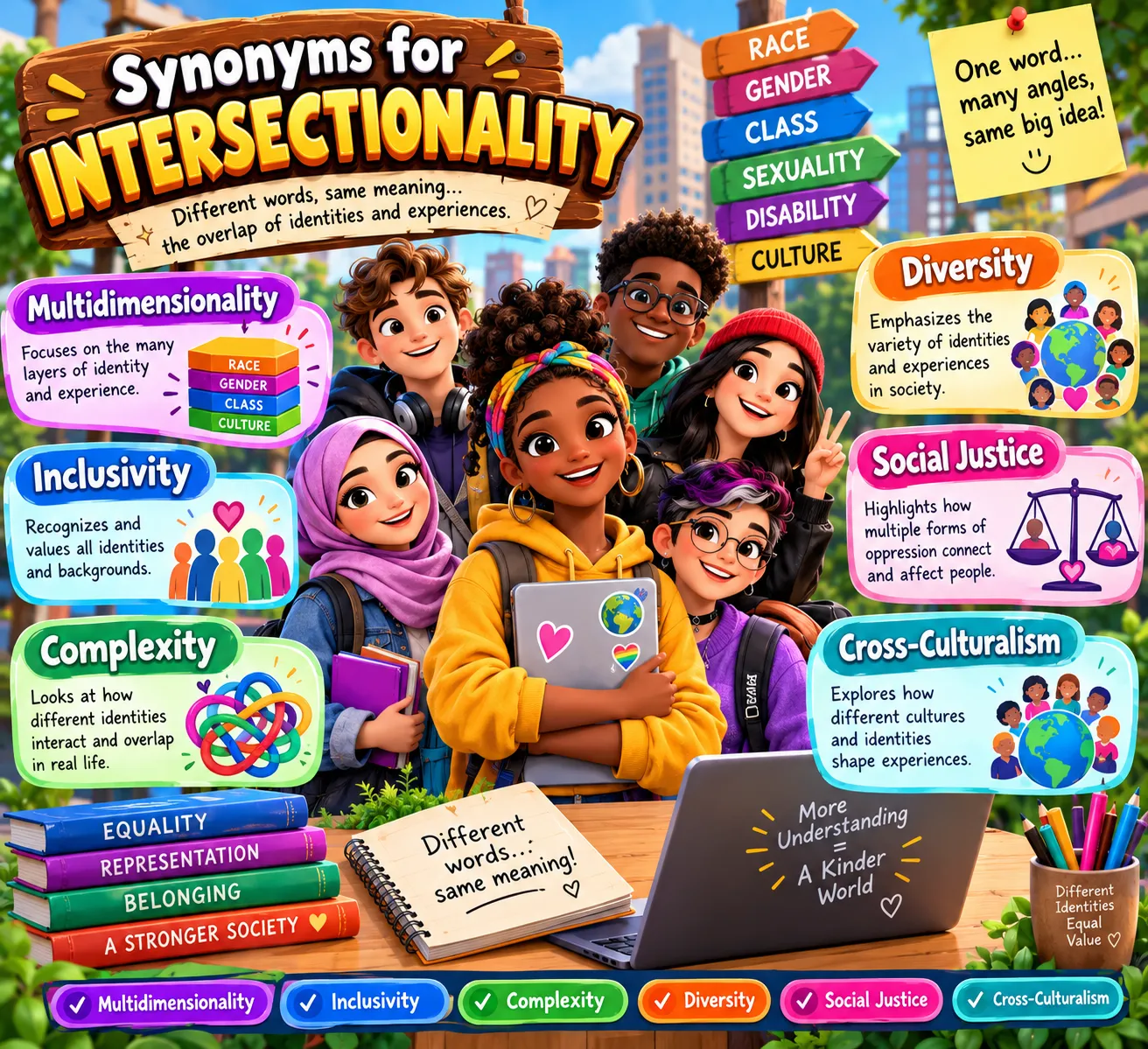
Intersectionality means how different parts of a person’s identity, such as race, gender, and class, overlap and shape their experiences.Related terms: overlapping identities, social inequality, multiple discrimination, systemic discrimination, equity, and social justice.
Intersectionality is the way different parts of a person’s identity can work together to shape their life. For example, a woman may face unfair treatment because she is a woman. If she also belongs to a racial group that faces bias, these forms of unfair treatment may affect her in a different way.
The word intersectionality is often used in social studies, education, law, and discussions about fairness. Learning related words can help English learners understand this idea and explain it clearly. It can also help writers avoid repeating the same word.
In this guide, we explore the meaning, history, pronunciation, and word forms of intersectionality. We also look at 30 related terms, simple examples, and ways to choose the best word for each context.
Meaning of Intersectionality
Definition
Intersectionality (noun): The way different parts of a person’s identity, such as race, gender, or class, can overlap and shape their experiences, including discrimination.
Examples
- Intersectionality helps us understand how race and gender can affect a person’s life.
- The school used intersectionality to study how different barriers affect students.
Connotative Meaning
Connotation (the feelings or ideas a word brings to mind):
- Positive tone: It can suggest fairness, understanding, and care for people’s different experiences.
- Negative tone: Some people may use it critically when they disagree with how the concept is applied.
- Neutral tone: In academic writing, it names a way to study how social identities and systems of power overlap.
Etymology
The word intersectionality is built from intersection and the suffix -ality. The concept was named by legal scholar Kimberlé Crenshaw in 1989.
- Old English (450–1100): The modern word intersectionality did not exist. Old English had words for crossing and meeting.
- Middle English (1100–1500): Words related to intersect developed through Latin roots and entered English through French.
- Modern English (1500–present): Intersection came to mean a place or point where things cross. Intersectionality was coined in 1989 to describe how forms of social identity and discrimination can overlap.
Pronunciation (IPA)
- IPA: /ˌɪn.tər.ˌsek.ʃəˈnæl.ə.ti/
- Syllables: in-ter-sec-tion-al-i-ty (7 syllables)
Affixation Pattern of Intersectionality
| Word part / formation | Type | Meaning |
| sect | Root (from Latin secare) | “To cut” |
| inter- | Prefix | “Between” or “among” |
| -ion | Suffix | Forms a noun |
| -al | Suffix | Forms an adjective |
| -ity | Suffix | Forms a noun expressing a quality or state |
| Intersect | Verb | To cross or meet |
| Intersection | Noun | A place or point where things cross |
| Intersectional | Adjective | Relating to overlapping identities or systems |
| Intersectionality | Noun | The concept of how overlapping identities or systems shape a person’s experience |
30 Synonyms and Related Terms for Intersectionality With Meaning & Examples
Important: Intersectionality is a specific academic concept. These 30 words and phrases are related to it, but they are not all exact synonyms. Some describe overlapping identities, while others describe social systems, unfair treatment, or ways to study these issues.
1. Overlapping identities (Noun phrase)
Meaning: Different parts of a person’s identity that exist together.
Examples:
- Her overlapping identities shaped her experience.
- The study explored overlapping identities in the workplace.
2. Interconnected identities (Noun phrase)
Meaning: Parts of a person’s identity that affect one another.
Examples:
- Gender and race can form interconnected identities.
- The lesson explored interconnected identities.
3. Multiple identities (Noun phrase)
Meaning: The different social or personal groups a person belongs to.
Examples:
- People have multiple identities.
- His multiple identities shaped his sense of belonging.
4. Identity overlap (Noun phrase)
Meaning: The way two or more parts of identity come together.
Examples:
- Identity overlap can shape a person’s daily life.
- The paper examined identity overlap in schools.
5. Interlocking identities (Noun phrase)
Meaning: Identities that connect and influence each other.
Examples:
- Her interlocking identities shaped her work life.
- The course explored interlocking identities.
6. Social identity (Noun)
Meaning: A person’s sense of belonging to social groups.
Examples:
- Social identity can affect how people see the world.
- The study focused on social identity.
7. Multiple social identities (Noun phrase)
Meaning: A person’s membership in more than one social group.
Examples:
- Multiple social identities can shape life experiences.
- The research looked at multiple social identities.
8. Identity complexity (Noun phrase)
Meaning: The way a person’s identity includes many connected parts.
Examples:
- Identity complexity can affect how people feel they belong.
- The class discussed identity complexity.
9. Social position (Noun)
Meaning: A person’s place in society, shaped by factors such as wealth, race, or gender.
Examples:
- Social position can affect access to education.
- The report explored social position and health.
10. Social location (Noun)
Meaning: A person’s place in society based on their social identities and life conditions.
Examples:
- Social location can shape a person’s views.
- The writer reflected on her social location.
11. Multiple marginalization (Noun phrase)
Meaning: Being pushed to the edges of society because of more than one social identity.
Examples:
- Multiple marginalization can create extra barriers.
- The project studied multiple marginalization.
12. Intersecting inequalities (Noun phrase)
Meaning: Forms of unfairness that overlap and affect one another.
Examples:
- Intersecting inequalities can limit job choices.
- The report explored intersecting inequalities in health care.
13. Overlapping discrimination (Noun phrase)
Meaning: Discrimination linked to more than one part of a person’s identity.
Examples:
- Overlapping discrimination may affect a person’s chances at work.
- The study examined overlapping discrimination.
14. Multiple discrimination (Noun phrase)
Meaning: Unfair treatment based on more than one identity or trait.
Examples:
- Multiple discrimination can affect access to housing.
- The group discussed multiple discrimination.
15. Compound discrimination (Noun phrase)
Meaning: Discrimination that involves more than one ground at the same time.
Examples:
- Compound discrimination can be hard to identify.
- The paper explored compound discrimination in hiring.
16. Cumulative disadvantage (Noun phrase)
Meaning: The way several barriers build up and create greater harm over time.
Examples:
- Cumulative disadvantage can affect a student’s future.
- The study explored cumulative disadvantage in health.
17. Structural inequality (Noun phrase)
Meaning: Unfair differences built into social systems and institutions.
Examples:
- Structural inequality can limit access to good schools.
- The report examined structural inequality.
18. Systemic discrimination (Noun phrase)
Meaning: Unfair treatment that is built into rules, practices, or institutions.
Examples:
- Systemic discrimination can affect hiring.
- The group studied systemic discrimination.
19. Social stratification (Noun phrase)
Meaning: The division of society into levels based on wealth, status, or power.
Examples:
- Social stratification can shape access to resources.
- The class explored social stratification.
20. Power relations (Noun phrase)
Meaning: The ways people or groups hold and use power over others.
Examples:
- Power relations can shape workplace rules.
- The study examined power relations in schools.
21. Social inequality (Noun phrase)
Meaning: Unfair differences in wealth, rights, or opportunities between groups.
Examples:
- Social inequality can affect life chances.
- The report focused on social inequality.
22. Disadvantage (Noun)
Meaning: A condition that makes it harder for someone to succeed or take part.
Examples:
- Poverty can create a serious disadvantage.
- The project aimed to reduce disadvantage.
23. Marginalization (Noun)
Meaning: The process of pushing a person or group to the edge of society.
Examples:
- Marginalization can reduce access to services.
- The research explored marginalization in public life.
24. Inclusion (Noun)
Meaning: The practice of making sure people can take part and feel welcome.
Examples:
- Inclusion helps students feel safe at school.
- The team worked to improve inclusion.
25. Diversity (Noun)
Meaning: The presence of people with different backgrounds and identities.
Examples:
- Diversity can bring new ideas to a team.
- The school values diversity.
26. Equity (Noun)
Meaning: Fair treatment that considers people’s different needs and barriers.
Examples:
- Equity can help students get the support they need.
- The policy aims to promote equity.
27. Social justice (Noun phrase)
Meaning: The idea that people should have fair rights, chances, and treatment.
Examples:
- Social justice calls for fair access to education.
- The group works for social justice.
28. Critical social analysis (Noun phrase)
Meaning: A close study of how society, power, and inequality work.
Examples:
- Critical social analysis can reveal hidden barriers.
- The course used critical social analysis.
29. Multidimensional inequality (Noun phrase)
Meaning: Inequality that affects several parts of life or involves several social factors.
Examples:
- Multidimensional inequality can affect health and income.
- The report studied multidimensional inequality.
30. Interconnected systems of oppression (Noun phrase)
Meaning: Social systems that work together to create unfair treatment.
Examples:
- Interconnected systems of oppression can shape people’s lives.
- The author examined interconnected systems of oppression.
Prototype Meaning
The most typical meaning of intersectionality is the idea that different parts of a person’s identity can overlap and shape their experiences. People often think of race, gender, class, disability, and other social factors. These factors do not always act alone. They can work together and create forms of unfair treatment that are not fully explained by looking at each factor on its own.
Prototype Categorization
The related terms can be grouped by the ideas they describe. This helps writers choose a term that matches their point.
| Semantic Category | Related Terms | What the Group Describes |
| Identity and overlap | Overlapping identities, interconnected identities, multiple identities, identity overlap, interlocking identities, social identity, multiple social identities, identity complexity | How different parts of identity connect |
| Social position | Social position, social location, social stratification, power relations | A person’s place in society and access to power |
| Discrimination and barriers | Multiple marginalization, overlapping discrimination, multiple discrimination, compound discrimination, cumulative disadvantage, disadvantage, marginalization | How unfair treatment and barriers affect people |
| Systems and inequality | Intersecting inequalities, structural inequality, systemic discrimination, social inequality, multidimensional inequality, interconnected systems of oppression | How social structures create or maintain unfairness |
| Fairness and social change | Inclusion, diversity, equity, social justice | Ideas and goals related to fair treatment |
| Research and analysis | Critical social analysis | Ways to study social power and inequality |
Use interconnected identities when focusing on identity, systemic discrimination when discussing institutions, and equity when describing fair support. These words help make your meaning clear, even though they do not all mean intersectionality itself.
Antonyms of Intersectionality
There is no exact antonym for intersectionality. The following terms describe ideas that contrast with its focus on overlapping identities and connected systems.
- Single factor analysis (noun phrase): Studying only one factor at a time. The report used single factor analysis.
- One-dimensional view (noun phrase): Seeing a person or issue through only one lens. A one-dimensional view may miss important details.
- Identity separation (noun phrase): Treating parts of identity as separate rather than connected. Identity separation can overlook shared experiences.
- Social homogeneity (noun phrase): A state in which people in a group are very similar. Social homogeneity can hide differences within a community.
- Individualism (noun): A view that puts the individual first, rather than social group ties. The debate focused on individualism.
These are contrasts, not strict opposites. Intersectionality can also be studied alongside individual experiences and single-factor analysis.
Short Questions and Answers
What does intersectionality mean?
Intersectionality means that different parts of a person’s identity can overlap and shape their experiences, including unfair treatment.
When should intersectionality be used?
Use it when discussing how social identities and systems of power connect, especially in studies of discrimination, fairness, or access to resources.
Is intersectionality positive or negative?
The word is usually neutral in academic use. It can support goals such as fairness and inclusion, but people may disagree about its use or meaning.
How is it different from similar words?
Diversity means that people have different backgrounds. Equity means fair support. Intersectionality examines how different identities and forms of power overlap.
Conclusion
Learning intersectionality and its related terms can help you explain complex social ideas in clear English. Words such as overlapping identities, structural inequality, and social justice each describe a different part of the topic.
They can make your writing more precise and help you avoid repeating the same word.Remember that related terms are not always true synonyms. Choose the word that fits your meaning.
Read examples, write your own sentences, and practice using a few new terms each day. This will build your vocabulary, strengthen your speaking and writing, and help you discuss social issues with more care and confidence.
Read More:
Synonyms for Dapper: 30 Stylish Words to Know

I’m Falak Naaz, an SEO writer at SameSynonyms.com with 10 years of experience creating clear, engaging, and search-friendly English content. I specialize in synonyms, antonyms, vocabulary, and word usage. Through careful research and practical examples, I help readers choose the right words and improve their English with confidence.