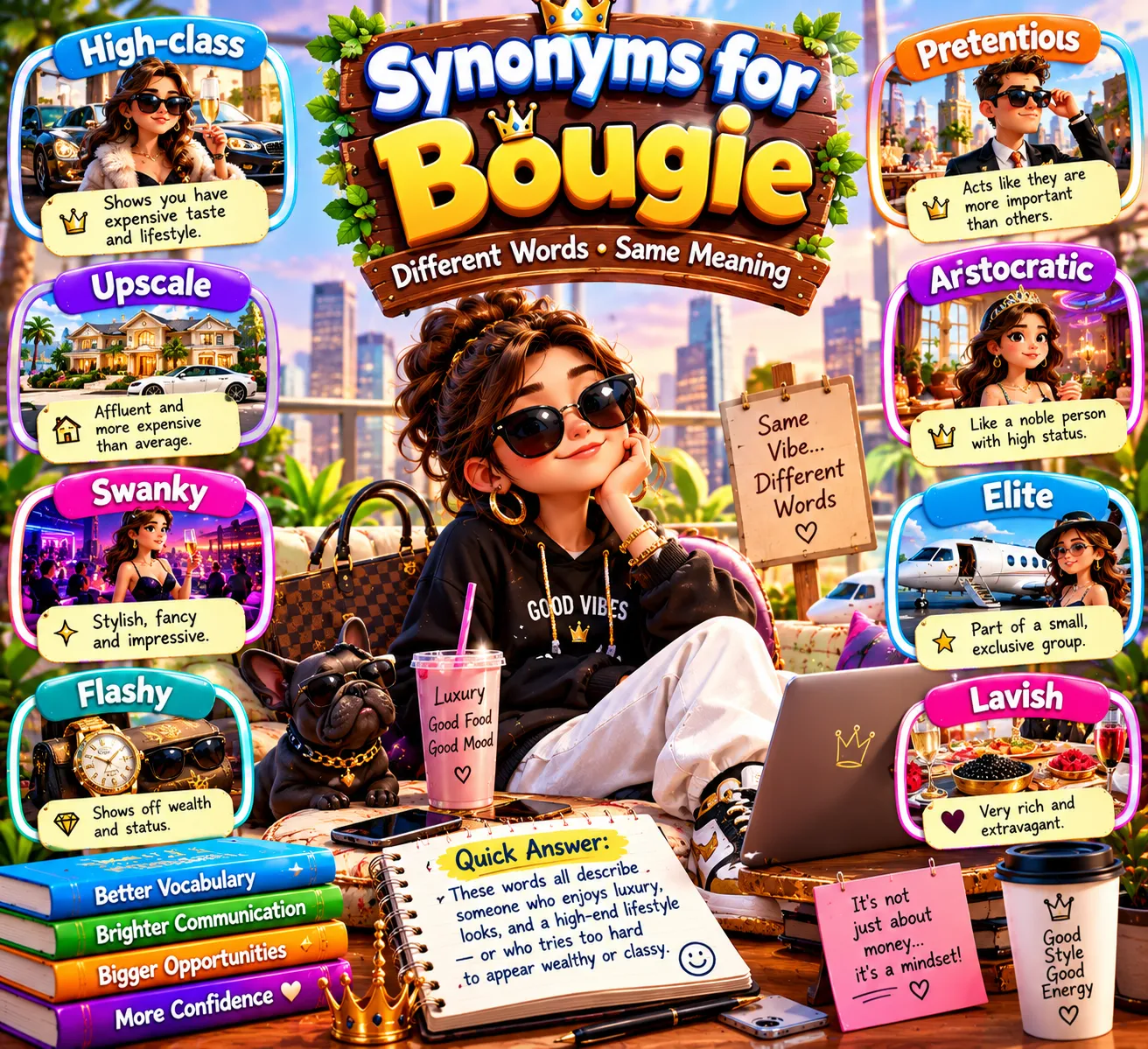
Synonyms for bougie include fancy, upscale, luxurious, posh, pretentious, snobbish, and high end. The best choice depends on whether you mean stylish and expensive or someone who acts as if they are better than others.
Bougie is a popular slang word used to describe someone or something that seems fancy, expensive, or focused on luxury. Imagine a friend who always chooses pricey cafés, orders designer clothes, and loves high-end products
. You might call that friend bougie. The word can be playful, positive, or critical, depending on the situation.Learning synonyms for bougie helps English learners understand casual conversations and express ideas with more detail. It also helps content writers avoid repeating the same word in blogs, social media posts, and everyday writing.
In this guide, you will learn the meaning of bougie, its history, pronunciation, word forms, and 30 synonyms or related terms with simple meanings and examples. You will also learn how to choose words that match the tone you want.
Meaning of Bougie
Definition
Bougie (adjective or noun): Informal slang used to describe someone or something that seems fancy, luxurious, expensive, or concerned with social status.
As a noun, bougie can describe a person who enjoys or acts in a fancy, status-focused way.
Examples
- My sister picked a bougie restaurant for her birthday dinner.
- He loves bougie coffee shops and designer clothes.
Connotative Meaning
(Connotation: the feeling or idea a word suggests beyond its basic meaning.)
- Positive tone: Stylish, classy, elegant, or luxurious.
- Negative tone: Snobbish, pretentious, showy, or overly focused on status.
- Neutral tone: Describes a person, place, or thing that seems upscale or expensive.
Etymology of Bougie
The slang word bougie comes from bourgeois, a word borrowed from French. Bourgeois originally referred to a town-dweller or a member of the middle class. Over time, it also became linked to middle-class values, comfort, and social status.
- Old English (450–1100): The modern slang word bougie was not part of Old English. English speakers used other words to describe wealth, rank, and social class.
- Middle English (1100–1500): The word bourgeois entered English through French influence during later historical development, rather than as an Old English term.
- Modern English (1500–present): Bourgeois became associated with the middle class and, at times, with materialism or social pretension. Bougie developed as an informal slang form, especially in modern American English, to describe fancy tastes or a desire for luxury.
Note: Bougie also has older technical meanings in medicine and other fields. This article focuses on its modern slang meaning.
Pronunciation (IPA)
- IPA: /ˈbuːʒi/
- Syllables: bou-gie (2 syllables)
Affixation Pattern of Bougie
- Root: A slang form related to bourgeois.
- Prefix: None.
- Suffix: No productive suffix is added in the slang form; -ie is part of its spelling.
Word formations
- Bougie (adjective): Fancy, luxurious, or status-focused.
- Bougie (noun): A person who enjoys or displays bougie tastes.
- Bourgeois (adjective/noun): Related to the middle class or its values.
- Bourgeoisie (noun): The middle class, especially as a social group.
- Bourgeoisness (noun): The quality of being bourgeois; less common.
30 Synonyms of Bougie With Meaning and Examples
These words vary in tone. Some praise luxury and style, while others suggest showing off or acting superior. They are related alternatives, not exact substitutes in every sentence.
1. Fancy (Adjective)
Meaning: More special, stylish, or expensive than usual.
Examples:
- We went to a fancy restaurant for dinner.
- She wore a fancy dress to the party.
2. Luxurious (Adjective)
Meaning: Very comfortable, costly, and full of quality features.
Examples:
- They stayed in a luxurious hotel by the sea.
- He enjoys luxurious cars and soft leather seats.
3. Upscale (Adjective)
Meaning: Designed for people who want high-quality or expensive goods and services.
Examples:
- They opened an upscale café downtown.
- She shops at upscale clothing stores.
4. Posh (Adjective)
Meaning: Stylish, expensive, or linked with a high social class.
Examples:
- We had lunch at a posh hotel.
- He lives in a posh part of the city.
5. High-end (Adjective)
Meaning: Made or sold at a high price and often of high quality.
Examples:
- The shop sells high-end watches.
- She bought a high-end camera.
6. Classy (Adjective)
Meaning: Stylish and attractive in a way that shows good taste.
Examples:
- The restaurant has a classy design.
- She chose a classy outfit for the event.
7. Elegant (Adjective)
Meaning: Graceful, tasteful, and attractive.
Examples:
- They held an elegant wedding reception.
- The room looked elegant with simple decorations.
8. Chic (Adjective)
Meaning: Fashionable and stylish.
Examples:
- She wore a chic black jacket.
- The boutique is known for its chic designs.
9. Glamorous (Adjective)
Meaning: Attractive and exciting in a way linked with luxury or fame.
Examples:
- The actress wore a glamorous gown.
- They planned a glamorous evening at the hotel.
10. Lavish (Adjective)
Meaning: Very rich, costly, or generous in style.
Examples:
- They hosted a lavish party.
- The palace had lavish rooms and gold decorations.
11. Extravagant (Adjective)
Meaning: Spending or using much more money or resources than needed.
Examples:
- He bought an extravagant gift.
- Their extravagant holiday cost a lot of money.
12. Swanky (Adjective)
Meaning: Fashionable, impressive, and often expensive.
Examples:
- We met at a swanky rooftop bar.
- The hotel has a swanky lounge.
13. Upscale-minded (Adjective)
Meaning: Interested in high-quality or expensive experiences; an informal descriptive phrase.
Examples:
- Her upscale-minded friends chose a luxury resort.
- He is upscale-minded when it comes to dining.
14. Refined (Adjective)
Meaning: Showing good taste, manners, or careful style.
Examples:
- The café has a refined atmosphere.
- She prefers refined designs over bright patterns.
15. Sophisticated (Adjective)
Meaning: Stylish, cultured, or showing knowledge and experience.
Examples:
- They chose a sophisticated restaurant for the meeting.
- His apartment has a sophisticated look.
16. Trendy (Adjective)
Meaning: Popular and fashionable at the moment.
Examples:
- The trendy café is always busy.
- She bought a trendy pair of shoes.
17. Fashionable (Adjective)
Meaning: Following or showing current styles.
Examples:
- He wore fashionable clothes to the event.
- The store sells fashionable bags.
18. Designer (Adjective)
Meaning: Made by a well-known fashion or product designer, often at a high price.
Examples:
- She saved money to buy designer shoes.
- He likes designer labels.
19. Exclusive (Adjective)
Meaning: Limited to certain people or difficult for most people to access.
Examples:
- They joined an exclusive club.
- The store held an exclusive launch event.
20. Premium (Adjective)
Meaning: Of a higher quality or price than standard options.
Examples:
- The hotel offers premium rooms.
- He pays extra for premium coffee.
21. Opulent (Adjective)
Meaning: Very rich, grand, and luxurious.
Examples:
- The guests entered an opulent ballroom.
- The mansion had opulent furniture.
22. Plush (Adjective)
Meaning: Soft, comfortable, and often luxurious.
Examples:
- They relaxed on plush sofas.
- The hotel has plush rooms and thick carpets.
23. Materialistic (Adjective)
Meaning: Too focused on money, possessions, and expensive things.
Examples:
- He seems materialistic because he cares about brands.
- The story warns against a materialistic lifestyle.
24. Pretentious (Adjective)
Meaning: Trying to seem more important, cultured, or impressive than one really is.
Examples:
- The restaurant’s menu sounded pretentious.
- He made pretentious comments about simple coffee.
25. Snobbish (Adjective)
Meaning: Acting as if you are better than people you consider less wealthy or less important.
Examples:
- His snobbish attitude upset his friends.
- She disliked the snobbish way he spoke to the staff.
26. Showy (Adjective)
Meaning: Designed to attract attention, often through display or decoration.
Examples:
- He bought a showy gold watch.
- The room had showy decorations.
27. Flashy (Adjective)
Meaning: Very bright, bold, or attention-grabbing, sometimes in a way that seems excessive.
Examples:
- He drove a flashy sports car.
- She wore a flashy necklace to the party.
28. Ostentatious (Adjective)
Meaning: Showing wealth or success in a way meant to impress others.
Examples:
- They built an ostentatious house.
- His ostentatious display of wealth made people uncomfortable.
29. Status-conscious (Adjective)
Meaning: Very aware of social rank, reputation, or the status linked to possessions.
Examples:
- He is status-conscious and always checks brand names.
- The status-conscious group chose the most expensive venue.
30. High-maintenance (Adjective)
Meaning: Requiring a lot of time, effort, attention, or money to satisfy.
Examples:
- Their high-maintenance lifestyle was costly.
- He joked that his expensive hobby was high-maintenance.
Prototype Meaning of Bougie
The most typical meaning of bougie is fancy, expensive, or focused on luxury and social status. People often imagine designer clothes, costly restaurants, premium coffee, stylish homes, and exclusive experiences. The word can be used as a compliment when something looks classy or fashionable. It can also be used as a joke or criticism when someone seems too concerned with money, brands, or appearing wealthy. The meaning depends on the speaker, the situation, and the tone.
Prototype Categorization of Bougie
The related words for bougie can be grouped by meaning and use. These categories help writers choose the right word for each situation.
| Category | Related Words | Meaning and Use |
| Luxury and Wealth | Luxurious, lavish, opulent, plush, extravagant | Describe costly items, rich settings, or expensive lifestyles. |
| Style and Fashion | Chic, classy, elegant, glamorous, fashionable, trendy, designer | Focus on appearance, style, and fashion. |
| High-End Quality | Fancy, upscale, high-end, premium, swanky, exclusive | Describe expensive products, services, or places. |
| Taste and Sophistication | Refined, sophisticated | Suggest good taste, culture, or a polished style. |
| Showing Off Wealth | Flashy, showy, ostentatious | Suggest that someone wants others to notice their money or possessions. |
| Negative Attitudes and Status | Pretentious, snobbish, materialistic, status-conscious | Describe people who care too much about status, possessions, or appearing superior. |
| Lifestyle and Demands | High-maintenance, upscale-minded | Describe a costly lifestyle or a strong preference for high-end experiences. These are related expressions, not exact synonyms. |
Grouping synonyms by meaning helps writers avoid repetition and choose words with the right tone. For example, elegant is often positive, while pretentious is usually critical. Upscale describes a high-end setting, while materialistic describes a strong focus on possessions.
Antonyms of Bougie
There is no single perfect antonym for bougie. The best opposite depends on whether you mean luxury, expensive taste, or an attitude of superiority.
- Modest (adjective): Simple and not showy.
- Humble (adjective): Not acting as if you are better than others.
- Unpretentious (adjective): Simple, natural, and not trying to impress.
- Down-to-earth (adjective): Practical, friendly, and not focused on status.
- Frugal (adjective): Careful about spending money.
- Thrifty (adjective): Good at saving money and avoiding waste.
- Plain (adjective): Simple, without extra decoration or luxury.
- Practical (adjective): Focused on usefulness rather than appearance.
- Inexpensive (adjective): Not costing much money.
- Low-key (adjective): Quiet, relaxed, and not designed to attract attention.
Short Questions and Answers
What does bougie mean?
Bougie is slang for fancy, luxurious, expensive, or focused on social status.
When should bougie be used?
Use bougie in informal conversations, social media posts, and casual writing when describing fancy tastes, expensive places, or status-focused behavior. Use more formal words, such as luxurious or upscale, in academic and professional writing.
Is bougie positive or negative?
It can be either. It may praise something as stylish or luxurious, or criticize someone for being pretentious or too focused on status.
How is bougie different from similar words?
Luxurious describes comfort and quality, posh suggests high social status, and pretentious means trying to seem more important or impressive than you are. Bougie can suggest any of these ideas, depending on context.
Conclusion
Learning bougie and its synonyms can help you understand modern slang and express ideas more clearly. Words such as upscale, luxurious, chic, and elegant describe style and quality, while pretentious, snobbish, and materialistic express a more critical view.
Choosing the right word helps you avoid repetition and communicate your meaning with greater accuracy.For English learners, these alternatives also build confidence in speaking, writing, and understanding casual conversations. Remember that bougie is informal, so it may not suit every professional or academic setting.
Practice a few synonyms each day, write your own example sentences, and notice how people use these words in real life. With regular practice, you can build a stronger vocabulary and express yourself naturally.
Read More:
Synonyms for Self-Centered: 30 Powerful Words to Know

I’m Falak Naaz, an SEO writer at SameSynonyms.com with 10 years of experience creating clear, engaging, and search-friendly English content. I specialize in synonyms, antonyms, vocabulary, and word usage. Through careful research and practical examples, I help readers choose the right words and improve their English with confidence.










