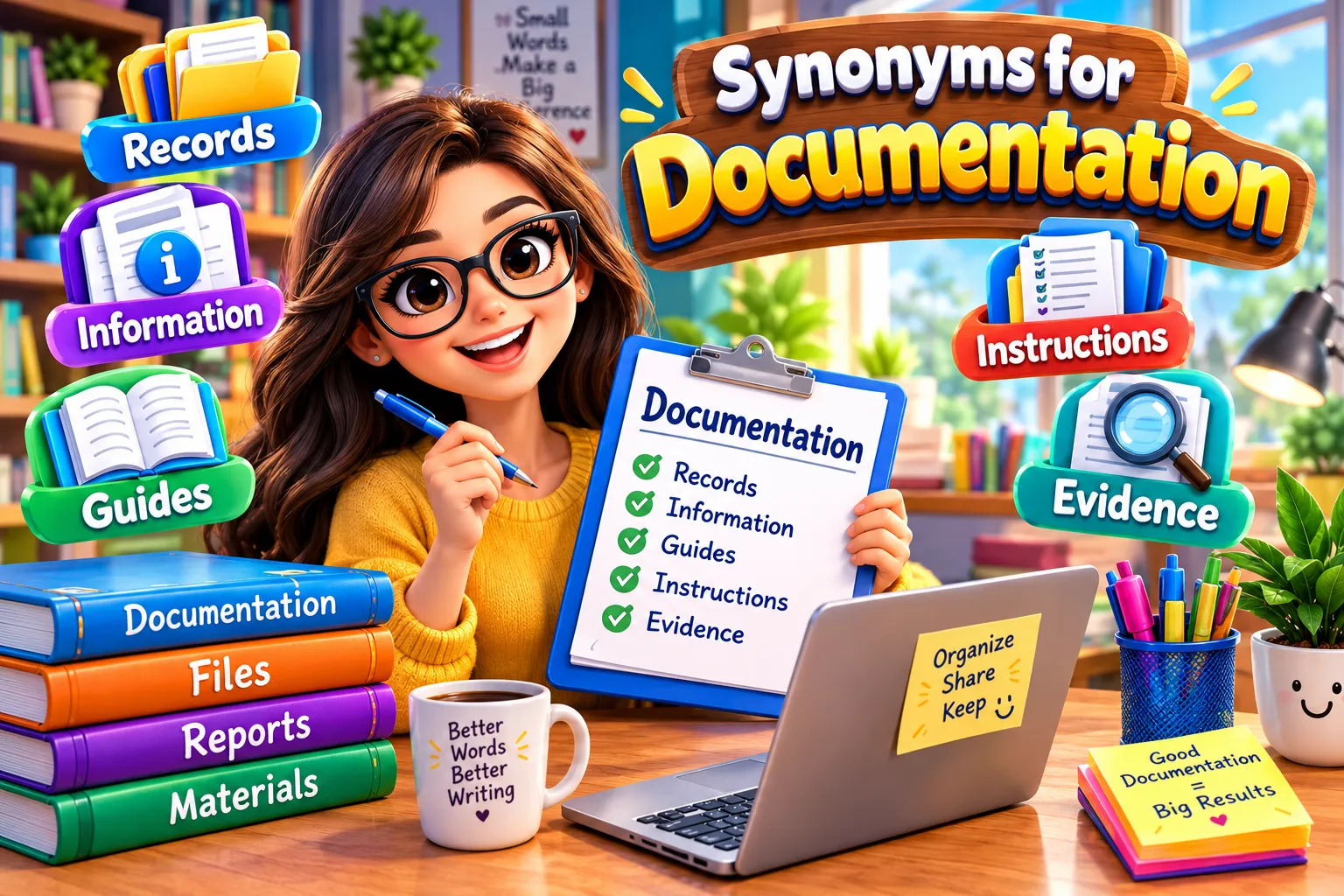
Synonyms for documentation include records, documents, paperwork, files, reports, evidence, records management, and written proof. The best alternative depends on whether you mean written information, official papers, or instructions.
Documentation means written or digital information that records facts, explains a process, or provides proof. For example, when you apply for a job, you may need documentation such as certificates, identification papers, or work records.
At school, students use documentation to support research. At work, teams create documents to explain tasks and keep track of important details.The word documentation is common in education, business, healthcare, law, and technology. However, using the same word again and again can make writing sound dull. Learning synonyms helps English learners build vocabulary and helps content writers express ideas more clearly.
In this guide, you will learn the meaning of documentation, its pronunciation, history, word forms, and 30 related alternatives. Simple definitions and examples will help you choose the right word for different situations.
Meaning of Documentation
Definition
Documentation (noun): Written, printed, or digital material that records information, provides evidence, or explains how something works.
Examples
- Please submit the required documentation with your application.
- The team prepared documentation to explain how the software works.
Connotative Meaning
(Connotation means the feeling or idea a word suggests beyond its basic meaning.)
- Positive tone: Documentation can suggest clear records, proof, accuracy, and good organization.
- Negative tone: It may suggest too much paperwork, delays, or complex rules.
- Neutral tone: It can simply mean written information or records about a subject.
Etymology of Documentation
| Period | Etymology and Development |
| Origin | Documentation comes from document, linked to the Latin word documentum, meaning “lesson,” “proof,” or “example.” |
| Old English (450–1100) | The word documentation was not used in Old English. People used other words to describe written records and proof. |
| Middle English (1100–1500) | Document entered English through French and Latin influence, referring to something that taught or provided evidence. |
| Modern English (1500–present) | Documentation developed as a term for collecting, preparing, and keeping written records. Today, it is widely used in business, law, research, and computing. |
Pronunciation (IPA)
- IPA: /ˌdɒk.jə.menˈteɪ.ʃən/ (British English); /ˌdɑː.kjə.menˈteɪ.ʃən/ (American English)
- Syllables: doc-u-men-ta-tion (five syllables)
Affixation Pattern of Documentation
- Root: document
- Prefix: None
- Suffix: -ation, which forms a noun describing an action, process, or result.
Word Formations
- Document (noun): A written or digital item containing information.
- Document (verb): To record facts or events.
- Documentation (noun): The process of recording information or the material created.
- Documented (verb/adjective): Recorded or supported by evidence.
- Documenting (verb): Recording information as it happens.
- Documentary (noun/adjective): A factual film or program; also related to documents.
- Documenter (noun): A person who records information, though documentarian is more common for someone who makes documentaries.
30 Synonyms of Documentation With Meaning and Examples
Note: These alternatives have related meanings, but they are not interchangeable in every sentence. Choose the one that matches your context.
1. Records (Noun)
Meaning: Information kept for future reference or as evidence.
Examples:
- The school keeps records of student progress.
- We checked the company’s financial records.
2. Documents (Noun)
Meaning: Written or digital items that contain facts or information.
Examples:
- Please send the documents by email.
- The lawyer reviewed the legal documents.
3. Paperwork (Noun)
Meaning: Forms and papers needed for an official task.
Examples:
- I finished the paperwork for my new job.
- The application requires a lot of paperwork.
4. Files (Noun)
Meaning: Collections of information stored on paper or a computer.
Examples:
- Save the files in the correct folder.
- The manager checked the employee files.
5. Reports (Noun)
Meaning: Written accounts that explain facts, findings, or events.
Examples:
- The team prepared a report on its results.
- Please read the safety report before starting work.
6. Evidence (Noun)
Meaning: Facts or material that help prove something is true.
Examples:
- The photographs provided evidence of the damage.
- Researchers collected evidence to support their claims.
7. Written Records (Noun Phrase)
Meaning: Information recorded in written form.
Examples:
- Keep written records of all payments.
- Written records helped explain what happened.
8. Written Proof (Noun Phrase)
Meaning: A written item that supports a claim or shows that something is true.
Examples:
- She provided written proof of her address.
- The receipt served as written proof of payment.
9. Archives (Noun)
Meaning: Collections of historical or important records kept for reference.
Examples:
- The library stores old letters in its archives.
- Researchers searched the archives for historical facts.
10. Manuals (Noun)
Meaning: Guides that explain how to use or operate something.
Examples:
- Read the user manual before using the device.
- The company created manuals for new staff.
11. Instructions (Noun)
Meaning: Directions that explain how to do something.
Examples:
- Follow the instructions carefully.
- The software includes instructions for installation.
12. Guidelines (Noun)
Meaning: Rules or advice that help people complete a task correctly.
Examples:
- The team follows safety guidelines.
- Read the writing guidelines before submitting your article.
13. Specifications (Noun)
Meaning: Detailed statements about the features or requirements of something.
Examples:
- The engineer checked the product specifications.
- The project must meet the listed specifications.
14. Reports and Findings (Noun Phrase)
Meaning: Written accounts of results and discoveries.
Examples:
- The researchers shared their reports and findings.
- The findings helped the team improve its plan.
15. Logs (Noun)
Meaning: Records of events, actions, or changes over time.
Examples:
- The system keeps logs of user activity.
- The driver recorded each trip in a log.
16. Registers (Noun)
Meaning: Official lists that record names, events, or details.
Examples:
- The office maintains a register of visitors.
- The school checked its attendance register.
17. Certificates (Noun)
Meaning: Official documents that confirm a fact, achievement, or qualification.
Examples:
- She submitted her educational certificates.
- The course provides certificates to successful students.
18. Forms (Noun)
Meaning: Documents with spaces for entering required information.
Examples:
- Complete the forms before your appointment.
- The office gave us two forms to sign.
19. Applications (Noun)
Meaning: Formal requests, often made using a document or online form.
Examples:
- The office received fifty job applications.
- Please attach the required papers to your application.
20. Correspondence (Noun)
Meaning: Letters, emails, and other written communication.
Examples:
- The manager saved all business correspondence.
- The correspondence explained the agreement between the two firms.
21. Transcripts (Noun)
Meaning: Written copies of spoken words or official records of academic results.
Examples:
- The student requested her university transcript.
- The court reviewed the transcript of the hearing.
22. Minutes (Noun)
Meaning: A written record of what was discussed or decided at a meeting.
Examples:
- The secretary prepared the meeting minutes.
- Please share the minutes with everyone who attended.
23. Case Files (Noun Phrase)
Meaning: Collections of records about a particular case or matter.
Examples:
- The investigator reviewed the case files.
- The lawyer organized the case files before the hearing.
24. References (Noun)
Meaning: Sources or materials used to support information or claims.
Examples:
- Add references to support your research.
- The report includes references to official sources.
25. Supporting Materials (Noun Phrase)
Meaning: Extra documents or information that help explain or support a main item.
Examples:
- Submit supporting materials with your proposal.
- The teacher provided supporting materials for the lesson.
26. Technical Writing (Noun Phrase)
Meaning: Writing that explains technical subjects, systems, or processes.
Examples:
- Technical writing helps users understand complex tools.
- She works in technical writing for a software company.
27. User Guides (Noun Phrase)
Meaning: Documents that show users how to use a product or service.
Examples:
- The website offers user guides for beginners.
- The team updated the user guide after the software change.
28. Specifications Sheet (Noun Phrase)
Meaning: A document listing the details or features of a product or system.
Examples:
- Check the specifications sheet before buying the laptop.
- The supplier sent a specifications sheet with the equipment.
29. Recordkeeping (Noun)
Meaning: The activity of creating and maintaining records.
Examples:
- Good recordkeeping helps prevent errors.
- The company improved its recordkeeping process.
30. Written Information (Noun Phrase)
Meaning: Facts or details presented in written form.
Examples:
- The website provides written information about the service.
- Please review the written information before signing.
Prototype Meaning
The most typical meaning of documentation is written or digital material that records facts, explains a process, or provides proof. People often imagine forms, reports, official records, user manuals, or files that help someone understand what happened or what to do next. In a workplace, documentation may explain a task or record a decision. In education, it may support research. In technology, it often describes how a system or program works.
Prototype Categorization
| Semantic Category | Synonyms | Meaning and Use |
| Official Records | Records, documents, registers, certificates, transcripts | Used for formal, academic, or legal information. |
| Forms and Administration | Paperwork, forms, applications | Refers to materials needed to complete official tasks. |
| Evidence and Support | Evidence, written proof, references, supporting materials | Helps confirm facts or support claims. |
| Reports and Meetings | Reports, reports and findings, minutes | Explains results, decisions, or events. |
| Technical Help | Manuals, instructions, guidelines, user guides, technical writing, specifications, specification sheets | Explains how something works or how a task should be done. |
| Stored Information | Files, archives, logs, case files, written records | Refers to information saved for future use. |
| Communication and Process | Correspondence, written information, recordkeeping | Relates to sharing information or maintaining records. |
This grouping helps writers choose the right synonym for each context. For example, evidence supports a claim, paperwork refers to administrative tasks, and a user guide explains how to use a product.
Antonyms of Documentation
Documentation has no single direct antonym in every context. These words express the opposite idea in certain situations.
- Disorganization (noun): A lack of order in information or records.
- Omission (noun): The act of leaving out important information.
- Silence (noun): The absence of a statement or explanation.
- Secrecy (noun): Keeping information hidden from others.
- Unrecorded (adjective): Not written down or saved.
- Undocumented (adjective): Not supported by records or formal documents.
- Verbal (adjective): Spoken rather than written, when contrasting with written documentation.
- Guesswork (noun): Making a judgment without enough facts or evidence.
Short Questions and Answers
What does documentation mean?
Documentation is written or digital information used to record facts, explain a process, or provide evidence.
When should documentation be used?
Use documentation when talking about records, supporting information, instructions, or materials that explain or prove something.
Is documentation positive or negative?
It is usually neutral. It can suggest good organization and clear evidence, but it may also refer to burdensome paperwork.
How is documentation different from similar words?
Documentation is a broad term for recorded information or the process of recording it. Paperwork usually means forms and official tasks, evidence supports a claim, and manuals explain how to do something.
Conclusion
Learning the meaning of documentation and its synonyms can improve your English vocabulary and make your writing clearer. Words such as records, paperwork, evidence, reports, and manuals are related to documentation, but each has a different use.
Choosing the right word helps you share information with less repetition and greater accuracy. These alternatives are useful in school assignments, business emails, technical writing, and everyday conversations.
To build confidence, practice using a few new words each day. Write simple sentences, compare their meanings, and notice how people use them in real situations. With regular practice, you can make your writing more natural, precise, and easy to understand.
Read More:
Synonyms for Bougie: 30 Stylish Alternatives to Know

I’m Noor Fatima, an English content writer at SameSynonyms.com, specializing in synonyms, antonyms, word meanings, and English vocabulary. I create clear, well-researched content with practical examples to help readers understand word usage, expand their vocabulary, and communicate more effectively.