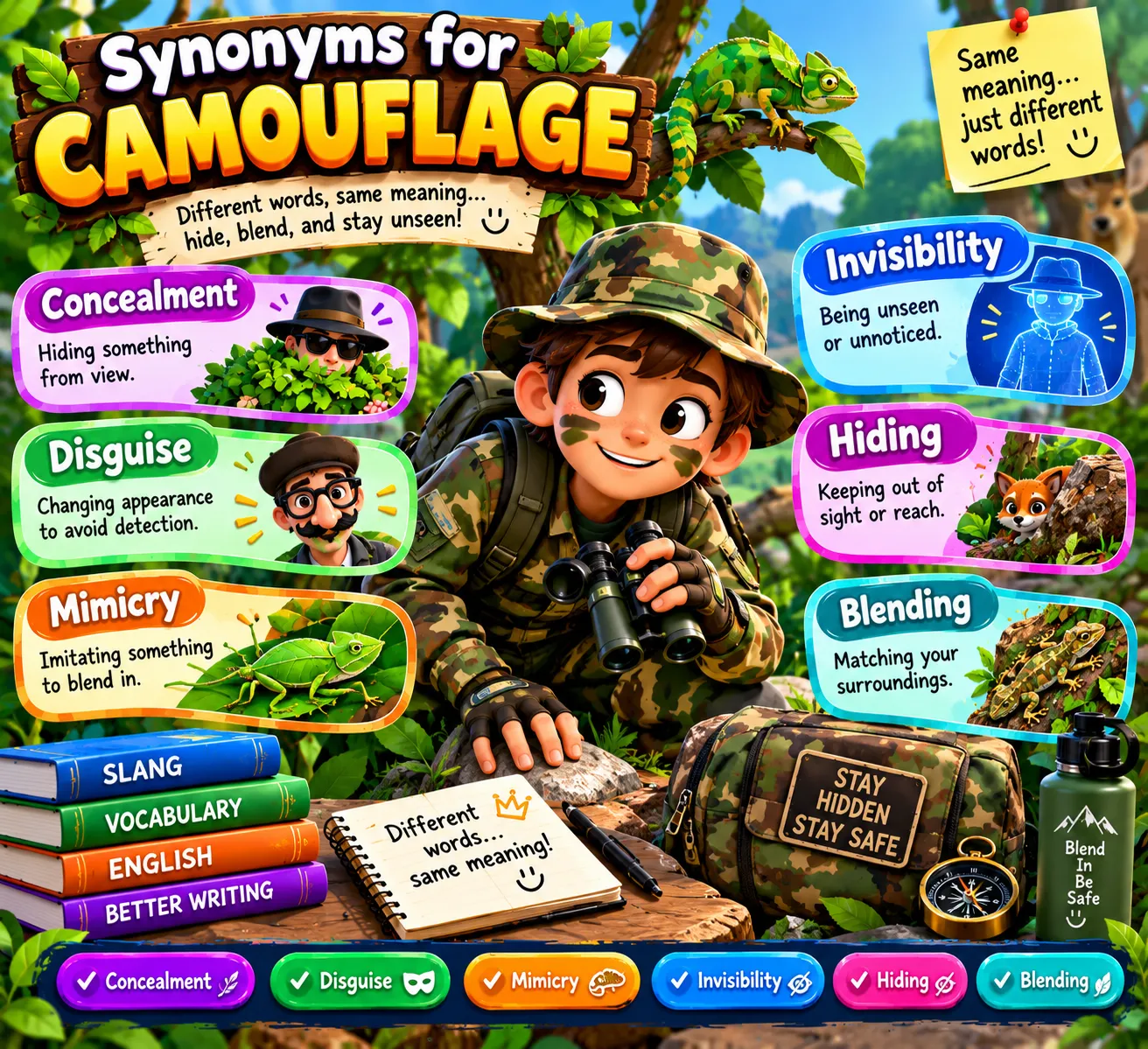
Synonyms for camouflage include concealment, disguise, hiding, masking, cloaking, blending in, mimicry, and concealment pattern. These words describe hiding something, blending into surroundings, or disguising its true appearance.
Camouflage is a way to hide something by making it blend in with its surroundings. For example, a soldier may wear green and brown clothes to blend into a forest. Animals also use camouflage to stay safe from predators or catch their prey.
The word is common in nature, military settings, fashion, and everyday speech.Learning synonyms for camouflage helps you explain hiding, blending in, and disguising things in different ways. English learners can use these words to build vocabulary and speak with more confidence.
Writers can also use them to avoid repeating the same word in stories, essays, and articles. In this guide, you will learn the meaning of camouflage, its history, pronunciation, word forms, and 30 related words with simple meanings and examples.
Meaning of Camouflage
Definition
Camouflage (noun or verb): A way to hide a person, animal, or object by making it look like its surroundings; it can also mean to hide something’s true nature or purpose.
Examples
- The tiger uses its stripes as camouflage in tall grass.
- She tried to camouflage the stain with a dark scarf.
Connotative Meaning
(Connotation means the feelings or ideas a word brings to mind beyond its basic meaning.)
- Positive tone: Can suggest cleverness, protection, and survival.
- Negative tone: Can suggest deception or an attempt to hide the truth.
- Neutral tone: Can simply describe blending in with the environment.
Etymology of Camouflage
The word camouflage comes from French camoufler, meaning “to disguise” or “to conceal.” It became widely used in English during the early 20th century, especially during World War I.
| Period | History and Development |
| Old English (450–1100) | The word camouflage was not part of Old English. People used other words to describe hiding or disguising things. |
| Middle English (1100–1500) | Camouflage had not yet entered English. Words such as hide and disguise expressed similar ideas. |
| Modern English (1500–present) | The word entered English from French in the early 20th century and became strongly linked to military concealment. |
| Word Origin | French camoufler, meaning “to disguise” or “conceal.” |
Pronunciation (IPA)
- IPA: /ˈkæməflɑːʒ/
- Syllables: cam-ou-flage (3 syllables)
Affixation Pattern of Camouflage
- Root: Camouflage
- Prefix: None
- Suffix: No productive English suffix is added in the base word.
- Word formations:
- Camouflage (noun): A method or pattern used to hide something.
- Camouflage (verb): To hide or disguise something.
- Camouflaged (adjective): Hidden or disguised.
- Camouflaging (verb): Hiding or blending something into its surroundings.
- Camouflages (verb): Hides or disguises something.
- Camoufleur (noun): A person who designs or applies camouflage, especially in military contexts.
30 Synonyms of Camouflage With Meaning and Examples
These words are related to camouflage, but they are not all exact substitutes. Choose one that fits the context.
1. Concealment (Noun)
Meaning: The act of keeping something hidden from view.
Examples:
- The bushes provided concealment for the hikers.
- The concealment of the evidence raised questions.
2. Disguise (Noun or Verb)
Meaning: Something that changes how a person or object looks to hide its identity.
Examples:
- He wore a disguise to avoid being recognized.
- She used makeup to disguise the mark on her face.
3. Cover (Noun or Verb)
Meaning: Something that hides or protects a person or object.
Examples:
- The soldiers took cover behind the wall.
- Leaves covered the small animal.
4. Masking (Noun or Verb)
Meaning: The act of hiding a feature, sound, or fact.
Examples:
- The loud music was masking the sound of traffic.
- Masking the smell made the room more pleasant.
5. Hiding (Noun or Verb)
Meaning: Keeping someone or something out of sight.
Examples:
- The fox was hiding among the trees.
- Hiding the gift was harder than she expected.
6. Obscuring (Verb)
Meaning: Making something difficult to see or understand.
Examples:
- Thick fog was obscuring the road.
- He used vague words, obscuring the real issue.
7. Dissembling (Verb)
Meaning: Hiding one’s true feelings, intentions, or beliefs.
Examples:
- She was dissembling to avoid an argument.
- His calm expression was dissembling his fear.
8. Deception (Noun)
Meaning: An act of making someone believe something that is not true.
Examples:
- The disguise was part of a larger deception.
- They uncovered the deception after checking the records.
9. Evasion (Noun)
Meaning: The act of avoiding a person, question, or duty.
Examples:
- His answer was an evasion of the main question.
- The suspect’s evasion made the search harder.
10. Veiling (Noun or Verb)
Meaning: Covering or partly hiding something.
Examples:
- Clouds were veiling the mountain peaks.
- She spoke with veiling words that hid her concern.
11. Cloaking (Noun or Verb)
Meaning: Covering or hiding something, often to keep it secret.
Examples:
- The mist was cloaking the valley.
- The company was cloaking its plans in secrecy.
12. Cover up (Noun)
Meaning: An attempt to hide a mistake, crime, or embarrassing fact.
Examples:
- The report revealed a cover up.
- They denied taking part in the cover up.
13. Screen (Noun or Verb)
Meaning: Something that blocks the view or protects something from being seen.
Examples:
- A row of trees screened the house from the road.
- The wall screened the workers from public view.
14. Shielding (Noun or Verb)
Meaning: Protecting someone or something from view, harm, or attention.
Examples:
- The umbrella was shielding her from the rain.
- He was shielding the child from the bright light.
15. Secrecy (Noun)
Meaning: The state of keeping information hidden from others.
Examples:
- The project was carried out in secrecy.
- They kept the plan in secrecy until launch day.
16. Stealth (Noun)
Meaning: The act of moving or acting quietly to avoid being noticed.
Examples:
- The cat approached its prey with stealth.
- The team moved with stealth through the forest.
17. Invisibility (Noun)
Meaning: The state of being impossible or very difficult to see.
Examples:
- The insect’s color gave it near invisibility among the leaves.
- The fog created a sense of invisibility on the road.
18. Blending In (Verb Phrase)
Meaning: Looking or behaving like the people or things around you.
Examples:
- The green insect was blending in with the plant.
- He wore plain clothes to blend in with the crowd.
19. Mimicry (Noun)
Meaning: The act of copying another organism’s appearance or behavior, sometimes for protection.
Examples:
- The harmless insect uses mimicry to resemble a wasp.
- Mimicry can help animals avoid predators.
20. Protective Coloration (Noun Phrase)
Meaning: Coloring that helps an animal avoid being seen by predators or prey.
Examples:
- The rabbit’s protective coloration helps it blend into the snow.
- Protective coloration makes the insect hard to spot on tree bark.
21. Cryptic Coloration (Noun Phrase)
Meaning: Coloring or markings that make an organism difficult to detect in its environment.
Examples:
- The moth’s cryptic coloration resembles the tree bark.
- Cryptic coloration helps many insects stay hidden.
22. Concealing Pattern (Noun Phrase)
Meaning: A design that makes something less noticeable.
Examples:
- The fabric had a concealing pattern of green and brown.
- The animal’s concealing pattern helped it disappear among the rocks.
23. Covertness (Noun)
Meaning: The quality of being hidden or secret.
Examples:
- The mission depended on covertness.
- The covertness of the operation kept it away from public attention.
24. Subterfuge (Noun)
Meaning: A trick or dishonest method used to hide the truth.
Examples:
- He used subterfuge to hide his real goal.
- The plan relied on subterfuge rather than open discussion.
25. Artifice (Noun)
Meaning: A clever trick or method used to mislead someone.
Examples:
- The magician used artifice to surprise the audience.
- The story exposed the artifice behind the public image.
26. Pretense (Noun)
Meaning: A false appearance or claim used to hide the truth.
Examples:
- He kept up the pretense that everything was fine.
- Their friendly behavior was only a pretense.
27. Simulation (Noun)
Meaning: An imitation of something real.
Examples:
- The training used a simulation of a battlefield.
- The pattern was a simulation of natural markings.
28. Imitation (Noun)
Meaning: A copy of the look or behavior of something else.
Examples:
- The toy used an imitation of animal skin patterns.
- The imitation helped the object resemble a rock.
29. False Appearance (Noun Phrase)
Meaning: An outward look that hides the real nature of something.
Examples:
- The calm room gave a false appearance of safety.
- The false appearance of confidence hid his fear.
30. Deceptive Appearance (Noun Phrase)
Meaning: A look that causes people to misunderstand what something really is.
Examples:
- The insect’s deceptive appearance confused its predators.
- The building’s deceptive appearance made it look empty.
Prototype Meaning of Camouflage
The most common meaning of camouflage is hiding a person, animal, or object by making it blend into its surroundings. People often picture soldiers wearing patterned uniforms or animals whose colors match leaves, sand, snow, or tree bark. The word can also describe hiding the truth, a mistake, or a person’s real intentions.
Prototype Categorization
Grouping synonyms by meaning helps writers choose a word that fits the situation instead of replacing camouflage with a word that has a different meaning.
| Semantic Category | Synonyms | Best Used For |
| Hiding and Concealment | Concealment, hiding, cover, masking, obscuring | Keeping something out of sight |
| Disguise and Covering | Disguise, veiling, cloaking, screen, concealing pattern | Changing or covering an appearance |
| Protection and Stealth | Shielding, stealth, invisibility, covertness | Avoiding attention or danger |
| Animal and Natural Camouflage | Mimicry, protective coloration, cryptic coloration, blending in | Explaining how animals avoid detection |
| Deception and Secrecy | Deception, subterfuge, artifice, pretense, cover-up, secrecy | Hiding the truth or misleading others |
| Imitation and Appearance | Simulation, imitation, false appearance, deceptive appearance | Making something look like something else |
| Avoidance | Evasion | Avoiding questions, attention, or responsibility |
Antonyms of Camouflage
Antonyms are words with opposite or contrasting meanings. The best choice depends on whether camouflage means hiding, disguising, or misleading.
- Exposure (noun): The act of making something visible or known.
- The exposure of the hidden object surprised everyone.
- Revelation (noun): The act of making something previously unknown public.
- The revelation showed the truth behind the story.
- Disclosure (noun): The act of sharing information that was hidden.
- The disclosure of the plan changed everything.
- Visibility (noun): The state of being easy to see.
- Bright colors increased the animal’s visibility.
- Transparency (noun): The quality of being open and clear.
- Transparency helped build trust in the company.
- Uncovering (noun): The act of finding or showing something hidden.
- The uncovering of the tracks revealed the animal’s path.
- Revealing (adjective): Showing something that was previously hidden.
- The revealing report explained what had happened.
Short Questions and Answers
What does camouflage mean?
Camouflage means hiding a person, animal, or object by helping it blend into its surroundings. It can also mean hiding the truth or one’s intentions.
When should camouflage be used?
Use camouflage when discussing concealment, protective patterns, military clothing, animal behavior, or attempts to hide something’s real nature.
Is camouflage positive or negative?
It depends on the context. It can be positive when it protects animals or people, but negative when it is used to deceive or hide wrongdoing. It can also be neutral in scientific descriptions.
How is camouflage different from similar words?
Concealment means keeping something hidden. Disguise changes how something looks. Mimicry involves copying another organism or object. Deception focuses on misleading someone. Camouflage most often means blending in with the surroundings.
Conclusion
Learning synonyms for camouflage helps you describe hiding and disguising in more precise ways. Words such as concealment, disguise, and masking work well when something is kept out of sight.
Terms like mimicry and protective coloration are useful for writing about animals and nature. Words such as deception and subterfuge are better when someone tries to hide the truth.Using the right synonym makes your writing clearer and helps you avoid repeating the same word. It also builds your vocabulary and improves your speaking skills.
Try learning a few new words each day, then use them in your own sentences. With regular practice, you can choose words that express your meaning with greater confidence.
Read More:
Synonyms for Dope: 30 Alternatives for Every Meaning

I’m Falak Naaz, an SEO writer at SameSynonyms.com with 10 years of experience creating clear, engaging, and search-friendly English content. I specialize in synonyms, antonyms, vocabulary, and word usage. Through careful research and practical examples, I help readers choose the right words and improve their English with confidence.










