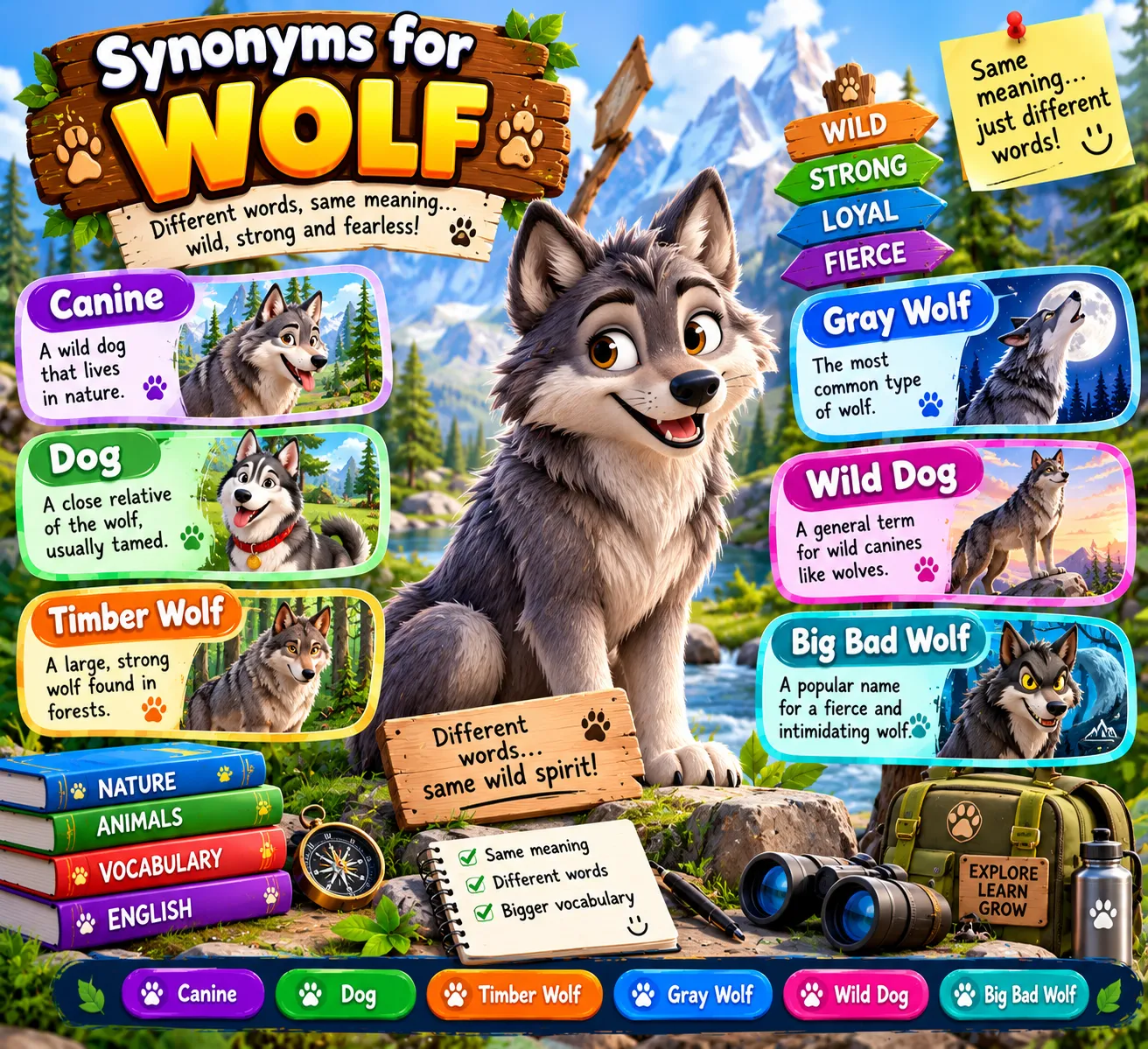
Synonyms and related words for wolf include gray wolf, timber wolf, Arctic wolf, canine, wild canid, predator, carnivore, lone wolf, and wild dog. The best choice depends on whether you mean a wolf species, its animal group, or its behavior.
A wolf is a wild animal that looks like a large dog. It often lives and hunts in a pack. Imagine walking through a forest and hearing a wolf howl in the distance. You may picture a strong, clever animal that works with its group to find food and stay safe.
Wolves appear in stories, myths, wildlife books, and films, so the word is common in both everyday and descriptive writing.Learning synonyms for wolf can help you describe this animal in fresh and clear ways. It can also help English learners build vocabulary and understand words linked to wild dogs, animal behavior, and folklore.
In this guide, you will learn the meaning, history, pronunciation, and word forms of wolf. You will also explore 30 related words, their meanings, examples, and semantic categories to help you choose the right term for each context.
Meaning of Wolf
Definition
Wolf (noun): A wild meat-eating mammal from the dog family that often lives and hunts in a pack.
Wolf (verb): To eat food very quickly or greedily.
Examples
- A gray wolf walked through the forest.
- The hungry children wolfed down their lunch.
Connotative Meaning
(Connotation means the feelings or ideas a word brings to mind beyond its basic meaning.)
- Positive tone: May suggest strength, loyalty, teamwork, or courage.
- Negative tone: May suggest danger, cruelty, greed, or a threat.
- Neutral tone: Refers to the wild animal itself.
Etymology of Wolf
The word wolf comes from Old English wulf. It has Germanic roots and is related to similar words in other Germanic languages.
| Period | History and Development |
| Old English (450–1100) | Wulf was the common word for the wild animal. |
| Middle English (1100–1500) | The word developed into forms such as wolf as English spelling changed. |
| Modern English (1500–present) | Wolf became the standard spelling and is used for the animal, in idioms, and as a verb meaning to eat greedily. |
| Word Origin | Old English wulf, from a Germanic root shared with related words in languages such as German. |
Pronunciation (IPA)
- IPA: /wʊlf/
- Syllables: wolf (1 syllable)
Affixation Pattern of Wolf
- Root: wolf
- Prefix: None in the base word.
- Suffix: None in the base word.
- Word formations:
- Wolf (noun): A wild animal from the dog family.
- Wolf (verb): To eat quickly or greedily.
- Wolves (plural noun): More than one wolf.
- Wolfed (verb): Ate something quickly or greedily.
- Wolfing (verb): Eating quickly or greedily.
- Wolfish (adjective): Resembling a wolf or suggesting wolf-like behavior.
- Wolf-like (adjective): Similar to a wolf in appearance or behavior.
- Wolfishness (noun): The quality of being wolfish.
30 Synonyms of Wolf With Meaning and Examples
There are few exact synonyms for wolf because it names a specific animal. The words below include related wild dogs, broader animal terms, and words used in stories or descriptions. They are not all interchangeable.
1. Gray Wolf (Noun)
Meaning: A large wild canine species that includes many familiar wolf populations.
Examples:
- A gray wolf crossed the snowy path.
- The gray wolf lives in different habitats.
2. Timber Wolf (Noun)
Meaning: A common name for a gray wolf, especially one associated with forest regions.
Examples:
- The timber wolf moved quietly through the woods.
- A timber wolf howled at dusk.
3. Arctic Wolf (Noun)
Meaning: A wolf adapted to the cold Arctic environment.
Examples:
- The Arctic wolf has thick fur.
- An Arctic wolf walked across the snow.
4. Red Wolf (Noun)
Meaning: A rare wolf species native to the southeastern United States.
Examples:
- The red wolf is a conservation concern.
- Researchers study the red wolf in protected areas.
5. Ethiopian Wolf (Noun)
Meaning: A rare wild canine found in the Ethiopian highlands.
Examples:
- The Ethiopian wolf lives in mountain grasslands.
- Conservation teams work to protect the Ethiopian wolf.
6. Maned Wolf (Noun)
Meaning: A long-legged South American wild canine that is not a true wolf.
Examples:
- The maned wolf walked through tall grass.
- A maned wolf has long legs and reddish fur.
7. Dire Wolf (Noun)
Meaning: An extinct large canine that lived in the Americas during the Ice Age.
Examples:
- The dire wolf lived thousands of years ago.
- Fossils help scientists learn about the dire wolf.
8. Canine (Noun)
Meaning: A member of the dog family, which includes wolves, dogs, and foxes.
Examples:
- The wolf is a wild canine.
- This canine has strong jaws and sharp teeth.
9. Wild Canid (Noun)
Meaning: A wild mammal from the dog family.
Examples:
- A wolf is a well-known wild canid.
- The wild canid searched for food at night.
10. Wild Dog (Noun)
Meaning: A dog-family animal that lives in the wild rather than as a domestic pet.
Examples:
- The wolf is a wild dog relative.
- A wild dog moved across the open plain.
11. Predator (Noun)
Meaning: An animal that hunts and eats other animals.
Examples:
- The wolf is a skilled predator.
- The predator followed the tracks through the snow.
12. Carnivore (Noun)
Meaning: An animal that mainly eats meat.
Examples:
- A wolf is a carnivore.
- The carnivore hunted for food.
13. Mammal (Noun)
Meaning: An animal that has hair or fur and feeds its young with milk.
Examples:
- A wolf is a mammal.
- The mammal rested in the shade.
14. Pack Animal (Noun)
Meaning: An animal that lives or moves in a group.
Examples:
- The wolf is a pack animal.
- Each pack animal has a role in the group.
15. Alpha Wolf (Noun)
Meaning: A term often used for a wolf thought to lead a pack, though wild wolf packs are usually family groups.
Examples:
- The alpha wolf term is common in popular books.
- The researchers studied how the wolf family worked together.
16. Lone Wolf (Noun)
Meaning: A wolf living or traveling alone; it can also describe a person who prefers to act alone.
Examples:
- The lone wolf moved away from the pack.
- He was a lone wolf who liked to work by himself.
17. Wolf Pup (Noun)
Meaning: A young wolf.
Examples:
- The wolf pup stayed close to its mother.
- A wolf pup played near the den.
18. Wolf Cub (Noun)
Meaning: Another term for a young wolf.
Examples:
- The wolf cub explored the den.
- A wolf cub followed the adults.
19. She-Wolf (Noun)
Meaning: A female wolf.
Examples:
- The she-wolf cared for her pups.
- A she-wolf watched the edge of the forest.
20. He Wolf (Noun)
Meaning: A male wolf, though this term is uncommon in ordinary modern English.
Examples:
- The story described a powerful he wolf.
- The old tale followed a he wolf across the mountains.
21. Canis Lupus (Noun)
Meaning: The scientific name for the gray wolf.
Examples:
- Canis lupus is the scientific name of the gray wolf.
- The report discussed the habitat of Canis lupus.
22. Lupine Animal (Noun Phrase)
Meaning: An animal related to or resembling a wolf; this is a descriptive phrase, not a standard species name.
Examples:
- The artist drew a lupine animal with thick fur.
- The creature had a lupine appearance.
23. Wolf Like Creature (Noun Phrase)
Meaning: An animal or fictional being that looks or acts like a wolf.
Examples:
- The fantasy book featured a wolf like creature.
- A wolf like creature appeared in the legend.
24. Werewolf (Noun)
Meaning: A person in folklore who changes into a wolf or wolf-like creature.
Examples:
- The story was about a werewolf in a small village.
- The werewolf appeared only at night in the film.
25. Lycanthrope (Noun)
Meaning: A person said in folklore or fiction to turn into a wolf; it can also refer to a person who believes they transform into an animal.
Examples:
- The old legend told of a lycanthrope.
- The fantasy novel featured a mysterious lycanthrope.
26. Wolfish Animal (Noun Phrase)
Meaning: An animal that looks or behaves in a way associated with wolves.
Examples:
- The artist painted a wolfish animal with sharp eyes.
- Its wolfish appearance made the creature seem fierce.
27. Hunter (Noun)
Meaning: A person or animal that searches for and catches prey.
Examples:
- The wolf is a skilled hunter.
- The hunter followed the tracks in the snow.
28. Stalker (Noun)
Meaning: A person or animal that follows another quietly, often to catch or attack it.
Examples:
- The wolf moved like a stalker through the grass.
- The stalker watched its prey from a distance.
29. Beast (Noun)
Meaning: A large or powerful animal; in stories, it may suggest a fierce or frightening creature.
Examples:
- The story described the wolf as a fierce beast.
- The beast howled under the moonlight.
30. Wild Beast (Noun Phrase)
Meaning: A wild animal, especially one seen as powerful or dangerous.
Examples:
- The wolf was called a wild beast in the tale.
- The wild beast disappeared into the forest.
Prototype Meaning of Wolf
The most common meaning of wolf is a wild canine that often lives and hunts in a pack. People usually imagine a strong animal with pointed ears, sharp teeth, thick fur, and a loud howl. Wolves are often linked with teamwork, hunting, wilderness, and survival. In stories, a wolf may also represent danger, cunning, or freedom.
Prototype Categorization
Grouping related terms helps writers choose the right word for the meaning they want. Some terms name wolf species, while others describe their family, role, age, or place in folklore.
| Category | Words | Meaning or Use |
| Wolf Species and Types | Gray wolf, timber wolf, Arctic wolf, red wolf, Ethiopian wolf, maned wolf, dire wolf | Name specific wolf species or wolf-like animals, including extinct species. |
| Scientific and Animal-Family Terms | Canine, wild canid, wild dog, Canis lupus, mammal, carnivore | Describe a wolf’s scientific classification, animal family, or diet. |
| Roles and Social Groups | Predator, pack animal, alpha wolf, lone wolf, hunter, stalker | Describe hunting behavior, group living, or an individual’s behavior. |
| Age and Sex | Wolf pup, wolf cub, she-wolf, he-wolf | Refer to a young wolf or a wolf described by sex. |
| Descriptions and Fiction | Lupine animal, wolf-like creature, werewolf, lycanthrope, wolfish animal, beast, wild beast | Describe wolf-like features or refer to wolves and wolf-like creatures in stories. |
These categories help you choose a specific term instead of a broad one. For example, Arctic wolf names a type of wolf, while predator describes its role in the food chain. Note that not all these words are exact synonyms for wolf.
Antonyms of Wolf
Because wolf names an animal, it has no exact antonym. These words offer contrasts based on domestication, diet, or the way wolves are described.
- Domestic dog (noun): A dog that lives with people.
- The domestic dog rested beside its owner.
- Herbivore (noun): An animal that mainly eats plants.
- A deer is a herbivore.
- Prey (noun): An animal hunted by another animal.
- The rabbit became prey for the wolf.
- Lamb (noun): A young sheep, often used as a symbol of gentleness.
- The lamb stayed close to the flock.
- Pet (noun): An animal kept for companionship.
- The family pet slept indoors.
- Tame animal (noun phrase): An animal accustomed to living near people.
- The tame animal did not fear its keeper.
Short Questions and Answers
What does wolf mean?
A wolf is a wild animal from the dog family. Wolves often live and hunt in packs.
When should wolf be used?
Use wolf when talking about the animal, its behavior, its role in nature, or its use in stories and expressions. Use a more specific term, such as gray wolf or Arctic wolf, when needed.
Is wolf positive or negative?
The word is neutral when it names the animal. In stories and figurative language, it can suggest strength and loyalty or danger and greed.
How is wolf different from similar words?
A canine is any member of the dog family. A predator is an animal that hunts other animals. A lone wolf is a wolf that lives alone or a person who prefers to act independently. These terms are related to wolf but do not mean exactly the same thing.
Conclusion
Learning synonyms and related words for wolf can improve your vocabulary and make your writing more vivid. Words such as canine and predator help describe its animal family and behavior. Terms such as wolf pup and she-wolf give more detail about age or sex. Words like werewolf and lycanthrope are useful in myths and fantasy stories, but they do not refer to real wolf species.
Choosing the right word also helps you avoid repetition and express ideas clearly. Remember that many of these words are related terms rather than exact synonyms. Practice using a few of them in sentences each day to build confidence in English.
Read More:
Synonyms for Camouflage: 30 Words for Hiding and Disguise

I’m Noor Fatima, an English content writer at SameSynonyms.com, specializing in synonyms, antonyms, word meanings, and English vocabulary. I create clear, well-researched content with practical examples to help readers understand word usage, expand their vocabulary, and communicate more effectively.










