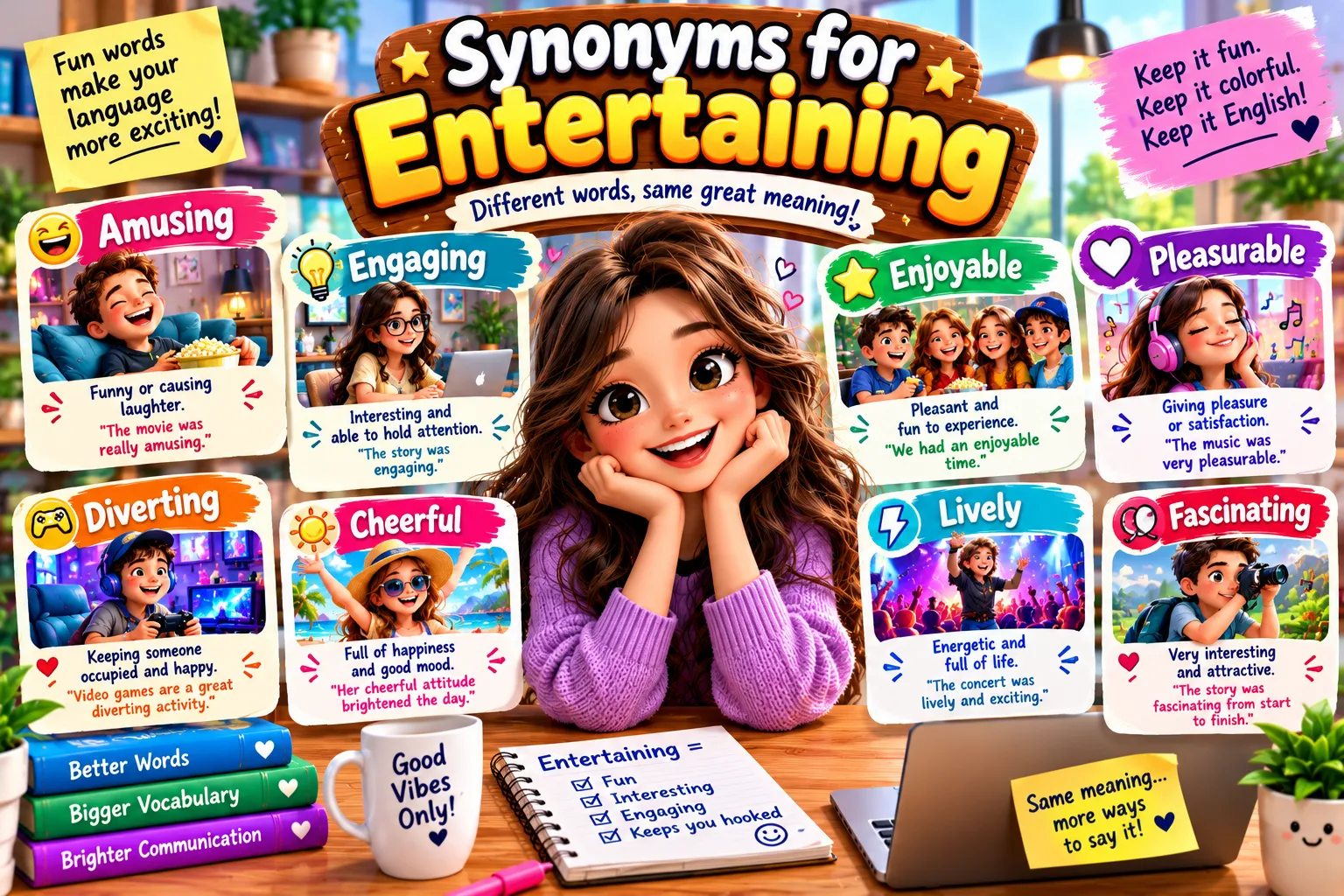
Synonyms for entertaining include amusing, enjoyable, funny, engaging, captivating, delightful, exciting, humorous, and fascinating. These words describe something that holds attention, creates enjoyment, or makes people laugh.
I have often noticed how a good movie, a funny story, or an engaging conversation can make people forget their worries for a while. These experiences show what entertaining means. The word describes something that gives pleasure, holds attention, or makes people feel amused. It is commonly used to talk about movies, books, games, events, people, and conversations.
Learning synonyms for entertaining helps English learners and content writers express ideas more clearly and avoid repeating the same word. For example, amusing describes something that makes people laugh, while captivating describes something that holds their attention.
In this guide, you will learn the meaning, examples, history, pronunciation, and 30 useful synonyms for entertaining. You will also discover how to choose the best word for different situations.
Meaning of Entertaining
Definition
Entertaining (adjective): Providing enjoyment, amusement, or interest.
Entertaining (verb form): The present participle of entertain, meaning to provide amusement or host guests.
Examples
- The movie was so entertaining that we watched it twice.
- Our teacher made the lesson entertaining with funny stories.
Connotative Meaning
Connotation (the feelings or ideas associated with a word) can vary by context.
- Positive tone: Enjoyable, amusing, exciting, or interesting.
- Negative tone: May suggest that something is merely amusing but lacks depth, especially in a serious context.
- Neutral tone: Describes something that provides interest or enjoyment without strong praise or criticism.
Etymology
The word entertaining comes from the verb entertain, which developed through French from Latin roots.
| Period | Word Origin | Meaning and Development |
| Old English (450–1100) | The modern word entertain was not yet in common English use. | English used other words to express ideas such as welcoming guests and providing enjoyment. |
| Middle English (1100–1500) | Entertain entered English through Anglo-French entretener, from Old French. | The word referred to keeping up, maintaining, or receiving someone hospitably. |
| Modern English (1500–Present) | Entertain developed meanings related to hosting, amusing, and engaging people. Entertaining became its -ing form. | Today, entertaining often describes something enjoyable, amusing, or interesting. |
Pronunciation (IPA)
- IPA: /ˌen.tərˈteɪ.nɪŋ/
- Syllables: en-ter-tain-ing
Affixation Pattern of Entertaining
- Root/base: Entertain
- Prefix: No productive prefix in the modern word.
- Suffix: -ing, which forms a present participle and can also form an adjective.
- Word formations:
- Entertain: verb
- Entertains: verb
- Entertained: verb or adjective
- Entertaining: verb form or adjective
- Entertainment: noun
- Entertainer: noun
- Entertainingly: adverb, meaning in an entertaining way
30 Synonyms of Entertaining With Meaning and Examples
1. Amusing (Adjective)
Meaning: Causing people to smile or laugh.
Examples:
- The comedian told an amusing story.
- I found his comments amusing.
2. Enjoyable (Adjective)
Meaning: Giving pleasure or making an experience pleasant.
Examples:
- We had an enjoyable evening together.
- The book was enjoyable from start to finish.
3. Funny (Adjective)
Meaning: Making people laugh or feel amused.
Examples:
- That was a funny movie.
- My brother shared a funny story at dinner.
4. Engaging (Adjective)
Meaning: Holding someone’s attention and interest.
Examples:
- The speaker gave an engaging presentation.
- Her engaging style made the lesson easy to follow.
5. Captivating (Adjective)
Meaning: Holding attention so strongly that it is hard to look away or stop listening.
Examples:
- The film had a captivating story.
- Everyone listened to his captivating speech.
6. Delightful (Adjective)
Meaning: Giving great pleasure or happiness.
Examples:
- We spent a delightful afternoon in the garden.
- The children put on a delightful show.
7. Exciting (Adjective)
Meaning: Creating strong interest, energy, or enthusiasm.
Examples:
- The final match was exciting.
- We watched an exciting adventure film.
8. Humorous (Adjective)
Meaning: Showing or expressing humor.
Examples:
- She wrote a humorous article about daily life.
- His humorous remarks made the meeting less tense.
9. Fascinating (Adjective)
Meaning: Extremely interesting and able to hold attention.
Examples:
- The documentary was fascinating.
- He told us a fascinating story about space.
10. Interesting (Adjective)
Meaning: Arousing curiosity or holding someone’s attention.
Examples:
- The book offers an interesting view of history.
- We had an interesting discussion in class.
11. Lively (Adjective)
Meaning: Full of energy, activity, or excitement.
Examples:
- The party had a lively atmosphere.
- Their lively conversation continued for hours.
12. Pleasurable (Adjective)
Meaning: Giving a sense of enjoyment or satisfaction.
Examples:
- Reading in the garden was a pleasurable experience.
- They enjoyed a pleasurable evening with friends.
13. Thrilling (Adjective)
Meaning: Causing strong excitement or suspense.
Examples:
- The thriller had a thrilling ending.
- It was a thrilling ride at the theme park.
14. Compelling (Adjective)
Meaning: So interesting or powerful that it holds attention.
Examples:
- The film tells a compelling story.
- She gave a compelling account of her experience.
15. Charming (Adjective)
Meaning: Pleasant or attractive in a way that makes people like it.
Examples:
- The host gave a charming welcome.
- We watched a charming family film.
16. Witty (Adjective)
Meaning: Using quick, clever humor.
Examples:
- Her witty comments made everyone laugh.
- The play is full of witty dialogue.
17. Hilarious (Adjective)
Meaning: Extremely funny.
Examples:
- The comedy show was hilarious.
- His hilarious imitation made us laugh loudly.
18. Entertaining (Adjective)
Meaning: Providing enjoyment, amusement, or interest.
Examples:
- The entertaining performance kept the audience engaged.
- She is an entertaining speaker.
19. Stimulating (Adjective)
Meaning: Encouraging interest, thought, or activity.
Examples:
- The class had a stimulating debate.
- It was a stimulating conversation about art.
20. Absorbing (Adjective)
Meaning: So interesting that it takes up all your attention.
Examples:
- I found the novel absorbing.
- The game was so absorbing that we lost track of time.
21. Riveting (Adjective)
Meaning: Extremely engaging and difficult to stop watching or listening to.
Examples:
- The documentary was riveting.
- She gave a riveting account of the journey.
22. Appealing (Adjective)
Meaning: Attractive or interesting to someone.
Examples:
- The show has an appealing mix of humor and music.
- The game is appealing to children and adults.
23. Refreshing (Adjective)
Meaning: Pleasantly different or new.
Examples:
- His refreshing sense of humor made the meeting enjoyable.
- The story offers a refreshing change from usual dramas.
24. Lighthearted (Adjective)
Meaning: Cheerful and not serious or troubling.
Examples:
- We watched a lighthearted romantic comedy.
- The host kept the conversation lighthearted.
25. Playful (Adjective)
Meaning: Full of fun, joking, or a desire to play.
Examples:
- The children enjoyed a playful game.
- Her playful remarks made everyone smile.
26. Colorful (Adjective)
Meaning: Full of vivid details, variety, or lively expression.
Examples:
- He shared a colorful account of his travels.
- The book uses colorful language to describe its characters.
27. Dramatic (Adjective)
Meaning: Full of striking events, emotion, or suspense.
Examples:
- The play had a dramatic ending.
- We watched a dramatic story about survival.
28. Whimsical (Adjective)
Meaning: Playfully unusual, imaginative, or fanciful.
Examples:
- The film features whimsical characters.
- The artist created a whimsical picture for the children.
29. Comical (Adjective)
Meaning: Funny in a way that makes people laugh.
Examples:
- His comical movements made the audience laugh.
- The play includes several comical scenes.
30. Pleasing (Adjective)
Meaning: Giving satisfaction or enjoyment.
Examples:
- The band delivered a pleasing performance.
- The story had a pleasing mix of humor and warmth.
Prototype Meaning
The typical meaning of entertaining is something that keeps people interested and gives them enjoyment. People often imagine a funny movie, an exciting show, a lively party, or a storyteller who holds an audience’s attention. However, entertaining does not always mean funny. A mystery can be entertaining because it creates suspense, while a documentary can be entertaining because it teaches something fascinating. The best synonym depends on the kind of enjoyment or interest being described.
Prototype Categorization
The 30 synonyms for entertaining fit into several semantic categories. This table helps writers choose the right word for each tone and purpose.
| Semantic Category | Synonyms | Best Used For |
| Humor and Laughter | Amusing, funny, humorous, witty, hilarious, comical | Jokes, comedy, and funny stories |
| Enjoyment and Pleasure | Enjoyable, delightful, pleasurable, pleasing, charming | Pleasant experiences and enjoyable activities |
| Interest and Attention | Engaging, captivating, fascinating, interesting, absorbing, riveting, compelling | Stories, videos, or activities that hold attention |
| Excitement and Suspense | Exciting, thrilling, dramatic | Action, adventure, and suspenseful events |
| Energy and Fun | Lively, lighthearted, playful, refreshing | Cheerful, relaxed, or energetic experiences |
| Imagination and Expression | Colorful, whimsical | Vivid storytelling, creative works, and imaginative styles |
| Thought and Curiosity | Stimulating, appealing | Content that sparks interest or attracts an audience |
Choosing a word from the right category makes your writing more precise. For example, hilarious is best when something makes people laugh, while riveting describes a story that holds attention from beginning to end.
makes people laugh, while riveting is better when a story holds attention from beginning to end.
Antonyms of Entertaining
These words describe things that fail to provide enjoyment or hold attention.
- Boring (adjective): Not interesting or enjoyable.
- Dull (adjective): Lacking excitement or interest.
- Tedious (adjective): Too long, repetitive, or tiring.
- Un amusing (adjective): Not funny or entertaining.
- Uninteresting (adjective): Failing to attract attention or curiosity.
- Monotonous (adjective): Repetitive and lacking variety.
- Mundane (adjective): Ordinary and lacking excitement.
- Tiresome (adjective): Causing boredom or annoyance.
- Dreary (adjective): Gloomy, dull, or depressing.
- Insipid (adjective): Lacking interest, excitement, or strong qualities.
Short Questions and Answers
What does entertaining mean?
Entertaining means providing enjoyment, amusement, or interest.
When should entertaining be used?
Use entertaining to describe movies, books, shows, conversations, people, events, or other things that hold attention or provide enjoyment.
Is entertaining positive or negative?
It is usually positive because it describes something enjoyable or interesting. Its tone can depend on context.
How is entertaining different from similar words?
Amusing focuses on humor, exciting suggests energy or suspense, engaging highlights attention, and captivating suggests a very strong hold on the audience.
Conclusion
Learning synonyms for entertaining helps you describe movies, books, people, and experiences with greater detail. Words such as amusing, captivating, hilarious, and thrilling each express a different kind of enjoyment.
Using the right word makes your writing clearer and helps you avoid repeating the same term. These synonyms are useful for English learners, students, bloggers, and content writers who want to express ideas naturally.
Try learning a few words each day and using them in your own sentences. With regular practice, you can improve your vocabulary, strengthen your speaking and writing skills, and feel more confident choosing the best word for every situation.
Read More:
Synonyms for Selective: 30 Powerful Alternatives to Know

I’m Falak Naaz, an SEO writer at SameSynonyms.com with 10 years of experience creating clear, engaging, and search-friendly English content. I specialize in synonyms, antonyms, vocabulary, and word usage. Through careful research and practical examples, I help readers choose the right words and improve their English with confidence.