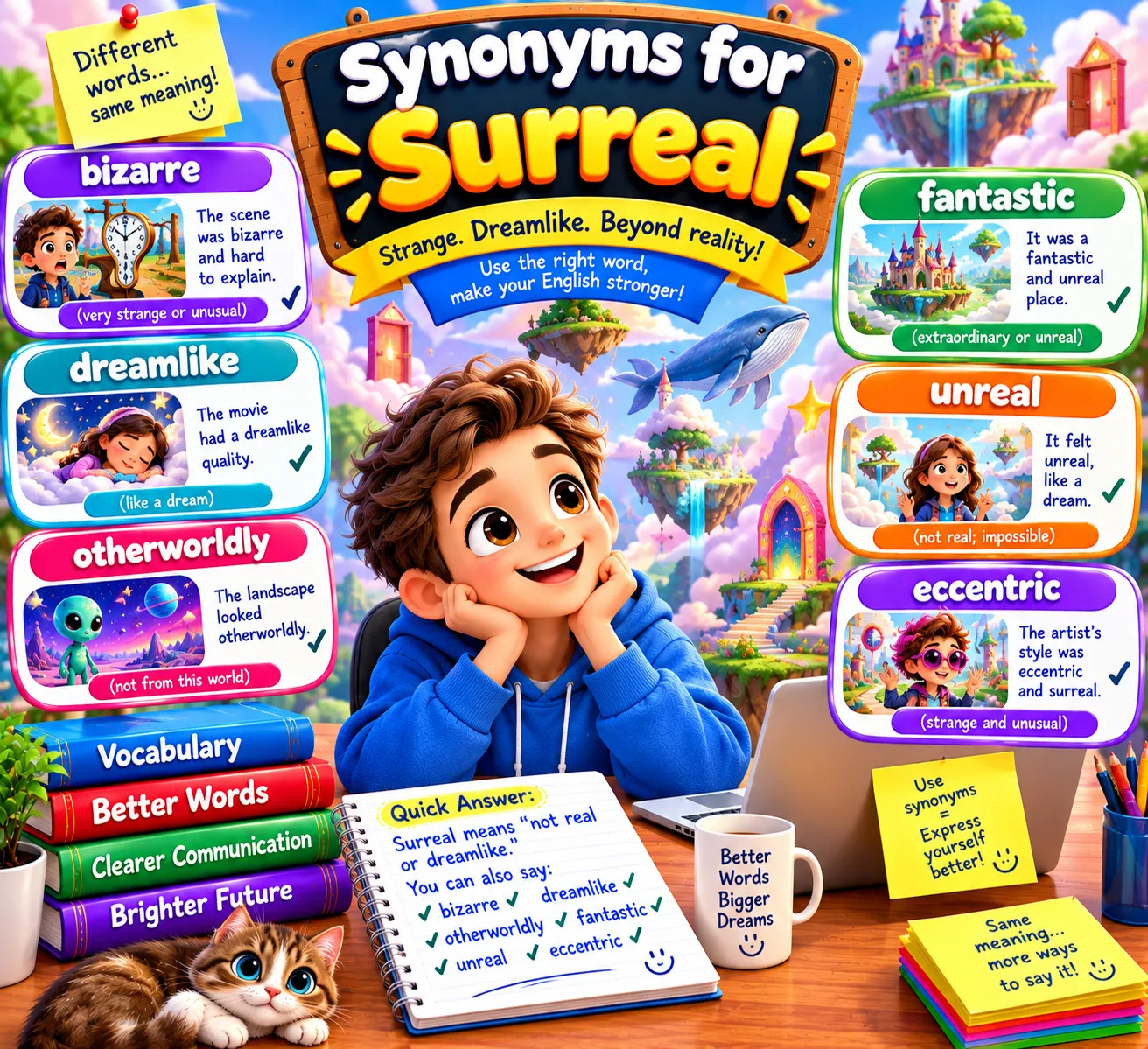
Synonyms for surreal include dreamlike, unreal, bizarre, strange, fantastical, otherworldly, and uncanny. These words describe things that seem like a dream, feel unusual, or appear far from normal reality.
I often use the word surreal to describe moments that feel too strange or amazing to be real. Imagine standing in front of a famous landmark you have only seen in pictures. The experience may feel like a dream.
That is when the word surreal fits well. People use it to describe unusual events, strange art, vivid dreams, and moments that are hard to believe. However, using the same word again and again can make writing less interesting.
Learning synonyms helps English learners and content writers express these feelings in fresh ways. In this guide, I will explain the meaning, history, pronunciation, and grammar of surreal. I will also share 30 related words with meanings, examples, and semantic categories to help you choose the right word.
Meaning of Surreal
Definition
Surreal (adjective): Something that seems dreamlike, strange, or unlike normal reality.
Examples
- The empty city looked surreal in the thick fog.
- Winning the award felt surreal to her.
Connotative Meaning
(Connotation means the feeling or idea a word suggests beyond its basic meaning.)
- Positive tone: Surreal can describe something magical, beautiful, or amazing.
- Negative tone: It can describe something disturbing, confusing, or unsettling.
- Neutral tone: It can simply describe an experience that feels unreal or dreamlike.
Etymology of Surreal
The word surreal comes from French surréel, meaning “above” or “beyond” the real. It became closely linked to Surrealism, an art and literary movement that explored dreams, imagination, and the unconscious mind.
| Historical Period | Development of “Surreal” |
| Old English (450–1100) | Surreal was not used in Old English. People used other words to describe strange or dreamlike things. |
| Middle English (1100–1500) | The word was not yet part of English vocabulary. Its roots developed from French elements that later helped form the word. |
| Modern English (1500–present) | Surreal entered English in the early 20th century through French influence. It describes dreamlike, bizarre, or unreal experiences and is linked to Surrealism. |
Pronunciation (IPA)
- IPA: /səˈriːəl/
- Syllables: sur-re-al (three syllables)
Affixation Pattern of Surreal
- Root: Real, relating to what exists or is true.
- Prefix: Sur-, from French, meaning “above” or “beyond.”
- Suffix: None in the word surreal.
Word Formations
- Surreal (adjective): Strange or dreamlike.
- Surreally (adverb): In a surreal way.
- Surrealness (noun): The quality of being surreal.
- Surrealism (noun): An art and literary movement that explores dreams and the unconscious.
- Surrealist (noun/adjective): An artist or writer connected with Surrealism, or something related to the movement.
- Surrealistic (adjective): Having the qualities of Surrealism or a dreamlike scene.
30 Synonyms of Surreal With Meanings and Examples
These words can describe dreamlike scenes, strange events, or experiences that feel far from normal life. Some are close synonyms, while others fit specific situations.
1. Dreamlike (Adjective)
Meaning: Like something seen in a dream.
Examples:
- The garden looked dreamlike in the moonlight.
- We walked through a dreamlike forest.
2. Unreal (Adjective)
Meaning: Seeming too strange or amazing to be real.
Examples:
- The view from the mountain was unreal.
- Winning the prize felt unreal to him.
3. Bizarre (Adjective)
Meaning: Very strange or unusual.
Examples:
- She told us a bizarre story.
- The building had a bizarre shape.
4. Strange (Adjective)
Meaning: Different from what is normal or expected.
Examples:
- A strange sound came from the attic.
- The whole situation felt strange.
5. Fantastical (Adjective)
Meaning: Full of imagination and unlike ordinary life.
Examples:
- The film showed a fantastical world.
- He painted fantastical creatures.
6. Otherworldly (Adjective)
Meaning: Seeming to belong to another world.
Examples:
- The blue light gave the cave an otherworldly look.
- Her voice sounded otherworldly in the empty hall.
7. Uncanny (Adjective)
Meaning: Strange in a way that feels mysterious or unsettling.
Examples:
- There was an uncanny silence in the house.
- The painting had an uncanny likeness to her.
8. Dreamy (Adjective)
Meaning: Soft, pleasant, or like a dream.
Examples:
- The beach looked dreamy at sunset.
- She loved the dreamy colors in the painting.
9. Surprising (Adjective)
Meaning: Unexpected or causing wonder.
Examples:
- The sudden snowfall was surprising.
- His quick success was surprising to everyone.
10. Extraordinary (Adjective)
Meaning: Very unusual or beyond what is normal.
Examples:
- They saw an extraordinary light in the sky.
- It was an extraordinary moment in her life.
11. Fantastic (Adjective)
Meaning: Extremely good, impressive, or imaginative.
Examples:
- The show created a fantastic world.
- It felt fantastic to see the ocean for the first time.
12. Improbable (Adjective)
Meaning: Unlikely to happen or be true.
Examples:
- The story had an improbable ending.
- It seemed improbable that we met in another country.
13. Absurd (Adjective)
Meaning: So unreasonable or strange that it seems silly.
Examples:
- The play had an absurd plot.
- It seemed absurd to see snow in the desert.
14. Peculiar (Adjective)
Meaning: Unusual or different from what is expected.
Examples:
- A peculiar smell filled the room.
- He noticed a peculiar pattern in the clouds.
15. Eerie (Adjective)
Meaning: Strange and frightening in a quiet or mysterious way.
Examples:
- The abandoned house looked eerie.
- An eerie mist covered the road.
16. Mystical (Adjective)
Meaning: Related to mystery, spiritual ideas, or hidden forces.
Examples:
- The forest had a mystical beauty.
- The story described a mystical land.
17. Magical (Adjective)
Meaning: Seeming to have magic or special wonder.
Examples:
- The snowy village looked magical.
- Watching the stars felt like a magical experience.
18. Hallucinatory (Adjective)
Meaning: Like something seen or felt during a hallucination.
Examples:
- The bright colors gave the artwork a hallucinatory quality.
- The fever made the room seem hallucinatory.
19. Phantasmagorical (Adjective)
Meaning: Featuring strange, changing, or dreamlike images.
Examples:
- The film showed a phantasmagorical city.
- The stage filled with phantasmagorical shapes.
20. Illusory (Adjective)
Meaning: Appearing real but not actually real.
Examples:
- The lake’s reflection created an illusory path.
- Their sense of safety proved illusory.
21. Enigmatic (Adjective)
Meaning: Mysterious and hard to understand.
Examples:
- An enigmatic smile appeared on her face.
- The strange message remained enigmatic.
22. Surprising (Adjective)
Meaning: Causing wonder because something was not expected.
Examples:
- The sudden meeting was surprising.
- It was surprising to see the streets completely empty.
23. Unbelievable (Adjective)
Meaning: So unusual that it is hard to believe.
Examples:
- The sunset looked unbelievable.
- Their story sounded unbelievable at first.
24. Imaginative (Adjective)
Meaning: Showing creativity or a strong use of imagination.
Examples:
- The artist created an imaginative landscape.
- The book takes readers on an imaginative journey.
25. Abstract (Adjective)
Meaning: Not showing things in a clear or realistic way.
Examples:
- The gallery displayed abstract paintings.
- The shapes formed an abstract design.
26. Unnatural (Adjective)
Meaning: Different from what is normal or found in nature.
Examples:
- An unnatural glow came from the window.
- The silence felt unnatural for such a busy place.
27. Astonishing (Adjective)
Meaning: So surprising that it causes great wonder.
Examples:
- The view was astonishing.
- It was an astonishing turn of events.
28. Mind bending (Adjective)
Meaning: So strange or complex that it is hard to understand.
Examples:
- The film had a mind-bending ending.
- The puzzle presented a mind-bending challenge.
29. Dreamy looking (Adjective)
Meaning: Having a soft, beautiful, or dreamlike appearance.
Examples:
- The dreamy-looking clouds filled the sky.
- The photographer captured a dreamy-looking scene.
30. Unfamiliar (Adjective)
Meaning: Not known or recognized, often making something feel strange.
Examples:
- The unfamiliar streets made the city feel unreal.
- The room had an unfamiliar design.
Note: Not every word above means exactly the same as surreal. For example, eerie suggests fear, magical suggests wonder, and abstract describes a style that may not represent reality directly. Choose the word that best matches your intended meaning.
Prototype Meaning of Surreal
The most typical meaning of surreal is something that feels like a dream rather than ordinary reality. People may imagine a strange landscape, an unexpected life event, or a moment so amazing that it seems impossible. For example, seeing snow fall in a hot desert might feel surreal. The word can express beauty, wonder, confusion, or unease. Its exact feeling depends on the situation.
Prototype Categorization of Surreal
Grouping synonyms by meaning helps you choose the best word for each situation.
| Semantic Category | Synonyms | Best Use |
| Dreamlike Experiences | Dreamlike, dreamy, dreamy-looking, unreal | Describe scenes or moments that feel like dreams. |
| Strange and Unusual Things | Bizarre, strange, peculiar, unnatural, unfamiliar | Describe things that differ from normal life. |
| Mysterious or Unsettling Experiences | Uncanny, eerie, enigmatic, mystical | Describe things that feel mysterious, eerie, or hard to explain. |
| Imaginative and Fantasy Worlds | Fantastical, fantastic, otherworldly, magical, imaginative | Describe creative, beautiful, or fantasy-like scenes. |
| Hard-to-Believe Events | Improbable, unbelievable, surprising, astonishing, extraordinary | Describe events that seem unlikely or amazing. |
| Illusions and Unusual Perceptions | Hallucinatory, illusory, phantasmagorical, mind-bending | Describe confusing images or experiences that challenge normal perception. |
| Art and Creative Expression | Abstract | Describe art or designs that do not show things in a realistic way. |
| Strange or Irrational Situations | Absurd | Describe situations that seem unreasonable or make little sense. |
This grouping helps writers express the exact feeling they want. Use dreamlike for a scene that feels like a dream, eerie for something frightening, magical for something wonderful, and bizarre for something very strange.
Antonyms of Surreal
The best antonym depends on the context.
- Real (Adjective): Existing in fact, not imagined. Example: “The danger was real.”
- Realistic (Adjective): Showing things as they are in real life. Example: “The film used realistic settings.”
- Ordinary (Adjective): Normal and not unusual. Example: “It was an ordinary day.”
- Normal (Adjective): Following what is usual or expected. Example: “Everything seemed normal again.”
- Practical (Adjective): Based on real needs and facts rather than imagination. Example: “We need a practical solution.”
- Believable (Adjective): Easy to accept as true. Example: “The story had a believable ending.”
- Grounded (Adjective): Sensible and connected to real life. Example: “Her ideas were grounded in facts.”
- Familiar (Adjective): Known from past experience. Example: “The familiar street made him feel at home.”
Short Questions and Answers
What does surreal mean?
Surreal means dreamlike, strange, or unlike normal reality. It often describes experiences that are hard to believe.
When should surreal be used?
Use surreal when a moment, scene, image, or event feels unreal, dreamlike, or unusually strange.
Is surreal positive or negative?
It can be either. A surreal experience may feel beautiful and magical, or strange and unsettling. The context determines its tone.
How is surreal different from similar words?
Dreamlike suggests a dream, bizarre means very strange, and eerie suggests fear or unease. Surreal is broader and often describes something that seems outside ordinary reality.
Conclusion
Learning surreal and its synonyms helps you describe unusual moments with greater detail and confidence. Words such as dreamlike, bizarre, otherworldly, and uncanny each express a different feeling.
Some suggest beauty and wonder, while others describe fear, mystery, or confusion. Choosing the right word makes your writing more vivid and helps you avoid repetition. It also gives you more ways to share your thoughts in everyday conversations, schoolwork, and creative writing. Try to learn a few new words each day and use them in your own sentences.
With regular practice, you can build a stronger vocabulary, improve your speaking and writing, and express your ideas in clear and natural English.
Read More:
Synonyms for Lay: 30 Words and Their Meanings

I’m Rubab, a content specialist at SameSynonym, focused on synonyms, antonyms, word meanings, and English vocabulary.
I create clear, well-researched content with accurate definitions and practical examples.
My goal is to help readers improve their vocabulary and writing with confidence.










