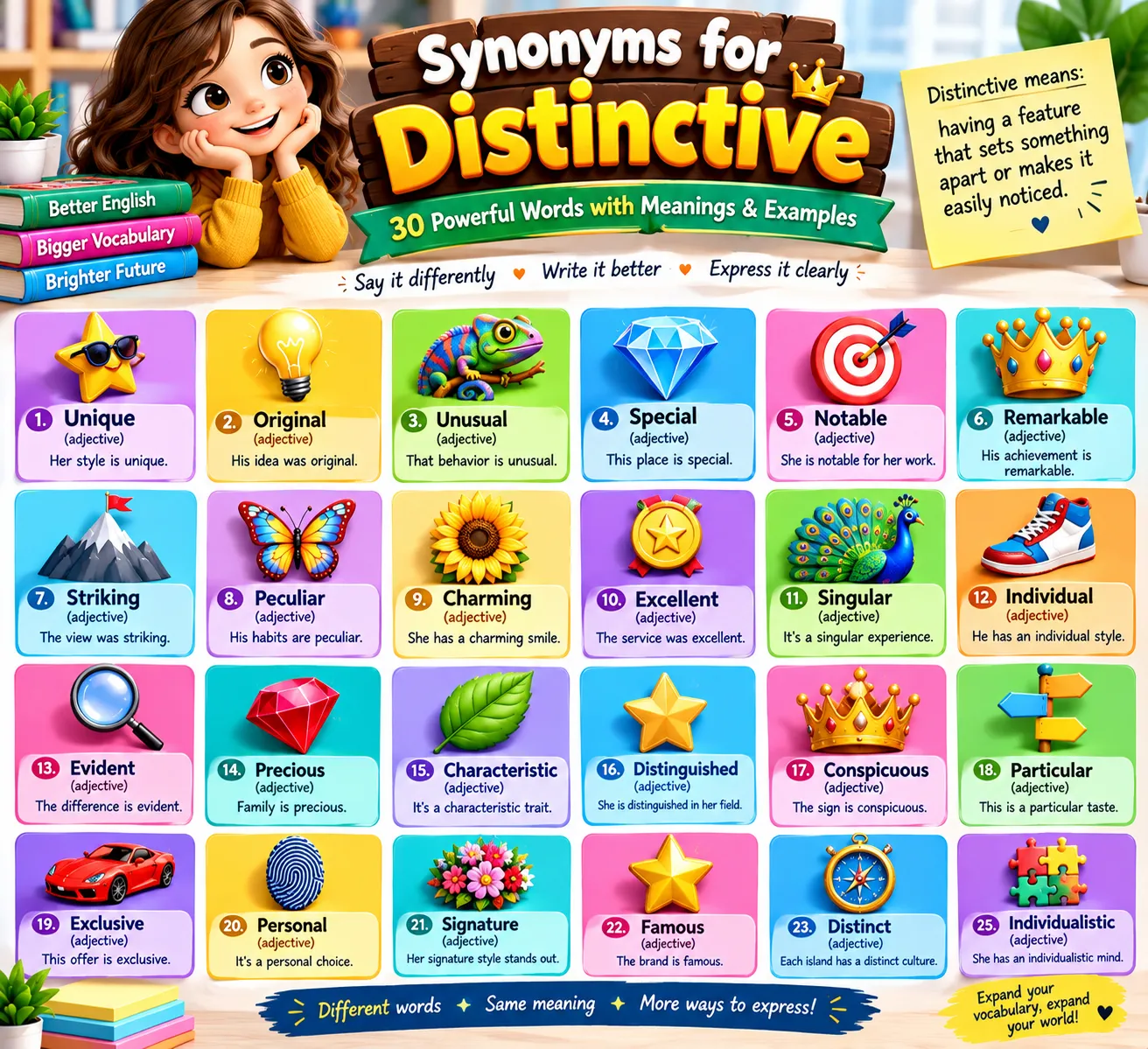
Distinctive means having a special quality that makes someone or something easy to recognize. Synonyms include unique, unusual, recognizable, striking, remarkable, and characteristic.
Distinctive means having a special quality that makes someone or something easy to recognize. For example, a bright red door can make a house stand out from others on the street. Its color gives it a distinctive look. We use this word when we talk about people, styles, voices, designs, and ideas that are different from the rest.
Learning synonyms for distinctive helps you express ideas in clear and interesting ways. It also helps you avoid using the same word again and again. English learners, students, bloggers, and content writers can use these words to improve their writing and speaking skills.
In this guide, you will learn the meaning of distinctive, its pronunciation, word origin, and grammar. You will also discover 30 synonyms with simple meanings and examples, along with antonyms and useful tips for choosing the right word.
Meaning of Distinctive
Definition
Distinctive (Adjective): Having a special feature or quality that makes someone or something easy to recognize.
Examples
- Her distinctive voice made her easy to recognize.
- The artist has a distinctive style of painting.
Connotative Meaning
Connotation means the feeling or idea a word suggests beyond its basic meaning.
- Positive tone: Unique, impressive, memorable, or attractive.
- Negative tone: Unusual or odd in a way that some people may dislike.
- Neutral tone: Clearly different from other people or things.
Etymology of Distinctive
| Period | Time | History and Development |
| Old English | 450–1100 | The word distinctive was not commonly used. English used other words to express difference. |
| Middle English | 1100–1500 | French and Latin influenced English vocabulary, including words related to distinction and difference. |
| Modern English | 1500–present | Distinctive developed into an adjective meaning having a feature that sets something apart. |
- Origin: The word distinctive comes from the Latin distinguere, meaning “to separate” or “to distinguish.” It entered English through French and developed from distinct.
Pronunciation (IPA)
- IPA: /dɪˈstɪŋktɪv/
- Syllables: dis-tinc-tive
- Part of speech: Adjective
Affixation Pattern of Distinctive
- Root: Distinct: separate or clearly different.
- Prefix: No prefix in the modern word.
- Suffix: -ive forms adjectives that describe a quality or tendency.
Word Formations
- Distinct (adjective): clearly different.
- Distinction (noun): a difference or special quality.
- Distinguish (verb): to recognize or identify differences.
- Distinctly (adverb): clearly or noticeably.
- Distinctiveness (noun): the quality of being distinctive.
- Indistinct (adjective): not clear or easy to recognize.
30 Synonyms of Distinctive With Meaning and Examples
The following words have meanings close to distinctive, but each has its own shade of meaning. Choose the word that best fits your sentence.
1. Unique (Adjective)
Meaning: Being the only one of its kind or very different from others.
Examples:
- She has a unique way of telling stories.
- The shop sells unique handmade gifts.
2. Distinct (Adjective)
Meaning: Clearly different or easy to recognize.
Examples:
- There is a distinct smell of fresh bread.
- The two designs have distinct features.
3. Special (Adjective)
Meaning: Different from usual or important in some way.
Examples:
- This necklace has a special design.
- She has a special talent for music.
4. Unusual (Adjective)
Meaning: Not common or not what people expect.
Examples:
- He has an unusual fashion sense.
- We heard an unusual sound outside.
5. Characteristic (Adjective)
Meaning: Typical of a person, place, or thing.
Examples:
- Her characteristic smile brightened the room.
- The bird has a characteristic call.
6. Recognizable (Adjective)
Meaning: Easy to know or identify.
Examples:
- His handwriting is instantly recognizable.
- The building is recognizable by its tall tower.
7. Identifiable (Adjective)
Meaning: Able to be recognized or identified.
Examples:
- The logo is easily identifiable.
- Each product has an identifiable design.
8. Notable (Adjective)
Meaning: Worth noticing because it is important or unusual.
Examples:
- The writer has a notable style.
- Her work shows notable creativity.
9. Remarkable (Adjective)
Meaning: Unusual or impressive enough to attract attention.
Examples:
- He has a remarkable singing voice.
- The artist created a remarkable design.
10. Exceptional (Adjective)
Meaning: Much better or different from what is usual.
Examples:
- She has exceptional artistic skill.
- The hotel is known for its exceptional service.
11. Original (Adjective)
Meaning: New, creative, or not copied from others.
Examples:
- His original ideas impressed the team.
- She wore an original dress design.
12. Individual (Adjective)
Meaning: Belonging to one person or thing rather than a group.
Examples:
- Each student has an individual learning style.
- The artist developed an individual approach.
13. Uncommon (Adjective)
Meaning: Not seen or found very often.
Examples:
- The flower has an uncommon color.
- He owns an uncommon collection of coins.
14. Peculiar (Adjective)
Meaning: Different from what is normal, sometimes in a strange way.
Examples:
- The machine makes a peculiar noise.
- She noticed a peculiar pattern on the wall.
15. Striking (Adjective)
Meaning: Very noticeable because of its appearance or effect.
Examples:
- She has striking blue eyes.
- The building has a striking modern design.
16. Memorable (Adjective)
Meaning: Easy to remember because it is special or interesting.
Examples:
- The singer gave a memorable performance.
- His distinctive style made the event memorable.
17. Signature (Adjective)
Meaning: Closely associated with a particular person or brand.
Examples:
- Red glasses are her signature look.
- The chef is famous for his signature dish.
18. Defining (Adjective)
Meaning: Showing the main quality that identifies someone or something.
Examples:
- Creativity is her defining quality.
- The building’s tall roof is its defining feature.
19. Hallmark (Noun)
Meaning: A typical sign or feature of a person, group, or thing.
Examples:
- Kindness is a hallmark of her character.
- Bold colors are a hallmark of the brand.
20. Characteristic (Noun)
Meaning: A feature or quality that belongs to someone or something.
Examples:
- Patience is an important characteristic of a good teacher.
- The bird’s call is a key characteristic of the species.
21. Signature (Noun)
Meaning: A special feature or style strongly linked to someone or something.
Examples:
- Bright colors are the artist’s signature.
- The brand’s curved logo became its signature.
22. Standout (Adjective)
Meaning: Much better or more noticeable than others.
Examples:
- She gave a standout performance.
- The standout feature is the large glass roof.
23. Prominent (Adjective)
Meaning: Easily noticed or important.
Examples:
- The store has a prominent sign.
- His prominent role made him well known.
24. Evident (Adjective)
Meaning: Clear and easy to see or understand.
Examples:
- Her talent was evident from the start.
- A distinctive pattern was evident on the fabric.
25. Specific (Adjective)
Meaning: Clearly defined or related to one particular thing.
Examples:
- The design has a specific shape.
- Each bird makes a specific sound.
26. Specially Marked (Adjective Phrase)
Meaning: Given a clear sign or feature to set it apart.
Examples:
- The specially marked boxes contain fragile items.
- We followed the specially marked path.
27. Differentiated (Adjective)
Meaning: Made or shown to be different from others.
Examples:
- The company offers a differentiated service.
- The products have differentiated features.
28. Singular (Adjective)
Meaning: Unusual or special in a way that sets something apart.
Examples:
- She has a singular talent for design.
- His singular style attracted many fans.
29. Inimitable (Adjective)
Meaning: So special that it is hard or impossible to copy.
Examples:
- The comedian has an inimitable style.
- Her inimitable voice made the song memorable.
30. Iconic (Adjective)
Meaning: Widely recognized and strongly linked to a person, place, or thing.
Examples:
- The brand is known for its iconic logo.
- The singer’s iconic look inspired many fans.
Usage note: These words are related to distinctive, but they are not interchangeable in every sentence. For example, unique suggests one of a kind, while recognizable focuses on being easy to identify.
Prototype Meaning of Distinctive
The prototype meaning of distinctive is having a clear feature that makes something stand apart from similar things. People often imagine a special voice, a recognizable logo, a bold fashion style, or an unusual design. The key idea is that one quality makes the person or thing easy to notice or identify.
Prototype Categorization of Distinctive Synonyms
Grouping synonyms by meaning helps you choose a word that fits your message.
- Uniqueness: unique, original, individual, singular. Use these when something feels one of a kind.
- Clear difference: distinct, specific, differentiated, identifiable. Use these to explain how things differ.
- Recognition: recognizable, characteristic, signature, hallmark. Use these for identifying features or familiar styles.
- Attention and impact: striking, remarkable, notable, prominent, standout, iconic. Use these when something attracts notice.
- Unusual qualities: unusual, uncommon, peculiar, exceptional. Use these when something differs from the norm.
- Memory and identity: memorable, defining, signature. Use these for qualities linked to a person or experience.
- Clarity and evidence: evident. Use this when a feature or quality is easy to see or understand.
- Hard to copy: inimitable. Use this for a style or quality that is difficult to reproduce.
- Specific features: specially marked, characteristic (noun), signature (noun), differentiated. Use these when describing signs, traits, or product features.
These categories help writers select precise words instead of replacing distinctive with a synonym that does not match the context.
- Antonyms of Distinctive
- Antonyms are words with opposite or contrasting meanings.
| Antonym | Part of Speech | Meaning |
| Ordinary | Adjective | Normal and not special. |
| Common | Adjective | Found often or shared by many. |
| Typical | Adjective | Usual for a person, group, or thing. |
| Generic | Adjective | Not special or linked to one identity. |
| Similar | Adjective | Almost the same as something else. |
| Ordinary-looking | Adjective | Having no special or noticeable appearance. |
| Unremarkable | Adjective | Not interesting or worth special attention. |
| Indistinct | Adjective | Not clear or easy to recognize. |
| Unoriginal | Adjective | Not new or creative. |
| Anonymous | Adjective | Not identified by name or individual features. |
Short Questions and Answers
What does distinctive mean?
Distinctive means having a special feature that makes someone or something easy to recognize.
When should distinctive be used?
Use distinctive when describing a feature, style, voice, appearance, or quality that sets someone or something apart.
Is distinctive positive or negative?
It is often positive when it means special or memorable. However, it can be neutral or negative depending on the feature and context.
How is distinctive different from similar words?
Distinctive focuses on what sets something apart. Unique suggests being one of a kind, recognizable means easy to identify, and striking means attracting strong attention.
Conclusion
Learning distinctive and its synonyms can help you build a stronger English vocabulary. Words such as unique, recognizable, striking, and inimitable let you describe people, objects, ideas, and styles with greater care. Each word has a slightly different meaning, so choosing the right one can make your writing clearer and more engaging.
Using synonyms also helps you avoid repetition in essays, blog posts, emails, and daily conversations. For the best results, learn a few new words each day and write your own sentences with them. Pay attention to how each word is used in real life. With regular practice, you can improve your writing, speak with more confidence, and express your ideas in a more natural way.
Read More:
Synonyms for Propel: 30 Strong Words to Use Instead

I’m Falak Naaz, an SEO writer at SameSynonyms.com with 10 years of experience creating clear, engaging, and search-friendly English content. I specialize in synonyms, antonyms, vocabulary, and word usage. Through careful research and practical examples, I help readers choose the right words and improve their English with confidence.