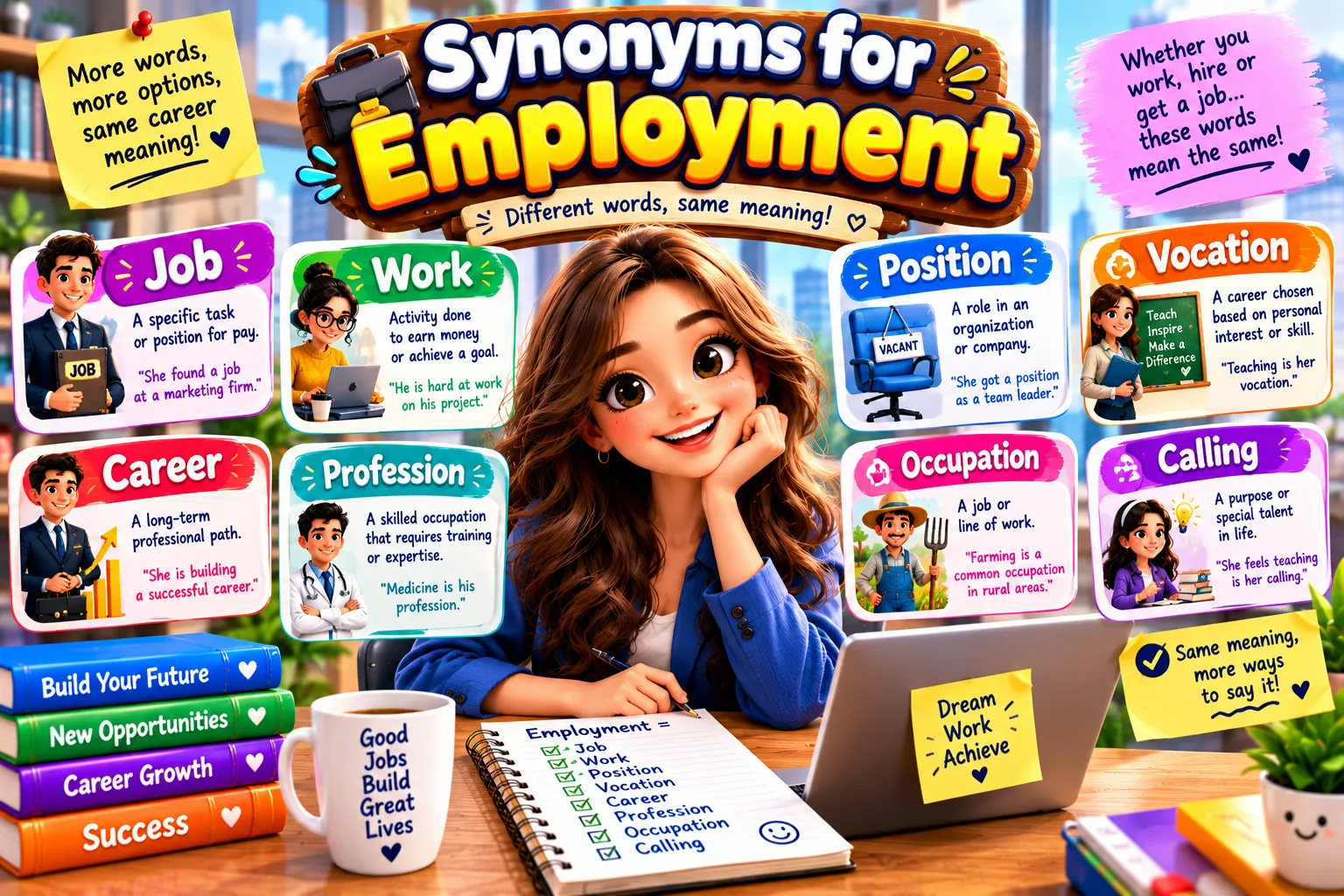
Synonyms for employment include work, job, occupation, profession, career, position, and livelihood. The best choice depends on whether you mean paid work, a specific role, or a long-term career.
I have often seen people use the word employment when talking about finding a job, earning money, or building a career. For example, a person may look for employment after finishing school, while another may seek new employment to improve their future. Although these uses are common, other words can express the same idea more clearly.
Learning synonyms for employment helps English learners grow their vocabulary and helps writers avoid repeating the same word. Words such as job, occupation, and profession are related, but each has a slightly different meaning. Choosing the right one makes your writing clearer and more natural.
In this guide, I will explain the meaning, history, pronunciation, and grammar of employment. You will also learn 30 useful synonyms with simple meanings and examples, explore semantic categories, and discover antonyms to improve your English writing and speaking.
Meaning of Employment
Definition
Employment (noun): The state of having paid work, or the act of giving someone a job.
Examples
- She found employment at a local school.
- The company provides employment for hundreds of people.
Connotative Meaning
(Connotation means the feelings or ideas a word suggests beyond its basic meaning.)
- Positive tone: Employment can suggest financial security, independence, stability, and personal growth.
- Negative tone: It may suggest stress, job insecurity, or difficult working conditions in some contexts.
- Neutral tone: It can simply refer to having a paid job or the state of being employed.
Etymology of Employment
The word employment developed from the verb employ, which entered English through French and ultimately comes from Latin.
| Period | Development | Meaning or Context |
| Old English (450–1100) | The modern word employment was not yet in use. | People used other words to describe work, labor, and service. |
| Middle English (1100–1500) | Employ entered English through Anglo-French and Old French forms linked to Latin implicāre. | The word developed the sense of using or engaging someone or something. |
| Modern English (1500–present) | Employment developed from employ with the suffix -ment. | It came to refer to paid work, the state of being employed, and the act of hiring workers. |
Pronunciation (IPA)
- IPA: /ɪmˈplɔɪ.mənt/
- Syllables: em-ploy-ment
- Part of speech: Noun
Affixation Pattern of Employment
- Root/base: employ
- Prefix: None in the modern word employment.
- Suffix: -ment, which forms a noun expressing an action, process, or result.
Word Formations
- Employ (verb): To give someone a job or use something for a purpose.
- Employment (noun): The state of having a job or the act of hiring someone.
- Employee (noun): A person who works for an employer.
- Employer (noun): A person or organization that hires workers.
- Employable (adjective): Having the skills or qualities needed to get a job.
- Employability (noun): The ability or potential to gain and keep employment.
- Unemployed (adjective): Without a job but generally seeking work.
- Unemployment (noun): The state of being without a job, especially while seeking work.
- Employing (verb form): Giving someone a job or using something.
- Employed (adjective/verb form): Having a job or having hired someone, depending on context.
30 Synonyms of Employment With Meanings and Examples
Not all these words are exact replacements for employment. Some refer to a specific job, some describe a type of work, and others refer to a person’s working life or source of income.
1. Job (Noun)
Meaning: A paid role or task that someone does for an employer.
Examples:
- I got a new job at a bank.
- She enjoys her job as a teacher.
2. Work (Noun)
Meaning: An activity done to earn money or achieve a goal.
Examples:
- He found work in a nearby town.
- I have a lot of work to finish today.
3. Occupation (Noun)
Meaning: A person’s regular job or main type of work.
Examples:
- Teaching is her occupation.
- Please write your occupation on the form.
4. Profession (Noun)
Meaning: A type of work that usually requires special education, training, or skills.
Examples:
- Medicine is a respected profession.
- He chose law as his profession.
5. Career (Noun)
Meaning: The work a person does over many years, often with chances to grow and advance.
Examples:
- She wants a career in science.
- His career began in a small office.
6. Position (Noun)
Meaning: A specific job or role within an organization.
Examples:
- He applied for a position at the company.
- The position requires strong communication skills.
7. Post (Noun)
Meaning: An official job or role, often in an organization or public service.
Examples:
- She accepted a post at the university.
- He held a senior post in the department.
8. Appointment (Noun)
Meaning: An official selection for a particular job or role.
Examples:
- Her appointment as manager was announced yesterday.
- He received an appointment at the hospital.
9. Engagement (Noun)
Meaning: An arrangement to work for someone or take part in a paid activity.
Examples:
- The singer accepted a short engagement.
- He began a temporary engagement with the firm.
10. Service (Noun)
Meaning: Work done for an organization, employer, or the public.
Examples:
- She spent twenty years in public service.
- His service to the company was highly valued.
11. Labor (Noun)
Meaning: Physical or mental effort used to do work.
Examples:
- The project required skilled labor.
- The factory depends on local labor.
12. Vocation (Noun)
Meaning: A type of work that someone feels strongly suited to or called to do.
Examples:
- She sees nursing as her vocation.
- Teaching became his vocation.
13. Trade (Noun)
Meaning: A skilled job, often involving practical or manual work.
Examples:
- He learned the trade of plumbing.
- Many young people train for a skilled trade.
14. Calling (Noun)
Meaning: Work that a person feels is especially meaningful or suited to them.
Examples:
- She believes helping others is her calling.
- He found his calling in education.
15. Livelihood (Noun)
Meaning: The work or income that allows someone to support themselves.
Examples:
- Farming provides their livelihood.
- He earns his livelihood by repairing cars.
16. Career Path (Noun)
Meaning: The sequence of jobs or steps someone follows during a working life.
Examples:
- She chose a career path in technology.
- Training can help you plan your career path.
17. Work Opportunity (Noun)
Meaning: A chance to get a job or earn money through work.
Examples:
- The new factory created work opportunities.
- He moved to the city for better work opportunities.
18. Placement (Noun)
Meaning: A job or work assignment arranged for someone, often through an agency or training program.
Examples:
- The college helped her find a work placement.
- He received a placement at a local company.
19. Assignment (Noun)
Meaning: A specific task or period of work given to someone.
Examples:
- She accepted a six-month assignment abroad.
- His assignment involved training new staff.
20. Work Placement (Noun)
Meaning: A period of practical work experience, often linked to education or training.
Examples:
- The student completed a work placement at a clinic.
- Her work placement helped her gain useful skills.
21. Appointment to a Role (Noun Phrase)
Meaning: The act of officially giving someone a particular job or responsibility.
Examples:
- His appointment to the role took effect in June.
- Her appointment to the leadership role surprised no one.
22. Work Arrangement (Noun)
Meaning: An agreement about how, where, or when someone works.
Examples:
- They agreed on a flexible work arrangement.
- The new work arrangement allows staff to work remotely.
23. Contract Work (Noun)
Meaning: Work done under a contract, often for a set period or project.
Examples:
- He does contract work for several businesses.
- Contract work gave her experience in different fields.
24. Freelancing (Noun)
Meaning: Working independently for different clients rather than as a permanent employee.
Examples:
- Freelancing allows her to choose her projects.
- He started freelancing after leaving his office job.
25. Workmanship (Noun)
Meaning: The skill and quality shown in someone’s work; it is related to work, but is not a direct synonym for employment.
Examples:
- The furniture shows excellent workmanship.
- The client praised the quality of his workmanship.
26. Occupancy (Noun)
Meaning: The state of occupying a position, office, or role; it is only a contextual alternative to employment.
Examples:
- Her occupancy of the post lasted five years.
- The role remained vacant after his occupancy ended.
27. Tenure (Noun)
Meaning: The period during which someone holds a job or position.
Examples:
- Her tenure as director lasted six years.
- During his tenure, the team expanded.
28. Workload (Noun)
Meaning: The amount of work assigned to or expected from someone; related to employment, but not a synonym for having a job.
Examples:
- Her workload increased during the busy season.
- The manager divided the workload fairly.
29. Staffing (Noun)
Meaning: The process of providing an organization with enough workers.
Examples:
- The hospital is reviewing its staffing needs.
- Better staffing helped the store serve customers faster.
30. Hiring (Noun)
Meaning: The process of recruiting or taking on workers for jobs.
Examples:
- The company is hiring new staff this month.
- Hiring slowed during the economic downturn.
Prototype Meaning of Employment
The most common meaning of employment is having paid work or being hired by a person or organization. When people hear this word, they often think of a job, a salary, an employer, and the duties a worker performs. Employment can also refer to the act of hiring people. Its exact meaning depends on the sentence: She is seeking employment means she is looking for a job, while The company provides employment means it gives people work.
Prototype Categorization
The 30 related words fit into several semantic categories. These groups help writers choose the best term for the meaning they want to express.
| Semantic Category | Synonyms and Related Terms | Best Used For |
| General Work | Job, work, labor | Talking about work or paid tasks in everyday situations |
| Occupation and Career | Occupation, profession, career, career path, vocation, calling, trade | Describing a person’s field, skills, or long-term working life |
| Official Roles | Position, post, appointment, engagement, service, appointment to a role | Referring to a specific role or formal work arrangement |
| Income and Opportunities | Livelihood, work opportunity | Explaining how people earn money or find work |
| Work Experience and Tasks | Placement, assignment, work placement, work arrangement | Describing practical experience, assigned duties, or work conditions |
| Types of Work | Contract work, freelancing | Explaining independent or contract-based work |
| Time in a Role | Tenure, occupancy | Describing how long someone holds a position |
| Hiring and Workforce Management | Hiring, staffing | Discussing recruitment and the process of providing workers |
| Work Quality and Demands | Workmanship, workload | Describing the quality of work or the amount of work expected |
Choosing the right word improves clarity. For example, job is a simple everyday alternative, profession often refers to skilled work, and career describes a person’s broader working life. Words such as hiring and staffing relate to employment but focus on recruitment rather than the state of having a job.
Antonyms of Employment
Employment has no single opposite in every context. These words express the absence of work or related negative conditions.
- Unemployment (noun): The state of being without a job while seeking work. Unemployment rose in the region.
- Joblessness (noun): The state of having no job. Joblessness affected many families.
- Unemployment status (noun phrase): The condition of not currently having a job. He reported his unemployment status to the agency.
- Inactivity (noun): A lack of work or action. The business faced a period of inactivity.
- Idleness (noun): A state of not working or doing anything useful. The long period of idleness frustrated him.
- Dismissal (noun): The act of removing someone from a job. Her dismissal came as a surprise.
- Termination (noun): The ending of a job or employment agreement. The termination of his contract was confirmed in writing.
- Resignation (noun): The act of voluntarily leaving a job. She submitted her resignation on Monday.
- Layoff (noun): The loss of a job because an employer reduces staff or work. The factory announced a temporary layoff.
- Retirement (noun): The act of leaving working life, usually after reaching a certain age or meeting other conditions. He plans to enjoy retirement next year.
Short Questions and Answers
1. What does employment mean?
Employment means having paid work or the act of hiring someone to do a job.
2. When should employment be used?
Use employment in formal writing, job searches, business discussions, and conversations about work status. For casual speech, job or work may sound more natural.
3. Is employment positive or negative?
Employment is usually neutral, but it often has a positive association with income, stability, and independence. Its emotional tone depends on the context.
4. How is employment different from similar words?
Employment refers to the state of having paid work or the act of hiring. A job is a specific role, an occupation is a person’s regular type of work, and a career is the broader path of work over time.
Conclusion
I have explained 30 synonyms and related terms for employment, along with their meanings, examples, categories, and antonyms. Learning these words can help you express ideas about jobs, careers, income, and professional life more clearly. It can also improve your speaking and writing by helping you avoid repeating the same word in every sentence.
Remember that not every alternative has exactly the same meaning. Use job for a specific role, profession for a skilled field, career for long-term work, and livelihood when talking about earning a living. Try learning a few words each day and using them in your own sentences. With regular practice, you can build a stronger vocabulary and communicate with greater confidence.
Read More:
Synonyms for Entertaining: 30 Fun Words to Know

I’m Rubab, a content specialist at SameSynonym, focused on synonyms, antonyms, word meanings, and English vocabulary.
I create clear, well-researched content with accurate definitions and practical examples.
My goal is to help readers improve their vocabulary and writing with confidence.