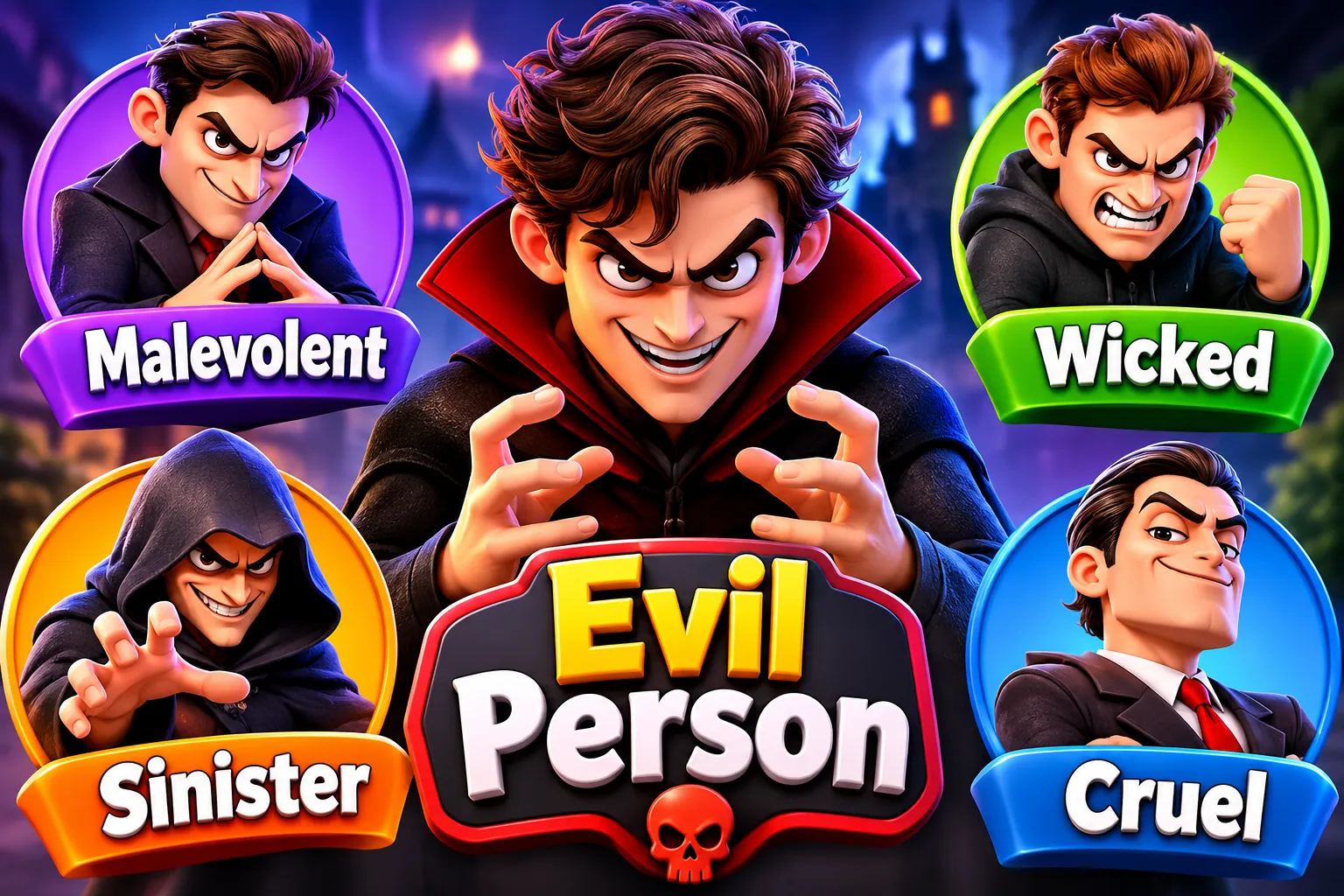
Synonyms for evil person include villain, evildoer, fiend, monster, scoundrel, tyrant, wrongdoer, malefactor, deceiver, and exploiter. These words describe different forms of cruelty, dishonesty, wickedness, and harmful behavior.
An evil person is someone who deliberately hurts others, behaves cruelly, or does things that cause serious harm. Imagine someone who cheats others, spreads lies, and takes advantage of people without showing regret.
You might describe that individual as an evil person. This phrase is commonly used in everyday conversations, books, films, news, and stories to describe harmful actions and intentions. However, repeating the same phrase can make your writing less interesting.
Learning synonyms helps English learners and content writers build stronger vocabulary and express ideas more clearly. In this guide, I will explain the meaning, history, pronunciation, grammar, and 30 useful synonyms for evil person with simple definitions, examples, and semantic categories.
Meaning of Evil Person
Definition
Evil Person (Noun Phrase):
An evil person is an individual who deliberately behaves cruelly, causes serious harm, or repeatedly engages in actions considered deeply immoral or wicked.
Examples
- The evil person harmed innocent people without showing any regret.
- Everyone feared the evil person because of their cruel actions.
Connotative Meaning
Connotation: The feelings, ideas, or emotions that a word creates beyond its basic meaning.
- Positive tone: The phrase has no usual positive meaning. It may sometimes appear humorously or ironically in fictional stories.
- Negative tone: It suggests cruelty, dishonesty, selfishness, hatred, wickedness, and harmful intentions.
- Neutral tone: The phrase is not normally neutral because it expresses a strong negative judgment. In formal writing, describing specific actions may be more objective.
Etymology of Evil Person
The phrase evil person combines two words with different historical origins. The word evil comes from Old English, while person entered English through French from Latin.
| Historical Period | Etymology of Evil Person |
|---|---|
| Old English (450–1100) | Evil comes from Old English yfel, meaning bad, vicious, harmful, or wicked. The modern word person was not yet established in English. |
| Middle English (1100–1500) | Evil developed through forms such as yvel, evel, and ivel. Person entered Middle English around the 13th century through Old French persone, from Latin persona, meaning a human being, character, or role. |
| Modern English (1500–Present) | Both words developed into their modern forms. Today, evil person is used to describe an individual considered deeply wicked or morally harmful. |
The word evil has Germanic roots, while person has Latin roots. The phrase combines an adjective and a noun to describe an individual with seriously harmful or immoral behavior.
Pronunciation (IPA)
- IPA (British English): /ˈiːvəl ˈpɜːsən/
- IPA (American English): /ˈiːvəl ˈpɝːsən/
- Syllables: E-vil Per-son
- Word stress: The first syllable of each word is stressed.
Affixation Pattern of Evil Person
The phrase evil person contains two separate words. It does not have a prefix or suffix in its basic form.
- Root: Evil + Person
- Prefix: None in the basic phrase.
- Suffix: None in the basic phrase.
Word Formations
- Evil (Adjective/Noun): Something morally wrong, wicked, or harmful.
- Evilly (Adverb): In a wicked or harmful way.
- Evilness (Noun): The quality or state of being evil.
- Evildoer (Noun): A person who deliberately does harmful or morally wrong things.
- Evildoing (Noun): A wicked, harmful, or immoral action.
- Person (Noun): An individual human being.
- Personal (Adjective): Related to an individual or their private life.
- Personally (Adverb): In an individual or private way.
- Personhood (Noun): The state or quality of being a person.
- Impersonal (Adjective): Not involving personal feelings or individual relationships.
24 Synonyms of Evil Person With Meaning & Examples
The following 30 synonyms describe different types of wickedness, cruelty, dishonesty, and harmful behavior. Each word has a slightly different meaning, so choose the one that best matches the situation.
1. Villain (Noun)
Meaning: A person who does evil things or causes harm, especially in a story or film.
Examples:
- The villain planned to destroy the peaceful kingdom.
- Everyone feared the villain because of their cruel behavior.
2. Evildoer (Noun)
Meaning: A person who deliberately does wrong or harmful things.
Examples:
- The evildoer was punished for their harmful actions.
- The story describes an evildoer who hurts innocent people.
3. Fiend (Noun)
Meaning: A cruel or wicked person who causes suffering or behaves terribly.
Examples:
- The fiend showed no kindness toward those they harmed.
- People feared the fiend because of their terrible actions.
4. Monster (Noun)
Meaning: A person who behaves in an extremely cruel, violent, or inhuman way.
Examples:
- Everyone called the character a monster after their cruel actions.
- The monster showed no sympathy for innocent people.
5. Demon (Noun)
Meaning: An evil spirit or, figuratively, a person who behaves in a very wicked way.
Examples:
- The demon tried to destroy everything in its path.
- The character’s enemies described them as a demon.
6. Wicked Individual (Noun Phrase)
Meaning: A person who behaves badly or deliberately does morally wrong things.
Examples:
- The wicked individual caused suffering throughout the community.
- Nobody trusted the wicked individual after the betrayal.
7. Malevolent Individual (Noun Phrase)
Meaning: A person who has harmful intentions or wishes bad things for others.
Examples:
- The malevolent individual planned to hurt the entire community.
- Everyone became concerned about the malevolent individual’s intentions.
8. Nefarious Individual (Noun Phrase)
Meaning: A person involved in extremely dishonest, wicked, or criminal activities.
Examples:
- The nefarious individual organized a dishonest business scheme.
- The investigation exposed the nefarious individual’s actions.
9. Cruel Person (Noun Phrase)
Meaning: An individual who deliberately causes pain or suffering to others.
Examples:
- The cruel person enjoyed making others feel helpless.
- Nobody wanted to work with such a cruel person.
10. Brute (Noun)
Meaning: A cruel, violent, or rough person who shows little kindness.
Examples:
- The brute pushed another person to the ground.
- Nobody wanted to deal with the violent brute.
11. Tormentor (Noun)
Meaning: A person who repeatedly causes physical or emotional suffering to others.
Examples:
- The tormentor made life difficult for the entire group.
- The victim finally spoke out against the tormentor.
12. Sadist (Noun)
Meaning: A person who takes pleasure in causing pain or suffering to others.
Examples:
- The sadist enjoyed watching others suffer.
- The story features a sadist who deliberately hurts other characters.
13. Abuser (Noun)
Meaning: A person who deliberately mistreats, harms, or controls others.
Examples:
- The abuser used threats to control other people.
- The organization introduced rules to protect people from abusers.
14. Oppressor (Noun)
Meaning: A person who treats others unfairly and uses power to control or restrict them.
Examples:
- The oppressor denied people their basic rights.
- The community stood together against the oppressor.
15. Tyrant (Noun)
Meaning: A cruel ruler or powerful individual who abuses authority and treats others unfairly.
Examples:
- The tyrant controlled the people through fear.
- The citizens finally stood against the tyrant.
16. Scoundrel (Noun)
Meaning: A dishonest or immoral person who treats others badly.
Examples:
- The scoundrel tricked the family out of their savings.
- Nobody trusted the scoundrel after the lies were exposed.
17. Rogue (Noun)
Meaning: A dishonest or immoral person who often breaks rules or behaves badly.
Examples:
- The rogue tricked people with false promises.
- Everyone discovered that the rogue had hidden the truth.
18. Knave (Noun)
Meaning: A dishonest or untrustworthy person. This is an old-fashioned word.
Examples:
- The knave stole money from an employer.
- The ruler punished the knave for their betrayal.
19. Rascal (Noun)
Meaning: A mischievous or dishonest person who behaves badly. It can also be used playfully.
Examples:
- The rascal cheated others in a business deal.
- Everyone knew the rascal could not be trusted.
20. Reprobate (Noun)
Meaning: A person who behaves in a morally unacceptable or wicked way.
Examples:
- The reprobate betrayed everyone who trusted them.
- The community criticized the reprobate for repeated dishonest actions.
21. Deceiver (Noun)
Meaning: A person who deliberately misleads others through lies or dishonest actions.
Examples:
- The deceiver gained people’s trust through false promises.
- Everyone discovered that the deceiver had hidden the truth.
22. Manipulator (Noun)
Meaning: A person who uses dishonest or unfair tactics to control or influence others.
Examples:
- The manipulator used false promises to gain people’s trust.
- Everyone eventually recognized the manipulator’s dishonest behavior.
23. Swindler (Noun)
Meaning: A person who cheats others out of money or property through dishonest methods.
Examples:
- The swindler tricked several people into losing their savings.
- The authorities investigated the swindler’s financial activities.
24. Fraudster (Noun)
Meaning: A person who commits fraud by using lies or deception for personal gain.
Examples:
- The fraudster created a false investment scheme.
- The investigation exposed the fraudster’s dishonest activities.
Prototype Meaning
The most common meaning of an evil person is someone who deliberately causes harm, behaves cruelly, or shows little concern for the suffering of others. People usually imagine an individual who lies, cheats, manipulates, exploits, or hurts others without showing regret. In books and films, this person is often presented as the main villain or enemy. However, not all synonyms have the same meaning. A tyrant abuses power, a swindler cheats people out of money, and a sadist takes pleasure in causing pain. Understanding these differences helps you choose the most accurate word for your sentence.
Prototype Categorization
Semantic Categories of Synonyms for Evil Person
The 30 synonyms for evil person can be divided into meaningful semantic categories. These groups help writers select words according to an individual’s behavior, intentions, and actions.
| Semantic Category | Synonyms | Description |
|---|---|---|
| General wickedness and harmful behavior | Villain, evildoer, fiend, demon, wicked individual, malevolent individual, nefarious individual, reprobate | Describe individuals who behave wickedly, cause harm, or act with seriously harmful intentions. |
| Cruelty and violence | Monster, cruel person, brute, tormentor, sadist, abuser | Refer to individuals who cause suffering, use violence, mistreat others, or show little compassion. |
| Dishonesty and deception | Scoundrel, rogue, knave, rascal, deceiver, manipulator, swindler, fraudster, cheat | Describe individuals who lie, cheat, manipulate, betray, or take unfair advantage of others. |
| Crime and wrongdoing | Criminal, offender, perpetrator, malefactor | Refer to individuals who commit crimes, break laws, or engage in harmful activities. |
| Abuse of power and exploitation | Oppressor, tyrant, exploiter | Describe individuals who misuse authority, control others unfairly, or take advantage of vulnerable people. |
Choosing synonyms from these categories makes your writing more accurate and expressive. Instead of repeating evil person, you can select a word that describes the specific behavior or action you want readers to understand.
Antonyms of Evil Person
Antonyms describe people who demonstrate kindness, honesty, compassion, and strong moral values.
- Good Person (Noun Phrase): Someone who behaves kindly, honestly, and responsibly.
- Saint (Noun): A person known for exceptional goodness or holiness.
- Angel (Noun): A person who is extremely kind, caring, or helpful.
- Benefactor (Noun): Someone who helps others, often by providing money or support.
- Humanitarian (Noun): A person who works to improve the lives of others.
- Altruist (Noun): Someone who puts other people’s needs before their own.
- Philanthropist (Noun): A person who gives money or resources to support charitable causes.
- Good Samaritan (Noun Phrase): Someone who helps people in need without expecting a reward.
- Peacemaker (Noun): A person who helps resolve disagreements peacefully.
- Virtuous Person (Noun Phrase): Someone who follows strong moral principles.
Short Questions and Answers
1. What does evil person mean?
An evil person is someone who deliberately behaves cruelly, harms others, or engages in seriously immoral actions.
2. When should evil person be used?
Use this phrase when describing someone whose actions or intentions are seriously harmful, cruel, dishonest, or morally wrong.
3. Is evil person positive or negative?
It has a strongly negative meaning because it describes wickedness, cruelty, dishonesty, and harmful behavior.
4. How is it different from similar words?
Evil person is a general phrase. A villain is often an enemy in a story, a criminal commits a crime, a tyrant abuses power, and a sadist takes pleasure in causing pain.
Conclusion
Learning the meaning of evil person and its synonyms can improve your English vocabulary and communication skills. Words such as villain, fiend, tyrant, evildoer, scoundrel, and wrongdoer help you describe different types of harmful behavior.
Each alternative has its own meaning and level of intensity, so choosing the right one makes your writing clearer and more natural. Using different words also prevents repetition in essays, stories, articles, and everyday conversations.
For English learners, understanding these alternatives builds confidence in speaking and writing. Try learning a few new synonyms every day and use them in your own sentences. With regular practice, you can express your thoughts more clearly and accurately.
Read More:
Synonyms for Where: 26 Helpful Alternatives to Learn

I’m Noor Fatima, an English content writer at SameSynonyms.com, specializing in synonyms, antonyms, word meanings, and English vocabulary. I create clear, well-researched content with practical examples to help readers understand word usage, expand their vocabulary, and communicate more effectively.










1 thought on “Synonyms for Evil Person: 24 Useful Alternatives”