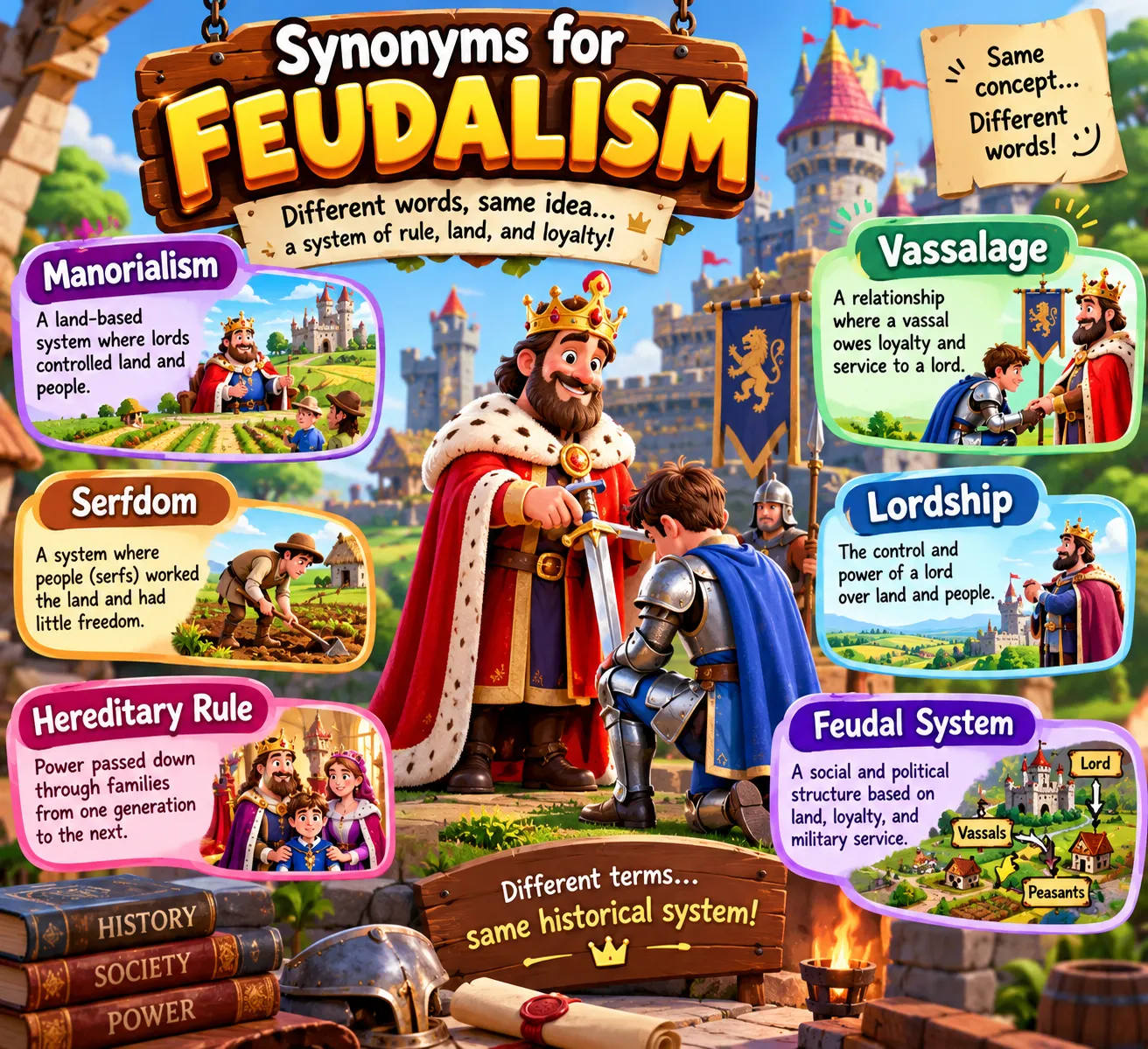
Feudalism means a medieval system based on land, loyalty, and service.Related words: manorialism, serfdom, vassalage, lordship, feudal system, and aristocracy.
Feudalism was a system in which kings and powerful lords gave land to people in return for service. Imagine a farmer who works on a lord’s land. He must give part of his crops to the lord and follow his rules. This is a simple example of life under feudalism.
The word feudalism is often used in history lessons, books, and discussions about power and land. Learning its synonyms can help English learners understand history and express ideas with more care. It can also help writers avoid using the same word again and again.
In this guide, we will explore the meaning of feudalism, its history, pronunciation, word forms, and 30 related words. Each word comes with a simple meaning and examples. We will also group the words by meaning, explain their differences, and share useful antonyms.
Meaning of Feudalism
Definition
Feudalism (noun): A system of society in which people hold land in return for service, loyalty, or work, often under the control of powerful lords.
Feudalism was common in parts of medieval Europe. Similar systems also existed in other parts of the world, though they did not all work in the same way.
Examples
- Feudalism shaped life in much of medieval Europe.
- Under feudalism, many farmers worked on land owned by powerful lords.
Connotative Meaning
Connotation (the feelings or ideas a word brings to mind) depends on how the word is used.
- Positive tone: Feudalism may suggest order, duty, or strong ties between people. These views are not shared by everyone.
- Negative tone: It can suggest unfair power, poverty, and a lack of freedom.
- Neutral tone: In history books, feudalism is often used as a name for a social and political system.
Etymology
| Period | Development of the word feudalism |
| Origin | Comes from feudal, linked to medieval Latin feudum, meaning land held under certain duties. |
| Old English (450–1100) | The word feudalism was not yet in use. English had words for land, duty, and lordship. |
| Middle English (1100–1500) | Words related to landholding and service entered English through French and Latin. |
| Modern English (1500–present) | Feudal and feudalism developed as terms for systems of land, power, and duty. Feudalism became common in historical writing. |
Pronunciation (IPA)
- IPA: /ˈfjuː.dəl.ɪ.zəm/
- Syllables: feu-dal-ism (3 syllables)
- Simple pronunciation: FYOO-duh-liz-um
Affixation Pattern of Feudalism
- Root: feud, linked to the Latin feudum, meaning land held under certain duties.
- Prefix: None.
- Suffix: -al forms the adjective feudal. -ism forms the noun feudalism, which names a system or belief.
- Word formations:
- Feud (noun): A long and bitter fight between people or groups. In the word feudal, it has a different historical origin and meaning.
- Feudal (adjective): Related to feudalism.
- Feudalism (noun): The system itself.
- Feudally (adverb): In a feudal way.
- Feudalistic (adjective): Based on or linked to feudal ideas.
30 Synonyms of Feudalism With Meaning & Examples
Note: Feudalism is a specific historical system. Most words below are related terms, broader systems, or features of feudalism not exact synonyms. Choose the word that best fits your meaning.
1. Manorialism (Noun)
Meaning: A medieval system based on a lord’s estate and the work of people who lived on it.
Examples:
- Manorialism shaped village life in medieval England.
- The estate relied on farming under manorialism.
2. Feudal system (Noun)
Meaning: A social and political system based on land, service, and loyalty.
Examples:
- The feudal system gave great power to local lords.
- Many peasants had duties under the feudal system.
3. Feudal hierarchy (Noun)
Meaning: A system in which people hold different levels of power and rank.
Examples:
- The feudal hierarchy placed the king near the top.
- A lord had a higher rank in the feudal hierarchy than a peasant.
4. Feudal order (Noun)
Meaning: The social and political structure linked to feudal rule.
Examples:
- The feudal order shaped life in the Middle Ages.
- Changes in trade weakened the old feudal order.
5. Feudal society (Noun)
Meaning: A society shaped by feudal landholding and duties.
Examples:
- Feudal society had clear social ranks.
- Farmers played a key role in feudal society.
6. Feudal regime (Noun)
Meaning: A form of rule based on feudal power and customs.
Examples:
- The feudal regime gave local lords wide control.
- The king tried to strengthen his feudal regime.
7. Feudal governance (Noun)
Meaning: The way a feudal society is ruled and managed.
Examples:
- Feudal governance often depended on local lords.
- The region used feudal governance for many years.
8. Feudal tenure (Noun)
Meaning: The holding of land under duties owed to a lord.
Examples:
- Feudal tenure linked land to service.
- The rules of feudal tenure shaped land ownership.
9. Feudal landholding (Noun)
Meaning: A system of holding land under feudal rules.
Examples:
- Feudal landholding gave lords control over large estates.
- Feudal landholding often came with duties.
10. Vassalage (Noun)
Meaning: A bond in which a vassal owes service or loyalty to a lord.
Examples:
- Vassalage linked knights to powerful lords.
- The lord gained support through vassalage.
11. Seigneurialism (Noun)
Meaning: A system in which a lord holds power over land and people.
Examples:
- Seigneurialism shaped life in parts of medieval Europe.
- The study explored seigneurialism and rural power.
12. Lordship (Noun)
Meaning: The power or position of a lord over land or people.
Examples:
- Lordship gave nobles control over local lands.
- The king tried to limit the power of lordship.
13. Serfdom (Noun)
Meaning: A condition in which peasants are tied to land and have limited freedom.
Examples:
- Serfdom restricted the freedom of many farmers.
- Some regions slowly moved away from serfdom.
14. Manorial system (Noun)
Meaning: A system of rural life based on a lord’s estate.
Examples:
- The manorial system relied on farming.
- Villages often formed part of a manorial system.
15. Landed aristocracy (Noun)
Meaning: A class of wealthy nobles who own large areas of land.
Examples:
- The landed aristocracy held much of the region’s wealth.
- The landed aristocracy had strong political influence.
16. Aristocratic rule (Noun)
Meaning: Government or control by members of the noble class.
Examples:
- Aristocratic rule shaped many medieval states.
- The people called for an end to aristocratic rule.
17. Noble privilege (Noun)
Meaning: Special rights or benefits held by members of the noble class.
Examples:
- Noble privilege gave some families great power.
- Reformers wanted to reduce noble privilege.
18. Estate system (Noun)
Meaning: A social structure in which people belong to ranked groups with different rights and duties.
Examples:
- The estate system divided society into social groups.
- The estate system gave each group a different role.
19. Class hierarchy (Noun)
Meaning: A social structure in which some groups have higher rank or power than others.
Examples:
- The class hierarchy limited social movement.
- Wealth often shaped the class hierarchy.
20. Social stratification (Noun)
Meaning: The division of society into layers based on wealth, power, or status.
Examples:
- Social stratification shaped access to land.
- The historian studied social stratification in medieval towns.
21. Hereditary rule (Noun)
Meaning: A system in which power passes from one family member to another.
Examples:
- Hereditary rule kept power within noble families.
- The kingdom followed hereditary rule for generations.
22. Oligarchy (Noun)
Meaning: A system in which a small group holds most political power.
Examples:
- The oligarchy controlled the main resources.
- Critics said the city was ruled by an oligarchy.
23. Aristocracy (Noun)
Meaning: A class of people with noble rank, often linked to wealth and power.
Examples:
- The aristocracy owned large estates.
- The aristocracy played a major role in politics.
24. Landed system (Noun)
Meaning: A social or economic system in which land ownership shapes power and wealth.
Examples:
- The landed system gave landowners great influence.
- The landed system affected rural life.
25. Patronage system (Noun)
Meaning: A system in which powerful people give support or benefits in return for loyalty.
Examples:
- The patronage system helped nobles gain loyal followers.
- The ruler used patronage to reward supporters.
26. Dependency system (Noun)
Meaning: A system in which people rely on more powerful people for support or protection.
Examples:
- The dependency system tied workers to local landowners.
- The village had a strong dependency system.
27. Hierarchical society (Noun)
Meaning: A society arranged in levels of rank and power.
Examples:
- Medieval life often took place in a hierarchical society.
- A hierarchical society can make social change difficult.
28. Land based social order (Noun)
Meaning: A social structure in which land shapes people’s status and duties.
Examples:
- The land based social order gave nobles high status.
- The land based social order changed as towns grew.
29. Manorial economy (Noun)
Meaning: A rural economy based on a lord’s estate and farm work.
Examples:
- The manorial economy relied on crops and labor.
- Trade slowly changed the manorial economy.
30. Lord vassal system (Noun)
Meaning: A system of ties between lords and vassals based on service and loyalty.
Examples:
- The lord vassal system linked land to military service.
- The lord vassal system helped shape medieval politics.
Prototype Meaning
The most typical meaning of feudalism is a medieval system in which land, power, and duty are closely linked. People often imagine a king, noble lords, knights, and peasants. Lords control land, while people below them provide work, service, or loyalty. The exact form of feudalism differed across places and times.
Prototype Categorization
The 30 related terms can be grouped by the part of feudalism they describe. This helps writers choose a word that matches the point they want to make.
- Land and estate systems: Manorialism, manorial system, manorial economy, feudal tenure, feudal landholding, landed system. Use these when writing about land, farms, and rural life.
- Power and rank: Feudal hierarchy, feudal order, feudal society, feudal regime, feudal governance, hierarchical society, class hierarchy, social stratification. Use these when discussing social structure or political control.
- Lord and vassal ties: Vassalage, lordship, lord-vassal system, dependency system, patronage system. Use these when explaining loyalty, service, and personal ties.
- Nobles and privilege: Landed aristocracy, aristocratic rule, noble privilege, aristocracy, oligarchy, hereditary rule. Use these when discussing wealth, elite power, or rule by a small group.
- Peasant status and labor: Serfdom, estate system, land-based social order, seigneurialism. Use these when writing about rural duties, social rank, or the control of people.
These groups show why the terms are related but not always interchangeable. For example, serfdom refers to the status of some peasants, while manorialism focuses on the rural estate. Oligarchy describes rule by a small group and can exist without feudal land ties.
Antonyms of Feudalism
| Antonym / Related Term | Part of Speech | Meaning | Example Sentence |
| Democracy | Noun | A system in which people have a say in government. | The country moved toward democracy. |
| Equality | Noun | The state of having equal rights or status. | The law aims to protect equality. |
| Republic | Noun | A state where public power is not held by a hereditary monarch. | The nation became a republic. |
| Centralized government | Noun | A system in which power is held by a central authority. | The king built a centralized government. |
| Free labor | Noun | Work done by people who are free to choose their jobs. | Free labor replaced forced duties in the region. |
| Social mobility | Noun | The ability to move to a different social or economic level. | Education can support social mobility. |
| Meritocracy | Noun | A system in which people gain roles or rewards based on ability or achievement. | The firm aimed to build a meritocracy. |
Short Questions and Answers
What does feudalism mean?
Feudalism is a system in which land, power, and service are linked. Lords hold land, and people owe them duties or loyalty.
When should feudalism be used?
Use feudalism when writing about a historical system of landholding, social rank, and duty. Use a related term when you mean one part of that system.
Is feudalism positive or negative?
The word is mostly neutral in history writing. It can sound negative when used to stress unfair power or limited freedom.
How is it different from similar words?
Feudalism names a broad system. Serfdom refers to the limited freedom of some peasants. Manorialism focuses on rural estates. Vassalage describes a bond of service and loyalty.
Conclusion
Learning feudalism and its related words can help you build a stronger English vocabulary. These terms make it easier to describe land, power, social rank, and duty. They also help you write with care and avoid repeating the same word.
Not every related term means exactly the same thing. Serfdom, manorialism, and vassalage each describe a different part of the wider system. Knowing these differences can improve your history essays, daily speech, and academic writing.
Try learning two or three words each day. Write a sentence for each one, then use the words in a short paragraph. With daily practice, you can speak and write with more confidence.
Read More:
Synonyms for Dork: 30 Useful Words to Know

I’m Noor Fatima, an English content writer at SameSynonyms.com, specializing in synonyms, antonyms, word meanings, and English vocabulary. I create clear, well-researched content with practical examples to help readers understand word usage, expand their vocabulary, and communicate more effectively.