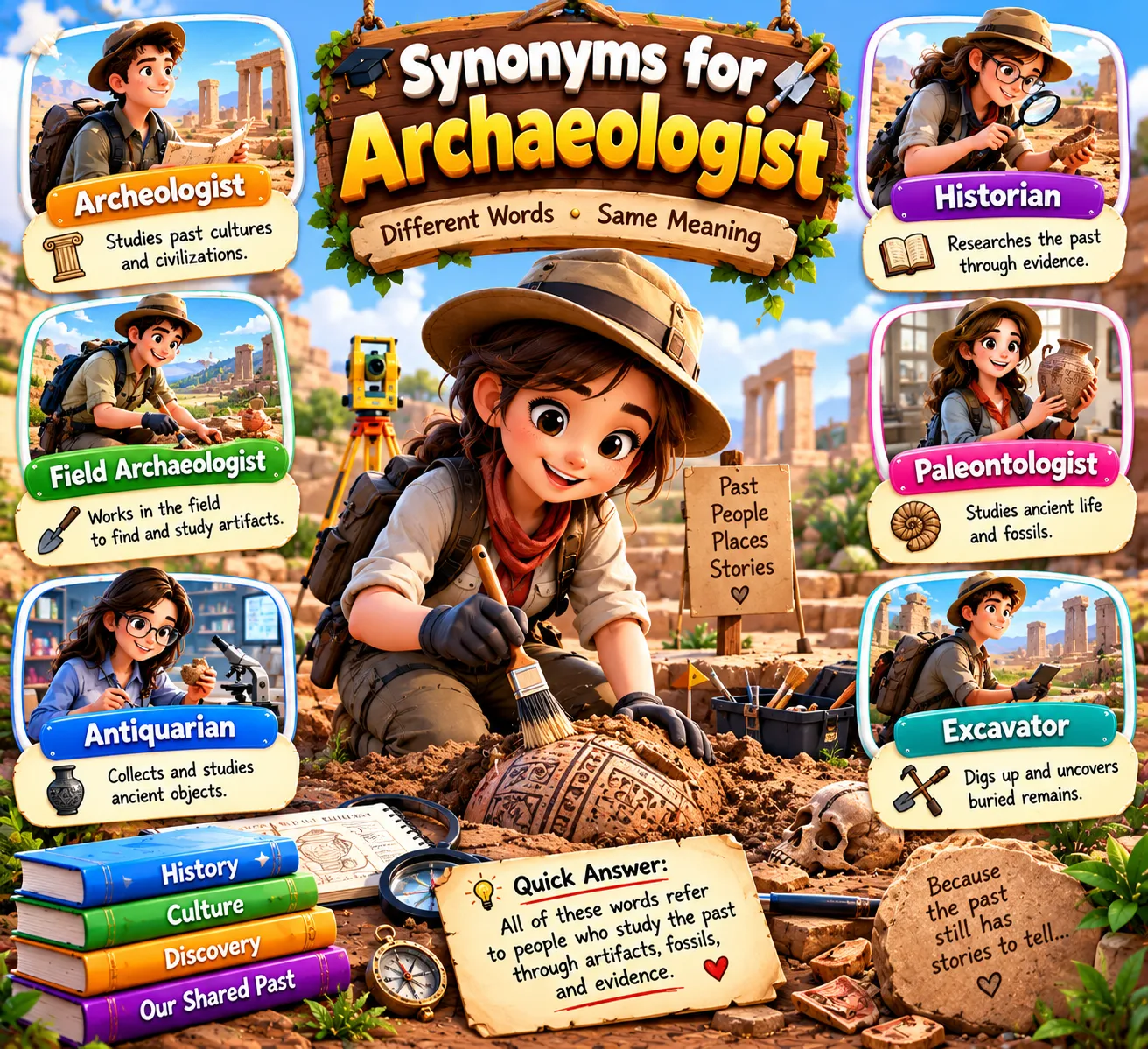
Synonyms and related terms for archaeologist include excavation expert, archaeological researcher, field researcher, antiquarian, historian, and anthropologist. Each word has a slightly different meaning, so choose one that fits the context.
An archaeologist is a person who studies the past by examining old objects, buildings, tools, and other remains. Imagine a team digging at an ancient site and finding a clay pot buried for hundreds of years.
An archaeologist studies the pot to learn how people lived, worked, and traded in the past. This word is often used in history, science, education, and museum work.Learning synonyms for archaeologist can help English learners build vocabulary and help content writers avoid repeating the same word.
However, not every related word has the same meaning. A historian studies the past through many types of evidence, while an archaeologist often focuses on physical remains. In this guide, you will learn the word’s meaning, history, pronunciation, word forms, and 30 synonyms or related terms with simple definitions and examples.
Meaning of Archaeologist
Definition
Archaeologist (noun): A person who studies human history and past cultures by examining objects, buildings, and other physical remains.
Examples
- The archaeologist found old tools at the ancient site.
- An archaeologist helped the museum explain how people lived thousands of years ago.
Connotative Meaning
(Connotation: the feelings or ideas a word brings to mind beyond its basic meaning.)
- Positive tone: Suggests discovery, knowledge, patience, and a love of history.
- Negative tone: Usually has no negative meaning, though a person may criticize an archaeologist’s methods or conclusions.
- Neutral tone: Names a person whose work involves studying the past through physical evidence.
Etymology of Archaeologist
| Period | Historical Development of “Archaeologist” |
| Greek Origins | The word comes from Greek arkhaios, meaning “ancient,” and logia, relating to study or knowledge. The suffix -ist refers to a person who works in a field. |
| Old English (450–1100) | Archaeologist was not a standard English word. People used other words to discuss ancient objects, places, and the past. |
| Middle English (1100–1500) | The modern word was not yet in common use. Interest in ancient history grew, but archaeology had not developed into its modern professional field. |
| Modern English (1500–present) | Archaeology entered English during the early modern period, and archaeologist developed later to describe a person who studies archaeology. The profession expanded as scientific excavation and artifact analysis became more systematic. |
Pronunciation (IPA)
- IPA: /ˌɑːrkiˈɑːlədʒɪst/ (one common pronunciation)
- Syllables: ar-chae-ol-o-gist
Affixation Pattern of Archaeologist
- Root: archae- relates to ancient things; the word also contains the element -logy, meaning study.
- Prefix: No separate productive prefix in the modern word.
- Suffix: -ist means a person who practices or specializes in something.
Word formations
- Archaeology (noun): The study of past people and cultures through physical remains.
- Archaeologist (noun): A person who studies archaeology.
- Archaeological (adjective): Related to archaeology.
- Archaeologically (adverb): In a way that relates to archaeology.
- Archaeologic (adjective): An alternative adjective form, less common than archaeological.
30 Synonyms of Archaeologist With Meanings and Examples
Some words below are close alternatives, while others name related specialists or roles. Use them according to the kind of work or study you mean.
1. Excavation Expert (Noun Phrase)
Meaning: A person with knowledge of digging sites to uncover buried remains.
Examples:
- The excavation expert carefully uncovered the old wall.
- We asked an excavation expert to assess the ancient site.
2. Archaeological Researcher (Noun Phrase)
Meaning: A person who researches past cultures using archaeological evidence.
Examples:
- The archaeological researcher studied pottery from the site.
- An archaeological researcher published a report about the ruins.
3. Field Archaeologist (Noun Phrase)
Meaning: An archaeologist who works at sites to record and recover evidence.
Examples:
- The field archaeologist mapped the remains of an old settlement.
- A field archaeologist spent weeks examining the site.
4. Excavator (Noun)
Meaning: A person who digs to uncover buried objects or structures; in archaeology, the word may refer to someone carrying out an excavation.
Examples:
- The excavator uncovered a stone foundation.
- The team’s excavator recorded each layer of soil.
5. Antiquarian (Noun)
Meaning: A person interested in old objects, artifacts, and historical records.
Examples:
- The antiquarian collected old maps and coins.
- An antiquarian helped identify the age of the pottery.
6. Historian (Noun)
Meaning: A person who studies and explains the past using sources such as documents, records, and artifacts.
Examples:
- The historian compared the artifact with old records.
- A historian explained how the settlement changed over time.
7. Anthropologist (Noun)
Meaning: A person who studies humans, cultures, and societies.
Examples:
- The anthropologist studied customs in the ancient community.
- An anthropologist worked with archaeologists on the project.
8. Paleontologist (Noun)
Meaning: A scientist who studies fossils of ancient life, such as dinosaurs and early plants.
Examples:
- The paleontologist examined a fossil found in the rock.
- A paleontologist explained what the fossil revealed about ancient life.
9. Egyptologist (Noun)
Meaning: A specialist who studies ancient Egypt, including its history, language, and material culture.
Examples:
- The Egyptologist examined symbols on the tomb wall.
- An Egyptologist helped translate the ancient inscription.
10. Classical Archaeologist (Noun Phrase)
Meaning: An archaeologist who focuses on ancient Greek and Roman cultures.
Examples:
- The classical archaeologist studied a Roman villa.
- A classical archaeologist examined pottery from ancient Greece.
11. Underwater Archaeologist (Noun Phrase)
Meaning: An archaeologist who studies remains found underwater, such as shipwrecks and submerged settlements.
Examples:
- The underwater archaeologist explored a sunken ship.
- An underwater archaeologist recorded the objects found near the wreck.
12. Bioarchaeologist (Noun)
Meaning: A specialist who studies human remains from archaeological sites to learn about past lives and health.
Examples:
- The bioarchaeologist studied bones from the burial site.
- A bioarchaeologist used skeletal evidence to learn about ancient diets.
13. Zooarchaeologist (Noun)
Meaning: A specialist who studies animal remains from archaeological sites to understand past human and animal relationships.
Examples:
- The zooarchaeologist examined animal bones near the settlement.
- A zooarchaeologist helped identify the animals people once raised.
14. Geoarchaeologist (Noun)
Meaning: A specialist who studies soil, landforms, and geological processes to understand archaeological sites.
Examples:
- The geoarchaeologist analyzed soil layers at the site.
- A geoarchaeologist helped explain how the settlement was buried.
15. Epigrapher (Noun)
Meaning: A specialist who studies inscriptions carved or written on hard surfaces.
Examples:
- The epigrapher examined writing on the stone tablet.
- An epigrapher helped researchers understand the ancient inscription.
16. Numismatist (Noun)
Meaning: A person who studies or collects coins, medals, and related objects.
Examples:
- The numismatist identified a coin from the ancient empire.
- A numismatist helped date the coins found at the site.
17. Curator (Noun)
Meaning: A person who manages and cares for a museum or collection.
Examples:
- The curator displayed artifacts from the excavation.
- A curator explained how the museum protects ancient objects.
18. Conservator (Noun)
Meaning: A specialist who preserves and repairs objects of historical or cultural value.
Examples:
- The conservator carefully cleaned the fragile pot.
- A conservator worked to prevent the ancient fabric from breaking down.
19. Museum Researcher (Noun Phrase)
Meaning: A person who studies collections and objects held by a museum.
Examples:
- The museum researcher examined a collection of stone tools.
- A museum researcher traced the history of an artifact.
20. Heritage Specialist (Noun Phrase)
Meaning: A professional who helps protect places, objects, and traditions with historical or cultural value.
Examples:
- The heritage specialist advised the town on protecting the ruins.
- A heritage specialist helped document the historic building.
21. Cultural Resource Manager (Noun Phrase)
Meaning: A professional who helps identify and protect archaeological and other cultural sites.
Examples:
- The cultural resource manager reviewed the construction plans.
- A cultural resource manager helped protect the burial ground.
22. Excavation Specialist (Noun Phrase)
Meaning: A person with specific skills in planning or carrying out excavations.
Examples:
- The excavation specialist showed the team how to remove soil safely.
- An excavation specialist recorded the location of each find.
23. Field Researcher (Noun Phrase)
Meaning: A person who gathers information through direct study at a location.
Examples:
- The field researcher recorded details about the ancient settlement.
- A field researcher visited the site each day.
24. Artifact Specialist (Noun Phrase)
Meaning: A person who examines objects made or used by people to learn about their age, use, or origin.
Examples:
- The artifact specialist identified a piece of ancient pottery.
- An artifact specialist compared the tools with similar finds.
25. Prehistoric Researcher (Noun Phrase)
Meaning: A researcher who studies human life before written records were kept.
Examples:
- The prehistoric researcher examined early stone tools.
- A prehistoric researcher studied evidence of ancient shelters.
26. Researcher (Noun)
Meaning: A person who carefully investigates a subject to discover or confirm information.
Examples:
- The researcher compared objects found at two sites.
- A researcher published new findings about the ancient town.
27. Scholar (Noun)
Meaning: A person who has deep knowledge of a subject and studies it in detail.
Examples:
- The scholar wrote a book about ancient trade.
- A scholar explained the importance of the discovery.
28. Academic (Noun)
Meaning: A person who teaches or researches at a college or university.
Examples:
- The academic presented findings at a history conference.
- An academic studied how ancient communities used their land.
29. Explorer (Noun)
Meaning: A person who travels to unfamiliar places to learn about or discover them.
Examples:
- The explorer documented the ruins in a remote area.
- An explorer helped bring attention to the ancient site.
30. Historical Researcher (Noun Phrase)
Meaning: A person who investigates the past using evidence from different sources.
Examples:
- The historical researcher studied records about the lost city.
- A historical researcher compared written accounts with objects from the site.
Prototype Meaning of Archaeologist
| Aspect | Description |
| Main Meaning | A person who studies ancient human life by examining physical evidence. |
| Common Example | An archaeologist carefully digs at an ancient site and discovers pottery, tools, bones, or buildings. |
| Purpose | To understand the past through discoveries and evidence. |
| Workplaces | Archaeologists may work at excavation sites, in laboratories, museums, universities, and offices. |
| Main Goal | To collect evidence and explain what it reveals about people and cultures from earlier times. |
Prototype Categorization of Archaeologist
The 30 synonyms and related terms can be grouped by their main meanings and areas of work. These categories help writers select the best word for each situation.
– General Archaeology: Archaeological researcher, field archaeologist, excavation expert, excavator, excavation specialist. These terms relate directly to archaeological research and excavation.
– History and Human Culture: Historian, anthropologist, historical researcher, prehistoric researcher, scholar. These terms focus on the past, human life, and cultural development.
– Specialist Archaeology: Egyptologist, classical archaeologist, underwater archaeologist, bioarchaeologist, zooarchaeologist, geoarchaeologist. These terms identify experts who study specific places, periods, or types of evidence.
– Artifacts and Inscriptions: Antiquarian, epigrapher, numismatist, artifact specialist. These terms describe people who study old objects, coins, or inscriptions.
– Research and Fieldwork: Researcher, field researcher, academic. These terms refer to people who investigate or study a subject, although they may not work in archaeology.
– Museums and Preservation: Curator, conservator, museum researcher, heritage specialist, cultural resource manager. These roles involve studying, managing, or protecting historical objects and places.
– Related Scientific and Discovery Roles: Paleontologist, explorer. These terms may overlap with archaeological work, but they are not direct synonyms. Paleontologists study fossils, while explorers investigate unfamiliar places.
Choosing words by category helps writers avoid repetition and maintain accuracy. For example, use field archaeologist for someone working at a dig, Egyptologist for an expert in ancient Egypt, and conservator for someone preserving fragile artifacts. Many terms in this list are related occupations rather than exact replacements for archaeologist.
Antonyms of Archaeologist
There is no exact antonym for archaeologist because it names a profession. However, these words can express contrasting roles or approaches in certain contexts.
- Destroyer (noun): A person or thing that causes damage or destruction. The destroyer damaged the ancient site.
- Vandal (noun): A person who deliberately damages property or historic places. The vandal damaged the old monument.
- Ignoramus (noun): An informal, often insulting term for someone who lacks knowledge. The writer called anyone who ignored the evidence an ignoramus.
- Amateur (noun): A person who does an activity without being a trained professional. An amateur collector found an old coin.
These are contextual contrasts, not true dictionary antonyms.
Short Questions and Answers
What does archaeologist mean?
An archaeologist is a person who studies past human life and cultures by examining objects, structures, and other physical remains.
When should archaeologist be used?
Use archaeologist when referring to someone who studies archaeological evidence, such as ancient tools, pottery, ruins, and burial sites.
Is archaeologist positive or negative?
The word is generally neutral. It often has positive associations with discovery, learning, and historical knowledge.
How is archaeologist different from similar words?
An archaeologist studies physical remains of past human life. A historian studies the past through many kinds of evidence, while an anthropologist studies humans and cultures more broadly. A paleontologist focuses on fossils of ancient life.
Conclusion
Learning archaeologist and its related terms can improve your vocabulary and help you write with greater accuracy. Words such as field archaeologist, historian, antiquarian, and artifact specialist describe different roles and areas of study.
Using these terms correctly can make your writing clearer, reduce repetition, and help you explain ideas in a more precise way.
For English learners, studying synonyms also builds confidence in speaking, reading, and writing. Remember that related words do not always have the same meaning, so consider the context before choosing an alternative.
Try learning a few new words each day, writing your own example sentences, and using them in conversation. With regular practice, you can develop a stronger vocabulary and communicate your ideas with confidence.
Read More:
Synonyms for Currency: 30 Useful Alternatives
I’m Noor Fatima, an English content writer at SameSynonyms.com, specializing in synonyms, antonyms, word meanings, and English vocabulary. I create clear, well-researched content with practical examples to help readers understand word usage, expand their vocabulary, and communicate more effectively.