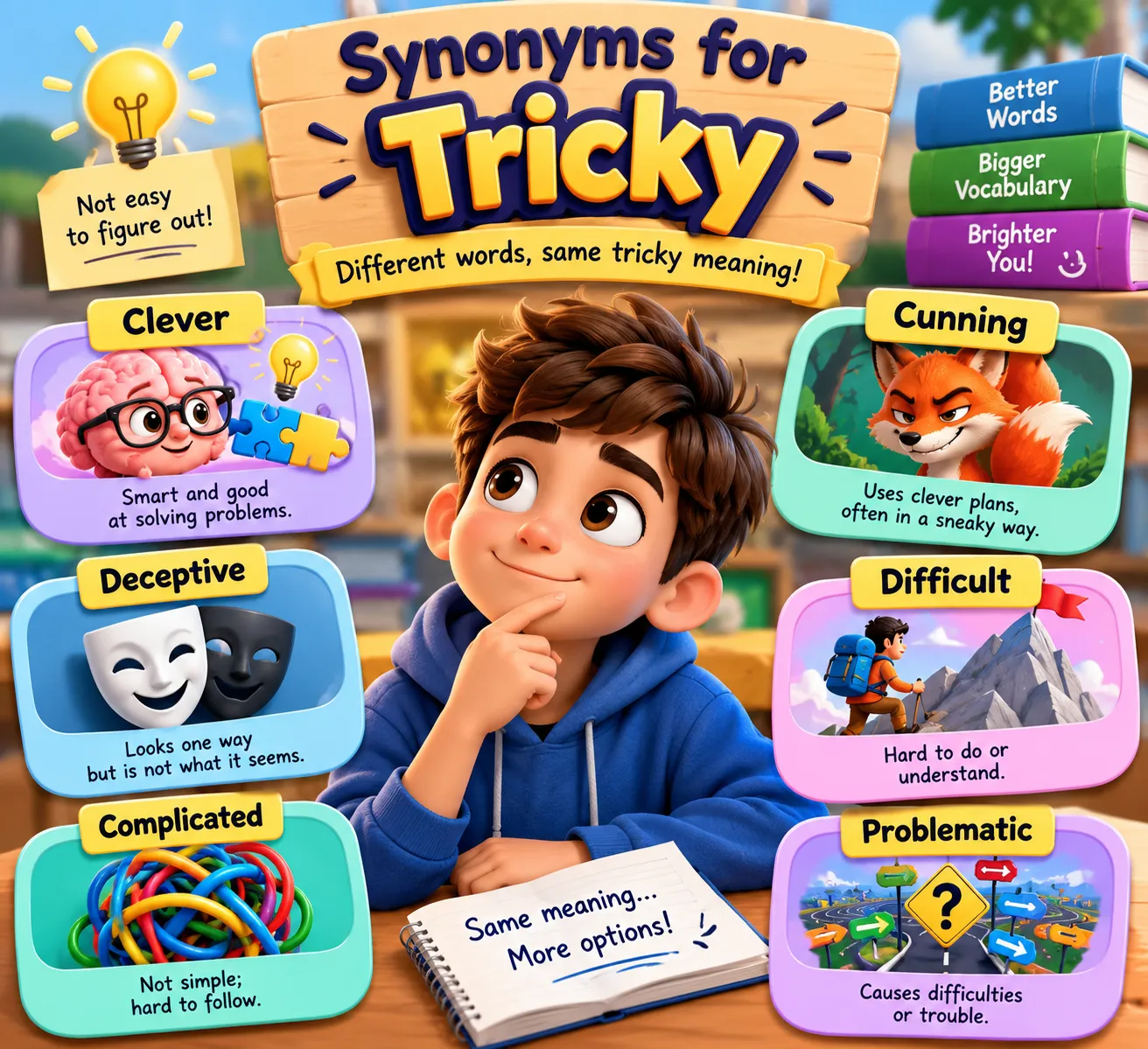
Synonyms for tricky include difficult, complicated, challenging, tricky, crafty, deceptive, subtle, and tricky to handle. These words describe tasks, situations, questions, or people that are hard to manage, understand, or trust.
Tricky means hard to do, understand, or deal with. It can describe a difficult question, a confusing task, or a person who uses clever ways to fool others. For example, I have come across tricky questions that look easy at first but need careful thought to answer.
People use this word in daily talks, school, work, and writing. However, using the same word again and again can make writing dull. Learning synonyms for tricky helps English learners build stronger vocabulary and express ideas more clearly. It also helps content writers choose words that fit the meaning and tone of each sentence.
In this guide, I will explain the meaning, history, pronunciation, and grammar of tricky. You will also learn 30 useful synonyms, their meanings, and simple examples to help you use them with confidence.
Meaning of Tricky
Definition
Tricky (Adjective): Difficult to understand, do, or handle; sometimes clever or designed to deceive someone.
Examples
- This is a tricky question, so read it carefully.
- He faced a tricky problem at work.
Connotative Meaning
(Connotation: the feeling or idea a word brings to mind beyond its basic meaning.)
- Positive tone: Suggests cleverness, skill, or a need for smart thinking. Example: “She solved a tricky puzzle.”
- Negative tone: Suggests dishonesty, deception, or a risk of being fooled. Example: “The tricky salesman hid the extra costs.”
- Neutral tone: Describes something that needs care or thought. Example: “Driving on this road can be tricky.”
Etymology of Tricky
| Period | Etymology of Tricky |
| Old English (450–1100) | Tricky was not a regular Old English word. People used other words to describe cleverness, deceit, and difficulty. |
| Middle English (1100–1500) | The word trick entered English through French influence and referred to clever acts, devices, or deception. |
| Modern English (1500–present) | Tricky formed from trick and the suffix -y, meaning having the qualities of something. It became a common adjective for difficult situations, clever methods, and deceptive behavior. |
Pronunciation (IPA)
- IPA: /ˈtrɪki/
- Syllables: trick-y (2 syllables)
- Stress: The first syllable is stressed.
Affixation Pattern of Tricky
- Root: trick
- Prefix: None
- Suffix: -y, meaning having the nature or qualities of something.
Word Formations
- Trick (noun): An action used to fool someone or achieve a result.
- Trick (verb): To fool or deceive someone.
- Tricky (adjective): Difficult to manage or likely to deceive.
- Trickily (adverb): In a tricky or deceptive way.
- Trickiness (noun): The quality of being tricky.
- Tricked (verb, past tense/past participle): Fooled or deceived.
- Tricking (verb, present participle): Fooling or deceiving someone.
- Trickster (noun): A person who uses tricks or deception.
30 Synonyms of Tricky With Meaning and Examples
The best synonym depends on what you mean. Some words describe difficulty, while others suggest confusion, danger, or dishonesty.
1. Difficult (Adjective)
Meaning: Not easy to do, understand, or deal with.
Examples:
- This is a difficult math problem.
- She found the test difficult.
2. Complicated (Adjective)
Meaning: Made up of many parts that are hard to understand or manage.
Examples:
- The instructions are complicated.
- He faced a complicated issue at work.
3. Challenging (Adjective)
Meaning: Requiring effort, skill, or careful thought.
Examples:
- Learning a new language can be challenging.
- She completed a challenging task.
4. Confusing (Adjective)
Meaning: Hard to understand because something is unclear.
Examples:
- The question was confusing.
- These rules can be confusing for beginners.
5. Deceptive (Adjective)
Meaning: Likely to make someone believe something that is not true.
Examples:
- The advertisement was deceptive.
- His deceptive words fooled many people.
6. Crafty (Adjective)
Meaning: Clever at using plans or tricks, often to gain an advantage.
Examples:
- The crafty fox escaped the trap.
- He used a crafty plan to win the game.
7. Cunning (Adjective)
Meaning: Skilled at using clever plans, often to deceive others.
Examples:
- The cunning thief avoided the guards.
- She made a cunning plan to escape.
8. Complex (Adjective)
Meaning: Having many connected parts that make something hard to understand.
Examples:
- The problem is more complex than it seems.
- They studied a complex topic in class.
9. Intricate (Adjective)
Meaning: Having many small details that need close attention.
Examples:
- The artist made an intricate design.
- The machine has an intricate system.
10. Complicated-to-handle (Adjective phrase)
Meaning: Difficult to manage or deal with.
Examples:
- The case was complicated to handle.
- This situation is complicated to handle alone.
11. Perplexing (Adjective)
Meaning: Very confusing or hard to explain.
Examples:
- The strange result was perplexing.
- She asked a perplexing question.
12. Puzzling (Adjective)
Meaning: Difficult to understand or solve.
Examples:
- His answer was puzzling.
- The missing keys created a puzzling mystery.
13. Bewildering (Adjective)
Meaning: So confusing that it is hard to know what to think.
Examples:
- The new rules were bewildering.
- She faced a bewildering choice.
14. Elusive (Adjective)
Meaning: Difficult to find, catch, define, or understand.
Examples:
- The answer remained elusive.
- Success can be elusive at times.
15. Subtle (Adjective)
Meaning: Not easy to notice or understand at first.
Examples:
- There was a subtle change in his voice.
- The writer used a subtle hint.
16. Devious (Adjective)
Meaning: Using dishonest or indirect methods to achieve a goal.
Examples:
- The villain had a devious plan.
- He used devious methods to gain power.
17. Sly (Adjective)
Meaning: Clever in a secretive way, often to fool others.
Examples:
- She gave him a sly smile.
- The sly fox stole the food.
18. Artful (Adjective)
Meaning: Showing skill in planning or doing something, sometimes deceptively.
Examples:
- He gave an artful reply.
- The artist created an artful design.
19. Sneaky (Adjective)
Meaning: Acting secretly to avoid being noticed or to deceive someone.
Examples:
- The boy made a sneaky move.
- That was a sneaky way to avoid the rules.
20. Shrewd (Adjective)
Meaning: Showing sharp judgment and good practical sense.
Examples:
- She made a shrewd business decision.
- The shrewd buyer noticed the hidden cost.
21. Risky (Adjective)
Meaning: Involving the chance of harm, loss, or failure.
Examples:
- It was a risky decision.
- Driving fast in heavy rain is risky.
22. Delicate (Adjective)
Meaning: Requiring careful handling because it is sensitive or difficult.
Examples:
- They discussed a delicate issue.
- This is a delicate matter for the family.
23. Sensitive (Adjective)
Meaning: Needing care because it may cause harm, worry, or strong feelings.
Examples:
- The topic is sensitive.
- She handled the sensitive issue with care.
24. Demanding (Adjective)
Meaning: Requiring a lot of effort, attention, or skill.
Examples:
- The job is physically demanding.
- He completed a demanding assignment.
25. Formidable (Adjective)
Meaning: Very difficult to deal with or overcome.
Examples:
- They faced a formidable opponent.
- The team had a formidable challenge ahead.
26. Thorny (Adjective)
Meaning: Difficult to solve because it involves many problems or disagreements.
Examples:
- They discussed a thorny legal issue.
- The group faced a thorny question.
27. Ambiguous (Adjective)
Meaning: Having more than one possible meaning.
Examples:
- The message was ambiguous.
- His ambiguous answer left us unsure.
28. Uncertain (Adjective)
Meaning: Not clear, known, or decided.
Examples:
- The outcome is uncertain.
- We faced an uncertain situation.
29. Trapsome (Adjective)
Meaning: Likely to trap or catch someone; this is a rare, nonstandard choice in modern English.
Examples:
- The old net was designed to catch animals.
- The hidden pit made the path dangerous.
30. Problematic (Adjective)
Meaning: Causing problems or making a situation difficult to manage.
Examples:
- The plan raised a problematic issue.
- The new rule proved problematic for small businesses.
Correction for synonym 29: Trapsome is not a standard modern English word. Use Misleading instead.
29. Misleading (Adjective)
Meaning: Giving the wrong idea or causing someone to believe something that is not true.
Examples:
- The headline was misleading.
- The map gave us misleading directions.
Prototype Meaning of Tricky
The most common meaning of tricky is something that is difficult to understand, solve, or handle and requires extra care. People often imagine a challenging question, a confusing situation, or a task that needs careful thought. The word can also describe a person or action that may deceive others. Its exact meaning depends on context. For example, a tricky puzzle is challenging, while a tricky person may be dishonest or clever in a dishonest way.
Prototype Categorization of Tricky Synonyms
| Semantic Category | Synonyms | Usage |
| Difficulty and Effort | Difficult, challenging, demanding, formidable, problematic | Describe hard tasks, jobs, and problems. |
| Confusion and Uncertainty | Confusing, perplexing, puzzling, bewildering, elusive, ambiguous, uncertain | Describe unclear questions, ideas, and situations. |
| Complexity and Detail | Complicated, complex, intricate, delicate | Describe systems, plans, and matters that need careful attention. |
| Deception and Dishonesty | Deceptive, cunning, crafty, devious, sly, sneaky, artful, misleading | Describe dishonest behavior, clever tricks, or false impressions. |
| Care and Risk | Risky, sensitive | Describe situations that involve danger or require thoughtful action. |
| Skill and Judgment | Shrewd, subtle | Describe sharp judgment, clever thinking, or details that are hard to notice. |
| Difficult Situations | Thorny, complicated to handle | Describe problems that require patience and careful planning. |
Choosing synonyms by category makes writing clearer and more accurate. For example, use challenging for a hard task, ambiguous for unclear wording, and deceptive for something that creates a false impression.
Antonyms of Tricky
Antonyms are words with opposite or nearly opposite meanings.
1. Easy (Adjective)
Meaning: Not difficult to do or understand.
2. Simple (Adjective)
Meaning: Easy to understand, use, or complete.
3. Clear (Adjective)
Meaning: Easy to understand or recognize.
4. Straightforward (Adjective)
Meaning: Easy to understand or deal with, without hidden problems.
5. Honest (Adjective)
Meaning: Truthful and not intended to deceive.
6. Obvious (Adjective)
Meaning: Easy to see, understand, or recognize.
7. Plain (Adjective)
Meaning: Clear, direct, and easy to understand.
8. Transparent (Adjective)
Meaning: Open and clear, without hidden motives or information.
Short Questions and Answers
What does tricky mean?
Tricky means difficult to understand, solve, or manage. It can also describe someone or something that uses deception.
When should tricky be used?
Use tricky when a task, question, or situation needs extra thought or care. It can also describe a clever but dishonest action.
Is tricky positive or negative?
It can be positive, negative, or neutral. A tricky puzzle may be fun, a tricky person may be dishonest, and a tricky situation may simply be hard to manage.
How is tricky different from similar words?
Difficult focuses on effort, complicated focuses on complexity, confusing focuses on a lack of clarity, and deceptive focuses on misleading someone. Tricky can cover several of these meanings, depending on context.
Conclusion
Learning tricky and its synonyms can help you build a stronger English vocabulary. Words such as challenging, complicated, and perplexing describe different kinds of difficulty. Words such as cunning, sneaky, and deceptive focus more on dishonesty or clever tricks. Choosing the right word makes your writing clearer and your speech more natural.
For English learners, these alternatives offer a simple way to express ideas without repeating the same word. Content writers can also use them to improve readability and make their articles more precise.
Try learning three new synonyms each day and writing a sentence with each one. With regular practice, you can improve your vocabulary, strengthen your communication skills, and speak English with greater confidence.
Read More:
Synonyms for Wolf: 30 Powerful Alternatives to Know

I’m Rubab, a content specialist at SameSynonym, focused on synonyms, antonyms, word meanings, and English vocabulary.
I create clear, well-researched content with accurate definitions and practical examples.
My goal is to help readers improve their vocabulary and writing with confidence.