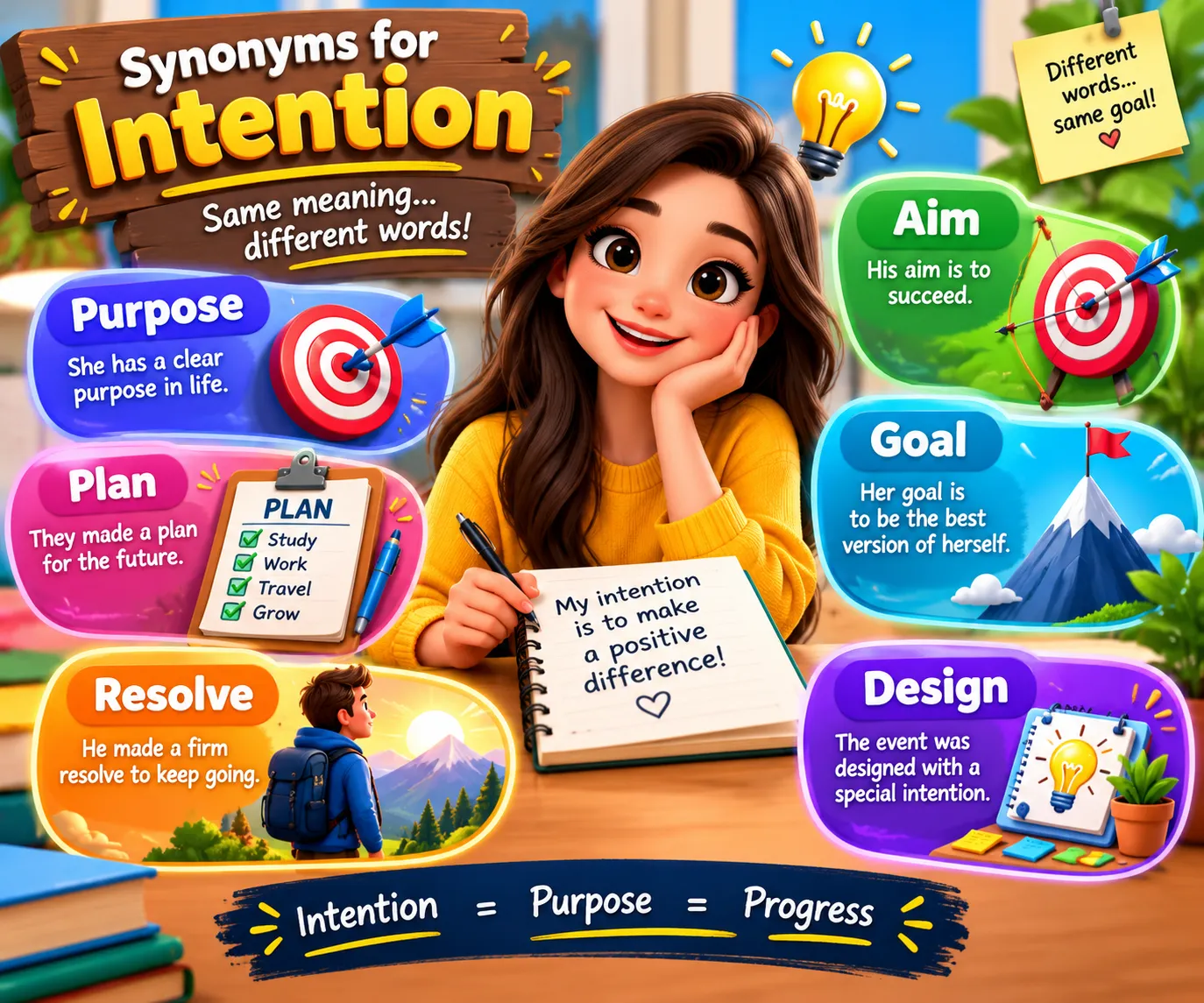
Synonyms for intention include purpose, aim, goal, plan, objective, intent, ambition, and determination. These words describe what someone wants to do or achieve.
Intention means something you plan or want to do. For example, you may have the intention to learn English, help a friend, or start a new business. Your intention shows what you hope to do and why you want to do it.
I often use the word intention when talking about plans, goals, and personal choices. However, using the same word too often can make writing sound repetitive. Learning synonyms for intention helps you express your thoughts in a clear and natural way. For example, purpose highlights the reason behind an action, while aim focuses on the result you want to reach.
In this guide, you will learn the meaning, history, pronunciation, and grammar of intention. You will also discover 30 useful synonyms with simple meanings and examples. These words can help you improve your English vocabulary and make your writing more effective.
Meaning of Intention
Definition
Intention (Noun): A plan, purpose, or decision to do something.
Examples
- My intention is to improve my English every day.
- She had no intention of hurting anyone.
Connotative Meaning
Connotation: The feeling or idea a word suggests beyond its basic meaning.
- Positive tone: Intention can suggest kindness, honesty, or a desire to help. Example: His intention was to support his team.
- Negative tone: It can suggest a harmful or dishonest plan. Example: The police questioned his intention to damage the property.
- Neutral tone: It can simply describe a plan or aim. Example: My intention is to finish the project today.
Etymology
| Historical Period | Origin and Development of Intention |
| Latin Origin | Comes from Latin intentio, meaning “a stretching toward,” purpose, or aim. |
| Old English (450–1100) | Intention was not commonly used in Old English. People used native words related to purpose, will, and desire. |
| Middle English (1100–1500) | The word entered English through French and Latin influence, referring to a purpose, aim, or mental focus. |
| Modern English (1500–Present) | Intention became a common noun meaning a plan, purpose, or desired action. |
Pronunciation (IPA)
- IPA: /ɪnˈtenʃən/
- Syllables: in-ten-tion
Affixation Pattern of Intention
- Root: Latin tendere, meaning “to stretch,” through the Latin form intentio.
- Prefix: In- appears in the Latin formation and contributes to the word’s historical development.
- Suffix: -tion forms a noun that expresses an action, process, or result.
Word Formations
- Intend (Verb): To plan or mean to do something.
- Intended (Adjective/Verb): Planned or meant for a particular purpose.
- Intending (Verb): Planning or meaning to do something.
- Intention (Noun): A plan or purpose.
- Intentions (Plural Noun): More than one plan or purpose.
- Intentional (Adjective): Done on purpose.
- Intentionally (Adverb): In a planned or deliberate way.
- Intentionality (Noun): The quality or state of being intentional.
- Unintentional (Adjective): Not done on purpose.
- Unintentionally (Adverb): Without meaning to do something.
30 Synonyms of Intention With Meaning and Examples
1. Purpose (Noun)
Meaning: The reason for doing something.
Examples:
- The purpose of this meeting is to solve the problem.
- Her purpose was to help young students.
2. Aim (Noun)
Meaning: Something you want to achieve.
Examples:
- My aim is to speak English with confidence.
- The team’s main aim is to win the match.
3. Goal (Noun)
Meaning: A result that someone wants to reach.
Examples:
- His goal is to become a teacher.
- We set a goal to save more money.
4. Plan (Noun)
Meaning: An idea or set of steps for doing something.
Examples:
- My plan is to study every evening.
- They made a plan to open a shop.
5. Objective (Noun)
Meaning: A clear result that someone wants to achieve.
Examples:
- Our objective is to improve customer service.
- She reached her main objective this year.
6. Intent (Noun)
Meaning: A purpose or plan to do something.
Examples:
- His intent was to tell the truth.
- The teacher asked about her intent.
7. Ambition (Noun)
Meaning: A strong desire to achieve something important.
Examples:
- Her ambition is to become a doctor.
- He worked hard to fulfill his ambition.
8. Aspiration (Noun)
Meaning: A strong hope or desire to achieve something.
Examples:
- His aspiration is to study abroad.
- She shared her career aspirations with her mentor.
9. Determination (Noun)
Meaning: A firm decision to do something or reach a goal.
Examples:
- Her determination helped her finish the race.
- He showed determination during difficult times.
10. Resolve (Noun)
Meaning: A firm decision to do something.
Examples:
- She showed resolve when facing a challenge.
- His resolve to succeed never changed.
11. Desire (Noun)
Meaning: A strong wish to have or do something.
Examples:
- Her desire is to help others.
- He has a strong desire to learn new skills.
12. Wish (Noun)
Meaning: Something that someone wants to happen.
Examples:
- My wish is to see my family happy.
- She expressed a wish to travel abroad.
13. Aspiration (Noun)
Meaning: A hope or goal for the future.
Examples:
- Teaching is one of his greatest aspirations.
- Her aspiration is to build a successful career.
14. Motive (Noun)
Meaning: The reason behind someone’s action.
Examples:
- The police asked about his motive.
- Her motive was to protect her friend.
15. Reason (Noun)
Meaning: The cause or explanation for an action.
Examples:
- The reason for my visit is to ask for advice.
- He explained his reason for leaving early.
16. Objective (Noun)
Meaning: A specific result someone plans to achieve.
Examples:
- The company’s objective is to increase sales.
- Our objective is to finish the work on time.
17. Design (Noun)
Meaning: A plan or intention behind an action.
Examples:
- It was not my design to upset anyone.
- The plan was carried out by design.
18. Scheme (Noun)
Meaning: A planned method or arrangement, sometimes dishonest.
Examples:
- They developed a scheme to reduce waste.
- The fraud was part of a dishonest scheme.
19. Agenda (Noun)
Meaning: A list of aims or matters to be dealt with.
Examples:
- The meeting has a clear agenda.
- She questioned the group’s hidden agenda.
20. Mission (Noun)
Meaning: An important task or purpose.
Examples:
- Their mission is to provide clean water.
- He sees teaching as his mission.
21. Commitment (Noun)
Meaning: A promise or firm decision to do something.
Examples:
- Her commitment to learning is clear.
- He made a commitment to help the team.
22. Decision (Noun)
Meaning: A choice made after thinking about something.
Examples:
- My decision is to continue my studies.
- She made the decision to start a business.
23. Proposal (Noun)
Meaning: A plan or suggestion offered for others to consider.
Examples:
- His proposal was to build a new library.
- The manager accepted her proposal.
24. Expectation (Noun)
Meaning: A belief about what will happen or what someone should do.
Examples:
- Her expectation was to finish by Friday.
- We discussed our expectations for the project.
25. Outlook (Noun)
Meaning: A way of thinking about or planning for the future.
Examples:
- He has a positive outlook for his career.
- The company’s outlook is focused on growth.
26. Inclination (Noun)
Meaning: A natural tendency or preference to do something.
Examples:
- She has an inclination to help others.
- He felt an inclination to accept the offer.
27. Will (Noun)
Meaning: The ability or desire to make a choice or do something.
Examples:
- She has the will to succeed.
- His will to improve remained strong.
28. Plan of Action (Noun Phrase)
Meaning: A set of steps designed to reach a goal.
Examples:
- We need a plan of action to solve the issue.
- The team agreed on a plan of action.
29. Target (Noun)
Meaning: A specific result or goal someone wants to reach.
Examples:
- Our target is to finish ten tasks today.
- She set a target for her monthly savings.
30. Undertaking (Noun)
Meaning: A task or project that someone agrees or intends to carry out.
Examples:
- Building the school was a major undertaking.
- He began the undertaking with care.
Usage note: Some words above are related to intention rather than exact substitutes. Choose the synonym that best matches your sentence.
Prototype Meaning
The most typical meaning of intention is a plan or purpose that exists in someone’s mind before they act. When people hear this word, they often imagine a person deciding what to do and why. For example, a student may have the intention to study harder, or a worker may intend to finish a task before the deadline. The word can describe good, bad, or neutral plans. It focuses on what someone means or plans to do, even if the action has not happened yet.
Prototype Categorization
| Semantic Category | Synonyms | Meaning and Use |
| Purpose and Reason | Purpose, motive, reason, intent, design | Explain why someone acts or plans to do something. |
| Goals and Results | Aim, goal, objective, target | Describe the result someone wants to achieve. |
| Plans and Arrangements | Plan, agenda, scheme, proposal, plan of action | Describe how someone expects or plans to act. |
| Hope and Ambition | Aspiration, ambition, desire, wish, expectation | Express what someone hopes or wants to achieve. |
| Commitment and Determination | Determination, resolve, commitment, will | Show a firm decision, strong effort, or dedication. |
| Tasks and Responsibilities | Mission, undertaking, decision | Describe a chosen task, commitment, or course of action. |
| Personal Tendency and Future Thinking | Inclination, outlook | Describe a natural preference or a way of thinking about the future. |
Antonyms of Intention
- Accident (Noun): Something that happens without being planned. Example: Breaking the glass was an accident.
- Chance (Noun): Something that happens without a clear plan. Example: We met by chance.
- Unintentional (Adjective): Not done on purpose. Example: The mistake was unintentional.
- Unplanned (Adjective): Not arranged or decided in advance. Example: Their visit was unplanned.
- Haphazardness (Noun): A lack of order or planning. Example: The haphazardness of the process caused delays.
- Aimlessness (Noun): A lack of purpose or direction. Example: He felt a sense of aimlessness after leaving his job.
Note: Intention has no single exact antonym. The best opposite depends on whether you mean a plan, a purpose, or a deliberate action.
Short Questions and Answers
What does intention mean?
Intention means a plan, purpose, or decision to do something.
When should intention be used?
Use intention when talking about what someone plans or means to do. For example, “My intention is to finish the work today.”
Is intention positive or negative?
Intention is neutral. It can describe a kind, harmful, or ordinary plan, depending on the context.
How is intention different from similar words?
Intention is a general plan or purpose. Purpose emphasizes the reason behind an action, goal focuses on the desired result, and motive explains why someone acts.
Conclusion
Learning synonyms for intention can help you express your plans, goals, and reasons with greater clarity. Words such as purpose, aim, and objective work well when discussing goals. Words like motive and reason explain why someone acts, while resolve and determination show a firm decision.
Using these alternatives also helps you avoid repeating the same word in essays, emails, conversations, and other writing. The best synonym depends on your meaning and the situation. Try learning a few new words each day and using them in your own sentences. With regular practice, you can build a stronger vocabulary, improve your speaking and writing, and feel more confident when using English.
Read More:
Synonyms for First of All: 30 Useful Alternatives

I’m Rubab, a content specialist at SameSynonym, focused on synonyms, antonyms, word meanings, and English vocabulary.
I create clear, well-researched content with accurate definitions and practical examples.
My goal is to help readers improve their vocabulary and writing with confidence.










