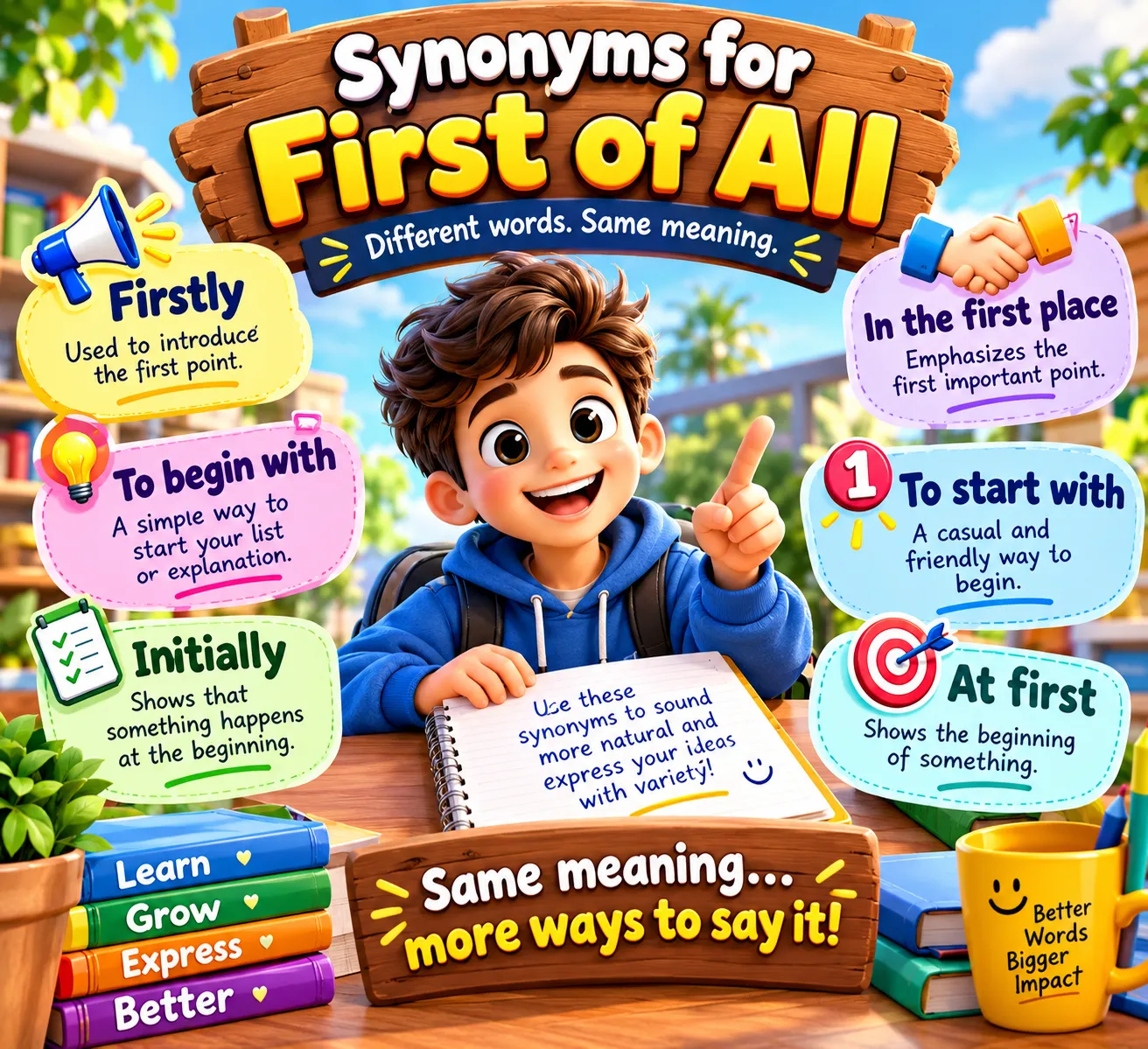
Synonyms for first of all include firstly, to begin with, first, initially, above all, most importantly, and to start with. These phrases help introduce a point, organize ideas, or highlight what matters most.
I often use the phrase first of all when I want to explain an idea in a clear order. For example, when I give instructions, I may say, “First of all, read the question carefully.” This phrase helps readers and listeners know that the first point is coming.
However, using first of all too often can make writing sound repetitive. Learning synonyms gives you more ways to start a sentence, organize your thoughts, and make your message clear. For example, firstly works well in a list, while most importantly highlights a key point. The best choice depends on what you want to say.
In this guide, I will explain the meaning, history, pronunciation, and grammar of first of all. You will also learn 30 alternatives with simple meanings and examples, plus semantic categories to help you choose the right phrase.
Meaning of First of All
Definition
First of all (adverbial phrase): A phrase used to introduce the first point in a list or discussion. It can also introduce the most important point.
Examples
- First of all, wash your hands before cooking.
- First of all, we need to understand the problem.
Connotative Meaning
(Connotation means the feeling or idea a word or phrase suggests beyond its basic meaning.)
- Positive tone: Sounds clear, organized, and helpful.
- Negative tone: May sound impatient or forceful if used to correct someone.
- Neutral tone: Simply marks the start of a list or explanation.
Etymology
The phrase first of all is made from older English words. It developed naturally as English speakers used first to show order and of all to refer to a whole group of things.
- Old English (450–1100): First developed from Old English fyrst, meaning “foremost” or “earliest.” The word all came from Old English eall, meaning “the whole” or “every.”
- Middle English (1100–1500): Forms of first and all continued to be used in everyday speech. Phrases that marked order became common in explanations and lists.
- Modern English (1500–present): First of all became a common phrase for introducing an opening point or emphasizing an important idea.
Pronunciation (IPA)
- IPA: /ˌfɜːst əv ˈɔːl/ (British English); /ˌfɝːst əv ˈɔːl/ (American English)
- Syllables: first of all (3 spoken syllables)
Affixation Pattern of First of All
| Word or Form | Grammatical Category | Meaning or Use |
| First of all | Adverbial phrase | Introduces the first point or an important idea. |
| First | Adjective, adverb, or noun | Refers to the earliest person, thing, or action. |
| Firstly | Adverb | Introduces the first point in a list. |
| First-rate | Adjective | Describes something of excellent quality. |
| Firsthand | Adjective or adverb | Refers to direct experience or knowledge. |
| Firstborn | Noun or adjective | Refers to the first child born in a family. |
| All | Determiner, pronoun, or adverb | Refers to the whole amount or group. |
| Overall | Adjective or adverb | Refers to the general or total view of something. |
- Note: First of all is a phrase, so it does not take a prefix or suffix as a complete unit. These are related words and forms, not all direct derivatives of the phrase.
30 Synonyms of First of All With Meaning and Examples
1. First (Adverb)
Meaning: Before anything else in a sequence.
Examples:
- First, open your book.
- First, let us check the facts.
2. Firstly (Adverb)
Meaning: Used to introduce the first point in a list.
Examples:
- Firstly, we need a clear plan.
- Firstly, check that all the doors are locked.
3. To Begin With (Adverbial Phrase)
Meaning: Used to introduce the starting point of an explanation.
Examples:
- To begin with, let us review the rules.
- To begin with, the room needs cleaning.
4. To Start With (Adverbial Phrase)
Meaning: Used to introduce the first step or idea.
Examples:
- To start with, write your name.
- To start with, we will discuss the main problem.
5. Initially (Adverb)
Meaning: At the beginning of a process or situation.
Examples:
- Initially, the task seemed easy.
- Initially, we planned to travel by bus.
6. At First (Adverbial Phrase)
Meaning: During the early part of a situation.
Examples:
- At first, I did not understand the lesson.
- At first, the new job felt difficult.
7. In the First Place (Adverbial Phrase)
Meaning: Used to introduce an original reason or a basic point.
Examples:
- In the first place, we need enough time.
- Why did you agree in the first place?
8. Before Anything Else (Adverbial Phrase)
Meaning: Before doing or considering other things.
Examples:
- Before anything else, save your work.
- Before anything else, we must keep everyone safe.
9. To Start Off (Adverbial Phrase)
Meaning: Used to introduce the beginning of an activity or discussion.
Examples:
- To start off, I will share a short story.
- To start off, let us introduce ourselves.
10. For Starters (Adverbial Phrase)
Meaning: Used informally to introduce the first point or example.
Examples:
- For starters, we need more chairs.
- For starters, this plan costs too much.
11. First and Foremost (Adverbial Phrase)
Meaning: Used to emphasize the most important point or priority.
Examples:
- First and foremost, we must protect the children.
- First and foremost, honesty matters.
12. Above All (Adverbial Phrase)
Meaning: More than anything else; most importantly.
Examples:
- Above all, be kind to others.
- Above all, we need to stay safe.
13. Most Importantly (Adverb)
Meaning: Used to introduce the point that matters most.
Examples:
- Most importantly, everyone must understand the rules.
- Most importantly, the patient needs rest.
14. Primarily (Adverb)
Meaning: Mainly or chiefly; used to state the main focus.
Examples:
- The course is primarily for beginners.
- Primarily, our goal is to help students learn.
15. Chiefly (Adverb)
Meaning: Mainly or more than anything else.
Examples:
- The book is chiefly about family life.
- Chiefly, we need to focus on safety.
16. Principally (Adverb)
Meaning: Mainly; used to identify the central purpose or reason.
Examples:
- The meeting is principally about the budget.
- The group works principally with young people.
17. To Start Things Off (Adverbial Phrase)
Meaning: Used to introduce the first action in an event or activity.
Examples:
- To start things off, we played a short game.
- To start things off, the teacher asked a question.
18. As a First Step (Adverbial Phrase)
Meaning: Used to introduce the first action in a process.
Examples:
- As a first step, make a list of your goals.
- As a first step, we should gather the facts.
19. For One Thing (Adverbial Phrase)
Meaning: Used to introduce one reason or point among several.
Examples:
- For one thing, the plan is too costly.
- For one thing, we do not have enough time.
20. To Begin (Adverbial Phrase)
Meaning: Used to introduce the start of an explanation or activity.
Examples:
- To begin, I would like to thank everyone.
- To begin, let us look at the main issue.
21. At the Outset (Adverbial Phrase)
Meaning: At the beginning of an event, process, or discussion.
Examples:
- At the outset, we agreed on the rules.
- At the outset, the project had a small budget.
22. From the Start (Adverbial Phrase)
Meaning: From the very beginning of something.
Examples:
- From the start, she knew what she wanted.
- From the start, we worked as a team.
23. In the Beginning (Adverbial Phrase)
Meaning: During the early part of a period or process.
Examples:
- In the beginning, learning English felt hard.
- In the beginning, the business had only two workers.
24. To Kick Things Off (Adverbial Phrase)
Meaning: Used informally to introduce the first activity or event.
Examples:
- To kick things off, let us hear from the host.
- To kick things off, the team shared its ideas.
25. As a Starting Point (Noun Phrase)
Meaning: A first idea or step used to begin further work.
Examples:
- As a starting point, use this simple guide.
- We can use the report as a starting point.
26. First of All Else (Phrase — Unnatural)
Meaning: An uncommon and unnatural construction sometimes intended to mean “before everything else.”
Examples:
- This phrase is not recommended in standard English.
- Use “before anything else” to express the idea clearly.
27. At the Very Beginning (Adverbial Phrase)
Meaning: At the earliest point of something.
Examples:
- At the very beginning, explain the goal.
- At the very beginning, we made a simple mistake.
28. Before All Else (Adverbial Phrase)
Meaning: Before other things; often used to express a strong priority.
Examples:
- Before all else, we must act with care.
- Before all else, the safety of the team comes first.
29. To Lead Off (Phrasal Verb)
Meaning: To be the first person or thing to speak, act, or appear.
Examples:
- The chairperson will lead off the meeting.
- She led off with a short introduction.
30. As a Priority (Adverbial Phrase)
Meaning: In a way that gives something special importance or attention.
Examples:
- We should treat safety as a priority.
- Please handle the urgent request as a priority.
Usage note: Not every phrase above is interchangeable with first of all. For a simple sequence, use first, firstly, or to begin with. For emphasis, use above all or most importantly. Some phrases, such as primarily and chiefly, mean “mainly” rather than “first in order.”
Prototype Meaning
The most common meaning of first of all is to introduce the first point in a list, explanation, or set of instructions. People usually expect the speaker to explain the next step or idea after hearing it. The phrase can also signal that a point is especially important, depending on the context.
Prototype Categorization
The synonyms for first of all can be grouped by their main use. These categories help writers choose a phrase that fits the message.
- Order and Sequence: First, firstly, to begin with, to start with, initially.
- Beginning a Process: To start off, to start things off, as a first step, at the outset, from the start.
- Importance and Priority: First and foremost, above all, most importantly, as a priority, before all else.
- Informal Introductions: For starters, to kick things off, for one thing.
- Main Focus or Purpose: Primarily, chiefly, principally.
- Time and Early Stages: At first, in the beginning, at the very beginning.
- Opening a Discussion: To begin, in the first place, before anything else, as a starting point.
- Leading or Starting an Event: To lead off.
Choosing the right category helps you avoid awkward wording. Use sequence words to organize steps, priority phrases to highlight importance, and informal phrases when speaking with friends or in casual settings.
Antonyms of First of All
| Opposite | Grammatical Category | Meaning |
| Finally | Adverb | At the end of a series or process. |
| Lastly | Adverb | Used to introduce the final point in a list. |
| Ultimately | Adverb | At the end of a process or after considering everything. |
| Eventually | Adverb | After some time or a series of events. |
| At the end | Adverbial phrase | At the final point of something. |
| Last of all | Adverbial phrase | After all the other items or actions. |
- Note: These expressions can serve as opposites of first of all when it refers to the beginning or first point of a sequence.
Short Questions and Answers
What does first of all mean?
It means “to begin with” or “before anything else.” It introduces the first point or a key idea.
When should first of all be used?
Use it when starting a list, giving instructions, or introducing an opening point in a discussion.
Is first of all positive or negative?
It is usually neutral. Its tone depends on the context and the speaker’s voice.
How is it different from similar phrases?
Firstly usually introduces a point in a list. Above all highlights importance. Initially refers to an early stage, while first of all often introduces the opening point.
Conclusion
Learning synonyms for first of all can make your English clearer and more varied. Phrases such as firstly, to begin with, and to start with help you organize ideas. Alternatives such as above all and most importantly help you show which points matter most. Choosing the right phrase also makes your writing easier to follow and your speech more natural.
Try using one new phrase each day in a sentence, an email, or a short paragraph. Pay attention to its meaning and tone before using it. With regular practice, you can avoid repetition, build a stronger vocabulary, and feel more confident when speaking or writing in English.
Read More:
Synonyms for Monumental: 30 Powerful Words to Know
I’m Noor Fatima, an English content writer at SameSynonyms.com, specializing in synonyms, antonyms, word meanings, and English vocabulary. I create clear, well-researched content with practical examples to help readers understand word usage, expand their vocabulary, and communicate more effectively.










