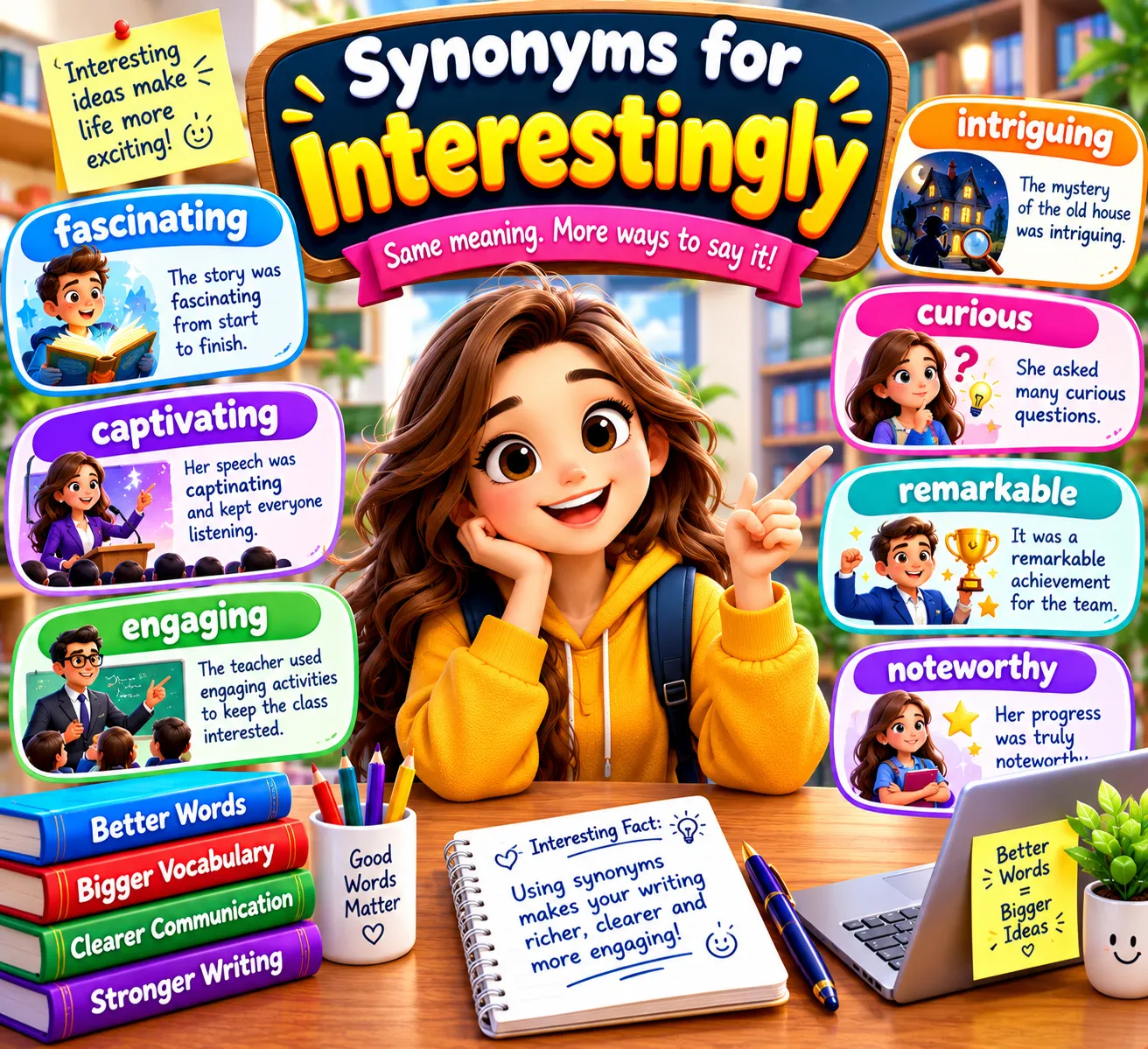
Synonyms for interestingly include surprisingly, remarkably, notably, curiously, intriguingly, fascinatingly, and unexpectedly. These words help highlight unusual facts, important details, and surprising information.
Interestingly means in a way that attracts attention, creates curiosity, or presents something surprising. For example, you might say, “Interestingly, both students gave the same answer.” This word helps you share facts, introduce new ideas, and highlight details that people may not expect.
It is common in everyday conversations, essays, reports, and online articles. However, using the same word too often can make your writing feel repetitive. Learning synonyms for interestingly helps English learners and content writers express ideas in fresh and clear ways.
In this guide, you will learn the meaning, pronunciation, history, and grammar of the word. You will also explore 30 alternatives, with simple meanings and examples, so you can choose the right word for each situation.
Meaning of Interestingly
Definition
Interestingly (adverb): In a way that attracts attention, creates interest, or presents something surprising or worth knowing.
Examples
- Interestingly, the two friends chose the same book.
- Interestingly, the old map showed a road that no longer exists.
Connotative Meaning
(Connotation: the feeling or idea that a word suggests beyond its basic meaning.)
- Positive tone: Suggests something useful, exciting, or worth learning.
- Negative tone: May introduce an awkward, unexpected, or troubling fact.
- Neutral tone: Simply points out a detail that deserves attention.
Etymology
| Period | History and Development |
| Old English (450–1100) | The modern word interestingly did not exist in its current form. English used other words to express curiosity and attention. |
| Middle English (1100–1500) | Interest entered English through Old French, from Latin interesse, meaning “to matter” or “to concern.” |
| Modern English (1500–present) | Interesting developed from interest with the suffix -ing. The suffix -ly then formed the adverb interestingly, meaning “in an interesting way.” |
Pronunciation (IPA)
- IPA: /ˈɪn.trəs.tɪŋ.li/
- Syllables: in-ter-est-ing-ly
Affixation Pattern of Interestingly
- Root: Interest
- Prefix: None
- Suffixes: -ing forms interesting; -ly forms interestingly.
Related word formations:
- Interest (noun/verb): A feeling of curiosity; to attract attention.
- Interested (adjective): Wanting to know more about something.
- Interesting (adjective): Holding attention or creating curiosity.
- Interestingly (adverb): In a way that attracts attention.
- Interest-free (adjective): Not requiring interest payments.
- Uninteresting (adjective): Not attracting attention or curiosity.
- Uninterested (adjective): Not showing interest in something.
30 Synonyms of Interestingly With Meaning and Examples
Note: Some alternatives are close synonyms, while others fit only certain contexts. Choose one that matches your sentence.
1. Remarkably (Adverb)
Meaning: In a way that is unusual or worthy of notice.
Examples:
- Remarkably, she finished the race without resting.
- The old building is remarkably well preserved.
2. Surprisingly (Adverb)
Meaning: In a way that causes surprise.
Examples:
- Surprisingly, the shy student gave the best speech.
- Surprisingly, the shop was open late.
3. Notably (Adverb)
Meaning: In a way that is important or worth noticing.
Examples:
- Notably, sales rose during the winter.
- The team performed well, notably in the final round.
4. Curiously (Adverb)
Meaning: In a way that shows curiosity or describes something unusual.
Examples:
- Curiously, nobody asked about the missing key.
- Curiously, the two stories had the same ending.
5. Intriguingly (Adverb)
Meaning: In a way that creates interest or a desire to know more.
Examples:
- Intriguingly, the letter had no name on it.
- The film intriguingly links two different stories.
6. Fascinatingly (Adverb)
Meaning: In a way that holds strong interest.
Examples:
- Fascinatingly, the book explains how birds find their way home.
- The speaker fascinatingly described life under the sea.
7. Astonishingly (Adverb)
Meaning: In a way that causes great surprise.
Examples:
- Astonishingly, the child solved the puzzle in seconds.
- Astonishingly, the small team won every match.
8. Remarkedly (Adverb)
Meaning: This is not a standard synonym in modern English; use remarkably instead.
Examples:
- Remarkably, the plant grew through the dry season.
- She remained remarkably calm during the test.
9. Unexpectedly (Adverb)
Meaning: In a way that was not expected.
Examples:
- Unexpectedly, our old teacher visited the school.
- The weather changed unexpectedly in the afternoon.
10. Unusually (Adverb)
Meaning: In a way that is different from what is normal.
Examples:
- Unusually, the streets were quiet on Friday.
- The water was unusually warm for October.
11. Significantly (Adverb)
Meaning: In a way that is important or has a noticeable effect.
Examples:
- Significantly, fewer people missed work this month.
- The new method significantly reduced waste.
12. Importantly (Adverb)
Meaning: In a way that highlights something important.
Examples:
- Importantly, all students had a chance to speak.
- Importantly, the plan keeps costs low.
13. Remarkably Enough (Adverbial Phrase)
Meaning: Used to emphasize a surprising or notable fact.
Examples:
- Remarkably enough, both teams finished with the same score.
- Remarkably enough, the old clock still works.
14. As It Happens (Adverbial Phrase)
Meaning: Used to introduce a fact that is relevant or unexpected.
Examples:
- As it happens, I know the author.
- As it happens, we have an extra ticket.
15. It Is Interesting to Note (Phrase)
Meaning: Used to draw attention to a fact worth considering.
Examples:
- It is interesting to note that both results were similar.
- It is interesting to note how quickly the town has grown.
16. Signally (Adverb)
Meaning: In a way that is especially notable or important; this is formal and uncommon.
Examples:
- The policy was signally successful in its main goal.
- Her work was signally important to the project.
17. Oddly (Adverb)
Meaning: In a way that seems strange or unusual.
Examples:
- Oddly, the lights turned on by themselves.
- Oddly, he remembered every detail except the date.
18. Strangely (Adverb)
Meaning: In a way that seems unusual or hard to explain.
Examples:
- Strangely, nobody heard the alarm.
- The room felt strangely familiar.
19. Ironically (Adverb)
Meaning: In a way that shows an unexpected contrast between what is expected and what happens.
Examples:
- Ironically, the fire station was damaged by fire.
- Ironically, the person who taught safety forgot their helmet.
20. Amusingly (Adverb)
Meaning: In a way that makes people smile or laugh.
Examples:
- Amusingly, the dog tried to copy its owner.
- The story amusingly describes a mix-up at the airport.
21. Entertainingly (Adverb)
Meaning: In a way that holds attention and gives enjoyment.
Examples:
- The guide entertainingly explained the town’s history.
- She entertainingly told us about her travels.
22. Engagingly (Adverb)
Meaning: In a way that attracts and keeps attention.
Examples:
- The teacher engagingly explained the lesson.
- He spoke engagingly about his new project.
23. Thoughtfully (Adverb)
Meaning: In a way that shows careful thought or consideration.
Examples:
- She thoughtfully raised a question about the results.
- He thoughtfully explained both sides of the issue.
24. Informatively (Adverb)
Meaning: In a way that gives useful information.
Examples:
- The guide informatively described each historic site.
- The report informatively explains the main causes.
25. Enlighteningly (Adverb)
Meaning: In a way that helps people understand something better.
Examples:
- The speaker enlighteningly explained the local tradition.
- The article enlighteningly explores the causes of the problem.
26. Revealingly (Adverb)
Meaning: In a way that shows something not known before.
Examples:
- Revealingly, the survey showed a gap between the two groups.
- She spoke revealingly about the team’s early struggles.
27. Evidently (Adverb)
Meaning: In a way that suggests something is clear from the available facts.
Examples:
- Evidently, the new system works well.
- Evidently, they had already discussed the plan.
28. Apparently (Adverb)
Meaning: Based on what seems to be true or what has been reported.
Examples:
- Apparently, the train arrived ahead of schedule.
- Apparently, the two neighbors share a hobby.
29. Remarkable as It May Seem (Phrase)
Meaning: Used to introduce a fact that may be hard to believe.
Examples:
- Remarkable as it may seem, the bird returned every spring.
- Remarkable as it may seem, the old bridge survived the storm.
30. Worth Noting (Phrase)
Meaning: Describes a fact that deserves attention.
Examples:
- Worth noting, the final cost was lower than expected.
- One detail worth noting is the change in attendance.
Prototype Meaning
The most typical meaning of interestingly is “in a way that makes a fact worth noticing.” People often use it at the start of a sentence to introduce a surprising detail, an unusual result, or a useful point. For example, “Interestingly, both students reached the same answer” signals that the result deserves attention. The word does not always mean that something is funny or exciting. It may simply show that a fact is unusual or useful to know.
Prototype Categorization
These categories help writers choose an alternative that matches their meaning and tone.
- Surprise and Unexpected Events: Surprisingly, astonishingly, unexpectedly, unusually.
- Importance and Notice: Remarkably, notably, significantly, importantly, worth noting.
- Curiosity and Mystery: Curiously, intriguingly, oddly, strangely.
- Strong Interest and Engagement: Fascinatingly, engagingly, entertainingly, informatively, enlighteningly.
- Humor and Contrast: Amusingly, ironically.
- Evidence and New Information: Revealingly, evidently, apparently.
- Introducing a Relevant Fact: As it happens, it is interesting to note, remarkably enough, remarkable as it may seem.
- Careful Thought and Formal Emphasis: Thoughtfully, signally.
Not all these expressions can replace interestingly in every sentence. For example, ironically signals a contrast, while surprisingly highlights an unexpected result. Choosing the right one makes your writing clearer and more precise.
Antonyms of Interestingly
- There is no perfect opposite for interestingly, but these words can work as antonyms in certain contexts.
| Antonym | Part of Speech | Meaning |
| Boringly | Adverb | In a way that does not hold attention. |
| Dully | Adverb | In a way that lacks energy or interest. |
| Tediously | Adverb | In a way that feels too long or repetitive. |
| Unremarkably | Adverb | In a way that is ordinary or not worth special notice. |
| Ordinarily | Adverb | In a usual or common way. |
| Predictably | Adverb | In a way that is expected and not surprising. |
| Monotonously | Adverb | In a way that lacks variety. |
Short Questions and Answers
What does interestingly mean?
Interestingly means in a way that attracts attention or presents something worth knowing.
When should interestingly be used?
Use it when introducing a surprising fact, an unusual detail, or a point that may interest the reader.
Is interestingly positive or negative?
It is usually neutral or positive. Its tone depends on the fact being discussed and the context.
How is interestingly different from similar words?
Interestingly draws attention to a fact. Surprisingly shows that something was unexpected, ironically highlights a contrast, and remarkably emphasizes something unusual or impressive.
Conclusion
Learning synonyms for interestingly can help you become a clearer and more confident English writer. Words such as surprisingly, notably, intriguingly, and remarkably help you express different shades of meaning. Some show surprise, while others highlight importance, mystery, or new information.
The best choice depends on your sentence and the point you want to make. Avoid replacing interestingly with a synonym just to sound different; make sure the new word fits the meaning.
Try learning one or two alternatives each day and use them in your own sentences. With regular practice, you can build a stronger vocabulary, reduce repetition, and make your writing more natural and engaging.
Read More:
Synonyms for Oligarchy: 30 Powerful Alternatives

I’m Noor Fatima, an English content writer at SameSynonyms.com, specializing in synonyms, antonyms, word meanings, and English vocabulary. I create clear, well-researched content with practical examples to help readers understand word usage, expand their vocabulary, and communicate more effectively.