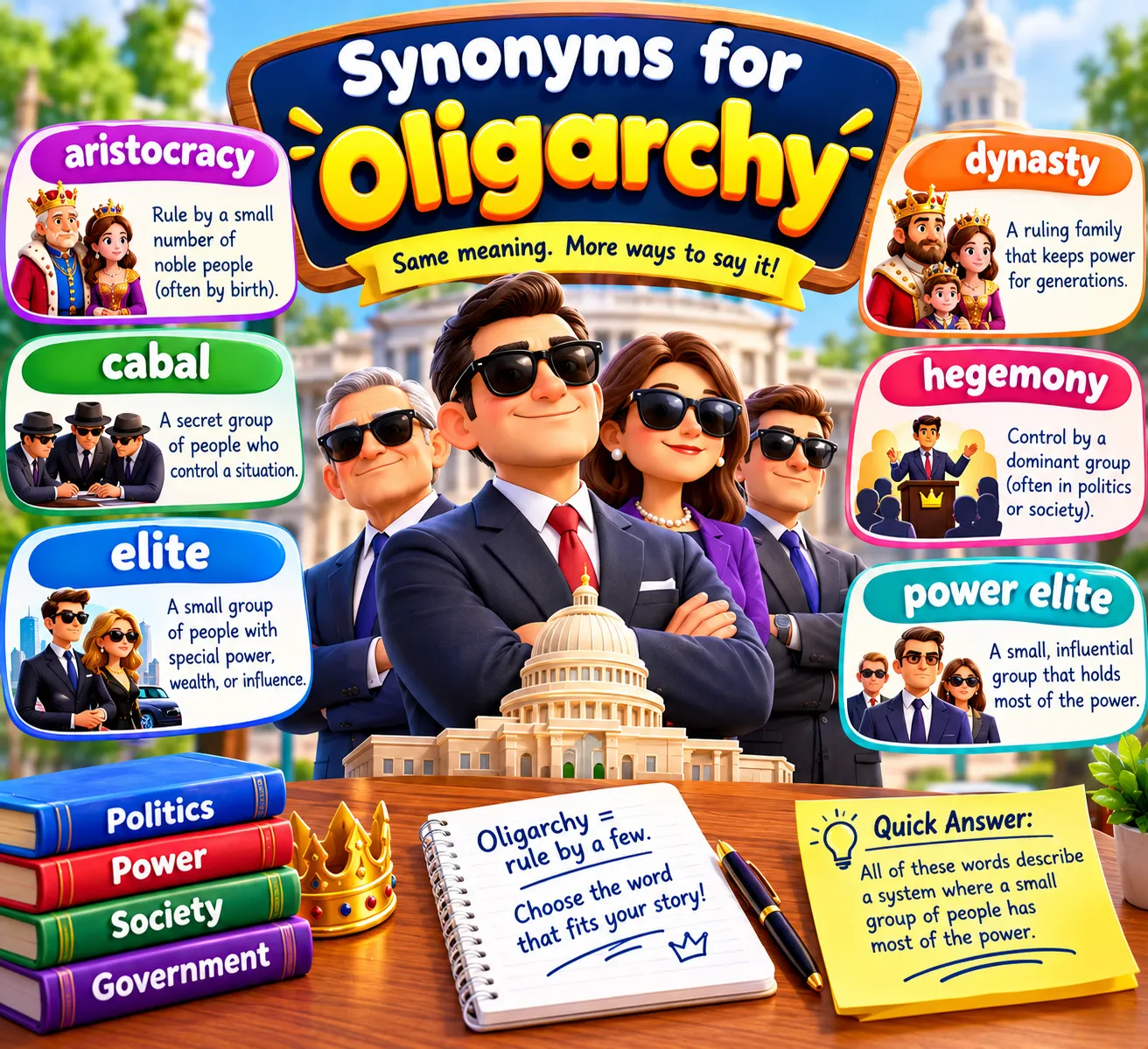
Synonyms for oligarchy include plutocracy, elite rule, minority rule, aristocracy, ruling elite, and oligarchic control. These terms describe systems where power is held by a small or privileged group.
An oligarchy is a system of government in which a small group of people holds most of the power. Imagine a country where a few wealthy families or powerful leaders make key decisions for everyone else. This is an example of an oligarchy. The word is often used in politics, history, and social studies to explain how power is shared or controlled.
Learning synonyms for oligarchy can help you understand political texts and express ideas with greater accuracy. It can also help students, researchers, and content writers avoid repeating the same word. However, not every synonym has the same meaning. Some describe rule by a few people, while others focus on wealth, privilege, or elite power.
In this guide, you will learn the meaning, history, pronunciation, and grammar of oligarchy. You will also explore 30 related words and phrases, with simple meanings and examples to help you choose the right term.
Meaning of Oligarchy
Definition
Oligarchy (noun): A system of government or control in which a small group of people holds most of the power.
Examples
- The country was ruled by an oligarchy of wealthy families.
- Critics said that a small group of business leaders had created an oligarchy.
Connotative Meaning
Connotation (the feeling or idea a word suggests beyond its basic meaning):
- Positive tone: In some contexts, it may suggest rule by experienced or capable leaders, though this is uncommon.
- Negative tone: It often suggests unfair control, privilege, or the abuse of power by a small group.
- Neutral tone: It can simply describe a political system in which power rests with a few people.
Etymology of Oligarchy
The word oligarchy comes from Greek and has been used in English for centuries.
- Old English (450–1100): Oligarchy was not a standard Old English word. Political ideas were expressed using other terms.
- Middle English (1100–1500): The word entered English through learned and Latin-influenced usage, drawing on the Greek political term.
- Modern English (1500–present): Oligarchy became established as a term for government or control by a small group, especially in political and historical writing.
The word comes from Greek oligoi, meaning “few,” and arkhein, meaning “to rule.”
Pronunciation (IPA)
- IPA: /ˈɒlɪɡɑːki/ (British English); /ˈɑːləɡɑːrki/ (American English, with regional variation)
- Syllables: ol-i-gar-chy
Affixation Pattern of Oligarchy
| Category | Word or Element | Explanation |
| Root | Olig- | From Greek oligoi, meaning “few.” |
| Root element | -archy | From Greek arkhia, meaning “rule” or “government.” |
| Prefix | None | Oligarchy has no separate modern English prefix. |
| Suffix | -archy | A word-forming element found in terms related to systems of rule. |
| Related word | Oligarch (noun) | A person who belongs to or has power in an oligarchy. |
| Related word | Oligarchic (adjective) | Relating to an oligarchy. |
| Related word | Oligarchical (adjective) | Relating to or characteristic of oligarchy. |
| Related word | Oligarchically (adverb) | In an oligarchic way. |
30 Synonyms of Oligarchy With Meaning and Examples
Many words related to oligarchy describe specific forms of government or elite control. They are not all exact synonyms, so the context matters.
1. Plutocracy (Noun)
Meaning: A system in which wealthy people hold political power.
Examples:
- Critics called the country a plutocracy.
- The new policies seemed to favor a small group of wealthy citizens.
2. Aristocracy (Noun)
Meaning: A system in which power belongs to a privileged or noble class.
Examples:
- The aristocracy controlled much of the nation’s land.
- The old aristocracy had great influence over the king.
3. Autocracy (Noun)
Meaning: A system in which one person holds supreme power.
Examples:
- The nation moved from democracy to autocracy.
- Under autocracy, one ruler makes most major decisions.
4. Elite Rule (Noun Phrase)
Meaning: A system in which a small, powerful group controls decisions.
Examples:
- The protest was against elite rule.
- Many citizens felt excluded under elite rule.
5. Minority Rule (Noun Phrase)
Meaning: A system in which a small group governs the larger population.
Examples:
- The movement challenged minority rule.
- Minority rule can create tension when most citizens lack a voice.
6. Rule by the Few (Noun Phrase)
Meaning: Government or control held by a small number of people.
Examples:
- The philosopher criticized rule by the few.
- The system became an example of rule by the few.
7. Kleptocracy (Noun)
Meaning: A system in which leaders use public power to steal wealth.
Examples:
- The investigation exposed corruption in the kleptocracy.
- Citizens demanded reform after years of kleptocracy.
8. Timocracy (Noun)
Meaning: In classical political philosophy, a government associated with honor or property-based status; its meaning varies by tradition.
Examples:
- The student studied Plato’s account of timocracy.
- The book compares timocracy with other classical systems of government.
9. Oligarchic Rule (Noun Phrase)
Meaning: Government controlled by a small and powerful group.
Examples:
- Oligarchic rule limited public influence.
- The reform aimed to weaken oligarchic rule.
10. Elite Domination (Noun Phrase)
Meaning: Control exercised by a small, privileged group.
Examples:
- The report described elite domination of the economy.
- Voters called for an end to elite domination.
11. Corporate Oligarchy (Noun Phrase)
Meaning: A system in which a small group of corporate leaders or firms holds great influence.
Examples:
- The author warned against corporate oligarchy.
- Critics argued that corporate oligarchy weakened competition.
12. Financial Oligarchy (Noun Phrase)
Meaning: Control by a small group of wealthy financiers or financial institutions.
Examples:
- The article examined the rise of financial oligarchy.
- Financial oligarchy can shape public policy.
13. Military Oligarchy (Noun Phrase)
Meaning: A system in which a small group of military leaders holds power.
Examples:
- The country came under a military oligarchy.
- The military oligarchy resisted political reform.
14. Ruling Elite (Noun Phrase)
Meaning: The small group of people who hold the most political or social power.
Examples:
- The ruling elite opposed the proposed changes.
- The ruling elite had close ties to major industries.
15. Power Elite (Noun Phrase)
Meaning: A small group that has strong influence over major institutions and decisions.
Examples:
- The study explored how the power elite shaped policy.
- Members of the power elite often met behind closed doors.
16. Privileged Class (Noun Phrase)
Meaning: A group that enjoys special advantages or social status.
Examples:
- The privileged class had greater access to education.
- The reform aimed to reduce the power of the privileged class.
17. Establishment (Noun)
Meaning: The group of people and institutions that hold established power.
Examples:
- The candidate promised to challenge the establishment.
- The establishment resisted changes to the political system.
18. Elitism (Noun)
Meaning: The belief that a select group is superior or should have greater influence.
Examples:
- Voters criticized the party’s elitism.
- The debate focused on elitism in public institutions.
19. Oligarchic System (Noun Phrase)
Meaning: A political or social system controlled by a small group.
Examples:
- The constitution was designed to prevent an oligarchic system.
- Critics argued that the oligarchic system favored insiders.
20. Power Monopoly (Noun Phrase)
Meaning: Control of power concentrated in one person or group, leaving little room for others.
Examples:
- The reforms aimed to break the ruling group’s power monopoly.
- A power monopoly can weaken public accountability.
21. Concentrated Power (Noun Phrase)
Meaning: Power held by a small number of people or institutions.
Examples:
- Concentrated power can make leaders hard to challenge.
- The new law sought to limit concentrated power.
22. Authoritarian Rule (Noun Phrase)
Meaning: A system in which leaders exercise strong control and limit political freedoms.
Examples:
- The nation struggled under authoritarian rule.
- Citizens called for an end to authoritarian rule.
23. Despotism (Noun)
Meaning: Government by a ruler who uses power in a cruel or oppressive way.
Examples:
- The revolution began after years of despotism.
- The writer warned that despotism destroys freedom.
24. Tyranny (Noun)
Meaning: Cruel or unjust use of power.
Examples:
- The people rose against tyranny.
- The speech warned against the tyranny of unchecked leaders.
25. Hierarchy (Noun)
Meaning: A system in which people or groups are ranked by authority or status.
Examples:
- The organization had a strict hierarchy.
- A small group sat at the top of the hierarchy.
26. Social Stratification (Noun Phrase)
Meaning: The division of society into different social levels or classes.
Examples:
- The research examined social stratification.
- Social stratification affected access to education and jobs.
27. Class Rule (Noun Phrase)
Meaning: Control exercised by a particular social or economic class.
Examples:
- The movement challenged class rule.
- The historian studied the effects of class rule.
28. Wealth Based Rule (Noun Phrase)
Meaning: A system in which wealth gives people strong political control.
Examples:
- The reform sought to end wealth-based rule.
- Wealth-based rule can give rich citizens an unfair advantage.
29. One Party Rule (Noun Phrase)
Meaning: A system in which one political party controls the government.
Examples:
- The country remained under one-party rule for decades.
- One-party rule restricted political competition.
30. Oligarchic Control (Noun Phrase)
Meaning: Control over decisions or resources held by a small group.
Examples:
- The investigation revealed oligarchic control of key industries.
- The activists wanted to reduce oligarchic control of public resources.
Prototype Meaning of Oligarchy
The most typical meaning of oligarchy is a system in which a small group holds most of the power. People often imagine wealthy business leaders, influential families, military officials, or political insiders making important decisions. The group may control government, business, or other major institutions. Unlike democracy, where citizens have a role in choosing their leaders, an oligarchy concentrates power among a few people. However, oligarchy does not always mean that the rulers are wealthy; their power may also come from family ties, military influence, or political connections.
Prototype Categorization of Oligarchy Synonyms
The 30 alternatives can be grouped by their main meanings. These categories help writers choose words that fit the political system or type of power they want to describe.
| Semantic Category | Synonyms | When to Use |
| Wealth-Based Power | Plutocracy, financial oligarchy, wealth-based rule, corporate oligarchy | When wealth, finance, or business influence shapes control. |
| Rule by a Small Group | Elite rule, minority rule, rule by the few, oligarchic rule, oligarchic system, oligarchic control | When a small group holds most of the power. |
| Social and Political Elites | Aristocracy, ruling elite, power elite, privileged class, establishment, elitism | When discussing privilege, status, or influential groups. |
| Military and Institutional Power | Military oligarchy, one-party rule, hierarchy, concentrated power, power monopoly | When power is held by military leaders, one party, or a narrow institution. |
| Oppressive or Abusive Rule | Kleptocracy, despotism, tyranny, authoritarian rule | When leaders steal public wealth, suppress freedom, or misuse power. |
| Social and Economic Structures | Social stratification, class rule, elite domination | When discussing class divisions and unequal influence. |
| Other Forms of Government | Autocracy, timocracy | When comparing oligarchy with other political systems. |
Note: These terms are related, but they are not all exact synonyms. For example, plutocracy focuses on wealth, kleptocracy on theft by rulers, and autocracy on power held by one person. Choose the term that matches the facts.
Antonyms of Oligarchy
There is no single perfect antonym for oligarchy, but these terms describe systems with a different distribution of power.
- Democracy (Noun): A system in which citizens have a role in governing, often through elections.
- Popular Government (Noun Phrase): A government based on the will or participation of the people.
- Participatory Democracy (Noun Phrase): A system that encourages citizens to take an active role in decisions.
- Political Equality (Noun Phrase): The principle that people should have equal political rights and standing.
- Power-Sharing (Noun): A system in which authority is divided among groups or institutions.
- Decentralization (Noun): The transfer of power from a central authority to local bodies or other groups.
- Egalitarianism (Noun): The belief that people should have equal rights and opportunities.
Short Questions and Answers
What does oligarchy mean?
Oligarchy means a system of government or control in which a small group of people holds most of the power.
When should oligarchy be used?
Use oligarchy when discussing political systems, social structures, or institutions where power is concentrated among a few people.
Is oligarchy positive or negative?
The word often has a negative tone because it can suggest unequal power and limited public influence. However, it can also be used as a neutral political term.
How is oligarchy different from similar words?
Oligarchy means rule by a small group. Plutocracy means rule by the wealthy, aristocracy refers to rule by a privileged or noble class, and autocracy means rule by one person.
Conclusion
Learning synonyms for oligarchy can improve your vocabulary and help you write about politics, history, and society with greater accuracy. Words such as plutocracy, elite rule, minority rule, and authoritarian rule describe different forms of power, but each has its own meaning. Understanding these differences helps you avoid mistakes and express your ideas more clearly.
These terms are useful for students, researchers, content writers, and anyone who wants to understand political discussions. They can also help you avoid repetition in essays and articles. Practice using one new word each day, read examples in context, and check its meaning before using it.
With regular practice, you can build stronger vocabulary, improve your writing, and discuss complex political ideas with greater confidence.
Read More:
Synonyms for Along With: 30 Better Words and Phrases

I’m Rubab, a content specialist at SameSynonym, focused on synonyms, antonyms, word meanings, and English vocabulary.
I create clear, well-researched content with accurate definitions and practical examples.
My goal is to help readers improve their vocabulary and writing with confidence.