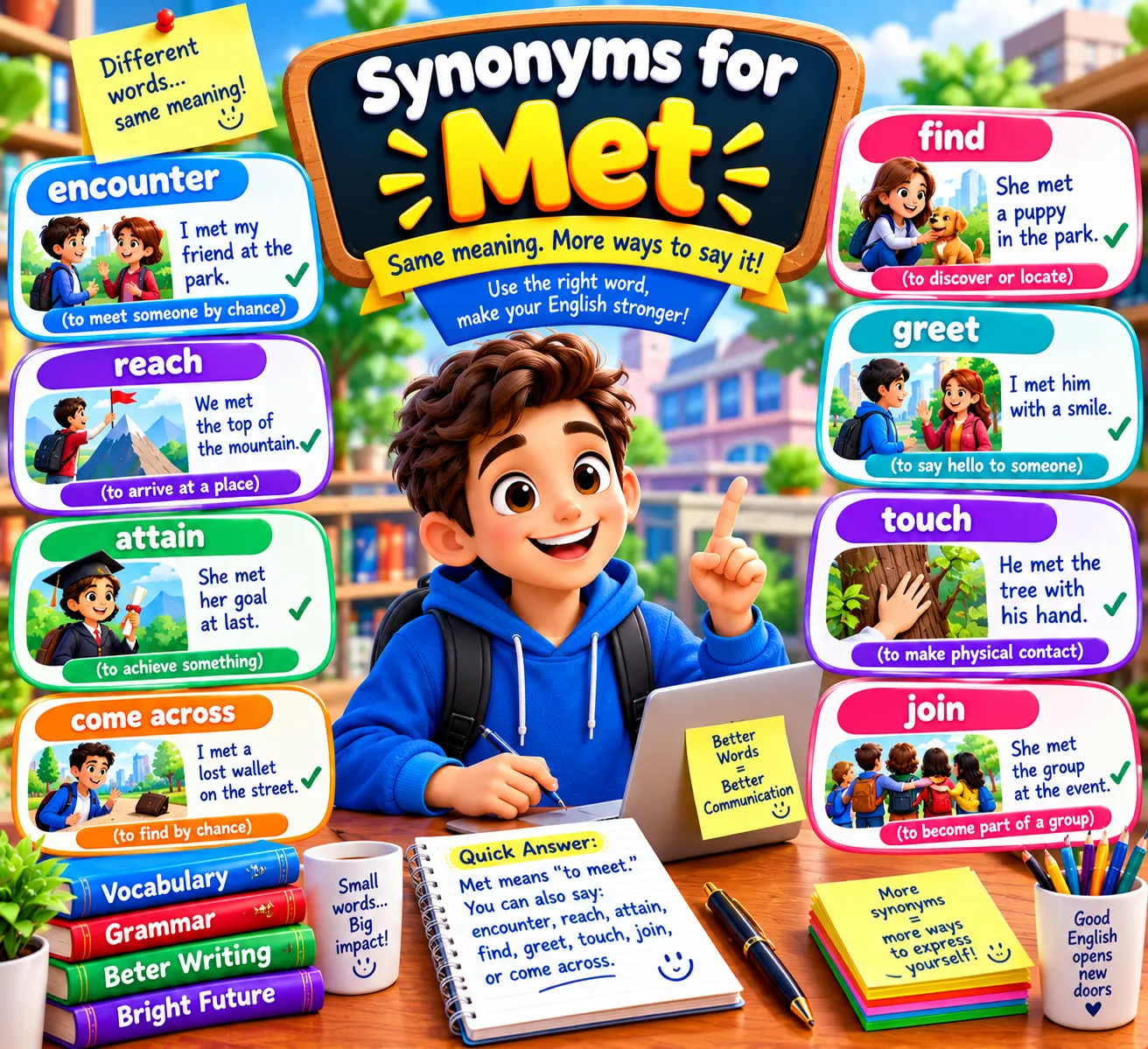
Synonyms for met include encountered, greeted, saw, visited, connected with, gathered, assembled, and came across. The best choice depends on whether you mean meeting a person, joining a group, or experiencing someone by chance.
I have often used the word met when writing stories, emails, and talking about past events. It is a simple word that helps us describe seeing someone, meeting a new friend, or facing a challenge.
However, using met too often can make writing sound repetitive. Learning its synonyms can help you express your ideas in a clearer and more natural way. Words like encountered, greeted, reunited, and connected with can add variety to your sentences.
In this article, I will explain the meaning, pronunciation, history, and grammar of met. I will also share 30 useful synonyms with simple meanings and examples to help you improve your vocabulary and make your English writing more engaging.
Meaning of Met
Definition
Met (verb): Met is the past tense and past participle of meet. It means to come together with someone, see someone, get to know a person, or encounter someone or something.
Examples
- I met my new teacher yesterday.
- We met at the library after class.
Connotative Meaning
(Connotation: the feeling or idea a word suggests beyond its basic meaning.)
- Positive tone: Met a wonderful friend or met an inspiring teacher.
- Negative tone: Met a difficult challenge or met with strong opposition.
- Neutral tone: Met a colleague at work or met someone at the station.
Etymology of Met
| Historical Period | Development of “Met” |
| Old English (450–1100) | The verb mētan meant to find, encounter, or come upon someone or something. |
| Middle English (1100–1500) | The word developed into forms such as meten, with meanings related to meeting, finding, and encountering. |
| Modern English (1500–present) | Met became the standard past tense and past participle of meet. |
Pronunciation (IPA)
- IPA: /mɛt/
- Syllables: (One syllable) met
Affixation Pattern of Met
- Root: Meet
- Prefix: None.
- Suffix: None in met. It is an irregular past-tense form of meet.
Related Word Formations
- Meet (verb/noun): To come together or a planned gathering.
- Meeting (noun): An event where people come together.
- Meets (verb): Comes together with someone or fulfills a need.
- Met (verb): Past tense and past participle of meet.
- Meetup (noun): An informal gathering.
- Meetinghouse (noun): A building used for religious or community meetings.
30 Synonyms of Met With Meanings and Examples
1. Encountered (Verb)
Meaning: Came across or experienced someone or something.
Examples:
- I encountered an old friend downtown.
- She encountered a problem at work.
2. Greeted (Verb)
Meaning: Welcomed someone with words or actions.
Examples:
- I greeted my teacher at the door.
- They greeted their guests with smiles.
3. Saw (Verb)
Meaning: Visited or spent time with someone, or noticed someone.
Examples:
- I saw my cousin yesterday.
- She saw her manager before lunch.
4. Visited (Verb)
Meaning: Went to see a person or place.
Examples:
- We visited our grandparents last weekend.
- He visited his friend after work.
5. Faced (Verb)
Meaning: Came up against a problem, challenge, or situation.
Examples:
- She faced a difficult choice.
- They faced many challenges during the project.
6. Came Across (Verb Phrase)
Meaning: Found or encountered someone or something, often by chance.
Examples:
- I came across an old friend at the market.
- She came across an interesting article online.
7. Ran Into (Verb Phrase)
Meaning: Met someone unexpectedly.
Examples:
- I ran into my neighbor at the store.
- We ran into our former teacher downtown.
8. Encountered by Chance (Verb Phrase)
Meaning: Met or found someone without planning to.
Examples:
- I encountered an old classmate by chance.
- She encountered a helpful stranger by chance.
9. Joined (Verb)
Meaning: Became part of a group or activity.
Examples:
- I joined my friends for lunch.
- He joined the team meeting late.
10. Gathered (Verb)
Meaning: Came together with other people in one place.
Examples:
- We gathered at the park.
- The family gathered for dinner.
11. Assembled (Verb)
Meaning: Came together as a group, often for a purpose.
Examples:
- The workers assembled in the hall.
- The committee assembled to discuss the plan.
12. Convened (Verb)
Meaning: Came together for a formal meeting.
Examples:
- The board convened on Monday.
- The committee convened to review the results.
13. Reunited (Verb)
Meaning: Came together again after being apart.
Examples:
- I reunited with my childhood friend.
- The family reunited after many years.
14. Reconnected (Verb)
Meaning: Renewed contact with someone after a period apart.
Examples:
- I reconnected with an old classmate.
- She reconnected with her former colleagues.
15. Welcomed (Verb)
Meaning: Received someone warmly.
Examples:
- We welcomed the new students.
- They welcomed their guests into the house.
16. Consulted (Verb)
Meaning: Spoke with someone to get advice or information.
Examples:
- I consulted my doctor about the issue.
- She consulted her manager before making a decision.
17. Confered (Verb)
Meaning: Discussed something with another person to reach a decision.
Examples:
- The managers conferred before the announcement.
- We conferred with our adviser about the project.
18. Interviewed (Verb)
Meaning: Asked someone questions to learn about them or their views.
Examples:
- I interviewed three job candidates.
- She interviewed the author for her article.
19. Encountered Face-to-Face (Verb Phrase)
Meaning: Came into direct, personal contact with someone.
Examples:
- I encountered the speaker face-to-face.
- They met the client face-to-face to discuss the deal.
20. Spoke With (Verb Phrase)
Meaning: Had a conversation with someone.
Examples:
- I spoke with my teacher after class.
- She spoke with the director about the plan.
21. Talked To (Verb Phrase)
Meaning: Had a conversation with someone.
Examples:
- I talked to my neighbor yesterday.
- He talked to his coach after practice.
22. Socialized With (Verb Phrase)
Meaning: Spent time talking or enjoying activities with others.
Examples:
- I socialized with my colleagues after work.
- She socialized with other parents at the event.
23. Encountered in Person (Verb Phrase)
Meaning: Met someone physically rather than online or by phone.
Examples:
- I encountered the researcher in person.
- We met the new team members in person.
24. Crossed Paths With (Verb Phrase)
Meaning: Met someone, often unexpectedly or briefly.
Examples:
- I crossed paths with my former boss.
- She crossed paths with an old friend at the airport.
25. Bumped Into (Verb Phrase)
Meaning: Met someone unexpectedly.
Examples:
- I bumped into my cousin at the mall.
- He bumped into a former colleague on his way home.
26. Encountered an Obstacle (Verb Phrase)
Meaning: Faced a difficulty that slowed progress.
Examples:
- We encountered an obstacle during the project.
- The team encountered several obstacles along the way.
27. Experienced (Verb)
Meaning: Went through an event, feeling, or situation.
Examples:
- She experienced great success in her career.
- We experienced delays during the journey.
28. Discovered (Verb)
Meaning: Found or learned about someone or something.
Examples:
- I discovered a useful website yesterday.
- She discovered a new talent during the course.
29. Came Face-to-Face With (Verb Phrase)
Meaning: Met or confronted someone or something directly.
Examples:
- He came face-to-face with his rival.
- We came face-to-face with a serious problem.
30. Had an Appointment With (Verb Phrase)
Meaning: Met someone at a planned time for a specific purpose.
Examples:
- I had an appointment with my dentist.
- She had an appointment with her adviser.
Usage note: “Confered” in item 17 should be spelled conferred. Also, not all these expressions can replace met in every sentence. Choose based on the intended meaning.
Prototype Meaning
The most common meaning of met is that two or more people came together or saw each other. People often imagine meeting a friend, greeting a new colleague, or getting together for a planned event. However, met can also describe encountering a problem, experiencing resistance, or fulfilling a requirement, as in “The team met its goal.”
Prototype Categorization
| Semantic Category | Synonyms for Met | Best Used When |
| Meeting People | Encountered, saw, visited, greeted, came across | Describing meeting or seeing someone. |
| Unexpected Meetings | Ran into, bumped into, crossed paths with, encountered by chance | Describing an unplanned meeting. |
| Planned or Formal Meetings | Convened, assembled, gathered, had an appointment with | Describing an organized or scheduled meeting. |
| Conversation and Advice | Spoke with, talked to, consulted, conferred | Describing a discussion or seeking advice. |
| Renewing Relationships | Reunited, reconnected, socialized with, welcomed | Describing reconnecting with people or spending time together. |
| Challenges and Experiences | Faced, experienced, encountered an obstacle, came face-to-face with | Describing challenges or difficult situations. |
| Learning and Professional Interaction | Interviewed, discovered, joined, encountered in person | Describing interviews, new information, or professional contact. |
Antonyms of Met
- Avoided (verb): Stayed away from someone or something.
- Missed (verb): Failed to see or connect with someone.
- Ignored (verb): Paid no attention to someone.
- Evaded (verb): Deliberately stayed away from a person or situation.
- Separated (verb): Moved apart from someone or something.
- Departed (verb): Left a place rather than staying to meet someone.
- Disregarded (verb): Chose not to consider or pay attention to something.
Short Questions and Answers
What does met mean?
Met is the past tense of meet. It means came together with someone, saw someone, or encountered something.
When should met be used?
Use met to talk about a meeting or encounter that happened in the past. For example, “I met my new colleague yesterday.”
Is met positive or negative?
Met is usually neutral. The surrounding words determine whether the situation sounds positive or negative.
How is met different from similar words?
Greeted focuses on welcoming someone, encountered often suggests finding someone or something, and reunited means meeting again after being apart.
Conclusion
Learning synonyms for met helps you express ideas more clearly in English. Words such as greeted, encountered, reconnected, and consulted describe different kinds of meetings and interactions. Choosing the right word can make your writing more specific and reduce repetition in essays, emails, stories, and everyday conversations.
Remember that synonyms do not always have exactly the same meaning. Think about whether the meeting was planned, unexpected, formal, or personal before choosing an alternative. Practice using a few new words each day in your own sentences. Over time, this habit can build your vocabulary, improve your speaking and writing, and help you feel more confident when communicating in English.
Read More:
Synonyms for Lead on Resume: 30 Strong Alternatives

I’m Rubab, a content specialist at SameSynonym, focused on synonyms, antonyms, word meanings, and English vocabulary.
I create clear, well-researched content with accurate definitions and practical examples.
My goal is to help readers improve their vocabulary and writing with confidence.