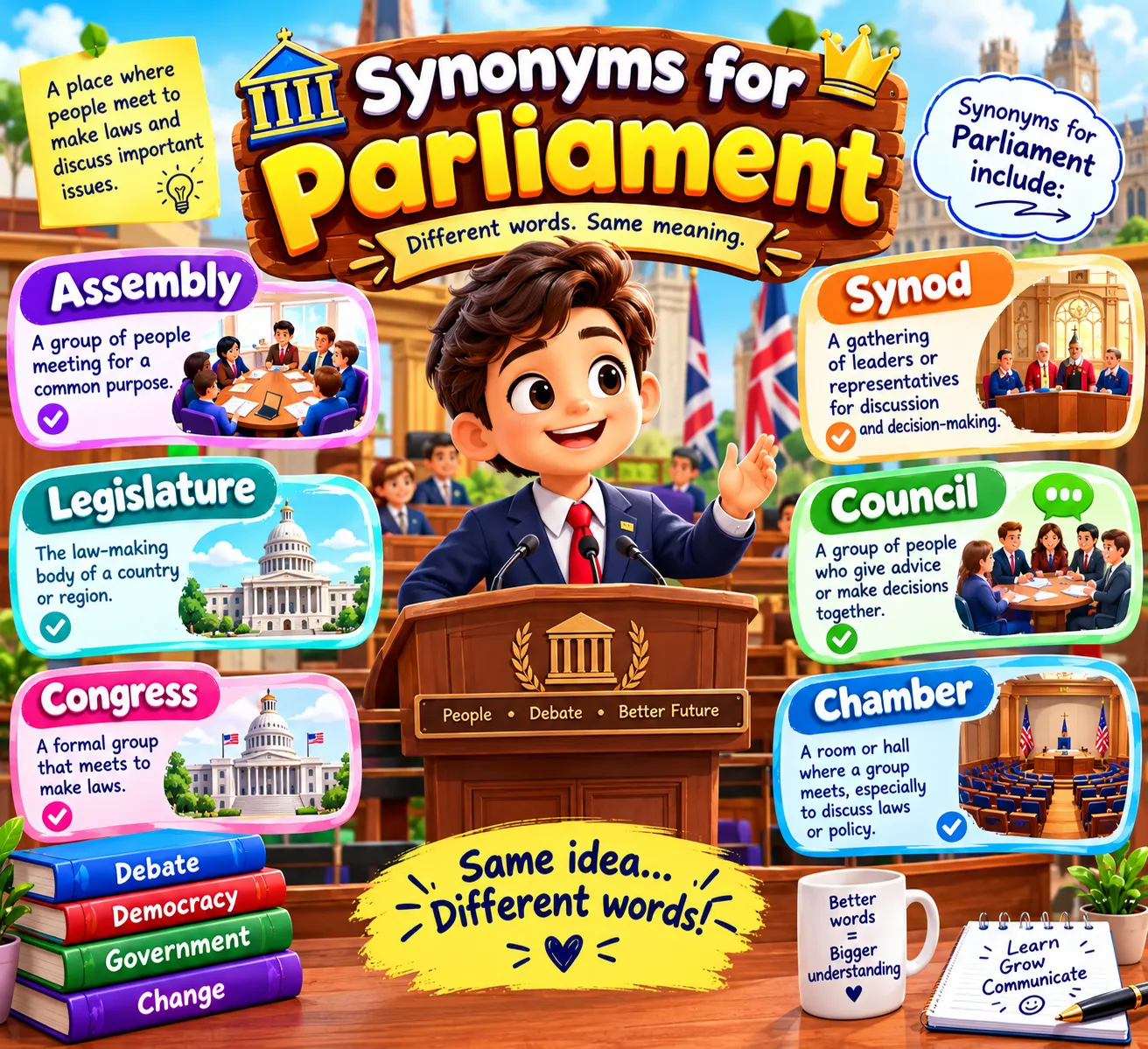
Synonyms for parliament include legislature, national assembly, congress, legislative body, and governing assembly. The best alternative depends on the country, political system, and political context.
Parliament is a group of people who meet to make laws, discuss public issues, and help govern a country. For example, when a country needs a new law about schools or roads, members of parliament may discuss the idea and vote on it. You may hear this word in news reports, history lessons, and political debates.
Learning synonyms for parliament helps you understand political news and express ideas in different ways. It also helps English learners build vocabulary and content writers avoid repeating the same word.
However, not every alternative means exactly the same thing. Some words refer to a lawmaking body in a specific country, while others describe a wider group of lawmakers. In this guide, you will learn 30 related words and phrases, their meanings, examples, grammar, history, pronunciation, and semantic categories.
Meaning of Parliament
Definition
Parliament (noun): A group of elected or appointed representatives who meet to make laws, discuss national issues, and oversee government.
Examples
- Parliament voted on the new education bill.
- The members of parliament discussed ways to improve public transport.
Connotative Meaning
(Connotation: the feeling or idea a word suggests beyond its basic meaning.)
- Positive tone: Parliament may suggest democracy, public service, debate, and fair representation.
- Negative tone: It may suggest political conflict, delays, or disagreements.
- Neutral tone: It can simply refer to a country’s lawmaking body.
Etymology of Parliament
The word parliament came into English through Anglo-French parlement, linked to parler, meaning “to speak.” It refers to a meeting or discussion.
| Period | Development |
| Old English (450–1100) | Parliament was not a regular Old English word. People used other words for meetings and discussions. |
| Middle English (1100–1500) | The word entered English through Anglo-French and was used for formal discussions and assemblies, especially those involving rulers and advisers. |
| Modern English (1500–Present) | Parliament became the common term for a national or regional lawmaking body, especially in countries such as the United Kingdom and Canada. |
Pronunciation (IPA)
- IPA: /ˈpɑː.lə.mənt/ (British English)
- Syllables: par-lia-ment (three syllables in common teaching division)
Affixation Pattern of Parliament
- Root: Parliament
- Prefix: None in the basic word.
- Suffix: No separate productive suffix is added in the modern base word parliament.
Related Word Formations
- Parliament (noun): A body of lawmakers.
- Parliamentary (adjective): Related to parliament or its procedures.
- Parliamentarian (noun): A member of parliament or an expert in parliamentary procedure.
- Parliamentarianism (noun): A system or principle of government based on a parliament.
- Parliamentarians (plural noun): Members of parliament or experts in parliamentary procedure.
- Parliaments (plural noun): More than one parliament.
- Parliamentarily (adverb): In a parliamentary manner; uncommon.
30 Synonyms of Parliament With Meaning and Examples
These words and phrases are alternatives in certain contexts, not exact replacements in every sentence. The official name of a country’s lawmaking body may differ.
1. Legislature (Noun)
Meaning: A group or institution with the power to make laws.
Examples:
- The legislature approved the new law.
- The state legislature discussed school funding.
2. Legislative Body (Noun)
Meaning: An organization whose main role is to make laws.
Examples:
- The legislative body met to review the proposal.
- The country has a two-part legislative body.
3. National Assembly (Noun)
Meaning: A national lawmaking body, often used as its official name in some countries.
Examples:
- The National Assembly debated the budget.
- Members of the National Assembly proposed new rules.
4. Congress (Noun)
Meaning: A lawmaking body, especially the national legislature of the United States.
Examples:
- Congress passed a new spending bill.
- The proposal was sent to Congress for review.
5. House of Representatives (Noun)
Meaning: A legislative chamber whose members usually represent the public.
Examples:
- The House of Representatives voted on the bill.
- She watched a debate in the House of Representatives.
6. House of Commons (Noun)
Meaning: The elected lower house of the UK Parliament and some other parliamentary systems.
Examples:
- The House of Commons discussed the proposal.
- Members questioned the minister in the House of Commons.
7. Senate (Noun)
Meaning: A legislative chamber that forms part of some national or regional legislatures.
Examples:
- The Senate reviewed the proposed law.
- The bill must pass the Senate before it can become law.
8. Legislative Assembly (Noun)
Meaning: A formal assembly that makes laws, often at a state or provincial level.
Examples:
- The Legislative Assembly debated the education plan.
- The province’s Legislative Assembly opened its session.
9. Federal Legislature (Noun)
Meaning: A lawmaking body that operates at the national level in a federal country.
Examples:
- The federal legislature considered tax changes.
- The proposal was presented to the federal legislature.
10. National Legislature (Noun)
Meaning: The lawmaking institution of a country.
Examples:
- The national legislature approved the budget.
- The issue was raised in the national legislature.
11. Lawmaking Body (Noun)
Meaning: A group or institution responsible for creating laws.
Examples:
- The lawmaking body discussed public safety.
- The new rule must be approved by the lawmaking body.
12. Lawmaking Assembly (Noun)
Meaning: A formal group that meets to discuss and create laws.
Examples:
- The lawmaking assembly held a special session.
- Members of the lawmaking assembly reviewed the draft law.
13. Legislative Chamber (Noun)
Meaning: One section or house of a larger legislative institution.
Examples:
- The legislative chamber voted on the proposal.
- The country has two legislative chambers.
14. Deliberative Assembly (Noun)
Meaning: A formal group that meets to discuss issues and make decisions.
Examples:
- The deliberative assembly considered several options.
- Members presented their views to the deliberative assembly.
15. Representative Assembly (Noun)
Meaning: A group of people chosen to represent others in making decisions.
Examples:
- The representative assembly discussed local needs.
- Citizens elected members to the representative assembly.
16. National Parliament (Noun)
Meaning: The main lawmaking institution of a country.
Examples:
- The national parliament passed the reform bill.
- The issue was debated in the national parliament.
17. Provincial Assembly (Noun)
Meaning: A lawmaking body that serves a province in some countries.
Examples:
- The Provincial Assembly discussed health services.
- Members of the Provincial Assembly proposed a new policy.
18. State Legislature (Noun)
Meaning: A lawmaking body that governs a state within a federal system.
Examples:
- The state legislature approved the funding.
- The state legislature introduced a new bill.
19. Council of Representatives (Noun)
Meaning: A body of representatives that discusses issues or makes decisions; its exact powers depend on the country.
Examples:
- The Council of Representatives debated the proposal.
- Members of the Council of Representatives met for a special session.
20. Legislative Council (Noun)
Meaning: A legislative body or chamber, often with a reviewing role in certain political systems.
Examples:
- The Legislative Council reviewed the draft law.
- The bill was discussed in the Legislative Council.
21. People’s Assembly (Noun)
Meaning: An assembly presented as representing the people, often used as an official name in some countries.
Examples:
- The People’s Assembly met to discuss reforms.
- The proposal was presented to the People’s Assembly.
22. People’s Representatives (Plural Noun)
Meaning: People chosen to speak or act on behalf of citizens.
Examples:
- The people’s representatives debated the new policy.
- Citizens contacted their people’s representatives about the issue.
23. Elected Assembly (Noun)
Meaning: A group whose members are chosen through an election.
Examples:
- The elected assembly reviewed the proposed law.
- Voters chose new members of the elected assembly.
24. Lawmakers (Plural Noun)
Meaning: People who create, discuss, or approve laws.
Examples:
- Lawmakers debated the new tax plan.
- The lawmakers met to discuss public safety.
25. Legislators (Plural Noun)
Meaning: People who serve in a legislative body and help make laws.
Examples:
- Legislators considered changes to the school system.
- The legislators voted on the bill.
26. Parliamentary Assembly (Noun)
Meaning: A formal assembly that operates within a parliamentary or representative system.
Examples:
- The parliamentary assembly discussed regional concerns.
- Delegates attended the parliamentary assembly.
27. Governing Assembly (Noun)
Meaning: An assembly that has an official role in governing or making rules.
Examples:
- The governing assembly considered the proposed changes.
- Members of the governing assembly met to review the plan.
28. National Council (Noun)
Meaning: A council that serves a national role; in some countries, it is the official name of a legislative chamber or body.
Examples:
- The National Council reviewed the legislation.
- Members of the National Council discussed the proposal.
29. People’s Congress (Noun)
Meaning: A representative or legislative body, used as an official name in some political systems.
Examples:
- The People’s Congress held its annual session.
- Members of the People’s Congress reviewed the policy.
30. Parliamentary Institution (Noun)
Meaning: An institution that forms part of a parliamentary system or supports its work.
Examples:
- The parliamentary institution oversees important public debates.
- The report explains how the parliamentary institution works.
Prototype Meaning
The most typical meaning of parliament is a national group of representatives who meet to discuss public matters and make laws. People often picture a debating chamber where elected members speak, question government officials, and vote on proposed laws. The exact structure differs by country. Some parliaments have one chamber, while others have two. The central idea is a formal institution that represents the public and takes part in lawmaking.
Prototype Categorization
The 30 synonyms for parliament can be grouped into semantic categories based on their meaning and use. This helps writers choose the right term for each country, institution, or political context.
| Semantic Category | Synonyms | Description |
| General Lawmaking Bodies | Legislature, legislative body, lawmaking body, national legislature, national parliament | General terms for institutions that make laws. |
| Official Assembly Names | National Assembly, People’s Assembly, People’s Congress, National Council, Council of Representatives | Names used by specific countries or political systems for representative or legislative bodies. |
| Legislative Chambers | House of Commons, House of Representatives, Senate, legislative chamber, Legislative Council | Terms for a chamber or section of a legislative institution. |
| Regional or Federal Bodies | Federal legislature, Provincial Assembly, State Legislature, Legislative Assembly | Lawmaking bodies that operate at national, state, or provincial levels. |
| Representative and Deliberative Groups | Deliberative assembly, representative assembly, elected assembly, lawmaking assembly, governing assembly | Groups that represent people, discuss issues, or make public decisions. |
| People Who Make or Represent Laws | Lawmakers, legislators, people’s representatives | Terms for individuals who create laws or represent citizens. |
| Parliament-Related Institutions | Parliamentary Assembly, parliamentary institution | Terms for institutions connected to parliamentary systems and procedures. |
These categories help writers avoid repetition and select accurate terms. For example, Congress usually refers to the US national legislature, while House of Commons names a specific chamber in the UK Parliament. Always use the official name when discussing a particular country’s institution.
Antonyms of Parliament
There is no direct antonym for parliament because it names a political institution. However, the following terms can express contrasting systems or ideas in certain contexts.
- Dictatorship (noun): A system in which one person or a small group holds strong power without meaningful democratic checks.
- Autocracy (noun): A system of government in which one ruler holds supreme power.
- Monarchy (noun): A system with a monarch as head of state; it is not always the opposite of parliament because many monarchies have parliaments.
- Executive (noun): The branch of government that carries out laws and policy, contrasted with the legislature in a separation-of-powers system.
- Judiciary (noun): The branch of government responsible for interpreting laws and administering justice.
- Abolition (noun): The act of formally ending an institution or system.
Short Questions and Answers
What does parliament mean?
Parliament is a lawmaking body whose members meet to discuss public issues, pass laws, and oversee government.
When should parliament be used?
Use parliament when referring to a country’s lawmaking institution, especially in parliamentary systems such as the United Kingdom, Canada, and Pakistan.
Is parliament positive or negative?
The word is neutral. Its connotation depends on the context and the actions of the institution being discussed.
How is parliament different from similar words?
Parliament is a particular type of lawmaking institution. Legislature is a broader term for a lawmaking body, while Congress, Senate, and National Assembly can refer to specific institutions or chambers.
Conclusion
Learning synonyms for parliament helps you understand political news and discuss government with greater confidence. Words such as legislature, national assembly, and lawmaking body can help you avoid repetition, while terms such as Senate and House of Commons are useful when discussing specific institutions. Still, these alternatives do not all mean exactly the same thing. Their meanings depend on the country’s political system and the role of each body.
To improve your vocabulary, practice using a few terms in sentences each day. Read news reports, notice how writers use political words, and check the official names of institutions before using them. With regular practice, you can write more clearly, speak more accurately, and explain political ideas with greater confidence.
Read More:
Synonyms for Inspect: 30 Useful Alternatives to Know

I’m Noor Fatima, an English content writer at SameSynonyms.com, specializing in synonyms, antonyms, word meanings, and English vocabulary. I create clear, well-researched content with practical examples to help readers understand word usage, expand their vocabulary, and communicate more effectively.