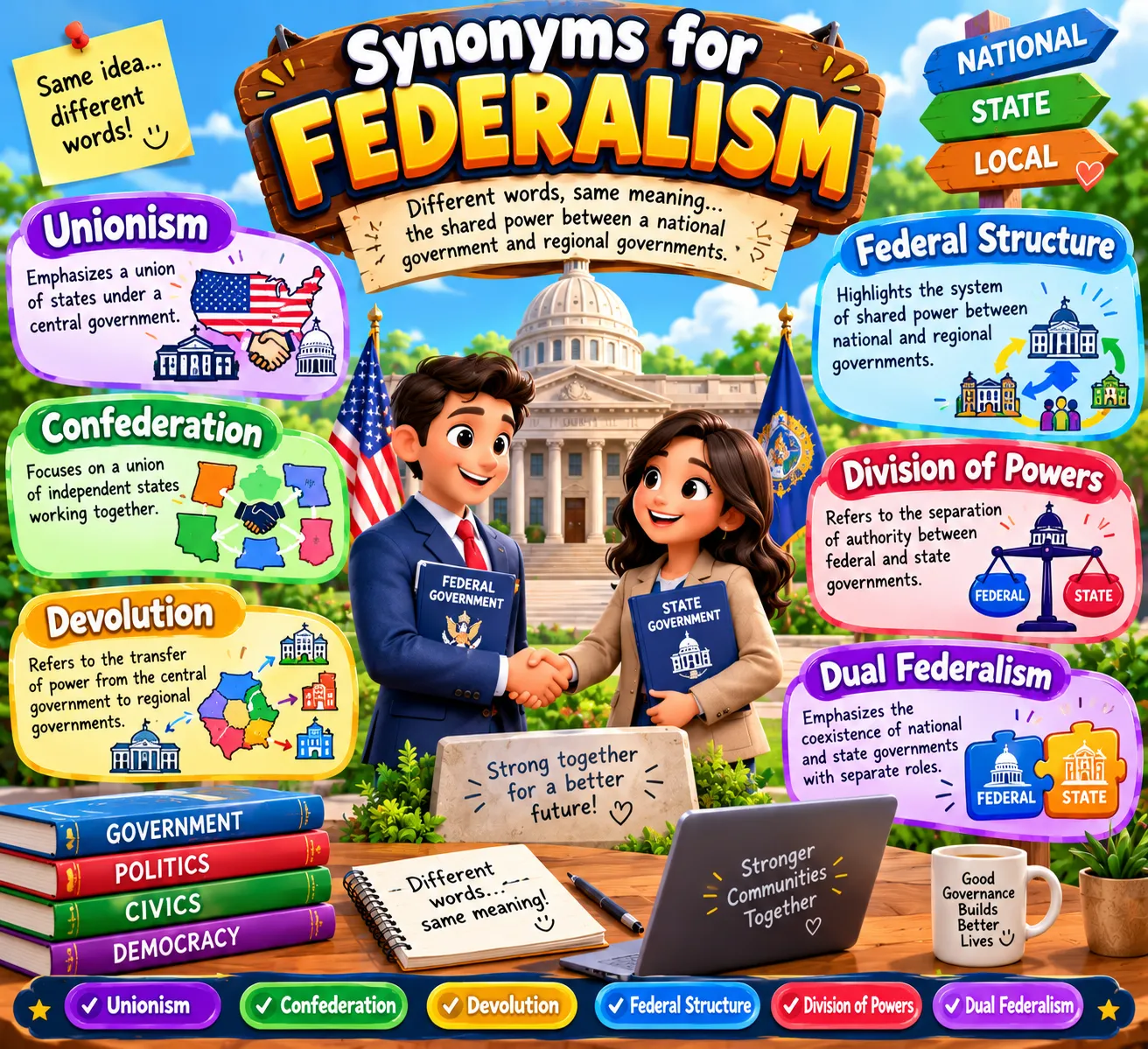
Federalism is a system of government in which power is shared between a central government and regional governments. Related terms include decentralization, federal system, power-sharing, regional autonomy, and constitutional government. These terms have similar ideas but are not exact synonyms.
Federalism is a system of government that shares power between a national government and regional governments, such as states or provinces. For example, a country may let its national government manage defense while state governments handle some local matters. This system helps different levels of government work together.
The word federalism is common in politics, law, history, and social studies. It helps explain how a country divides power and makes decisions. Learning synonyms for federalism can help English learners understand political texts and help writers explain complex ideas in simple words.
However, not every related term has the same meaning. Some focus on shared power, while others describe local control or the structure of a government. In this guide, you will learn the meaning, history, pronunciation, word forms, and 30 related terms with clear meanings and examples.
Meaning of Federalism
Definition
Federalism (noun): A system of government in which political power is divided between a central government and regional governments.
Examples
- Federalism allows states and the national government to share power.
- The country adopted federalism to give its regions a role in government.
Connotative Meaning
(Connotation: the feelings or ideas that a word suggests beyond its basic meaning.)
- Positive tone: May suggest cooperation, local freedom, and balanced power.
- Negative tone: May suggest conflict, slow decisions, or disagreements between levels of government.
- Neutral tone: Describes a political system in which central and regional governments share authority.
Etymology of Federalism
| Period | History and Development of “Federalism” |
| Old English (450–1100) | The word federalism was not used in ordinary Old English. People used other words to describe agreements, rule, and political authority. |
| Middle English (1100–1500) | English developed under strong French and Latin influence. Words linked to agreements and alliances became part of the wider vocabulary. |
| Modern English (1500–present) | Federal and federalism developed as terms for political unions and systems that divide authority between central and regional governments. |
| Word Origin | Federal is linked to Latin foedus, meaning “treaty,” “agreement,” or “covenant.” |
| Suffix | -ism refers to a system, principle, or belief. |
Pronunciation (IPA)
- IPA: /ˈfed.ər.əl.ɪ.zəm/
- Syllables: fed-er-al-ism (five syllables)
Affixation Pattern of Federalism
- Root: feder related to alliance, agreement, or union.
- Prefix: None.
- Suffix: -al forms an adjective; -ism forms a noun describing a system or principle.
Word Formations
- Federation (noun): A union of states or groups.
- Federal (adjective): Relating to a federation or central government.
- Federally (adverb): In a way connected with a federal government.
- Federalist (noun/adjective): A person who supports federalism, or something related to it.
- Federalize (verb): To organize something under a federal system.
- Federalization (noun): The process of making something federal.
- Federalism (noun): The principle or system of dividing power between levels of government.
30 Synonyms of Federalism With Meanings and Examples
The following words and phrases are related to federalism. Some describe similar systems, while others refer to specific features of shared government. Use them according to the context.
1. Decentralization (Noun)
Meaning: The transfer of power from a central authority to local or regional authorities.
Examples:
- Decentralization gave local councils more control over public services.
- The government supported decentralization to improve local decisions.
2. Federal System (Noun)
Meaning: A form of government that divides constitutional powers between national and regional governments.
Examples:
- The country uses a federal system to govern its different states.
- A federal system gives regional governments defined powers.
3. Power Sharing (Noun)
Meaning: An arrangement in which power is divided among different groups or authorities.
Examples:
- Power-sharing helped the national and regional governments cooperate.
- The agreement introduced power-sharing between political groups.
4. Regional Autonomy (Noun)
Meaning: The ability of a region to manage certain matters independently.
Examples:
- Regional autonomy allowed the province to manage local education.
- The leaders called for greater regional autonomy.
5. Devolution (Noun)
Meaning: The transfer of powers from a central government to regional or local bodies.
Examples:
- Devolution gave local governments more responsibility.
- The reform increased devolution in several regions.
6. Confederation (Noun)
Meaning: A union of states or political units that retain substantial independence.
Examples:
- The confederation allowed its member states to keep much of their power.
- The states formed a confederation to work toward common goals.
7. Federation (Noun)
Meaning: A political union in which regional units are joined under a shared national government.
Examples:
- The federation brought several regions under one constitution.
- Each state in the federation has its own government.
8. Shared Sovereignty (Noun Phrase)
Meaning: The distribution or exercise of political authority across different levels of government.
Examples:
- Shared sovereignty shaped the country’s constitutional structure.
- The debate focused on shared sovereignty between national and regional authorities.
9. Regional Government (Noun Phrase)
Meaning: A government that manages public affairs in a particular region.
Examples:
- The regional government introduced new transport rules.
- Federalism gives regional governments authority over certain matters.
10. Local Self-Government (Noun Phrase)
Meaning: The right of local communities to manage their own public affairs.
Examples:
- Local self-government helped towns address their own needs.
- The reform strengthened local self-government in rural areas.
11. Political Decentralization (Noun Phrase)
Meaning: The transfer of political decision-making power to lower levels of government.
Examples:
- Political decentralization gave elected local leaders more influence.
- The country introduced political decentralization to improve representation.
12. Fiscal Federalism (Noun Phrase)
Meaning: The way financial powers and responsibilities are divided among levels of government.
Examples:
- Fiscal federalism determines how tax revenue is shared.
- The researchers studied fiscal federalism and regional spending.
13. Administrative Decentralization (Noun Phrase)
Meaning: The transfer of administrative duties from central authorities to regional or local bodies.
Examples:
- Administrative decentralization helped local offices provide faster services.
- The reform moved some public duties to regional agencies.
14. Constitutional Division of Powers (Noun Phrase)
Meaning: The formal allocation of government powers under a constitution.
Examples:
- The constitutional division of powers defines each government’s role.
- Courts reviewed the constitutional division of powers after the dispute.
15. Intergovernmental Relations (Noun Phrase)
Meaning: The interactions and cooperation between different levels of government.
Examples:
- Strong intergovernmental relations improved emergency planning.
- The new policy changed intergovernmental relations across the country.
16. Regionalism (Noun)
Meaning: A political or social focus on the interests and identity of a particular region.
Examples:
- Regionalism influenced the country’s political debate.
- The party promoted regionalism to protect local traditions.
17. Autonomy (Noun)
Meaning: The power to manage one’s own affairs within established limits.
Examples:
- The region gained greater autonomy over cultural policy.
- Autonomy allowed local leaders to address community needs.
18. Subsidiarity (Noun)
Meaning: The principle that decisions should be made at the lowest level capable of handling them effectively.
Examples:
- Subsidiarity supports decisions made close to local communities.
- The policy followed subsidiarity by giving towns more responsibility.
19. Multilevel Governance (Noun Phrase)
Meaning: A system in which decisions are made by authorities at several levels.
Examples:
- Multilevel governance involved local, regional, and national officials.
- The project relied on multilevel governance to coordinate services.
20. Cooperative Federalism (Noun Phrase)
Meaning: A form of federalism in which national and regional governments work together on shared responsibilities.
Examples:
- Cooperative federalism helped both levels respond to a natural disaster.
- The program used cooperative federalism to improve public health services.
21. Dual Federalism (Noun Phrase)
Meaning: A model of federalism in which national and regional governments have separate, defined areas of authority.
Examples:
- Dual federalism emphasizes distinct roles for each level of government.
- The textbook explained dual federalism through constitutional examples.
22. Asymmetric Federalism (Noun Phrase)
Meaning: A federal arrangement in which some regions have different powers or special constitutional status.
Examples:
- Asymmetric federalism gave one region additional legislative powers.
- The constitution established asymmetric federalism to address regional differences.
23. Constitutional Federalism (Noun Phrase)
Meaning: A federal system in which the constitution establishes and protects the division of powers.
Examples:
- Constitutional federalism limits the authority of each level of government.
- The court examined the case under constitutional federalism.
24. Territorial Power Sharing (Noun Phrase)
Meaning: The division of political authority among governments responsible for different geographic areas.
Examples:
- Territorial power-sharing gave provinces a stronger role in policymaking.
- The agreement used territorial power-sharing to reduce regional tensions.
25. Deconcentration (Noun)
Meaning: The distribution of administrative work to local offices while authority remains largely with the central government.
Examples:
- Deconcentration allowed the central ministry to serve remote areas.
- The government used deconcentration to improve its local administration.
26. Local Governance (Noun Phrase)
Meaning: The way local authorities make decisions and manage community services.
Examples:
- Local governance improved waste collection in the town.
- Effective local governance helps communities express their needs.
27. Political Union (Noun Phrase)
Meaning: An arrangement in which two or more political units join under a common political structure.
Examples:
- The political union brought several territories under shared institutions.
- Leaders debated whether the political union should grant regions more powers.
28. Federal Governance (Noun Phrase)
Meaning: The practice of governing through a system that divides authority between central and regional governments.
Examples:
- Federal governance requires clear rules for shared responsibilities.
- The report examined federal governance in a diverse country.
29. Regional Power Sharing (Noun Phrase)
Meaning: The distribution of political authority among regions or between regional and national institutions.
Examples:
- Regional power-sharing gave provinces a voice in national decisions.
- The reform encouraged regional power-sharing in the legislature.
30. Plural Governance (Noun Phrase)
Meaning: A broad approach to governing that involves multiple institutions, groups, or centers of decision-making.
Examples:
- Plural governance included local councils and national agencies.
- The study explored plural governance in a diverse society.
Usage note: These terms are not fully interchangeable. Federal system, federation, and federal governance are close alternatives in many contexts. Decentralization, autonomy, and power-sharing describe related ideas but can also exist outside a federal system.
Prototype Meaning of Federalism
The prototype meaning of federalism is a system of government that divides power between a national government and regional governments. People usually imagine a country with one central authority and several states or provinces, each with its own responsibilities. Both levels of government work under a constitution or legal framework. This arrangement allows national leaders to manage shared matters while regional leaders address local needs. The main idea is divided government power within one political system.
Prototype Categorization of Federalism Synonyms
| Semantic Category | Synonyms | Description |
| Federal Structures | Federal system, federation, confederation, federal governance, political union | Describe political arrangements, although a confederation usually gives member states greater independence. |
| Power Distribution | Power-sharing, shared sovereignty, territorial power-sharing, regional power-sharing, constitutional division of powers | Focus on how political authority is divided among governments or regions. |
| Local and Regional Independence | Regional autonomy, autonomy, local self-government, regional government | Emphasize the ability of regions or local authorities to manage their own affairs. |
| Decentralization and Administration | Decentralization, political decentralization, administrative decentralization, deconcentration, devolution | Describe different ways of transferring or distributing government powers and responsibilities. |
| Government Cooperation | Intergovernmental relations, cooperative federalism, multilevel governance | Focus on cooperation and coordination between different levels of government. |
| Constitutional and Financial Arrangements | Constitutional federalism, fiscal federalism, dual federalism | Describe constitutional rules, financial responsibilities, or specific models of federal government. |
| Special Political Principles and Models | Subsidiarity, asymmetric federalism, regionalism, plural governance, local governance | Highlight decision-making principles, regional interests, or broader approaches to governing. |
These categories help writers choose the most accurate term for each context. For example, devolution emphasizes the transfer of powers to regional or local authorities, while fiscal federalism focuses on how financial responsibilities and resources are shared between levels of government.
Antonyms of Federalism
Federalism does not have one perfect antonym in every context. However, the following terms describe contrasting political structures or principles.
1. Centralization (Noun)
Meaning: The concentration of power in a central authority.
Example: Centralization placed most major decisions in the national government’s hands.
2. Unitary System (Noun Phrase)
Meaning: A system in which the central government holds ultimate constitutional authority, even if local powers are delegated.
Example: The country operates under a unitary system.
3. Centralized Government (Noun Phrase)
Meaning: A government in which major decisions are controlled by central authorities.
Example: The centralized government managed policies across the country.
4. Authoritarianism (Noun)
Meaning: A system of rule in which political power is concentrated and political freedoms are restricted.
Example: Authoritarianism limits meaningful political opposition.
5. Autocracy (Noun)
Meaning: A system of government in which one person holds supreme political power.
Example: The nation moved away from autocracy toward representative government.
6. Concentration of Power (Noun Phrase)
Meaning: The gathering of political authority in one person, institution, or level of government.
Example: The constitution aimed to prevent the concentration of power.
7. Unitary Government (Noun Phrase)
Meaning: A government based on a unitary state rather than a federal division of constitutional authority.
Example: A unitary government may delegate local duties without creating constitutionally sovereign regional governments.
Short Questions and Answers
What does federalism mean?
Federalism is a system of government that divides political power between national and regional governments.
When should federalism be used?
Use federalism when discussing political systems, constitutions, shared authority, or the relationship between central and regional governments.
Is federalism positive or negative?
Federalism is generally a neutral term. It can suggest cooperation and local representation, but debates about it may involve conflict or inefficiency.
How is federalism different from decentralization?
Federalism divides constitutional authority between levels of government. Decentralization is a broader process of transferring power or duties away from a central authority.
Is federation the same as federalism?
No. A federation is the political union or structure, while federalism is the principle or system behind the division of power.
What is the closest synonym for federalism?
Federal system is often the closest alternative. The best choice depends on whether you are discussing a political structure, shared authority, or regional independence.
Conclusion
Learning federalism and its related terms can improve your vocabulary and help you understand political discussions. Words such as federal system, federation, decentralization, and power-sharing make it easier to explain how governments divide authority.
However, each term has its own meaning, so choosing the right one matters.For English learners, these words also build confidence in reading textbooks, writing essays, and discussing history or politics. For content writers, they provide useful alternatives that reduce repetition without changing the main idea.
Try learning a few terms each day and writing your own sentences with them. Compare their meanings before using them in formal writing. With regular practice, you can express complex political ideas in clear, simple, and accurate English.
Read More:
Synonyms for Intersectionality: 30 Related Terms to Know

I’m Noor Fatima, an English content writer at SameSynonyms.com, specializing in synonyms, antonyms, word meanings, and English vocabulary. I create clear, well-researched content with practical examples to help readers understand word usage, expand their vocabulary, and communicate more effectively.