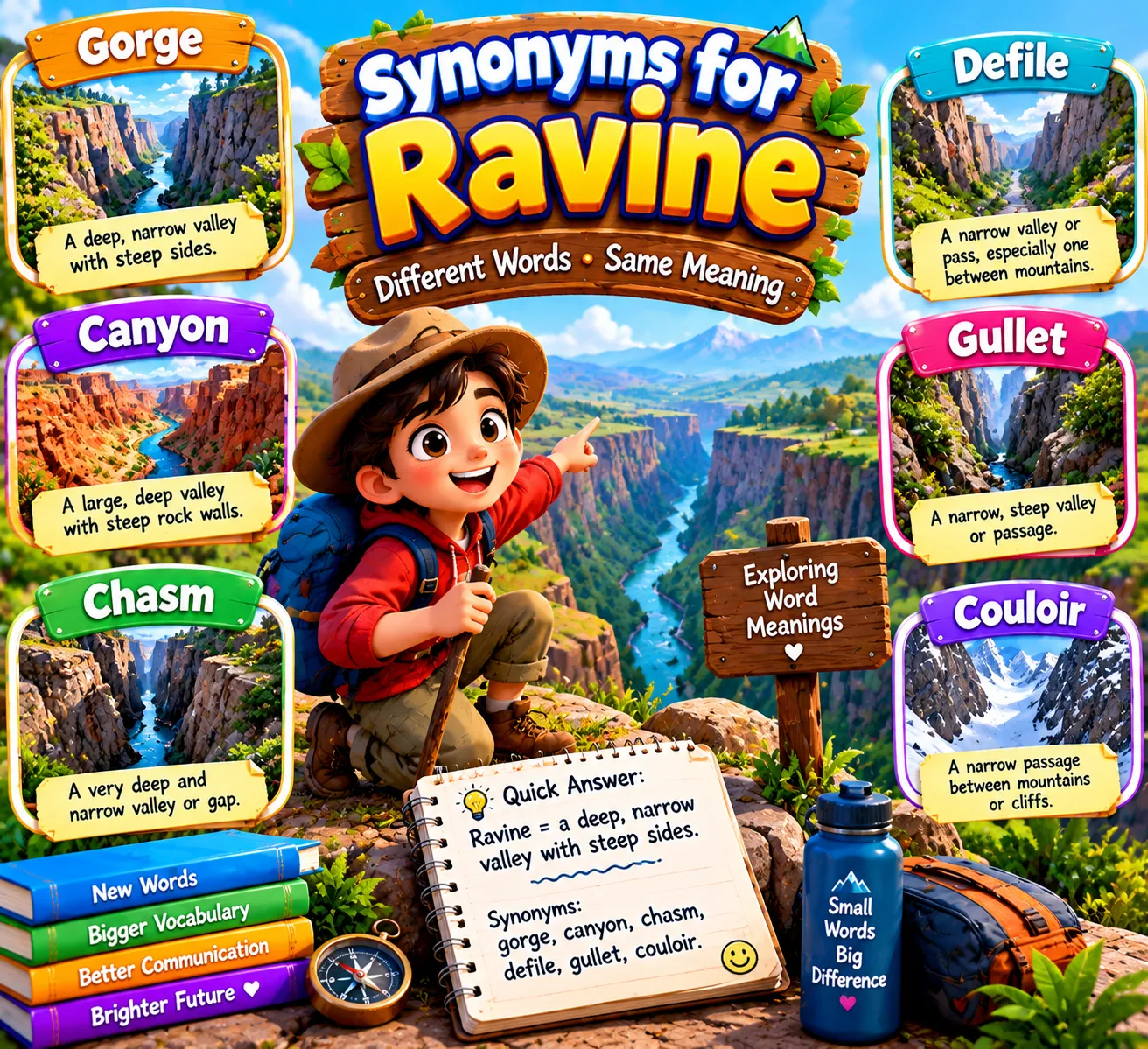
Synonyms for ravine include gorge, gully, canyon, gulch, chasm, valley, hollow, and coulee. The best alternative depends on the landform’s depth, width, shape, and how it was formed.
A ravine is a deep, narrow valley with steep sides, often formed by flowing water. Imagine walking through a forest and finding a deep gap between two hills. That narrow, steep-sided space may be a ravine. The word is common in geography, nature writing, travel stories, and descriptions of land.
Learning synonyms for ravine helps English learners and writers describe landscapes in more varied ways. Words such as gorge, gully, and canyon may seem similar, but they can describe landforms of different sizes and shapes.
Choosing the right word makes your writing clearer and more vivid. In this guide, you will learn the meaning, history, pronunciation, and grammar of ravine. You will also explore 30 synonyms and related terms, with simple meanings and examples to help you use them correctly.
Meaning of Ravine
Definition
Ravine (Noun): A deep, narrow valley with steep sides, often made by water flowing through the land.
Examples
- We followed a trail along the edge of a deep ravine.
- Heavy rain carried soil down into the ravine.
Connotative Meaning
(Connotation: the feelings or ideas a word suggests beyond its basic meaning.)
- Positive tone: May suggest natural beauty, adventure, or a scenic landscape.
- Negative tone: May suggest danger, isolation, or a difficult barrier.
- Neutral tone: Describes a deep, narrow landform with steep sides.
Etymology of Ravine
| Period | Etymology and Development of “Ravine” |
| Old English (450–1100) | Ravine was not part of common Old English vocabulary. Speakers used other words to describe valleys, hollows, and cuts in the land. |
| Middle English (1100–1500) | The word entered English through French influence and developed in use to describe steep-sided valleys and channels. |
| Modern English (1500–present) | Ravine became an established word for a deep, narrow valley, especially one shaped by water erosion. |
| French Origin | The word comes from French ravin, meaning a deep hollow or channel. It is related to raviner, a verb associated with water erosion. |
Pronunciation (IPA)
- IPA: /rəˈviːn/
- Syllables: ra-vine (2 syllables)
Affixation Pattern of Ravine
- Root: Ravine the complete word for a deep, narrow valley.
- Prefix: None.
- Suffix: No productive suffix is added in the modern English word.
Word Formations
- Ravine (noun): A deep, narrow valley with steep sides.
- Ravines (plural noun): More than one ravine.
- Ravined (adjective, rare): Cut or marked by ravines.
- Ravine-like (adjective): Resembling a ravine.
30 Synonyms of Ravine With Meaning and Examples
Note: Some words below are close synonyms, while others describe related landforms. Their meanings can differ by size, depth, shape, or how they form.
1. Gorge (Noun)
Meaning: A deep, narrow valley with steep, rocky sides, often formed by a river.
Examples:
- The river rushed through the rocky gorge.
- We took photos from a bridge above the gorge.
2. Gully (Noun)
Meaning: A narrow channel or small valley cut into the ground by running water.
Examples:
- Rainwater flowed through the muddy gully.
- The farmer planted grass to stop the gully from growing.
3. Canyon (Noun)
Meaning: A deep valley with steep sides, often carved by a river over a long time.
Examples:
- The river had carved a huge canyon through the rock.
- Tourists walked along the canyon rim.
4. Gulch (Noun)
Meaning: A narrow, steep-sided valley or deep channel, often found in dry areas.
Examples:
- The hikers crossed a rocky gulch.
- A small stream ran through the gulch after the storm.
5. Chasm (Noun)
Meaning: A deep opening or gap in the ground, often with steep sides.
Examples:
- The old bridge crossed a deep chasm.
- They stood far from the edge of the chasm.
6. Valley (Noun)
Meaning: A low area of land between hills or mountains, often with a river.
Examples:
- A green valley lay between the mountains.
- The village stood in a wide valley.
7. Ditch (Noun)
Meaning: A long, narrow channel in the ground, often made to carry water.
Examples:
- The road ran beside a deep ditch.
- Rainwater collected in the ditch.
8. Trench (Noun)
Meaning: A long, narrow cut or deep channel in the ground.
Examples:
- Workers dug a trench for the new water pipe.
- The trench ran along the edge of the field.
9. Crevasse (Noun)
Meaning: A deep crack or opening, especially in a glacier or ice sheet.
Examples:
- The climbers moved carefully around the crevasse.
- Snow covered part of the deep crevasse.
10. Fissure (Noun)
Meaning: A long, narrow crack or split in rock, earth, or another surface.
Examples:
- A fissure appeared in the dry ground.
- Water seeped through a narrow fissure in the rock.
11. Ravine Valley (Noun Phrase)
Meaning: A valley-like area marked by a deep, narrow cut in the land.
Examples:
- The map showed a ravine valley near the forest.
- The stream passed through the ravine valley.
Note: This is a descriptive phrase, not a standard synonym.
12. Hollow (Noun)
Meaning: A low or sunken area of land, often surrounded by higher ground.
Examples:
- The cottage stood in a wooded hollow.
- Mist settled in the hollow at dawn.
13. Dell (Noun)
Meaning: A small, sheltered valley, often covered with trees or grass.
Examples:
- A quiet stream ran through the dell.
- They rested in a shady dell.
14. Dale (Noun)
Meaning: A broad or open valley, especially one between hills.
Examples:
- Sheep grazed in the peaceful dale.
- A small village stood in the dale.
15. Vale (Noun)
Meaning: A valley, often used in literary or poetic writing.
Examples:
- The castle overlooked a green vale.
- Morning mist filled the vale.
16. Basin (Noun)
Meaning: A low area of land surrounded by higher ground.
Examples:
- The town lies in a wide mountain basin.
- Rainwater collected in the basin.
17. Depression (Noun)
Meaning: A low area of land that sits below the surrounding ground.
Examples:
- The small depression filled with rainwater.
- The field had a shallow depression near the fence.
18. Gully Ravine (Noun Phrase)
Meaning: A narrow, eroded channel that resembles a small ravine.
Examples:
- The storm deepened the gully ravine.
- Grass grew along the sides of the gully ravine.
Note: This is a descriptive phrase rather than an established synonym.
19. Watercourse (Noun)
Meaning: A natural or artificial channel through which water flows.
Examples:
- The watercourse ran through the low ground.
- Heavy rain changed the path of the watercourse.
20. Gorge Valley (Noun Phrase)
Meaning: A valley with the narrow, steep sides typical of a gorge.
Examples:
- The trail followed the gorge valley.
- Trees covered the slopes of the gorge valley.
Note: This phrase describes a landform but is not a standard synonym.
21. Coulee (Noun)
Meaning: A deep ravine, gully, or channel, especially in parts of North America.
Examples:
- The road passed through a dry coulee.
- Wildflowers grew along the coulee slopes.
22. Arroyo (Noun)
Meaning: A dry streambed or small ravine that may carry water after heavy rain, especially in dry regions.
Examples:
- The hikers crossed the arroyo before sunset.
- Flash floods can fill an arroyo very quickly.
23. Wash (Noun)
Meaning: A dry channel or low area where water flows during heavy rain, especially in arid regions.
Examples:
- The vehicle stopped before crossing the wash.
- Rainwater rushed through the wash after the storm.
24. Draw (Noun)
Meaning: A shallow valley or natural drainage channel, often found in hilly or dry terrain.
Examples:
- The deer moved through a narrow draw.
- The soldiers took cover in the draw.
25. Recess (Noun)
Meaning: A hollow or inward area set back from the surrounding surface.
Examples:
- The rock face had a deep recess.
- The animals sheltered in a recess along the slope.
26. Cut (Noun)
Meaning: A narrow passage or opening through land, often made by erosion or human activity.
Examples:
- The railway passed through a cut in the hillside.
- Water had formed a deep cut in the soil.
27. Channel (Noun)
Meaning: A narrow passage through which water or another substance flows.
Examples:
- The stream carved a channel through the earth.
- The channel grew deeper after the storm.
28. Ravine Gorge (Noun Phrase)
Meaning: A descriptive phrase for a narrow, deep valley with steep sides.
Examples:
- The path led toward a ravine gorge.
- They viewed the ravine gorge from a safe distance.
Note: This phrase is descriptive and not a standard synonym.
29. Valley Gorge (Noun Phrase)
Meaning: A valley with steep sides that resemble a gorge.
Examples:
- The river crossed the valley gorge.
- The valley gorge was surrounded by tall cliffs.
Note: This is a descriptive phrase, not a common standalone synonym.
30. Erosion Channel (Noun Phrase)
Meaning: A channel cut into the land by flowing water or other forces of erosion.
Examples:
- The erosion channel widened after the heavy rain.
- Plants helped hold the soil around the erosion channel.
Prototype Meaning
The prototype meaning of ravine is a deep, narrow valley with steep sides, often formed by running water. People may picture a wooded gap, a rocky slope, or a stream flowing far below the surrounding land. Ravines can be beautiful places to explore, but their steep sides may also make them dangerous to cross. Unlike a broad valley, a ravine is usually narrow and sharply cut into the landscape.
Prototype Categorization
The words related to ravine can be grouped by landform, size, formation, and use. This table helps writers choose the most accurate word for a landscape.
| Category | Related Words | Meaning or Usage |
| Deep, Steep-Sided Landforms | Gorge, canyon, gulch, chasm | Describe deep openings or valleys with steep sides. |
| Small Valleys and Low Areas | Gully, hollow, dell, dale, vale, valley | Refer to low areas of land, often between hills or slopes. |
| Cracks and Narrow Openings | Crevasse, fissure, trench, cut, recess | Describe narrow gaps, cracks, or openings in the ground. |
| Water-Shaped Channels | Watercourse, channel, wash, arroyo, coulee | Refer to channels or landforms shaped by flowing water. |
| Low or Enclosed Landforms | Basin, depression, draw | Describe areas of land that lie lower than the surrounding ground. |
| Descriptive Phrases | Ravine valley, gully ravine, gorge valley, ravine gorge, valley gorge | Descriptive combinations, but generally not standard synonyms for ravine. |
Tip: Choose a word based on the landscape. A gorge is usually deep and steep-sided, a gully is often smaller and formed by water erosion, and a canyon generally refers to a larger, deep valley. A fissure is a crack, not a valley.
Antonyms of Ravine
There is no exact antonym for ravine, because it names a type of landform. However, these words describe contrasting shapes or features.
- Plain (noun): A large area of flat or gently rolling land.
- Plateau (noun): A broad, raised area of fairly level land.
- Ridge (noun): A long, narrow area of high ground.
- Summit (noun): The highest point of a hill or mountain.
- Peak (noun): The pointed top of a mountain or hill.
- Upland (noun): High or raised land.
- Rise (noun): An area where the ground slopes upward.
- Flatland (noun): Land that is mostly level.
Short Questions and Answers
What does ravine mean?
A ravine is a deep, narrow valley with steep sides, often formed by flowing water.
When should ravine be used?
Use ravine when describing a deep, narrow cut in the land, especially one with steep sides. It is common in nature writing, geography, and outdoor descriptions.
Is ravine positive or negative?
The word is usually neutral. It can suggest beauty and adventure in a scenic setting or danger when the ravine is steep or difficult to cross.
How is ravine different from similar words?
A ravine is usually deep and narrow. A gorge is also steep-sided and may be larger or more dramatic. A gully is often smaller, while a canyon usually describes a much larger valley. A fissure is a crack, not a valley.
Conclusion
Learning synonyms for ravine helps you describe landforms with greater detail and accuracy. Words such as gorge, gully, canyon, and gulch can add variety to your writing, but each has its own meaning.
Some words describe deep valleys, while others refer to small channels, low areas, or cracks in the ground. Knowing these differences helps you choose the best word for schoolwork, travel writing, stories, and everyday conversation.
Build your vocabulary by learning a few related words each day. Write simple sentences with each word and compare how the meanings differ. With regular practice, you can improve your English, avoid repetition, and describe natural landscapes with more confidence.
Read More:
Synonyms for Seriously: 30 Better Words to Use

I’m Noor Fatima, an English content writer at SameSynonyms.com, specializing in synonyms, antonyms, word meanings, and English vocabulary. I create clear, well-researched content with practical examples to help readers understand word usage, expand their vocabulary, and communicate more effectively.