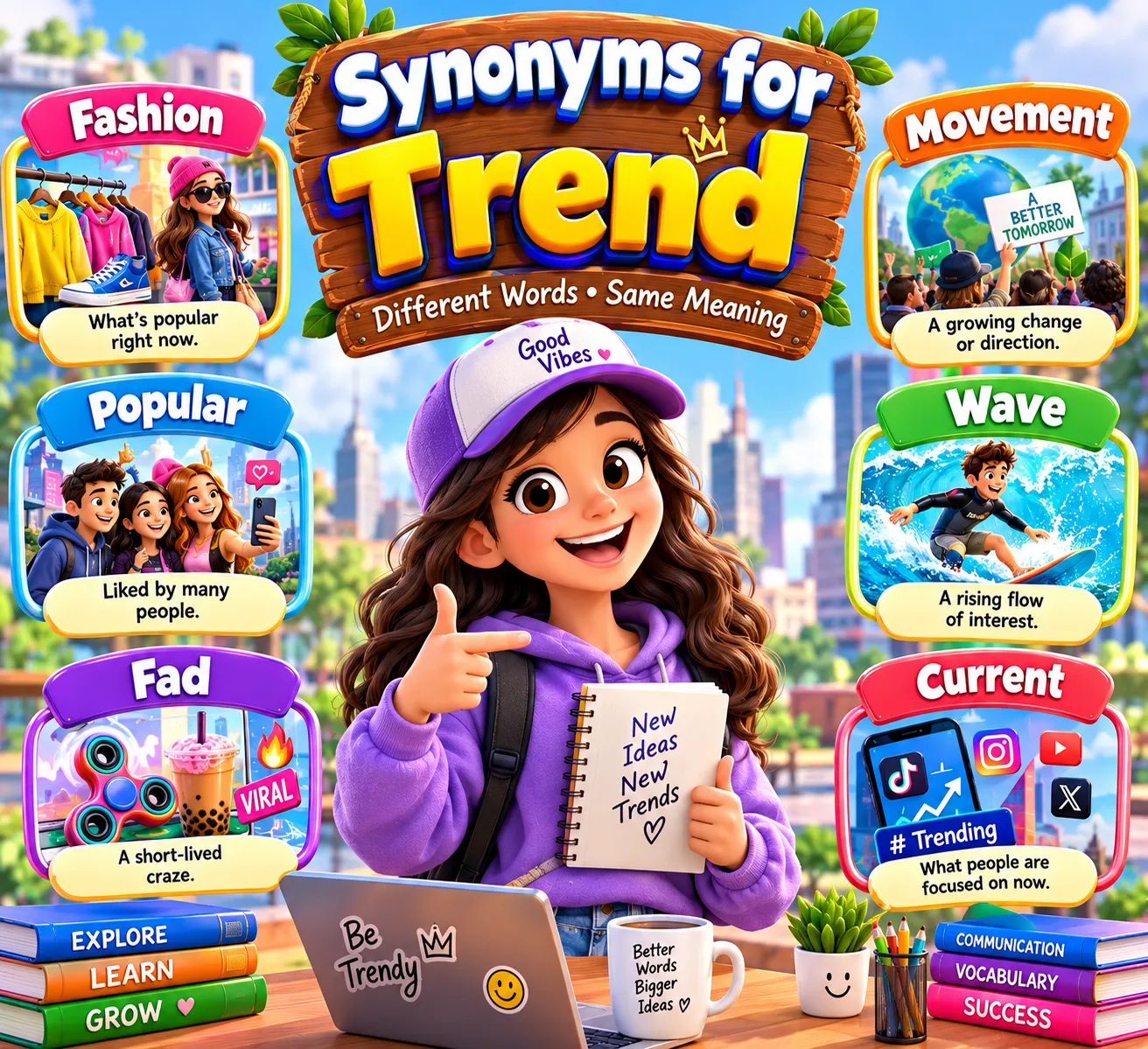
Synonyms for trend include pattern, tendency, movement, shift, fashion, development, direction, evolution, craze, and vogue. The best alternative depends on whether you mean a popular style, a change over time, or a pattern in data.
A trend is a general direction in which something changes or develops. It can also mean a popular style, idea, or activity that many people follow. For example, a new fashion trend may become popular among young people, while a sales trend can show whether a business is growing or losing customers.
The word trend is common in daily conversations, business reports, social media, and academic writing. Learning its synonyms helps you explain changes, patterns, and popular ideas with greater accuracy.
Words such as pattern, movement, tendency, and fashion have similar meanings, but each fits a different context. In this guide, you will learn the meaning of trend, its history, pronunciation, grammar, and 30 useful synonyms with simple meanings and examples.
Meaning of Trend
Definition
Trend (noun): A general direction of change or a style, idea, or activity that becomes popular over time.
Trend (verb): To move or develop in a particular direction.
Examples
- Online shopping is a growing trend among young adults.
- The company’s sales trend shows steady growth.
Connotative Meaning
Connotation (the feelings or ideas a word suggests beyond its basic meaning):
- Positive tone: Growth, progress, popularity, or improvement.
- Negative tone: A passing craze, harmful change, or unwanted pattern.
- Neutral tone: A general direction of change or a repeated pattern.
Etymology of Trend
The word trend comes from Middle English and is linked to the Old English verb trendan, meaning “to turn” or “revolve.” Its meaning later developed to describe a general direction or tendency.
| Period | Etymology |
| Old English (450–1100) | The related verb trendan meant to turn or revolve. |
| Middle English (1100–1500) | Related forms continued to express turning or moving in a particular direction. |
| Modern English (1500–present) | Trend developed the sense of a general direction, tendency, or popular style. |
Pronunciation (IPA)
- IPA: /trend/
- Syllables: trend (one syllable)
Affixation Pattern of Trend
- Root: Trend
- Prefix: None in the base word.
- Suffix: None in the base word.
Word Formations
- Trend (noun): A direction of change or a popular style.
- Trend (verb): To move or develop in a certain direction.
- Trends (plural noun / verb): More than one trend; also the verb form used with he, she, or it.
- Trended (verb): Moved or developed in a particular direction.
- Trending (verb/adjective): Becoming popular or receiving attention.
- Trendsetter (noun): A person who starts or influences a new trend.
- Trendsetting (adjective): Introducing new styles or ideas.
- Trendiness (noun): The quality of being fashionable or popular.
- Trendy (adjective): Modern, fashionable, or popular at a given time.
30 Synonyms of Trend With Meaning and Examples
The best synonym depends on whether trend refers to a popular style, a pattern in data, or a direction of change.
1. Pattern (Noun)
Meaning: A repeated or regular way in which something happens.
Examples:
- We noticed a pattern in customer behavior.
- The weather follows a seasonal pattern.
2. Tendency (Noun)
Meaning: A usual way in which someone or something behaves or changes.
Examples:
- There is a tendency for prices to rise in summer.
- He has a tendency to check his phone often.
3. Fashion (Noun)
Meaning: A popular style of clothing, behavior, or design.
Examples:
- Bright colors are in fashion this year.
- The fashion for oversized jackets has returned.
4. Movement (Noun)
Meaning: A general change in ideas, behavior, or social direction.
Examples:
- The movement toward greener energy is growing.
- A new social movement gained public support.
5. Direction (Noun)
Meaning: The way in which something develops or changes.
Examples:
- The business is moving in a positive direction.
- The data shows a clear direction of change.
6. Development (Noun)
Meaning: A change or event that causes something to grow or progress.
Examples:
- The development of online learning changed education.
- Recent developments show a shift in public opinion.
7. Shift (Noun)
Meaning: A change from one position, idea, or way of doing things to another.
Examples:
- There has been a shift toward remote work.
- The survey shows a shift in buying habits.
8. Change (Noun)
Meaning: The act or result of becoming different.
Examples:
- The change in consumer habits surprised the store owner.
- We saw a change in fashion preferences.
9. Drift (Noun)
Meaning: A slow or gradual movement in a particular direction.
Examples:
- There is a drift toward simpler website designs.
- The report shows a drift in public opinion.
10. Current (Noun)
Meaning: A general movement or direction of thought, feeling, or activity.
Examples:
- A current of public opinion supported the proposal.
- The artist followed the current in modern design.
11. Wave (Noun)
Meaning: A sudden rise in a particular activity, interest, or behavior.
Examples:
- A wave of interest in electric cars swept the market.
- The city saw a wave of new coffee shops.
12. Craze (Noun)
Meaning: A short period when something becomes extremely popular.
Examples:
- The toy became a craze among children.
- The dance craze spread across social media.
13. Fad (Noun)
Meaning: Something that becomes popular quickly but often does not last.
Examples:
- Some online challenges are only a passing fad.
- The product was a fad that soon lost attention.
14. Vogue (Noun)
Meaning: The state of being popular or fashionable at a certain time.
Examples:
- Minimalist furniture is in vogue.
- That hairstyle was once in vogue.
15. Movement Pattern (Noun Phrase)
Meaning: A repeated or noticeable way in which something moves or changes.
Examples:
- The scientist studied the movement pattern of birds.
- The chart shows a movement pattern in stock prices.
16. Trajectory (Noun)
Meaning: The path or direction in which something develops over time.
Examples:
- The company’s growth trajectory looks promising.
- The report tracks the trajectory of housing prices.
17. Course (Noun)
Meaning: The direction or progress of an event or process.
Examples:
- The course of public opinion changed over time.
- The company changed its course after reviewing sales.
18. Inclination (Noun)
Meaning: A natural tendency or preference toward something.
Examples:
- She has an inclination toward creative work.
- There is an inclination among buyers to choose simple products.
19. Propensity (Noun)
Meaning: A natural tendency to behave or develop in a certain way.
Examples:
- The study found a propensity to shop online.
- Some customers have a propensity to buy familiar brands.
20. Progression (Noun)
Meaning: A process of moving forward through stages or changes.
Examples:
- The progression toward digital payments has been rapid.
- The chart shows the progression of sales over six months.
21. Evolution (Noun)
Meaning: A gradual process of change or development.
Examples:
- The evolution of mobile phones has changed communication.
- The report follows the evolution of consumer tastes.
22. Cycle (Noun)
Meaning: A series of events or changes that repeat over time.
Examples:
- Fashion often follows a cycle.
- The business cycle affects hiring and spending.
23. Phenomenon (Noun)
Meaning: An event or behavior that attracts attention or is widely observed.
Examples:
- Viral videos have become a global phenomenon.
- The rise of remote work is a major social phenomenon.
24. Style (Noun)
Meaning: A particular way of designing, doing, or presenting something.
Examples:
- This style of clothing is popular among teenagers.
- The brand follows a clean design style.
25. Practice (Noun)
Meaning: A usual or accepted way of doing something.
Examples:
- Flexible working is becoming a common workplace practice.
- The company changed its hiring practices.
26. Habit (Noun)
Meaning: Something a person does regularly or often.
Examples:
- Reading before bed is a growing habit among students.
- The survey examined changes in shopping habits.
27. Standard (Noun)
Meaning: A level or type that is commonly accepted or used.
Examples:
- Digital payments have become a standard in many stores.
- The new design may set a standard for future products.
28. Surge (Noun)
Meaning: A sudden and strong increase in something.
Examples:
- The store saw a surge in online orders.
- A surge in interest boosted the product’s sales.
29. Upswing (Noun)
Meaning: An increase or improvement in activity, value, or success.
Examples:
- The market is showing an upswing in sales.
- The industry experienced an upswing in demand.
30. Incline (Noun)
Meaning: A tendency or movement toward a particular direction.
Examples:
- The data shows an incline in demand for digital services.
- The graph displays an incline in monthly sales.
Usage note: For data, pattern, direction, shift, and trajectory are often more precise than fashion or fad. For popular styles, vogue, craze, and fad may fit better.
Prototype Meaning of Trend
The most common meaning of trend is a general direction of change or a popular style that many people follow. People may think of fashion, social media, technology, or business data when they hear the word. For example, a clothing trend shows what people are wearing, while a sales trend shows how purchases change over time. The word can describe something that lasts for years or something that fades quickly.
Prototype Categorization of Trend Synonyms
Grouping synonyms by meaning helps writers choose a word that matches their subject and tone.
| Semantic Category | Synonyms | Best Used For |
| Patterns and Tendencies | Pattern, tendency, inclination, propensity | Describing repeated behavior or likely outcomes |
| Popularity and Fashion | Fashion, vogue, style, craze, fad | Discussing popular styles, products, and activities |
| Change and Development | Change, shift, development, evolution, progression | Explaining how something changes over time |
| Direction and Movement | Direction, movement, drift, current, trajectory, course | Describing the path or direction of change |
| Sudden Increase | Wave, surge, upswing | Describing a rise in interest, demand, or activity |
| Repeated Behavior | Cycle, habit, practice | Discussing recurring actions or established ways of doing things |
| Wider Social or Market Changes | Phenomenon, standard, movement pattern, incline | Describing noticeable developments or broader changes |
Antonyms of Trend
There is no single exact antonym for trend. The opposite depends on the intended meaning.
- Stability (noun): A state in which something remains steady and does not change much.
- Stagnation (noun): A lack of growth, progress, or movement.
- Decline (noun): A decrease in quality, value, number, or strength.
- Reversal (noun): A change in the opposite direction.
- Tradition (noun): A long-established belief or practice, especially when contrasted with a new trend.
- Obscurity (noun): A state of receiving little attention or being little known.
- Unpopularity (noun): The state of not being liked or widely accepted.
- Discontinuity (noun): A break or interruption in a pattern or process.
Short Questions and Answers
What does trend mean?
A trend is a general direction of change or a style, idea, or activity that becomes popular.
When should trend be used?
Use trend when describing changes in data, popular styles, social behavior, business activity, or public interest.
Is trend positive or negative?
The word is neutral. A trend can describe positive growth, negative decline, or any general pattern of change.
How is trend different from similar words?
A trend is a general direction or popular development. A pattern is something that repeats, a fad is often short-lived, and a tendency is a usual way something happens.
Conclusion
Learning synonyms for trend helps you describe changes and popular ideas with greater precision. Words such as pattern, tendency, shift, and trajectory are useful for reports and data analysis. Terms such as fashion, vogue, and craze work better when discussing popular styles or activities.
Choosing the right synonym makes your writing clearer and helps you avoid repeating the same word. It also improves your vocabulary for school, work, and daily conversations.
Practice using a few alternatives each day, and write your own examples to understand their differences. With regular practice, you can build stronger English skills and express your ideas with more confidence.
Read More:
Synonyms for Assimilation: 30 Powerful Alternatives

I’m Falak Naaz, an SEO writer at SameSynonyms.com with 10 years of experience creating clear, engaging, and search-friendly English content. I specialize in synonyms, antonyms, vocabulary, and word usage. Through careful research and practical examples, I help readers choose the right words and improve their English with confidence.