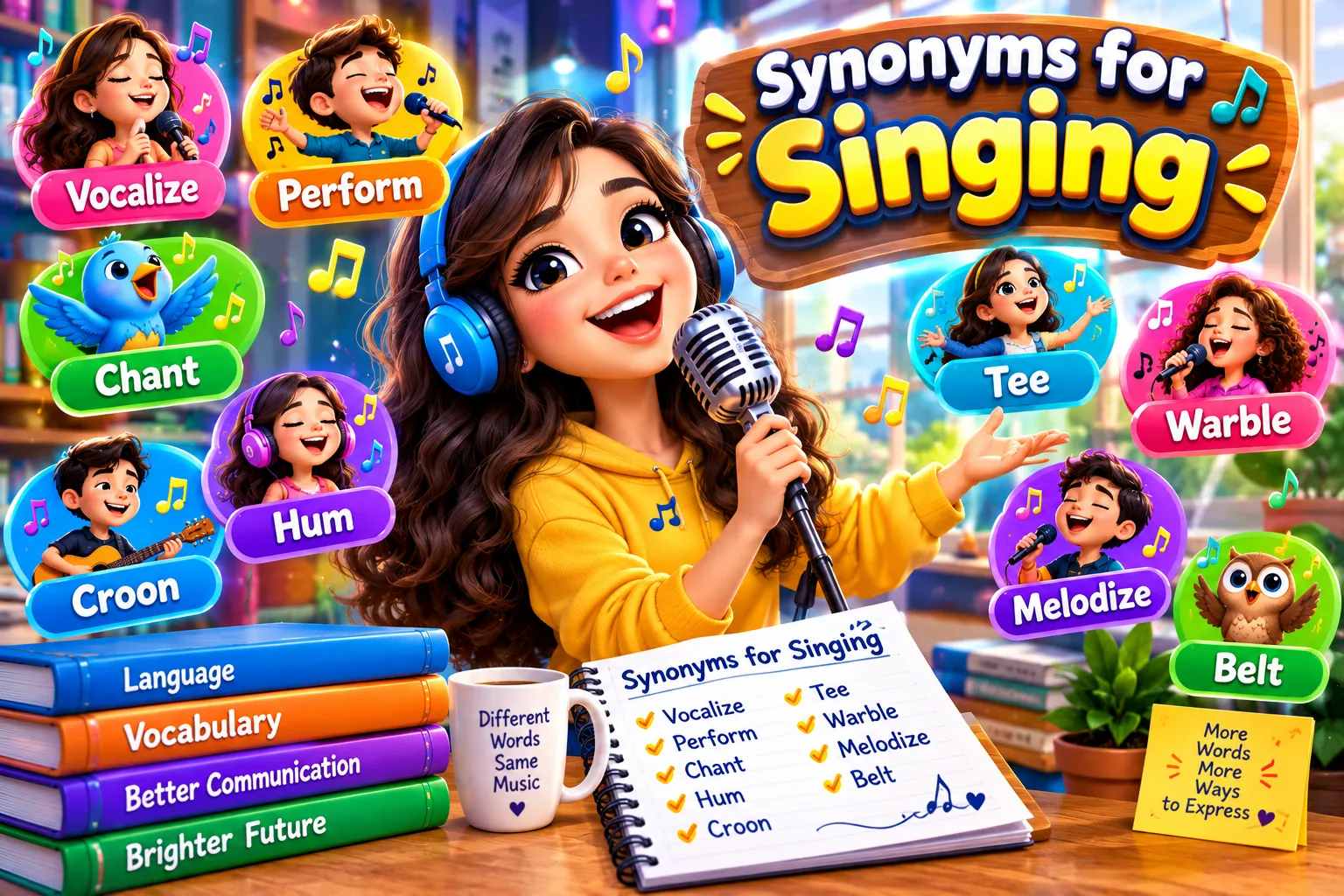
Synonyms for singing include vocalizing, crooning, chanting, humming, warbling, performing, and serenading. The best choice depends on the style of singing and the situation.
Singing is the act of making musical sounds with your voice. You may sing your favorite song in the shower, hum a tune while working, or sing with friends at a party. Singing is a common part of daily life. It helps people share feelings, enjoy music, and express themselves.
However, using the word singing again and again can make writing sound dull. Learning synonyms helps English learners build vocabulary and helps writers describe different sounds, styles, and performances. For example, humming means making a tune with your lips closed, while crooning often describes soft and gentle singing.
In this guide, you will learn the meaning of singing, its history, pronunciation, word forms, and 30 related alternatives. Simple definitions and examples will help you choose the right word for each situation.
Meaning of Singing
Definition
Singing (noun/verb form): The act of making musical sounds with the voice.
Examples
- Her singing made everyone smile.
- We were singing our favorite song together.
Connotative Meaning
(Connotation means the feeling or idea a word suggests beyond its basic meaning.)
- Positive tone: Singing can suggest joy, beauty, love, hope, and self-expression.
- Negative tone: It may suggest unwanted noise when someone sings loudly or at the wrong time.
- Neutral tone: It can simply describe using the voice to produce music.
Etymology of Singing
The word singing comes from the verb sing, which has roots in Old English and Germanic languages.
| Period | Etymology and Development |
| Old English (450–1100) | The verb singan meant to sing or produce musical sounds with the voice. |
| Middle English (1100–1500) | The word developed into singen and later sing, keeping its meaning of producing music with the voice. |
| Modern English (1500–present) | Singing became the common -ing form of sing. It can describe the act of singing or an ongoing action. Today, it is used in music, daily life, worship, and performance. |
Pronunciation (IPA)
- IPA: /ˈsɪŋ.ɪŋ/
- Syllables: sing-ing (two syllables)
Affixation Pattern of Singing
- Root: Sing
- Prefix: None
- Suffix: -ing, used to form a present participle or a gerund.
Word Formations
- Sing (verb): To make musical sounds with the voice.
- Singing (noun/verb): The act of producing music with the voice or the ongoing action.
- Singer (noun): A person who sings.
- Sang (verb): The past tense of sing.
- Sung (verb): The past participle of sing.
- Singable (adjective): Easy or suitable to sing.
- Song (noun): A piece of music usually made for the voice.
- Songbird (noun): A bird known for its musical call or song.
- Sing-along (noun): An activity in which people sing together.
30 Synonyms of Singing With Meaning and Examples
Note: Some words below describe a specific singing style or a related vocal activity. They are not exact substitutes in every sentence.
1. Vocalizing (Verb)
Meaning: Producing sounds with the voice, with or without words.
Examples:
- The singer began vocalizing before the show.
- She practiced vocalizing to warm up her voice.
2. Crooning (Verb/Noun)
Meaning: Singing in a soft, gentle, and often romantic way.
Examples:
- He was crooning a love song.
- Her quiet crooning filled the room.
3. Chanting (Verb/Noun)
Meaning: Singing or saying words in a repeated rhythm.
Examples:
- The crowd was chanting the team’s name.
- The group began chanting together.
4. Humming (Verb/Noun)
Meaning: Making a tune with the lips closed.
Examples:
- She was humming her favorite song.
- I heard him humming in the kitchen.
5. Warbling (Verb/Noun)
Meaning: Singing with a series of changing, often high musical notes.
Examples:
- The bird was warbling in the tree.
- She began warbling a cheerful tune.
6. Serenading (Verb)
Meaning: Singing to someone, often to show love or affection.
Examples:
- He was serenading his partner under the window.
- The musician serenaded the guests.
7. Caroling (Verb/Noun)
Meaning: Singing songs, especially traditional songs at Christmas.
Examples:
- The children went caroling in the neighborhood.
- We heard a group caroling outside.
8. Trilling (Verb/Noun)
Meaning: Singing or producing a quick series of repeated musical notes.
Examples:
- The singer was trilling the final note.
- The bird’s trilling could be heard at dawn.
9. Yodeling (Verb/Noun)
Meaning: Singing by quickly changing between high and low vocal registers.
Examples:
- The performer was yodeling on stage.
- We heard yodeling during the mountain festival.
10. Belting (Verb/Noun)
Meaning: Singing loudly and powerfully, often with a strong, clear voice.
Examples:
- She was belting out a popular song.
- His belting impressed the audience.
11. Warbling (Verb/Noun)
Meaning: Producing a light, wavering, musical sound with the voice.
Examples:
- The singer was warbling softly.
- We heard warbling from the garden.
12. Performing (Verb/Noun)
Meaning: Presenting music or another form of entertainment to an audience.
Examples:
- The band was performing at the school event.
- Her singing performance won a prize.
13. Harmonizing (Verb/Noun)
Meaning: Singing notes that blend with another voice to create harmony.
Examples:
- The sisters were harmonizing beautifully.
- Harmonizing made the chorus sound rich.
14. Vocalizing Melodies (Verb Phrase)
Meaning: Making musical tunes with the voice.
Examples:
- The choir was vocalizing melodies before the concert.
- She enjoys vocalizing melodies while she cooks.
15. Crooning Softly (Verb Phrase)
Meaning: Singing gently and quietly.
Examples:
- He was crooning softly to the baby.
- The singer crooned softly into the microphone.
16. Intoning (Verb)
Meaning: Saying or singing words in a steady, measured tone.
Examples:
- The speaker was intoning the opening lines.
- The choir began intoning a solemn hymn.
17. Warbling a Tune (Verb Phrase)
Meaning: Singing a tune with light, changing notes.
Examples:
- She was warbling a tune as she walked.
- The bird kept warbling a tune from the branch.
18. Chorusing (Verb)
Meaning: Singing or speaking together as a group.
Examples:
- The children were chorusing the song’s final line.
- The audience began chorusing the familiar refrain.
19. Singing Along (Verb Phrase)
Meaning: Joining in with a song that someone else is singing or playing.
Examples:
- We were singing along with the radio.
- Everyone sang along at the concert.
20. Rapping (Verb/Noun)
Meaning: Delivering rhythmic words, often in rhyme, to a beat.
Examples:
- He was rapping over the music.
- The artist performed a rap about daily life.
21. Scatting (Verb/Noun)
Meaning: Improvising jazz vocals using sounds or syllables instead of clear words.
Examples:
- The jazz singer was scatting during the solo.
- Her scatting added fun to the performance.
22. Lullabying (Verb)
Meaning: Singing or soothing someone with a lullaby; this is an uncommon form.
Examples:
- She was lullabying the baby to sleep.
- He gently lullabied his child with a familiar tune.
23. Hymning (Verb)
Meaning: Singing hymns, often during a religious service; this form is uncommon.
Examples:
- The congregation was hymning together.
- They spent the morning hymning in the chapel.
24. Singing in Unison (Verb Phrase)
Meaning: Singing the same notes and words at the same time.
Examples:
- The students were singing in unison.
- The choir sang the chorus in unison.
25. Singing in Harmony (Verb Phrase)
Meaning: Singing different notes that sound pleasing together.
Examples:
- The friends were singing in harmony.
- The choir sang the final verse in harmony.
26. Warbling Melodies (Verb Phrase)
Meaning: Singing musical tunes with a wavering or ornamented sound.
Examples:
- The performer was warbling melodies on stage.
- Birds were warbling melodies in the early morning.
27. Exclaiming Musically (Verb Phrase)
Meaning: Expressing words with a musical or song-like voice.
Examples:
- The actor was exclaiming musically during the scene.
- She exclaimed the phrase in a playful, melodic way.
28. Trilling a Song (Verb Phrase)
Meaning: Singing a song with quick, repeated notes.
Examples:
- The soprano was trilling a song’s high notes.
- She trilled a short song for the children.
29. Singing Sweetly (Verb Phrase)
Meaning: Singing in a pleasant, gentle, or attractive way.
Examples:
- The child was singing sweetly.
- She sang sweetly at the family gathering.
30. Making Music (Verb Phrase)
Meaning: Creating music through singing or playing instruments.
Examples:
- The group was making music together.
- They spent the evening making music at home.
Prototype Meaning
The most typical meaning of singing is using the human voice to make musical sounds, often by following a tune and rhythm. People usually imagine someone singing a song alone, performing with a band, or joining a choir. Singing can be soft or loud, joyful or sad, and simple or highly skilled. Related words describe different ways of using the voice, such as humming without opening the lips, crooning gently, or belting with power.
Prototype Categorization
The synonyms and related expressions for singing can be grouped by vocal style and purpose.
| Semantic Category | Synonyms and Related Expressions | Meaning and Use |
| General Vocal Activity | Vocalizing, performing, making music | Broad terms for creating sounds or presenting music. |
| Soft and Gentle Singing | Crooning, crooning softly, singing sweetly, humming | Describes quiet, gentle, or pleasant vocal sounds. |
| Rhythmic and Repeated Singing | Chanting, intoning, chorusing, singing in unison | Describes repeated words or group singing with a clear rhythm. |
| Ornamented Vocal Styles | Warbling, trilling, yodeling, scatting | Describes changing notes, quick vocal patterns, or improvised sounds. |
| Group and Harmony Singing | Harmonizing, singing in harmony, singing along | Describes singing with others or blending different notes. |
| Special-Purpose Singing | Caroling, serenading, hymning, lullabying | Describes singing for a holiday, a person, worship, or soothing a child. |
| Powerful or Rhythmic Performance | Belting, rapping | Describes strong singing or rhythmic vocal delivery. |
Grouping words this way helps writers select a term that matches the sound or purpose. For example, humming describes a tune made with closed lips, belting suggests a powerful voice, and serenading means singing to someone.
Antonyms of Singing
There is no single direct antonym for singing in every context. These words describe opposite or contrasting actions.
- Silence (noun): The absence of sound.
- Quietness (noun): A state with little or no noise.
- Speaking (noun/verb): Using the voice to communicate words rather than sing them.
- Whispering (noun/verb): Speaking very softly without a normal vocal tone.
- Shouting (noun/verb): Speaking in a very loud voice rather than singing.
- Listening (noun/verb): Paying attention to sounds or music instead of producing them.
- Muteness (noun): The state of being unable or unwilling to speak; not a direct opposite in all uses.
Short Questions and Answers
What does singing mean?
Singing means making musical sounds with the voice, usually by following a tune or rhythm.
When should singing be used?
Use singing when describing the act of producing music with the voice, whether alone, in a group, or in a performance.
Is singing positive or negative?
Singing is usually neutral or positive. It can suggest joy, beauty, and expression, but it may be viewed negatively when it causes unwanted noise.
How is singing different from similar words?
Singing is the broad act of making music with the voice. Humming usually happens with closed lips, chanting uses repeated rhythmic words, and crooning describes soft, gentle singing.
Conclusion
Learning synonyms for singing helps you describe music and voices in a more exact way. Words such as humming, crooning, chanting, belting, and harmonizing each express a different vocal style. Using these alternatives can make your writing more lively and help you avoid repeating the same word.
They are useful in schoolwork, music reviews, stories, and daily conversations. Remember that not every related term can replace singing in every sentence, so consider the meaning and tone before choosing one. Practice a few words each day by writing your own examples or using them when talking about music.
With regular practice, you can build your vocabulary, improve your speaking and writing, and feel more confident in English.
Read More:
Synonyms for Documentation: 30 Useful Alternatives

I’m Rubab, a content specialist at SameSynonym, focused on synonyms, antonyms, word meanings, and English vocabulary.
I create clear, well-researched content with accurate definitions and practical examples.
My goal is to help readers improve their vocabulary and writing with confidence.










