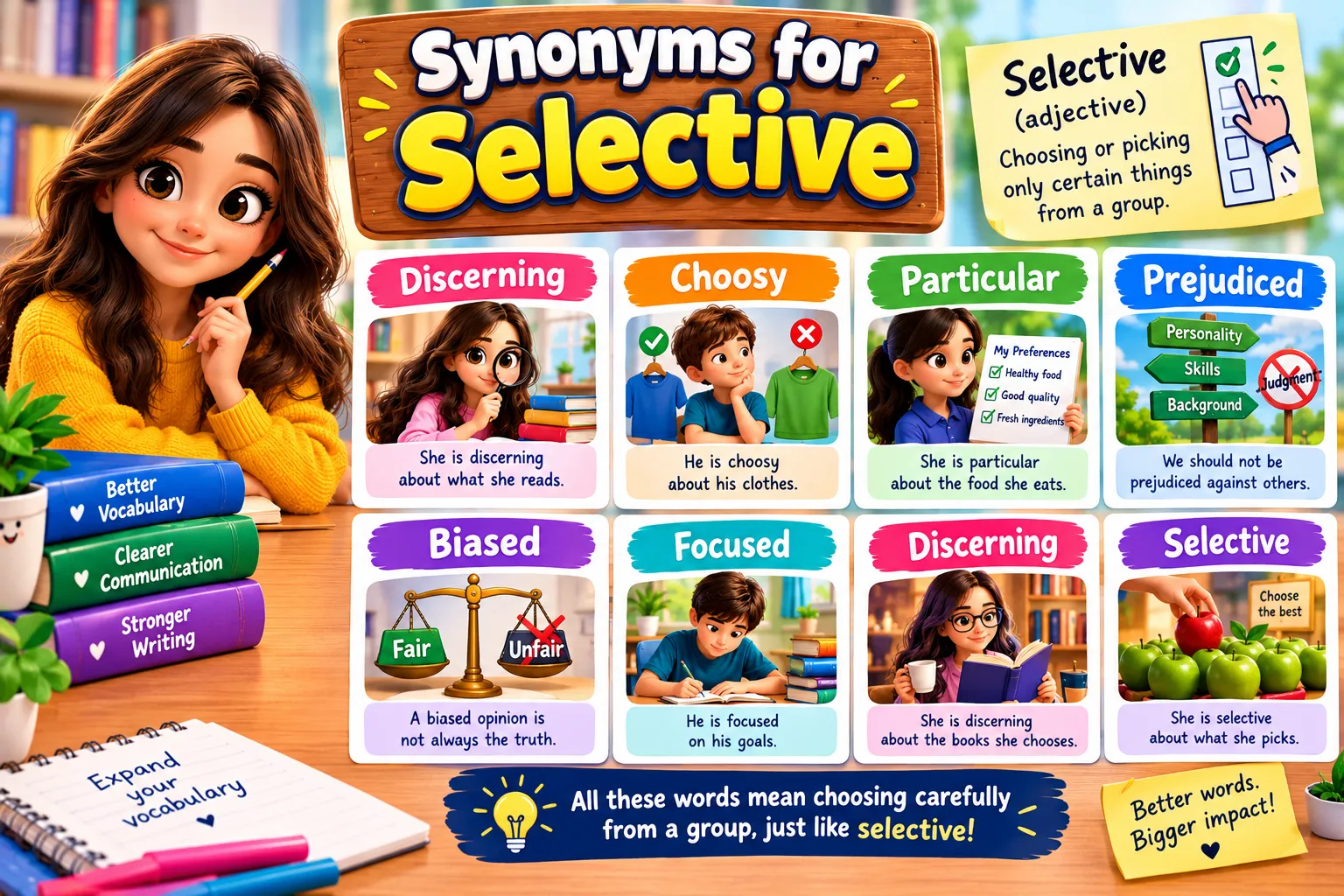
Synonyms for selective include discerning, choosy, picky, particular, careful, judicious, and discriminating. These words describe choosing carefully based on personal preferences, needs, or standards.
I often use the word selective when talking about choices, preferences, or careful decisions. For example, a teacher may be selective when choosing students for a special program. A person may also be selective when picking friends, food, or books. The word helps us show that someone chooses with care instead of accepting everything.
Learning synonyms for selective can make your English more clear and interesting. Words such as discerning, choosy, and careful have similar meanings, but each fits a different situation. Using the right synonym can help you avoid repetition and express your ideas more clearly.
In this guide, I will explain the meaning, pronunciation, history, and grammar of selective. You will also learn 30 synonyms with simple meanings and examples, along with antonyms and useful tips to improve your vocabulary.
Meaning of Selective
Definition
Selective (adjective): Choosing carefully from a group of people or things based on specific needs, standards, or preferences.
Examples
- She is selective about the books she reads.
- The school has a selective admission process.
Connotative Meaning
Connotation (the feeling or idea a word suggests beyond its basic meaning).
- Positive tone: Shows good judgment, high standards, and careful choices.
- Negative tone: May suggest that someone is too picky or unwilling to consider other options.
- Neutral tone: Describes choosing certain people or things according to set rules.
Etymology of Selective
| Historical Period | Development of “Selective” |
| Old English (450–1100) | The word selective was not used in its modern form. English used other words to express choosing or picking. |
| Middle English (1100–1500) | French and Latin influences helped develop English vocabulary related to selection and choice. |
| Modern English (1500–Present) | Selective developed from select and the suffix -ive, which expresses a quality or tendency. Select comes from Latin seligere, meaning “to choose.” |
Pronunciation (IPA)
- IPA: /sɪˈlek.tɪv/
- Syllables: se-LEC-tive
- Part of speech: Adjective
Affixation Pattern of Selective
- Root: Select
- Prefix: None
- Suffix: -ive, which helps form adjectives.
- Word formations:
- Select (verb/adjective): To choose or carefully chosen.
- Selection (noun): The act or result of choosing.
- Selective (adjective): Choosing carefully.
- Selectively (adverb): In a selective manner.
- Selectiveness (noun): The quality of being selective.
- Selectivity (noun): The degree or tendency of choosing certain things over others.
- Selected (verb/adjective): Chosen from a group.
- Selector (noun): A person or device that chooses.
30 Synonyms of Selective With Meaning and Examples
The following words have meanings close to selective. Some are direct alternatives, while others fit only certain situations.
1. Discerning (Adjective)
Meaning: Able to judge the quality or value of something well.
Examples:
- She is a discerning reader who chooses good books.
- Discerning buyers compare quality before they spend money.
2. Choosy (Adjective)
Meaning: Careful about what you accept or want.
Examples:
- My brother is choosy about his clothes.
- She is very choosy when picking a restaurant.
3. Picky (Adjective)
Meaning: Hard to please because you have strong preferences.
Examples:
- The child is picky about food.
- He is picky when choosing a new phone.
4. Particular (Adjective)
Meaning: Having clear and specific preferences or standards.
Examples:
- She is particular about how she keeps her desk.
- He is particular about the quality of his work.
5. Discriminating (Adjective)
Meaning: Able to recognize and choose what is best or most suitable.
Examples:
- A discriminating buyer looks for lasting quality.
- She has a discriminating eye for art.
6. Careful (Adjective)
Meaning: Taking time to avoid mistakes and make good choices.
Examples:
- Be careful when selecting your words.
- He was careful when choosing a business partner.
7. Cautious (Adjective)
Meaning: Careful to avoid risks or unwanted results.
Examples:
- She is cautious about sharing personal details.
- The company is cautious when hiring new staff.
8. Judicious (Adjective)
Meaning: Showing good judgment when making decisions.
Examples:
- He made a judicious choice of investments.
- A judicious reader checks facts before sharing a story.
9. Fastidious (Adjective)
Meaning: Very attentive to details and high standards.
Examples:
- She is fastidious about keeping her home clean.
- The editor is fastidious about grammar.
10. Exacting (Adjective)
Meaning: Demanding high standards from people or things.
Examples:
- The coach has exacting standards for the team.
- She is exacting when reviewing a report.
11. Discriminative (Adjective)
Meaning: Able to distinguish between different things or qualities.
Examples:
- The test measures discriminative skills.
- Discriminative thinking helps us compare similar ideas.
12. Exclusive (Adjective)
Meaning: Limited to a particular group or excluding others.
Examples:
- The club offers exclusive membership.
- The event is exclusive to invited guests.
13. Limited (Adjective)
Meaning: Restricted in amount, number, or range.
Examples:
- The store has a limited selection of shoes.
- We have limited options for the trip.
14. Restricted (Adjective)
Meaning: Kept within certain limits or rules.
Examples:
- Access is restricted to staff members.
- The program has restricted entry requirements.
15. Specialized (Adjective)
Meaning: Designed for a particular purpose or area of knowledge.
Examples:
- She works in a specialized medical field.
- The shop sells specialized tools for builders.
16. Targeted (Adjective)
Meaning: Directed toward a specific person, group, or goal.
Examples:
- The school offers targeted support to struggling students.
- The campaign uses targeted messages for young readers.
17. Focused (Adjective)
Meaning: Concentrating on a specific task, goal, or subject.
Examples:
- She takes a focused approach to learning.
- The team held a focused discussion about its goals.
18. Intentional (Adjective)
Meaning: Done on purpose rather than by chance.
Examples:
- His choice of words was intentional.
- She made an intentional effort to improve her writing.
19. Deliberate (Adjective)
Meaning: Carefully considered before a decision is made.
Examples:
- He made a deliberate choice to study abroad.
- The manager took a deliberate approach to hiring.
20. Considered (Adjective)
Meaning: Thought about carefully before being accepted or chosen.
Examples:
- It was a considered decision.
- She made a considered choice after comparing the offers.
21. Refined (Adjective)
Meaning: Showing good taste, care, or a high level of quality.
Examples:
- He has refined tastes in music.
- Her refined style reflects years of experience.
22. Sophisticated (Adjective)
Meaning: Showing knowledge, experience, or a high level of understanding.
Examples:
- She has sophisticated taste in art.
- The company uses a sophisticated selection system.
23. Exclusive-minded (Adjective)
Meaning: Inclined to prefer a limited group or keep others out.
Examples:
- The exclusive-minded group rarely welcomes new members.
- His exclusive-minded attitude made teamwork harder.
24. Select (Adjective)
Meaning: Carefully chosen as the best or most suitable.
Examples:
- The store offers a select range of products.
- Only a select group attended the private event.
25. Discriminative in taste (Phrase)
Meaning: Able to tell the difference between things and prefer higher-quality options.
Examples:
- She is discriminative in taste when choosing artwork.
- He is discriminative in taste and prefers well-made furniture.
26. Choosy-minded (Adjective)
Meaning: Having a tendency to choose only according to personal preferences.
Examples:
- The choosy-minded shopper checked every label.
- A choosy-minded reader may prefer certain genres.
27. Selective-minded (Adjective)
Meaning: Inclined to accept only certain options.
Examples:
- Her selective-minded approach shaped the final list.
- A selective-minded buyer may compare many products before deciding.
28. Quality-conscious (Adjective)
Meaning: Focused on the quality of products, services, or results.
Examples:
- Quality-conscious customers read product reviews.
- The quality-conscious chef buys fresh ingredients.
29. Option-conscious (Adjective)
Meaning: Aware of different choices and careful about which one to take.
Examples:
- Option conscious buyers compare prices and features.
- She is option conscious when planning a holiday.
30. Discerning-minded (Adjective)
Meaning: Inclined to judge options carefully and recognize differences in quality.
Examples:
- The discerning-minded collector checks each item’s history.
- A discerning-minded reader looks for reliable information.
Usage note: The strongest everyday synonyms are discerning, choosy, picky, particular, careful, and discriminating. Some phrases above, such as selective-minded and option-conscious, are uncommon or descriptive expressions rather than standard dictionary synonyms. Use them only when their meaning fits your context.
Prototype Meaning of Selective
The most typical meaning of selective is choosing some options carefully while leaving out others. When people hear this word, they often imagine someone who has clear standards or preferences. For example, a selective student may choose only certain courses, while a selective shopper may compare products before buying. The word can describe wise judgment, personal taste, formal rules, or a limited process. Its exact meaning depends on the situation.
Prototype Categorization
| Meaning Category | Synonyms for Selective | When to Use |
| Careful Judgment | Discerning, discriminating, judicious, careful, cautious | When someone thinks carefully before making a choice. |
| Strong Preferences | Choosy, picky, particular, fastidious, exacting | When someone has high standards or is difficult to please. |
| Limits and Access | Exclusive, limited, restricted, select | When describing groups, memberships, or availability. |
| Purpose and Focus | Targeted, focused, intentional, deliberate, considered | When choices are made to achieve a specific goal. |
| Quality and Taste | Refined, sophisticated, quality-conscious, discriminating | When discussing standards, products, art, or personal style. |
| Specific Needs or Expertise | Specialized, discriminative, option-conscious | When choices depend on particular skills, purposes, or available options. |
Tip: Choose a synonym based on its meaning, tone, and context. For example, discerning usually sounds positive, while picky can suggest that someone is difficult to please.
Antonyms of Selective
Antonyms describe the opposite idea: accepting many options, making few distinctions, or choosing without much care.
- Inclusive (adjective): Open to many people or options.
- Unselective (adjective): Not choosing carefully between options.
- Indiscriminate (adjective): Acting without careful judgment or distinction.
- Broad (adjective): Covering a wide range of options.
- General (adjective): Not limited to a specific group or purpose.
- Open (adjective): Available to many people or possibilities.
- Uncritical (adjective): Accepting something without careful evaluation.
- Careless (adjective): Not taking enough care when making a choice.
- Random (adjective): Chosen without a clear plan or pattern.
- Unrestricted (adjective): Not limited by rules or boundaries.
Short Questions and Answers
What does selective mean?
Selective means choosing certain people or things carefully based on standards, needs, or preferences.
When should selective be used?
Use selective when someone chooses carefully, limits options, or follows specific standards. For example, “She is selective about the news she reads.”
Is selective positive or negative?
It can be both. It sounds positive when it suggests good judgment, but it can sound negative when it suggests someone is too picky.
How is selective different from similar words?
Selective is a general term for choosing carefully. Discerning emphasizes good judgment, choosy emphasizes strong preferences, and exclusive emphasizes keeping access limited.
Conclusion
Learning selective and its synonyms helps you express your ideas with greater accuracy. Words such as discerning, careful, and judicious can describe wise choices, while choosy and picky can describe strong personal preferences. Other words, such as exclusive and restricted, focus on limits and access.
When you understand these small differences, your writing becomes clearer and less repetitive. You can also speak with more confidence because you know which word best fits each situation. Try learning a few synonyms each day, writing your own example sentences, and using new words in conversations. With regular practice, you can build a stronger vocabulary and become a more confident English learner.
Read More:
Synonyms for Good Work Ethic: 30 Words to Describe It

I’m Rubab, a content specialist at SameSynonym, focused on synonyms, antonyms, word meanings, and English vocabulary.
I create clear, well-researched content with accurate definitions and practical examples.
My goal is to help readers improve their vocabulary and writing with confidence.