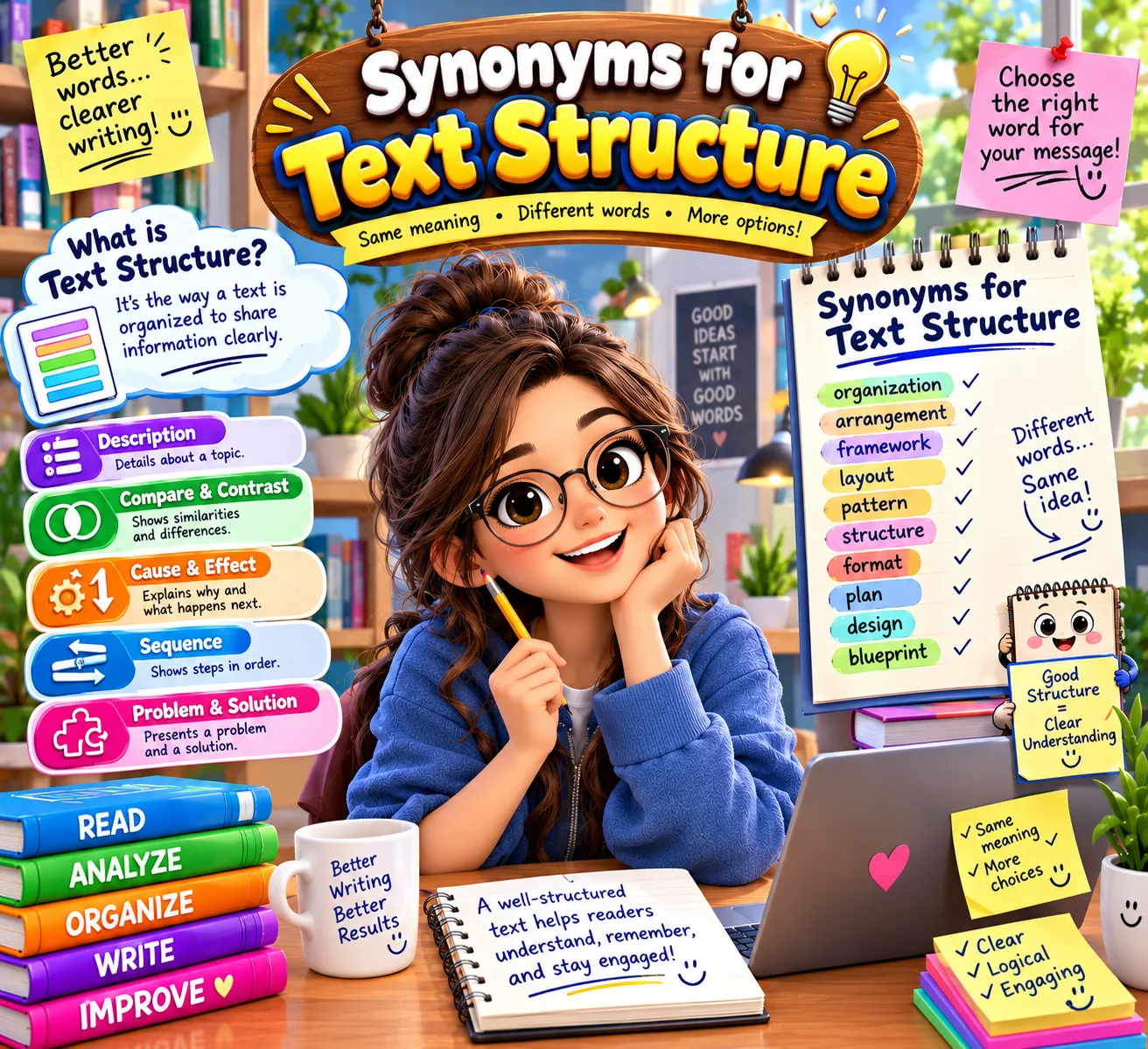
Synonyms for text structure include text organization, document layout, writing format, content organization, composition structure, and document framework. The best choice depends on whether you mean how a text is arranged, how ideas are organized, or how a document is formatted.
Text structure is the way a piece of writing is organized. It helps readers follow ideas and understand how information fits together. For example, a student may organize an essay by comparing two things, explaining a problem and its solution, or describing events in time order. Each method uses a different text structure.
Writers, teachers, students, and content creators use this term when they discuss clear and effective writing. Learning synonyms for text structure can help you explain writing methods in different ways and avoid repeating the same phrase.
However, not every alternative has the same meaning. Some refer to the order of ideas, while others describe the layout of a document. In this guide, you will learn the meaning, pronunciation, history, grammar, and 30 related terms, with simple examples to help you choose the right word.
Meaning of Text Structure
Definition
Text structure (noun phrase): The way ideas, details, and information are arranged in a piece of writing.
Examples
- The teacher explained the text structure of the story.
- A clear text structure helps readers understand the main idea.
Connotative Meaning
(Connotation: the feeling or idea that a word or phrase suggests beyond its basic meaning.)
- Positive tone: Suggests clear, logical, and well-organized writing.
- Negative tone: May suggest a rigid or confusing arrangement when the structure is poorly designed.
- Neutral tone: Simply describes how information is arranged in a text.
Etymology of Text Structure
- Old English (450–1100): The modern phrase text structure was not used in its current form. Old English had words such as stōw and stowian for place and arrangement, though they were not exact equivalents.
- Middle English (1100–1500): Text entered English through Old French from Latin textus, meaning “woven fabric” or “written work.” Structure developed from Latin structura, meaning “a building or arrangement.”
- Modern English (1500–present): Both words became common in English. The phrase text structure is now used in education, reading, writing, and language study to describe how information is organized.
Pronunciation (IPA)
- IPA: /tɛkst ˈstrʌk.tʃər/ (common American English)
- Syllables: text struc-ture (3 syllables)
Affixation Pattern of Text Structure
- Affixation Pattern of Text Structure
| Category | Word or Form | Part of Speech | Meaning |
| Root Words | Text | Noun | Written or printed words. |
| Root Words | Structure | Noun | The way parts are arranged. |
| Prefix | None | — | The phrase text structure has no prefix. |
| Suffix | -ure | Noun-forming suffix | Appears in structure and helps form a noun. |
| Word Formation | Textual | Adjective | Related to a written text. |
| Word Formation | Textually | Adverb | In a way related to a text. |
| Word Formation | Structurally | Adverb | In terms of structure or arrangement. |
| Word Formation | Restructure | Verb | To arrange something in a new way. |
| Word Formation | Restructuring | Noun/Verb | The act of changing an arrangement or the process of changing it. |
| Word Formation | Structured | Adjective/Verb | Organized in a particular way or arranged according to a plan. |
| Word Formation | Structuring | Noun/Verb | The act or process of organizing parts. |
30 Synonyms of Text Structure With Meaning and Examples
Note: Some alternatives below are close synonyms, while others describe a specific aspect of text structure, such as layout, format, or the order of ideas. Choose the phrase that matches your intended meaning.
1. Text Organization (Noun Phrase)
Meaning: The way information and ideas are arranged in a text.
Examples:
- Good text organization makes the essay easy to follow.
- The teacher helped us improve our text organization.
2. Writing Structure (Noun Phrase)
Meaning: The way a piece of writing is built and arranged.
Examples:
- The story has a simple writing structure.
- Strong writing structure helps readers understand each point.
3. Text Arrangement (Noun Phrase)
Meaning: The order in which parts of a text are placed.
Examples:
- The text arrangement makes the report easy to read.
- We changed the text arrangement to improve the flow.
4. Content Organization (Noun Phrase)
Meaning: The way ideas and information are grouped and ordered.
Examples:
- Content organization is important for a useful website.
- The writer improved content organization by adding clear sections.
5. Document Structure (Noun Phrase)
Meaning: The way the parts of a document are organized.
Examples:
- The document structure includes a title, headings, and main sections.
- A clear document structure helps readers find information quickly.
6. Writing Format (Noun Phrase)
Meaning: The way writing is presented or arranged for a specific purpose.
Examples:
- The assignment requires a formal writing format.
- I changed the writing format to suit the report.
7. Text Framework (Noun Phrase)
Meaning: The basic plan or arrangement that supports a text.
Examples:
- The writer created a text framework before drafting the article.
- A strong text framework keeps the main ideas connected.
8. Organizational Pattern (Noun Phrase)
Meaning: A repeated method used to arrange information.
Examples:
- Cause and effect is a common organizational pattern.
- The students identified the organizational pattern of the passage.
9. Text Pattern (Noun Phrase)
Meaning: The way ideas or details follow a recognizable order in a text.
Examples:
- The text pattern shows how the problem develops.
- Readers can use the text pattern to understand the passage.
10. Discourse Structure (Noun Phrase)
Meaning: The way ideas and messages are connected across spoken or written communication.
Examples:
- The researcher studied the discourse structure of the speech.
- Discourse structure helps explain how an argument develops.
11. Narrative Structure (Noun Phrase)
Meaning: The way events and characters are arranged in a story.
Examples:
- The novel uses a simple narrative structure.
- The writer changed the narrative structure to build suspense.
12. Essay Structure (Noun Phrase)
Meaning: The arrangement of an essay’s introduction, body, and conclusion.
Examples:
- The teacher explained the correct essay structure.
- A clear essay structure helps students present their arguments.
13. Paragraph Structure (Noun Phrase)
Meaning: The way sentences and ideas are arranged within a paragraph.
Examples:
- Good paragraph structure keeps each idea focused.
- The student improved paragraph structure by adding a topic sentence.
14. Sentence Structure (Noun Phrase)
Meaning: The way words and phrases are arranged to form a sentence.
Examples:
- Correct sentence structure makes writing easier to understand.
- We practiced sentence structure in English class.
15. Information Structure (Noun Phrase)
Meaning: The way information is ordered and presented to readers or listeners.
Examples:
- The report’s information structure follows a clear sequence.
- Good information structure helps readers find key facts.
16. Logical Organization (Noun Phrase)
Meaning: An arrangement in which ideas follow a clear and sensible order.
Examples:
- The article uses logical organization to explain the topic.
- Logical organization makes the argument more convincing.
17. Outline (Noun)
Meaning: A plan that lists the main points and their order before writing.
Examples:
- I made an outline before writing my essay.
- The outline helped me organize the main ideas.
18. Blueprint (Noun)
Meaning: A plan that guides how a piece of writing will be developed.
Examples:
- The outline served as a blueprint for the report.
- A good blueprint helps the writer stay focused.
19. Composition Structure (Noun Phrase)
Meaning: The way parts of a written composition are organized.
Examples:
- The teacher reviewed the composition structure.
- A clear composition structure made the student’s ideas easier to follow.
20. Document Layout (Noun Phrase)
Meaning: The way text, headings, images, and other elements are placed on a page.
Examples:
- The document layout looks clean and professional.
- I changed the document layout to make the headings stand out.
21. Page Layout (Noun Phrase)
Meaning: The arrangement of text and other elements on a page.
Examples:
- The page layout gives the report a neat appearance.
- A simple page layout makes the document easier to scan.
22. Formatting (Noun)
Meaning: The way text is styled and presented using features such as spacing, headings, and fonts.
Examples:
- Proper formatting makes the assignment look organized.
- I fixed the formatting before submitting the document.
23. Content Framework (Noun Phrase)
Meaning: A basic plan for arranging and developing information.
Examples:
- The editor created a content framework for the guide.
- A content framework helped the team cover every key point.
24. Structural Pattern (Noun Phrase)
Meaning: A recognizable way of arranging the parts of a text.
Examples:
- The passage follows a problem-and-solution structural pattern.
- Students learned to identify the structural pattern of each passage.
25. Rhetorical Structure (Noun Phrase)
Meaning: The way a text is organized to explain, persuade, or achieve another communication goal.
Examples:
- The speech’s rhetorical structure supports its main argument.
- The writer used rhetorical structure to persuade readers.
26. Expository Structure (Noun Phrase)
Meaning: An arrangement used to explain or provide information about a topic.
Examples:
- The article uses an expository structure to explain climate change.
- An expository structure helps readers learn new facts.
27. Chronological Order (Noun Phrase)
Meaning: An arrangement of events according to the order in which they happen.
Examples:
- The biography presents events in chronological order.
- Chronological order makes the history lesson easier to follow.
28. Compare-and-Contrast Structure (Noun Phrase)
Meaning: An arrangement that shows the similarities and differences between two or more things.
Examples:
- The essay uses a compare-and-contrast structure.
- A compare-and-contrast structure helps readers see key differences.
29. Problem-and-Solution Structure (Noun Phrase)
Meaning: An arrangement that presents a problem and explains ways to solve it.
Examples:
- The article follows a problem-and-solution structure.
- This structure helps readers understand the issue and possible answers.
30. Cause-and-Effect Structure (Noun Phrase)
Meaning: An arrangement that explains why something happens and what results from it.
Examples:
- The passage uses a cause-and-effect structure.
- A cause-and-effect structure shows how one event leads to another.
Prototype Meaning
The most typical meaning of text structure is the way a writer arranges ideas and information in a written piece. Readers often think of an introduction, body paragraphs, and a conclusion, along with patterns such as sequence, comparison, cause and effect, and problem and solution. A clear structure helps readers follow the message and understand how each idea connects to the next.
Prototype Categorization
The related terms for text structure can be grouped into semantic categories based on their meanings and uses.
| Semantic Category | Related Words | Meaning and Usage |
| General Organization | Text organization, writing structure, text arrangement, content organization, document structure | Describe how information and ideas are arranged in a text or document. |
| Patterns of Ideas | Organizational pattern, text pattern, information structure, logical organization, structural pattern | Explain how ideas connect, develop, and follow a clear order. |
| Writing Plans | Text framework, outline, blueprint, content framework | Refer to plans that guide the organization and development of writing. |
| Specific Writing Structures | Narrative structure, essay structure, paragraph structure, sentence structure, composition structure | Describe the arrangement of stories, essays, paragraphs, sentences, or complete compositions. |
| Communication and Argument | Discourse structure, rhetorical structure | Explain how messages, arguments, and ideas are connected to communicate effectively. |
| Page Design and Presentation | Writing format, document layout, page layout, formatting | Describe how text, headings, spacing, and visual elements appear on a page or screen. |
| Explanatory Structures | Expository structure, chronological order, compare-and-contrast structure, problem-and-solution structure, cause-and-effect structure | Describe common methods for explaining information, comparing ideas, presenting problems, or showing relationships between events. |
| Related Structural Terms | Document structure, content framework | Describe the overall plan for arranging the parts of a document or organizing its content. |
Usage tip: Grouping synonyms by meaning helps writers choose precise words. For example, chronological order describes the sequence of events, while document layout describes the placement of text and visual elements. These terms are related, but they are not always interchangeable.
Antonyms of Text Structure
Text structure has no single exact antonym. However, the following words describe a lack of clear organization.
1. Disorganization (Noun)
Meaning: A lack of order or proper arrangement.
2. Disorder (Noun)
Meaning: A state in which things are not arranged in a clear or orderly way.
3. Chaos (Noun)
Meaning: Complete confusion or a lack of order.
4. Randomness (Noun)
Meaning: An arrangement without a clear or planned pattern.
5. Incoherence (Noun)
Meaning: A lack of clear connections between ideas, making writing difficult to understand.
Short Questions and Answers
What does text structure mean?
Text structure means the way ideas, details, and information are arranged in a piece of writing.
When should text structure be used?
Use text structure when discussing how a story, essay, article, or other text is organized.
Is text structure positive or negative?
It is neutral. A clear text structure can improve readability, while a poor structure can confuse readers.
How is text structure different from similar words?
Text structure refers to how ideas and sections are arranged. Formatting refers to visual presentation, while an outline is a plan created before writing.
Conclusion
Learning synonyms for text structure helps you describe writing in clearer and more varied ways. Words such as text organization, writing structure, and document structure can reduce repetition and make your writing more precise. Other terms, such as chronological order, cause-and-effect structure, and compare-and-contrast structure, help explain specific ways of arranging ideas.
Remember that related terms do not always have the same meaning. Choose a word based on what you want to describe, whether it is the order of ideas, the purpose of a text, or the design of a page. Try learning a few terms each day and using them in your own sentences. With regular practice, you can build your vocabulary, improve your writing and speaking, and feel more confident using English.
Read More:
Synonyms for Documentary: 30 Better Words to Use

I’m Rubab, a content specialist at SameSynonym, focused on synonyms, antonyms, word meanings, and English vocabulary.
I create clear, well-researched content with accurate definitions and practical examples.
My goal is to help readers improve their vocabulary and writing with confidence.