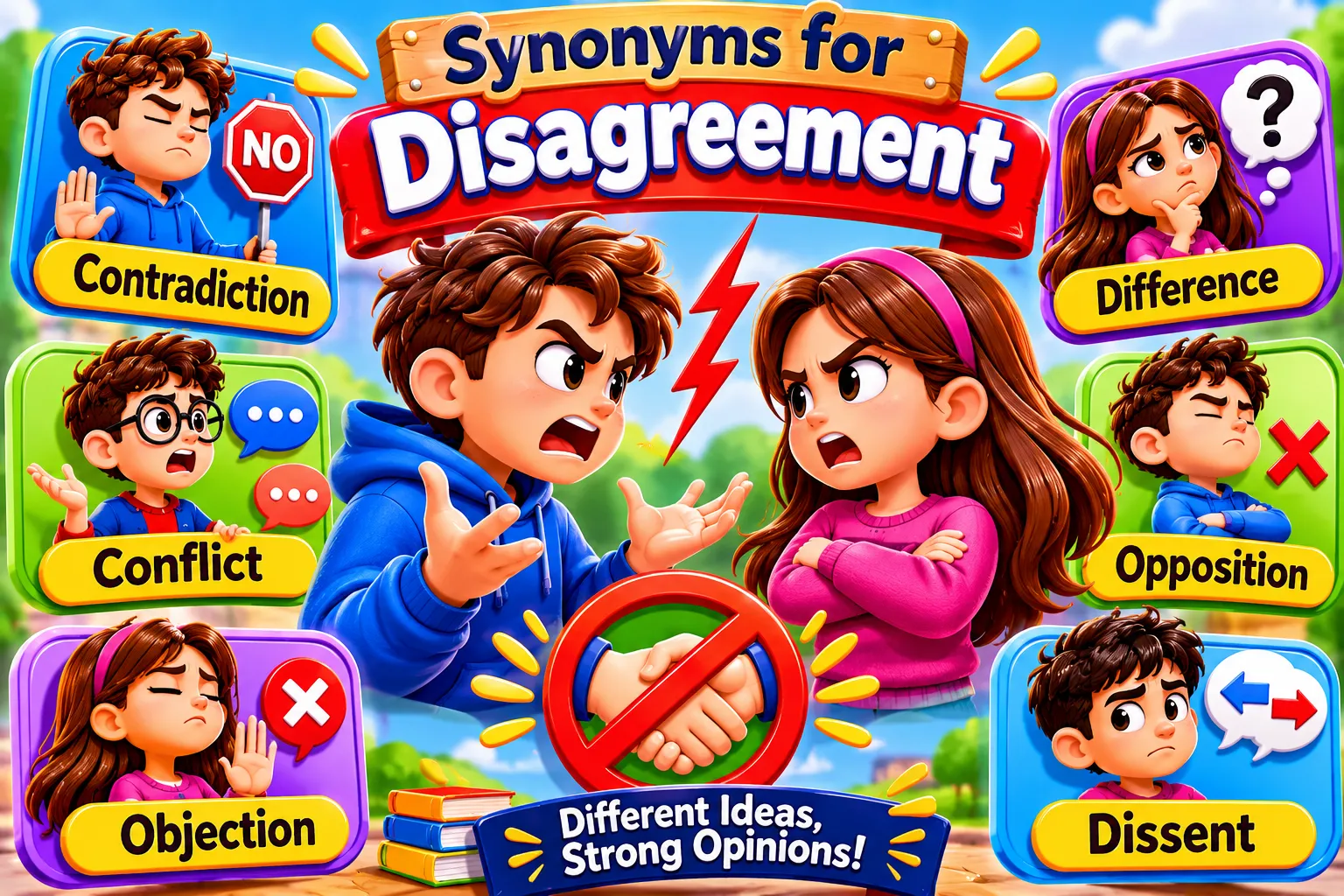
Synonyms for disagreement include dispute, argument, conflict, debate, discord, dissension, opposition, quarrel, difference of opinion, and controversy. These words describe different forms of opposing views, beliefs, or ideas.
Disagreement is a common part of daily life. Two friends may disagree about a movie. Students may have different views on a school topic. Workers may disagree about how to complete a task. The word disagreement means a lack of agreement between people, ideas, or opinions. It is often used in talks, debates, meetings, and writing.
Learning synonyms for disagreement helps English learners express their thoughts with greater care. It also helps content writers avoid using the same word again and again. Some alternatives show a mild difference of opinion, while others describe a strong conflict or dispute.
In this guide, you will learn the meaning of disagreement, its history, pronunciation, grammar, and 30 useful synonyms. Each synonym includes a simple meaning and examples. You will also explore semantic categories, antonyms, and common questions to help you use these words with confidence.
Meaning of Disagreement
Definition
Disagreement (Noun): A situation in which two or more people have different opinions, beliefs, or views about something.
Examples
- The two friends had a disagreement about where to eat.
- Their disagreement over the plan led to a long discussion.
Connotative Meaning
(Connotation: the feeling or idea a word suggests beyond its basic meaning.)
- Positive tone: Disagreement can be positive when it leads to open discussion, new ideas, or better decisions.
- Negative tone: It can suggest tension, conflict, or a lack of peace between people.
- Neutral tone: It can simply describe two people having different views without any anger.
Etymology
The word disagreement is formed from the prefix dis-, the root agree, and the suffix -ment. The word agree entered English through Old French agreer, meaning to please or accept.
| Language Period | Origin and Development | Meaning |
| Old English (450–1100) | The exact word disagreement was not used. Related words expressed ideas of approval and accord. | Agreement or harmony was expressed through other words. |
| Middle English (1100–1500) | Agree entered English from Old French agreer. The prefix dis- was used to express opposition or lack. | To disagree meant to differ in opinion or fail to agree. |
| Modern English (1500–Present) | Disagreement developed as a noun from disagree with the suffix -ment. | A difference of opinion, belief, or view. |
Pronunciation (IPA)
- IPA: /ˌdɪs.əˈɡriː.mənt/
- Syllables: dis-a-gree-ment (4 syllables)
Affixation Pattern of Disagreement
- Root: Agree
- Prefix: Dis- (shows opposition or lack of agreement)
- Suffix: -ment (forms a noun that describes a state, result, or action)
Word Formations
- Agree (Verb): To have the same opinion.
- Agreed (Verb): Accepted or shared the same view.
- Agreeing (Verb): Showing the same opinion.
- Agreement (Noun): A shared opinion or arrangement.
- Disagree (Verb): To have a different opinion.
- Disagreed (Verb): Had a different opinion.
- Disagreeing (Verb): Having a different view.
- Disagreement (Noun): A difference of opinion.
- Disagreeable (Adjective): Unpleasant or difficult to accept.
- Disagreeably (Adverb): In an unpleasant manner.
27 Synonyms of Disagreement With Meaning & Examples
1. Difference of Opinion (Noun)
Meaning: A situation in which people hold different views about something.
Examples:
- We had a difference of opinion about the project.
- A difference of opinion does not have to end a friendship.
2. Dispute (Noun)
Meaning: A serious disagreement that may involve arguments or opposing claims.
Examples:
- The neighbors had a dispute over the fence.
- The dispute lasted for several days.
3. Argument (Noun)
Meaning: A discussion in which people express opposing views, often with strong feelings.
Examples:
- Their argument began over a small mistake.
- I heard an argument between two workers.
4. Conflict (Noun)
Meaning: A serious clash between different ideas, interests, or people.
Examples:
- The conflict between the teams grew stronger.
- Their goals caused a conflict at work.
5. Debate (Noun)
Meaning: A formal or organized discussion in which people present different opinions.
Examples:
- The students took part in a debate.
- The debate focused on school rules.
6. Discord (Noun)
Meaning: A lack of harmony or agreement among people.
Examples:
- The decision created discord within the group.
- Discord among the team members slowed their work.
7. Dissension (Noun)
Meaning: Disagreement within a group, often about a decision or belief.
Examples:
- Dissension arose among the leaders.
- The plan caused dissension in the club.
8. Difference (Noun)
Meaning: A way in which opinions, ideas, or views are not the same.
Examples:
- There is a difference between our views.
- They settled their differences through discussion.
9. Opposition (Noun)
Meaning: The act of resisting or disagreeing with an idea or action.
Examples:
- The proposal faced strong opposition.
- She spoke in opposition to the new rule.
10. Contradiction (Noun)
Meaning: A statement or idea that goes against another statement or idea.
Examples:
- His answer was a contradiction of her claim.
- The report contains a clear contradiction.
11. Quarrel (Noun)
Meaning: An angry disagreement between people.
Examples:
- The brothers had a quarrel.
- Their quarrel began over money.
12. Controversy (Noun)
Meaning: A public disagreement about an issue that people have strong views on.
Examples:
- The new law caused controversy.
- The topic remains a source of controversy.
13. Clashing (Noun)
Meaning: A strong difference between opinions, interests, or beliefs.
Examples:
- The clashing views made the meeting difficult.
- Their clashing interests led to a problem.
14. Difference in Views (Noun)
Meaning: A situation where people see or understand something in different ways.
Examples:
- There was a difference in views about the budget.
- Their difference in views did not affect their friendship.
15. Misunderstanding (Noun)
Meaning: A failure to understand something correctly that may lead to disagreement.
Examples:
- A misunderstanding caused the disagreement.
- We cleared up the misunderstanding quickly.
16. Wrangle (Noun)
Meaning: A long and often heated disagreement.
Examples:
- The partners had a wrangle over the contract.
- Their wrangle delayed the decision.
17. Feud (Noun)
Meaning: A long-lasting and bitter disagreement between people or groups.
Examples:
- The families had a feud for many years.
- The feud began over a property issue.
18. Contest (Noun)
Meaning: A disagreement or challenge over a claim, decision, or right.
Examples:
- The election result became a contest.
- They entered a contest over ownership of the land.
19. Schism (Noun)
Meaning: A deep division between people or groups caused by different beliefs.
Examples:
- The disagreement led to a schism in the organization.
- A schism formed between the two groups.
20. Antagonism (Noun)
Meaning: Strong hostility or opposition between people or groups.
Examples:
- Antagonism grew between the two leaders.
- Their antagonism made cooperation difficult.
21. Resistance (Noun)
Meaning: The act of opposing or refusing to accept something.
Examples:
- The plan faced resistance from workers.
- Resistance to change is common.
22. Disunity (Noun)
Meaning: A lack of agreement or unity within a group.
Examples:
- Disunity weakened the team.
- The group showed disunity over the decision.
23. Incompatibility (Noun)
Meaning: A state in which two ideas, beliefs, or people do not fit or agree.
Examples:
- Their beliefs showed incompatibility.
- Incompatibility between the plans caused problems.
24. Variance (Noun)
Meaning: A difference or disagreement between opinions, facts, or actions.
Examples:
- His statement was at variance with the report.
- The two accounts were at variance.
25. Nonconformity (Noun)
Meaning: The act of not following a shared belief, rule, or opinion.
Examples:
- Her nonconformity challenged the group’s views.
- Nonconformity can lead to disagreement.
26. Protest (Noun)
Meaning: An expression of disagreement or objection to something.
Examples:
- The workers made a protest against the policy.
- She raised a protest during the meeting.
27. Objection (Noun)
Meaning: A statement that expresses disagreement or disapproval.
Examples:
- He raised an objection to the proposal.
- No one had an objection to the plan.
Prototype Meaning
The prototype meaning of disagreement is a difference in opinion between two or more people. People usually imagine a situation where individuals do not share the same views on a topic, decision, or belief. A disagreement may be calm and respectful, or it may lead to an argument. For example, two friends may disagree about a movie but still remain close. The word is commonly used in conversations, debates, meetings, and formal writing.
Prototype Categorization
Prototype Categorization of Synonyms for Disagreement
The 27 synonyms of disagreement can be divided into meaningful semantic categories. These groups help writers choose words that match the level and type of disagreement.
| Semantic Category | Synonyms | Description |
| Mild differences in opinion | Difference of opinion, difference, difference in views, variance, incompatibility | Describe differences without always suggesting anger or conflict. |
| Arguments and disputes | Dispute, argument, quarrel, wrangle, contest | Describe direct disagreements that may involve discussion or conflict. |
| Strong conflict and hostility | Conflict, feud, antagonism, rift, clashing | Suggest serious tension or strained relationships. |
| Group division and lack of unity | Discord, dissension, disunity, schism, split, disharmony | Describe disagreement that affects a group or organization. |
| Opposition and rejection | Opposition, resistance, protest, objection, nonconformity | Show that someone does not accept or support an idea or action. |
| Differences in ideas or statements | Contradiction, debate, controversy, misunderstanding | Relate to opposing claims, public discussions, or problems in understanding. |
| General disagreement and separation | Difference of opinion, disagreement, variance, incompatibility | Describe different beliefs, views, or positions. |
Semantic categorization helps writers select the right synonym for each situation. A mild difference may call for difference of opinion, while a serious conflict may be better described as a dispute or feud.
Antonyms of Disagreement
1. Agreement (Noun)
Meaning: A shared opinion or decision between people.
– We reached an agreement after the meeting.
2. Harmony (Noun)
Meaning: A state of peace and agreement.
– The team worked in harmony.
3. Accord (Noun)
Meaning: An agreement or shared understanding.
– The two groups reached an accord.
4. Consensus (Noun)
Meaning: A general agreement among a group of people.
– The members reached a consensus.
5. Unity (Noun)
Meaning: The state of being joined or working together.
– Unity helped the team succeed.
6. Concurrence (Noun)
Meaning: The act of sharing the same opinion or decision.
– The plan received concurrence from the leaders.
7. Understanding (Noun)
Meaning: A shared view or agreement between people.
– They came to an understanding.
8. Cooperation (Noun)
Meaning: The act of working together toward a common goal.
– Cooperation made the task easier.
Short Questions and Answers
What does disagreement mean?
Disagreement means a difference in opinions, beliefs, or views between two or more people.
When should disagreement be used?
Use disagreement when people have different opinions about a topic, decision, belief, or action.
Is disagreement positive or negative?
Disagreement can be positive or negative. It may lead to useful discussion, but it can also cause conflict or tension.
How is disagreement different from dispute?
A disagreement is a general difference in opinion. A dispute is often a more serious disagreement that may involve arguments or opposing claims.
Conclusion
Learning the word disagreement and its synonyms can improve your English vocabulary. These words help you express different levels of conflict, opposition, and differences in opinion. Words like difference of opinion describe mild differences, while dispute, quarrel, and conflict suggest stronger disagreement.
Using the right synonym can make your writing clearer and more engaging. It also helps you avoid repetition in essays, articles, conversations, and professional communication. English learners can build confidence by studying these words and using them in daily sentences.
Practice a few synonyms each day, read examples, and try to use them in your own writing. With regular practice, you will express your thoughts more clearly and naturally.
Read More:
Synonyms for Negatively: 29 Useful Alternatives to Know

I’m Rubab, a content specialist at SameSynonym, focused on synonyms, antonyms, word meanings, and English vocabulary.
I create clear, well-researched content with accurate definitions and practical examples.
My goal is to help readers improve their vocabulary and writing with confidence.






1 thought on “Synonyms for Disagreement: 27 Useful Alternatives to Learn”