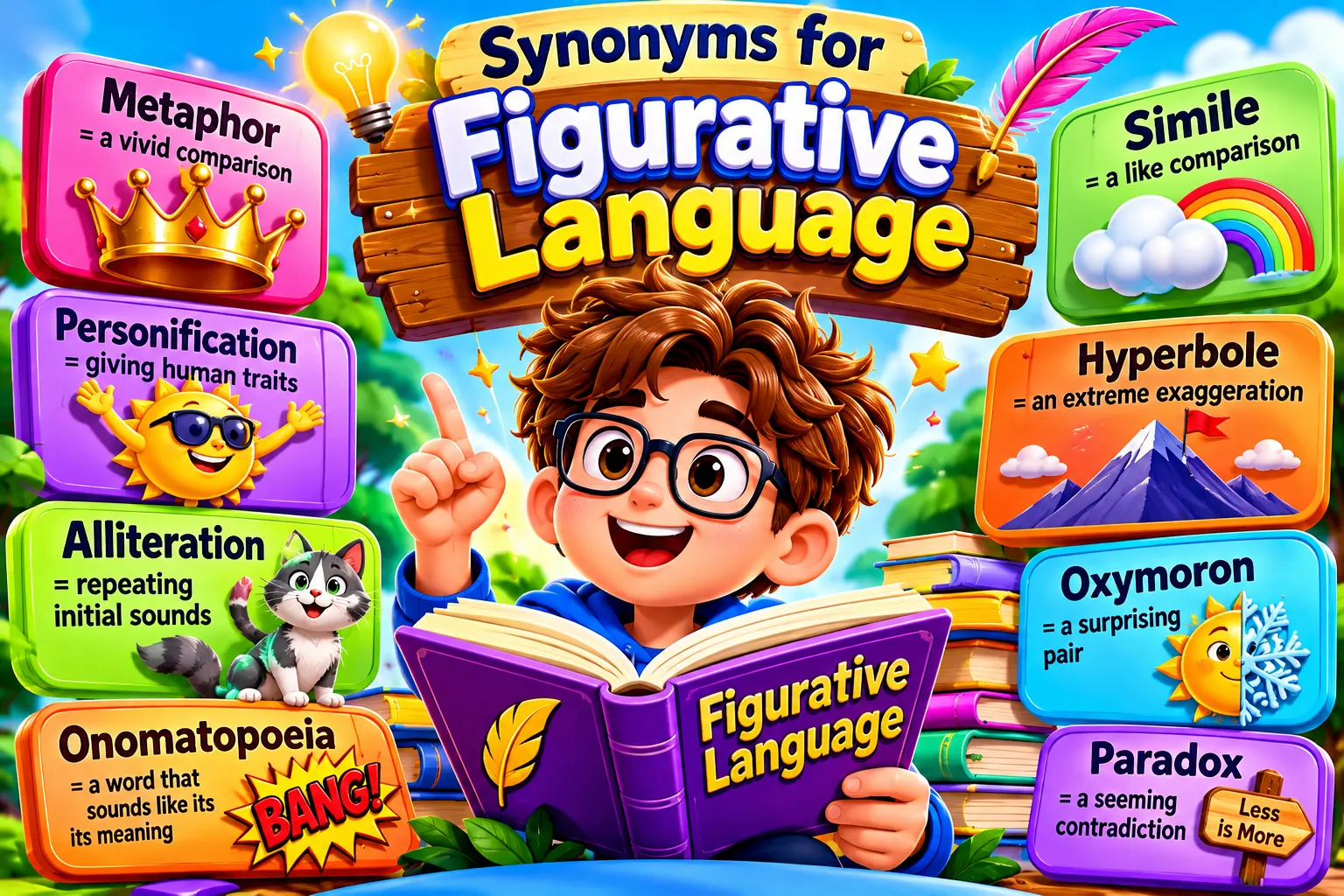
Synonyms and related terms for figurative language include nonliteral language, metaphorical language, figure of speech, symbolic language, poetic language, imagery, expressive language, and imaginative language. These terms describe creative expressions that communicate ideas beyond their literal meanings.
Figurative language uses words in a creative way to express ideas beyond their literal meaning. For example, when someone says, “Time is money,” they do not mean that time is real cash. They use a figure of speech to show that time is valuable.
Figurative language is common in poems, stories, songs, speeches, and everyday conversations. It helps writers make their words more vivid and memorable. Learning synonyms for figurative language can help English learners and content writers explain ideas in fresh ways and avoid repeating the same terms.
In this guide, you will explore the meaning, history, pronunciation, grammar, and 30 related terms. You will also learn how these terms fit into different semantic categories and how to use them in sentences.
Meaning of Figurative Language
Definition
Figurative language (Noun phrase): A way of using words or expressions to create a meaning that goes beyond their usual, literal meaning.
Examples
- The phrase “Her smile was sunshine” is an example of figurative language.
- Writers use figurative language to make stories more vivid and interesting.
Connotative Meaning
(Connotation: the feeling or idea that a word suggests beyond its basic meaning.)
- Positive tone: Creative, expressive, imaginative, and beautiful language.
- Negative tone: It may seem unclear, exaggerated, or confusing when used poorly.
- Neutral tone: A general term for language that uses nonliteral meaning or creative expression.
Etymology
The phrase figurative language comes from the word figure, which has roots in Latin.
| Language Period | Origin and Development | Meaning |
| Old English (450–1100) | The exact phrase figurative language was not used. Old English had words such as gesceap, meaning form or shape. | Ideas of form, shape, and expression were described through other words. |
| Middle English (1100–1500) | Figure entered English through Old French figure, from Latin figura. | Form, shape, or a way of representing something. |
| Modern English (1500–Present) | Figurative developed from figure, while language came through Old French from Latin lingua. | The phrase refers to language that uses figures of speech and nonliteral meanings. |
Pronunciation (IPA)
- IPA: /ˈfɪɡ.ər.ə.tɪv ˈlæŋ.ɡwɪdʒ/
- Syllables: fig-ur-a-tive lan-guage (6 syllables)
Affixation Pattern of Figurative Language
- Root: Figure (a form, shape, or representation)
- Prefix: None
- Suffix: -ative (forms an adjective meaning related to or having the nature of something)
- Word formations:
- Figure (Noun): A shape, form, or representation.
- Figure (Verb): To calculate or understand something.
- Figurative (Adjective): Using a meaning beyond the literal one.
- Figuratively (Adverb): In a nonliteral or symbolic way.
- Figuration (Noun): The act or process of giving form or expression.
- Figurativeness (Noun): The quality of being figurative.
- Language (Noun): A system of words used to communicate.
- Linguistic (Adjective): Related to language.
- Linguist (Noun): A person who studies language.
24 Synonyms and Related Terms for Figurative Language With Meanings & Examples
Note: Figurative language is a broad term. Some alternatives below are close equivalents, while others name specific techniques or styles used to create figurative meaning.
1. Nonliteral Language (Noun Phrase)
Meaning: Language that does not express its meaning in a strictly direct or literal way.
Examples:
- The poem uses nonliteral language to express love.
- Children may need help understanding nonliteral language.
2. Metaphorical Language (Noun Phrase)
Meaning: Language that describes one thing as another to show a connection between them.
Examples:
- The writer uses metaphorical language to describe hope.
- “Life is a journey” is an example of metaphorical language.
3. Figurative Expression (Noun Phrase)
Meaning: A phrase that communicates an idea beyond its literal meaning.
Examples:
- “Break the ice” is a common figurative expression.
- The story contains several figurative expressions.
4. Figure of Speech (Noun Phrase)
Meaning: A creative use of words that gives an idea a special or nonliteral meaning.
Examples:
- A simile is a common figure of speech.
- The teacher asked us to find a figure of speech in the poem.
5. Symbolic Language (Noun Phrase)
Meaning: Language that uses symbols to represent deeper ideas or meanings.
Examples:
- The author uses symbolic language to represent freedom.
- The dove is part of the story’s symbolic language.
6. Poetic Language (Noun Phrase)
Meaning: Expressive language that uses creative words, images, and sounds.
Examples:
- The poet uses poetic language to describe nature.
- Poetic language makes the passage more memorable.
7. Imagery (Noun)
Meaning: Descriptive language that helps readers imagine what they see, hear, feel, taste, or smell.
Examples:
- The writer uses imagery to describe the forest.
- Strong imagery helps readers picture the scene.
8. Rhetorical Language (Noun Phrase)
Meaning: Language used to influence, persuade, or make an idea more powerful.
Examples:
- The speaker used rhetorical language to inspire the crowd.
- Rhetorical language made the speech more effective.
9. Descriptive Language (Noun Phrase)
Meaning: Language that gives details about a person, place, object, or experience.
Examples:
- The story uses descriptive language to show the beauty of the garden.
- Good descriptive language helps readers imagine a scene.
10. Expressive Language (Noun Phrase)
Meaning: Language that communicates feelings, thoughts, or ideas in a strong and creative way.
Examples:
- The writer uses expressive language to show sadness.
- Expressive language gives the poem an emotional tone.
11. Symbolism (Noun)
Meaning: The use of objects, people, or actions to represent deeper ideas.
Examples:
- The red rose is a symbol of love.
- The novel uses symbolism to explore hope.
12. Metaphor (Noun)
Meaning: A figure of speech that describes one thing as another to show a shared quality.
Examples:
- “The classroom was a zoo” is a metaphor.
- The writer used a metaphor to describe his busy mind.
13. Simile (Noun)
Meaning: A figure of speech that compares two things using like or as.
Examples:
- “She is as brave as a lion” is a simile.
- The poem contains a simile about the sea.
14. Personification (Noun)
Meaning: A figure of speech that gives human qualities to animals, objects, or ideas.
Examples:
- “The wind whispered” is an example of personification.
- The writer uses personification to bring nature to life.
15. Hyperbole (Noun)
Meaning: A figure of speech that uses strong exaggeration for effect.
Examples:
- “I have told you a million times” is hyperbole.
- The speaker used hyperbole to make the story funny.
16. Idiom (Noun)
Meaning: A common expression whose meaning is different from the meanings of its individual words.
Examples:
- “A piece of cake” is an idiom meaning something easy.
- She used an idiom that confused the new student.
17. Allusion (Noun)
Meaning: An indirect reference to a well-known person, event, story, or idea.
Examples:
- The poem contains an allusion to Greek mythology.
- The writer used an allusion to a famous historical event.
18. Allegory (Noun)
Meaning: A story or description that uses characters and events to represent deeper ideas.
Examples:
- The story is an allegory about good and evil.
- The author uses allegory to discuss freedom.
19. Irony (Noun)
Meaning: A figure of speech or situation in which the real meaning differs from what is expected or stated.
Examples:
- Calling a very tall person “Tiny” can be an example of irony.
- The story uses irony to create humor.
20. Metonymy (Noun)
Meaning: A figure of speech that uses the name of something closely related to represent the thing itself.
Examples:
- “The crown” can represent a king or queen.
- The writer uses metonymy when referring to the government as “the White House.”
21. Synecdoche (Noun)
Meaning: A figure of speech in which a part represents the whole, or the whole represents a part.
Examples:
- “All hands on deck” uses synecdoche to mean all workers.
- The phrase “wheels” can refer to a car.
22. Euphemism (Noun)
Meaning: A mild or polite expression used instead of one that may sound harsh or unpleasant.
Examples:
- “Passed away” is a euphemism for “died.”
- The speaker used a euphemism to discuss the sad news.
23. Oxymoron (Noun)
Meaning: A figure of speech that places two words with opposite meanings together.
Examples:
- “Deafening silence” is an oxymoron.
- The writer used an oxymoron to create a strong effect.
24. Paradox (Noun)
Meaning: A statement that seems impossible or contradictory but may reveal a deeper truth.
Examples:
- “Less is more” is a well-known paradox.
- The writer used a paradox to make readers think.
Prototype Meaning
The prototype meaning of figurative language is the creative use of words to express ideas beyond their direct meaning. When people hear this term, they often think of metaphors, similes, personification, and other figures of speech. For example, saying “The stars danced in the sky” gives stars a human action to create a vivid picture. Figurative language helps writers make ideas more colorful, emotional, and memorable. It is widely used in poetry, fiction, speeches, songs, and everyday communication.
Prototype Categorization
The 24 synonyms and related terms for figurative language can be grouped into meaningful semantic categories. These groups help writers choose a term that matches the type of expression or literary technique they want to discuss.
| Semantic Category | Synonyms and Related Terms | Description |
| General Nonliteral Expression | Nonliteral language, figurative expression, figure of speech, metaphorical language | Describe language that goes beyond its direct or literal meaning. |
| Creative and Poetic Expression | Poetic language, expressive language, imaginative language, literary language, evocative language | Describe language that creates emotion, beauty, and strong impressions. |
| Comparison and Representation | Metaphor, simile, analogy, symbolism, allegory | Use comparisons or symbols to communicate deeper ideas and meanings. |
| Descriptive and Sensory Language | Imagery, descriptive language, onomatopoeia | Help readers imagine scenes, details, feelings, and sounds. |
| Rhetorical and Indirect Expression | Rhetorical language, allusion, irony, euphemism, connotative language | Add persuasive force, indirect meaning, or emotional suggestions. |
| Figures Based on Word Relationships | Metonymy, synecdoche, oxymoron, paradox, hyperbole, personification, idiom | Describe specific language techniques that create special meanings or literary effects. |
Semantic categorization helps writers and students understand the differences between broad terms and specific literary devices. For example, figurative language is a broad concept, while metaphor and simile refer to particular techniques.
Antonyms of Figurative Language
There is no exact antonym for figurative language. However, the following terms describe language that uses direct, literal, or plain meanings.
- Literal Language (Noun Phrase): Language that uses the direct meaning of words without hidden or symbolic meanings.
- Plain Language (Noun Phrase): Simple and clear language that is easy to understand.
- Direct Language (Noun Phrase): Language that expresses ideas clearly without indirect expressions.
- Denotative Language (Noun Phrase): Language that uses the basic dictionary meaning of words.
- Factual Language (Noun Phrase): Language that focuses on facts rather than creative descriptions.
- Explicit Language (Noun Phrase): Language that states its meaning clearly and directly.
- Straightforward Language (Noun Phrase): Language that avoids complex expressions and unclear meanings.
Short Questions and Answers
What does figurative language mean?
Figurative language uses words in a creative way to express meanings beyond their literal definitions.
When should figurative language be used?
Use figurative language in stories, poems, speeches, and conversations when you want to make ideas more vivid, emotional, or memorable.
Is figurative language positive or negative?
Figurative language is generally neutral. Its effect can be positive or negative depending on the words and context.
How is figurative language different from a figure of speech?
Figurative language is the broad use of nonliteral expressions. A figure of speech is a specific technique, such as a metaphor, simile, or personification.
Conclusion
Learning figurative language and its related terms can improve your English vocabulary and writing skills. Words such as metaphor, simile, imagery, symbolism, and personification help you understand how writers express ideas in creative ways.
These terms also help you describe literary techniques with greater accuracy. Using a range of related expressions makes your writing more interesting and helps you avoid repetition. English learners can build confidence by reading poems, stories, and articles and identifying examples of figurative language.
Try learning a few terms each day and using them in your own sentences. With regular practice, you can become a clearer and more creative writer and speaker.
Read More:
Synonyms for Disagreement: 27 Useful Alternatives to Learn

I’m Falak Naaz, an SEO writer at SameSynonyms.com with 10 years of experience creating clear, engaging, and search-friendly English content. I specialize in synonyms, antonyms, vocabulary, and word usage. Through careful research and practical examples, I help readers choose the right words and improve their English with confidence.











1 thought on “Synonyms for Figurative Language: 24 Powerful Alternatives”