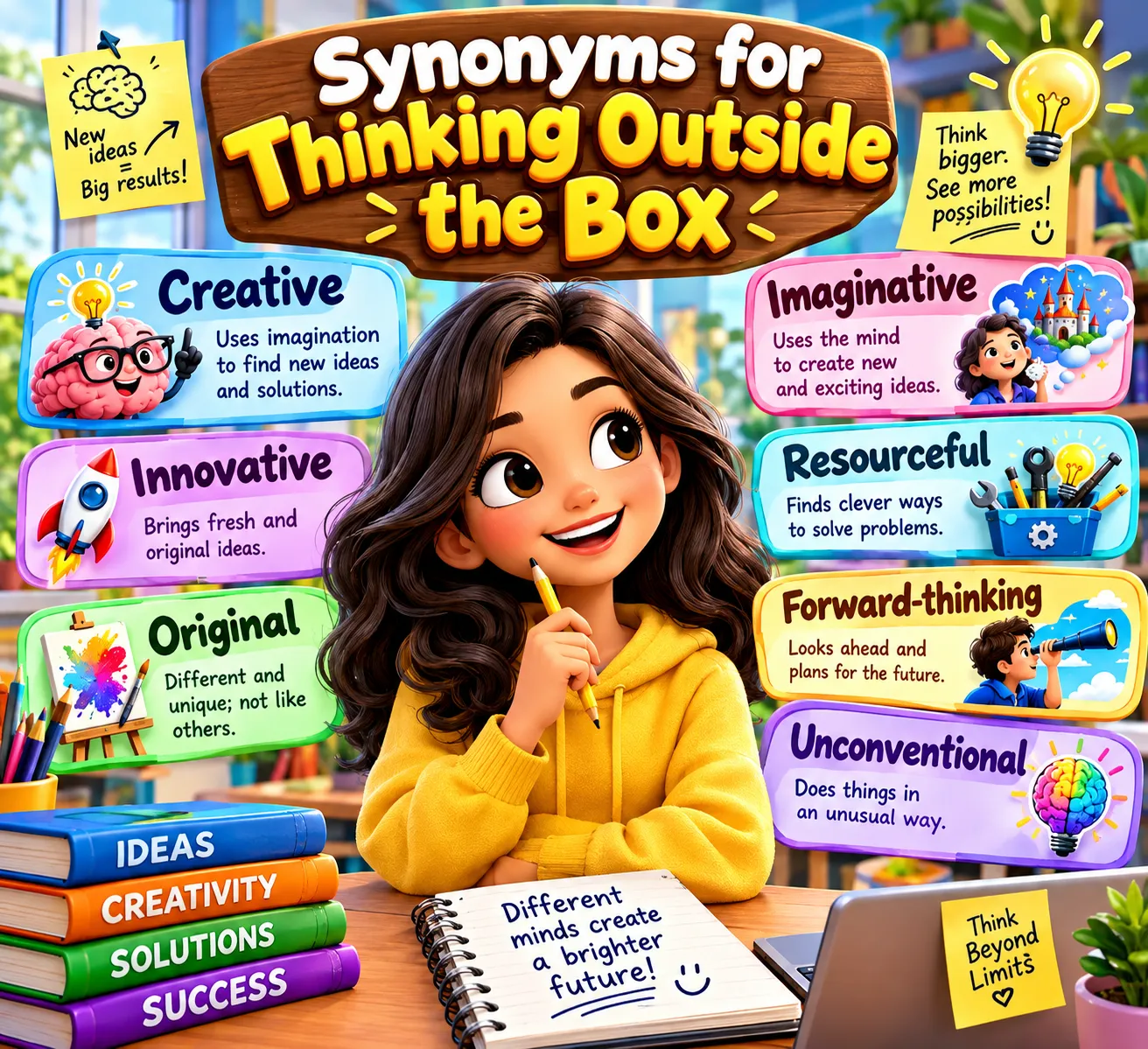
Thinking outside the box means finding creative and unusual ways to solve problems. Synonyms include creative, innovative, imaginative, resourceful, original, ingenious, and unconventional.
Thinking outside the box means finding new and creative ways to solve problems. Imagine a student who cannot solve a math problem using the usual method. Instead of giving up, the student tries a new idea and finds the answer.
This is a great example of thinking outside the box. People often use this phrase at work, in school, and in daily life to describe fresh ideas and smart solutions. Learning synonyms for thinking outside the box helps you express your ideas in different ways.
It also makes your writing more engaging and improves your English vocabulary. In this guide, you will learn 30 useful alternatives, their meanings, and examples. You will also explore the phrase’s origin, pronunciation, grammar, antonyms, and common uses.
Meaning of Thinking Outside the Box
Definition
Thinking outside the box (Verb phrase): Finding new, creative, or unusual ways to solve a problem or approach a situation.
Examples
- We need to think outside the box to improve our sales.
- She thought outside the box and created a fun way to teach children.
Connotative Meaning
(Connotation means the feeling or idea a word or phrase suggests beyond its basic meaning.)
- Positive tone: Creative, clever, open-minded, and innovative.
- Negative tone: Sometimes suggests an impractical or overly unusual idea.
- Neutral tone: Simply means using a different approach from the usual one.
Etymology
| Historical Period | Time Frame | Development of “Thinking Outside the Box” |
| Old English | 450–1100 | The full phrase was not used. English speakers had words to express thought, ideas, and problem-solving. |
| Middle English | 1100–1500 | Words related to think and box developed through earlier English and other language influences. However, the modern idiom had not yet formed. |
| Modern English | 1500–present | The phrase became popular as an expression for creative thinking and new approaches, especially in business, education, and design. Its exact origin remains uncertain, but it gained widespread use during the late 20th century. |
Pronunciation (IPA)
- IPA: /ˌθɪŋ.kɪŋ ˌaʊt.saɪd ðə ˈbɑːks/ (American English)
- Syllables: think-ing / out-side / the / box
Affixation Pattern of Thinking Outside the Box
- Root: Think is the main word in the phrase.
- Prefix: No prefix is added to the full phrase.
- Suffix: -ing is added to think to form thinking.
- Word formations:
- Think (Verb): To use your mind to form ideas.
- Thinking (Noun/Gerund): The process of using your mind.
- Thinker (Noun): A person who thinks.
- Thought (Noun): An idea formed in the mind.
- Thoughtful (Adjective): Showing care or careful thought.
- Thoughtfully (Adverb): In a careful or considerate way.
- Thoughtfulness (Noun): The quality of being thoughtful.
30 Synonyms of Thinking Outside the Box With Meaning and Examples
These alternatives have similar meanings, but they are not all exact replacements. Choose one that best fits your sentence.
1. Creative (Adjective)
Meaning: Able to make new ideas or things.
Examples:
- She found a creative way to solve the problem.
- Creative thinking helped the team succeed.
2. Innovative (Adjective)
Meaning: Using new ideas or methods.
Examples:
- The company introduced an innovative product.
- We need an innovative plan to reach more people.
3. Imaginative (Adjective)
Meaning: Good at forming new ideas in the mind.
Examples:
- He wrote an imaginative story.
- Her imaginative design caught everyone’s attention.
4. Inventive (Adjective)
Meaning: Skilled at creating new ideas or solutions.
Examples:
- The inventive student built a simple robot.
- His inventive approach saved time.
5. Original (Adjective)
Meaning: New and different from what others have done.
Examples:
- She shared an original idea.
- The artist has an original style.
6. Resourceful (Adjective)
Meaning: Good at finding ways to solve problems with what is available.
Examples:
- The resourceful worker fixed the machine.
- Be resourceful when you face a challenge.
7. Open-minded (Adjective)
Meaning: Willing to consider new ideas.
Examples:
- An open-minded leader listens to everyone.
- Try to stay open-minded during the discussion.
8. Forward-thinking (Adjective)
Meaning: Planning for the future and welcoming new ideas.
Examples:
- The forward-thinking school uses new teaching methods.
- We need a forward-thinking business plan.
9. Visionary (Adjective)
Meaning: Able to imagine a better future or major changes.
Examples:
- The visionary leader changed the industry.
- Her visionary plan inspired the team.
10. Unconventional (Adjective)
Meaning: Different from the usual way of doing things.
Examples:
- He used an unconventional method to teach math.
- Their unconventional plan worked well.
11. Original-minded (Adjective)
Meaning: Having ideas that are fresh and different.
Examples:
- The original-minded designer created a new style.
- We need original-minded people on this project.
12. Ingenious (Adjective)
Meaning: Very clever and good at solving problems.
Examples:
- She found an ingenious way to save water.
- The device uses an ingenious design.
13. Clever (Adjective)
Meaning: Quick to understand or find a solution.
Examples:
- That was a clever answer.
- He found a clever way to organize the files.
14. Inventive-minded (Adjective)
Meaning: Ready to create new ideas or methods.
Examples:
- The inventive-minded team designed a better tool.
- An inventive-minded student may find new ways to learn.
15. Innovative-thinking (Noun phrase)
Meaning: The act of developing fresh ideas or methods.
Examples:
- Innovative thinking helped the business grow.
- The workshop encourages innovative thinking.
16. Lateral Thinking (Noun phrase)
Meaning: Solving problems by using unusual angles or approaches.
Examples:
- Lateral thinking helped us find another solution.
- The puzzle tests your lateral thinking skills.
17. Divergent Thinking (Noun phrase)
Meaning: Generating many possible answers or ideas.
Examples:
- Divergent thinking helped the class list new ideas.
- The activity builds divergent thinking skills.
18. Critical Thinking (Noun phrase)
Meaning: Examining facts and ideas carefully before making a judgment.
Examples:
- Critical thinking helped her compare the options.
- Good decisions often need critical thinking.
19. Strategic Thinking (Noun phrase)
Meaning: Planning carefully to reach a goal.
Examples:
- Strategic thinking helped the team beat its rivals.
- The project needs strategic thinking.
20. Outside the Box Thinking (Noun phrase)
Meaning: Using fresh and unusual ideas to solve a problem.
Examples:
- Outside-the-box thinking led to a new design.
- The manager praised her outside-the-box thinking.
21. Problem Solving (Noun)
Meaning: The process of finding answers to difficult situations.
Examples:
- Problem-solving is an important life skill.
- The activity improves problem-solving skills.
22. Fresh Thinking (Noun phrase)
Meaning: Looking at a problem with new ideas.
Examples:
- The team needs fresh thinking.
- Fresh thinking helped us improve the website.
23. New Perspective (Noun phrase)
Meaning: A different way of seeing or understanding something.
Examples:
- The book gave me a new perspective.
- Her advice helped us see the issue from a new perspective.
24. Original Thinking (Noun phrase)
Meaning: Creating ideas that are not copied from others.
Examples:
- Original thinking made his project stand out.
- The teacher encourages original thinking.
25. Bold Thinking (Noun phrase)
Meaning: Thinking that is brave and willing to try new ideas.
Examples:
- Bold thinking helped the company enter a new market.
- The project needs bold thinking.
26. Experimental (Adjective)
Meaning: Involving new methods or tests to see what works.
Examples:
- The team used an experimental teaching method.
- Her experimental design attracted interest.
27. Trailblazing (Adjective)
Meaning: Introducing new ideas or methods that others may follow.
Examples:
- The scientist made a trailblazing discovery.
- The company is known for its trailblazing work.
28. Groundbreaking (Adjective)
Meaning: New and important enough to change how people do something.
Examples:
- The research led to a groundbreaking result.
- They developed a groundbreaking treatment method.
29. Progressive (Adjective)
Meaning: Supporting change, improvement, or new ideas.
Examples:
- The school follows a progressive teaching approach.
- The team suggested progressive changes.
30. Improvise (Verb)
Meaning: To create or do something without a full plan, using what is available.
Examples:
- We had to improvise when the power went out.
- She improvised a solution with the tools she had.
Prototype Meaning
The most common meaning of thinking outside the box is finding a creative way to solve a problem instead of following the usual method. People often imagine someone who questions old rules, explores fresh ideas, and finds a solution others may have missed. For example, a teacher who uses a game to explain a hard lesson is thinking outside the box. The phrase usually suggests creativity, flexibility, and a willingness to try new approaches.
Prototype Categorization
| Semantic Category | Synonyms and Alternatives | Main Use |
| Creativity and Imagination | Creative, imaginative, original, inventive, fresh thinking, original thinking | Describe creativity in art, writing, and idea generation. |
| Clever Solutions | Ingenious, clever, resourceful, problem-solving, improvise | Describe practical ways to solve problems or handle challenges. |
| New Approaches | Innovative, unconventional, experimental, outside-the-box thinking, innovative thinking | Explain methods that differ from traditional approaches. |
| Different Ways of Reasoning | Lateral thinking, divergent thinking, critical thinking, strategic thinking | Describe how people explore ideas, evaluate options, and plan solutions. |
| Future-Focused Ideas | Forward-thinking, visionary, progressive, trailblazing | Describe leaders, plans, or ideas that may shape the future. |
| Fresh Viewpoints and Bold Ideas | Open-minded, new perspective, bold thinking, original-minded | Describe considering different views or taking creative risks. |
| Major New Developments | Groundbreaking | Describe an idea, discovery, or achievement that brings significant change. |
Grouping synonyms by category helps writers choose words that match their intended meaning, avoid repetition, and communicate ideas clearly and accurately.
Antonyms of Thinking Outside the Box
These words describe thinking that follows familiar patterns or avoids new ideas.
- Conventional (Adjective): Following accepted or usual methods.
- Traditional (Adjective): Based on long-standing customs or practices.
- Rigid (Adjective): Unwilling to change ideas or methods.
- Narrow-minded (Adjective): Unwilling to consider different views.
- Unimaginative (Adjective): Lacking new or creative ideas.
- Unoriginal (Adjective): Not new or different from existing ideas.
- Routine (Adjective): Done in the same way again and again.
- Predictable (Adjective): Easy to guess because it follows a familiar pattern.
- Inflexible (Adjective): Not willing or able to adapt.
- Conformist (Noun/Adjective): A person who follows accepted rules or behavior rather than challenging them.
Short Questions and Answers
What does thinking outside the box mean?
It means finding new or unusual ways to solve problems or approach tasks.
When should thinking outside the box be used?
Use it when someone explores fresh ideas, challenges familiar methods, or finds a different solution.
Is thinking outside the box positive or negative?
It is usually positive because it suggests creativity. However, an idea may be impractical if it ignores important facts or limits.
How is it different from similar words?
Creative describes the ability to make new ideas. Innovative focuses on new methods or improvements. Lateral thinking means approaching a problem from an unusual angle. Thinking outside the box is a broad phrase for moving beyond normal ways of thinking.
Conclusion
Learning synonyms for thinking outside the box can improve your English vocabulary and help you express ideas more clearly. Words such as creative, innovative, and resourceful describe different parts of creative problem-solving.
Other terms, such as lateral thinking and fresh thinking, help explain how people find new ways to handle challenges. Using the right synonym makes your writing more engaging and helps you avoid repeating the same phrase. These words are useful in school, work, essays, emails, and daily conversations.
Try learning a few new words each day and use them in your own sentences. With regular practice, you can build stronger writing skills, speak with more confidence, and share your ideas in a clear and natural way.
Read More:
Synonyms for Allegedly: 30 Better Words to Use

I’m Noor Fatima, an English content writer at SameSynonyms.com, specializing in synonyms, antonyms, word meanings, and English vocabulary. I create clear, well-researched content with practical examples to help readers understand word usage, expand their vocabulary, and communicate more effectively.










