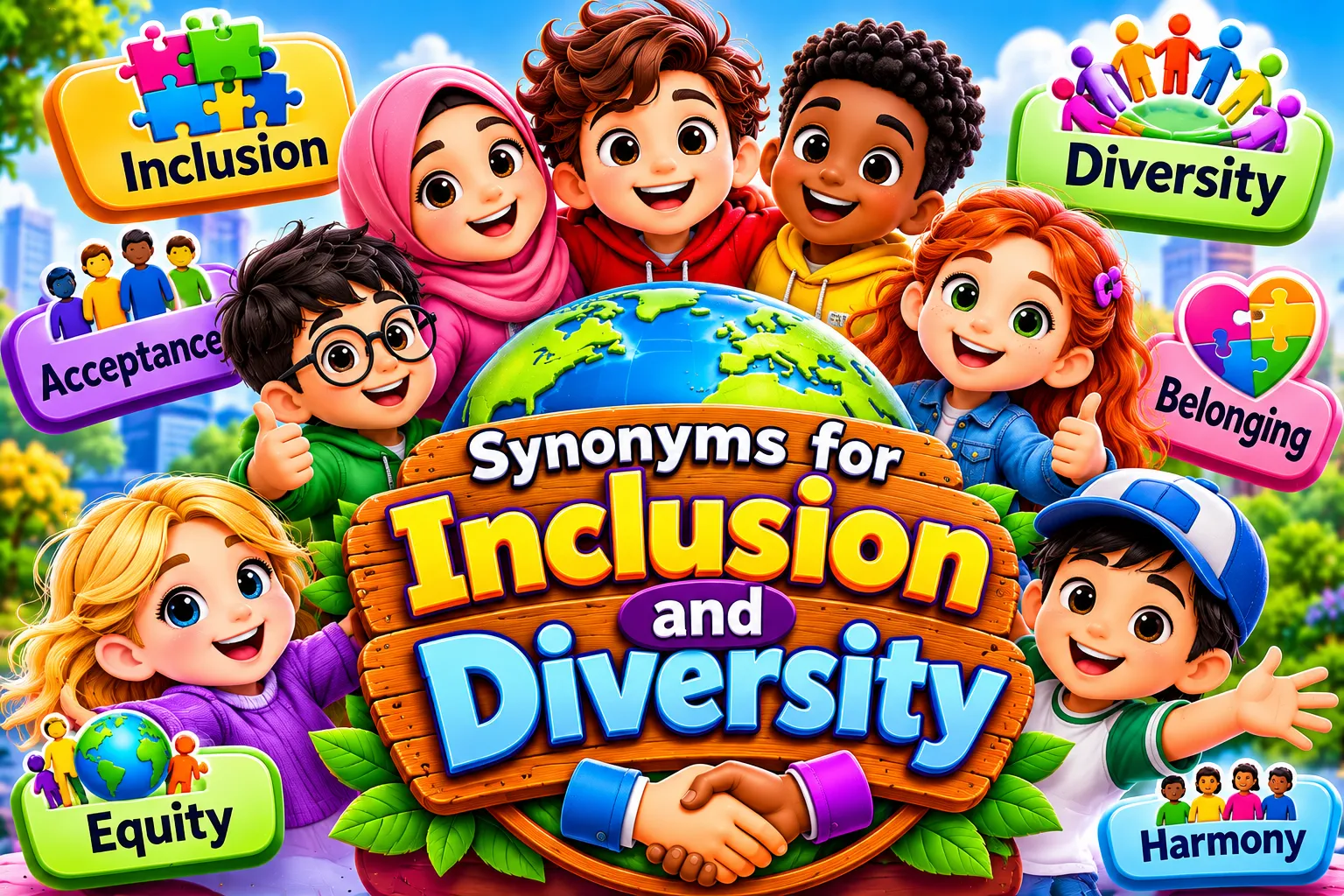
Synonyms for inclusion and diversity include equity, equality, belonging, representation, acceptance, accessibility, integration, fairness, and multiculturalism. These words describe different ways people are welcomed, respected, and valued in a group or society.
Inclusion and diversity are key ideas in schools, workplaces, and communities. Diversity means having people with different backgrounds, cultures, skills, and views. Inclusion means making sure everyone feels welcome and has a fair chance to take part.
For example, a school may have students from many cultures. When each student feels safe, valued, and respected, the school shows inclusion and diversity.These terms are common in education, business, and social life. Learning their synonyms helps English learners build strong vocabulary. It also helps writers avoid using the same words again and again.
A word like belonging may fit a personal story, while equity may work better in a formal report. In this guide, we will explore the meaning, history, pronunciation, grammar, and 30 synonyms of inclusion and diversity. Each word includes simple meanings and clear examples to help you use it with confidence.
Meaning of Inclusion and Diversity
Definition
Inclusion and Diversity (Noun Phrases):
- Inclusion: The act of welcoming people and making sure they can take part in a group or activity.
- Diversity: The presence of people with different backgrounds, cultures, identities, skills, and views.
Together, inclusion and diversity describe an environment where differences are valued and everyone has a fair chance to participate.
Examples
- Our school promotes inclusion and diversity by welcoming students from all backgrounds.
- The company values inclusion and diversity in its hiring process.
Connotative Meaning
Connotation: The feeling or idea a word creates beyond its basic meaning.
- Positive tone: Inclusion and diversity suggest fairness, respect, acceptance, and belonging.
- Negative tone: In some contexts, the terms may be linked to forced participation, unfair treatment, or tokenism.
- Neutral tone: The terms can describe the makeup of a group and the ways people participate in it.
Etymology
The words inclusion and diversity have Latin roots.
| Period | Inclusion | Diversity |
| Old English (450–1100) | The exact word was not used in Old English. Related ideas were expressed through words such as innan (within). | The exact word was not used in Old English. Related ideas were expressed through words meaning difference or variety. |
| Middle English (1100–1500) | The word developed from Latin includere, meaning to shut in or enclose. | The word developed from Old French diversité, from Latin diversitas, meaning difference or variety. |
| Modern English (1500–Present) | Inclusion came to mean the act of including someone or something. | Diversity came to mean the state of having variety or differences. |
In modern English, these words are often used together to describe fair and welcoming environments.
Pronunciation (IPA)
- Inclusion: /ɪnˈkluːʒən/
- Syllables: in-clu-sion (3 syllables)
- Diversity: /daɪˈvɜːrsəti/
- Syllables: di-ver-si-ty (4 syllables)
Affixation Pattern of Inclusion and Diversity
Inclusion
- Root: Latin cludere, meaning “to shut” or “to close.”
- Prefix: in meaning “in” or “within.”
- Suffix: -sion forms a noun that describes an act or process.
Word Formations
- Include (Verb): To make someone or something part of a group.
- Included (Verb/Adjective): Made part of something.
- Including (Preposition): Containing or involving something.
- Inclusive (Adjective): Welcoming people from different backgrounds.
- Inclusively (Adverb): In a way that welcomes or involves everyone.
- Inclusiveness (Noun): The quality of being inclusive.
- Inclusion (Noun): The act of making someone part of a group.
- Exclusion (Noun): The act of leaving someone out.
- Exclude (Verb): To leave someone or something out.
Diversity
- Root: Latin diversus, meaning “different” or “turned in different directions.”
- Prefix: None.
- Suffix: -ity forms a noun that describes a state or quality.
Word Formations
- Diverse (Adjective): Having many different types.
- Diversity (Noun): The state of having differences.
- Diversify (Verb): To make something more varied.
- Diversified (Adjective/Verb): Made up of different types.
- Diversifying (Verb): Making something more varied.
- Diversification (Noun): The process of adding variety.
- Diversely (Adverb): In different ways.
- Diverseness (Noun): The quality of being diverse.
30 Synonyms of Inclusion and Diversity With Meaning & Examples
The following words and phrases are related alternatives. Some focus on welcoming people, while others focus on differences, fairness, or equal participation.
1. Inclusiveness (Noun)
Meaning: The quality of welcoming and involving people from different backgrounds.
Examples:
- The school promotes inclusiveness among all students.
- Inclusiveness helps build a strong community.
2. Equity (Noun)
Meaning: Fair treatment that gives people the support they need to succeed.
Examples:
- The program promotes equity in education.
- Equity helps students overcome barriers.
3. Equality (Noun)
Meaning: The state of giving everyone the same rights and opportunities.
Examples:
- Equality is a basic human right.
- The policy supports equality in the workplace.
4. Belonging (Noun)
Meaning: The feeling of being accepted and valued as part of a group.
Examples:
- The team created a strong sense of belonging.
- Belonging helps students feel safe at school.
5. Acceptance (Noun)
Meaning: The act of respecting people as they are.
Examples:
- Acceptance helps people build friendships.
- The community showed acceptance of different cultures.
6. Representation (Noun)
Meaning: The presence of different people or groups in a place or activity.
Examples:
- The company values representation in its leadership.
- Better representation helps people feel seen.
7. Accessibility (Noun)
Meaning: The quality of being easy for people to use, enter, or take part in.
Examples:
- Accessibility is important in public buildings.
- The school improved accessibility for all students.
8. Integration (Noun)
Meaning: The process of bringing different people or groups together.
Examples:
- Integration helped students learn from one another.
- The program supports social integration.
9. Multiculturalism (Noun)
Meaning: The presence and respect of many cultures in a society.
Examples:
- Multiculturalism makes the city rich in traditions.
- The school celebrates multiculturalism through events.
10. Fairness (Noun)
Meaning: The quality of treating people in a just and reasonable way.
Examples:
- Fairness is important in every workplace.
- The teacher showed fairness to all students.
11. Tolerance (Noun)
Meaning: The willingness to accept views or behaviors that differ from one’s own.
Examples:
- Tolerance helps people live together peacefully.
- The lesson taught tolerance toward different beliefs.
12. Respect (Noun)
Meaning: The act of valuing the rights, feelings, and views of others.
Examples:
- Respect is vital in a diverse community.
- The team showed respect for every member.
13. Unity (Noun)
Meaning: The state of being joined together despite differences.
Examples:
- Unity helped the group reach its goal.
- The event promoted unity among local communities.
14. Pluralism (Noun)
Meaning: The acceptance of different cultures, beliefs, and groups within a society.
Examples:
- Pluralism supports a peaceful society.
- The country values cultural pluralism.
15. Equal Opportunity (Noun Phrase)
Meaning: The idea that everyone should have a fair chance to succeed.
Examples:
- The company supports equal opportunity.
- Equal opportunity helps people reach their goals.
16. Social Justice (Noun Phrase)
Meaning: The idea that people should have fair rights, treatment, and opportunities.
Examples:
- Social justice is a key goal of the campaign.
- The group works to promote social justice.
17. Participation (Noun)
Meaning: The act of taking part in an activity or group.
Examples:
- Student participation improved during the project.
- Participation helps people feel involved.
18. Collaboration (Noun)
Meaning: The act of working together to achieve a shared goal.
Examples:
- Collaboration brought different ideas together.
- The project encouraged collaboration among students.
19. Community (Noun)
Meaning: A group of people who share a place, interest, or connection.
Examples:
- The community welcomed new families.
- A strong community values different voices.
20. Openness (Noun)
Meaning: The willingness to accept new ideas and different people.
Examples:
- Openness helps teams solve problems.
- The manager showed openness to new views.
21. Empowerment (Noun)
Meaning: The process of giving people the power and confidence to act.
Examples:
- Empowerment helps workers share their ideas.
- The program focuses on youth empowerment.
22. Non-Discrimination (Noun)
Meaning: The practice of treating people fairly without unjust bias.
Examples:
- The policy supports non-discrimination at work.
- Non-discrimination protects people’s rights.
23. Heterogeneity (Noun)
Meaning: The presence of different types of people or things in a group.
Examples:
- The class showed cultural heterogeneity.
- Heterogeneity brought many views to the discussion.
24. Variety (Noun)
Meaning: The presence of different kinds of people or things.
Examples:
- The team benefits from a variety of skills.
- Variety makes the group more creative.
25. Difference (Noun)
Meaning: A way in which people or things are not the same.
Examples:
- The group respects every difference.
- Difference can bring new ideas to a team.
26. Social Inclusion (Noun Phrase)
Meaning: The process of making sure people can take part in society.
Examples:
- Social inclusion helps reduce isolation.
- The program supports social inclusion for older adults.
27. Cultural Diversity (Noun Phrase)
Meaning: The presence of people from different cultures in a group or society.
Examples:
- Cultural diversity enriches the school.
- The city is known for its cultural diversity.
28. Equal Access (Noun Phrase)
Meaning: The ability of all people to use or reach the same services and opportunities.
Examples:
- Equal access to education is vital.
- The policy aims to provide equal access to healthcare.
29. Acceptance of Differences (Noun Phrase)
Meaning: The willingness to respect the ways people differ from one another.
Examples:
- Acceptance of differences builds trust.
- The school teaches acceptance of differences.
30. Shared Humanity (Noun Phrase)
Meaning: The idea that all people have common human value despite their differences.
Examples:
- Shared humanity connects people across cultures.
- The speech focused on shared humanity and respect.
Prototype Meaning
The most typical meaning of inclusion and diversity is the idea of bringing people with different backgrounds, identities, skills, and views into a group while making sure they feel welcome and respected. People usually imagine a workplace, school, or community where everyone has a voice and a fair chance to take part. Diversity focuses on the differences among people, while inclusion focuses on how those people are welcomed and involved. Together, these ideas help create a place where people can share ideas, learn from one another, and work toward common goals.
Prototype Categorization
Prototype Categorization of Inclusion and Diversity
The 30 synonyms of inclusion and diversity can be divided into meaningful semantic categories. These groups help writers choose words that match the exact meaning they want to express.
| Semantic Category | Synonyms | Description |
| Welcoming and Belonging | Inclusiveness, belonging, acceptance, openness, respect | These words describe how people feel valued and welcomed. |
| Fairness and Equal Rights | Equity, equality, fairness, equal opportunity, social justice, non-discrimination | These terms focus on fair treatment and equal rights. |
| Cultural and Social Differences | Multiculturalism, pluralism, heterogeneity, variety, difference, cultural diversity | These words describe the presence of different cultures and backgrounds. |
| Participation and Access | Accessibility, integration, participation, social inclusion, equal access | These terms focus on helping people take part in society. |
| Community and Shared Values | Unity, community, shared humanity, collaboration | These words describe connection, cooperation, and working together. |
| Voice and Personal Growth | Representation, empowerment, acceptance of differences | These terms focus on giving people a voice and helping them feel valued. |
This categorization helps writers avoid repetition and select the most suitable synonym for essays, reports, speeches, and everyday conversations.
Antonyms of Inclusion and Diversity
Antonyms are words that express opposite meanings. Since inclusion and diversity have different meanings, their antonyms also vary.
1. Exclusion (Noun)
Meaning: The act of leaving someone out of a group.
2. Discrimination (Noun)
Meaning: Unfair treatment of people based on their identity or background.
3. Segregation (Noun)
Meaning: The act of separating people into different groups.
4. Uniformity (Noun)
Meaning: The state of being the same in form or type.
5. Homogeneity (Noun)
Meaning: The state of having similar qualities or characteristics.
6. Isolation (Noun)
Meaning: The state of being separated from others.
7. Inequality (Noun)
Meaning: The state of having unequal rights, resources, or opportunities.
8. Intolerance (Noun)
Meaning: The unwillingness to accept different beliefs or views.
9. Bias (Noun)
Meaning: An unfair preference for or against a person or group.
10. Marginalization (Noun)
Meaning: The act of making a person or group feel less important or pushing them out of society.
Short Questions and Answers
What does inclusion and diversity mean?
Inclusion and diversity mean welcoming people with different backgrounds and making sure they feel valued, respected, and able to take part.
When should inclusion and diversity be used?
Use these terms when discussing schools, workplaces, communities, social policies, or efforts to welcome people from different backgrounds.
Is inclusion and diversity positive or negative?
The terms usually have a positive tone because they relate to fairness, acceptance, and respect. However, their meaning can depend on the context.
How is it different from similar words?
Diversity focuses on differences among people. Inclusion focuses on welcoming and involving them. Equity means giving people fair support, while equality means giving people equal rights or opportunities.
Conclusion
Learning inclusion and diversity and their synonyms can help you improve your English vocabulary. Words like equity, belonging, acceptance, representation, and multiculturalism allow you to express ideas in a clear and meaningful way.
These alternatives also help you avoid repetition in your writing and speaking. Each word has a special meaning, so choosing the right one can make your message stronger. Whether you are writing an essay, preparing a school lesson, or discussing workplace values, these words can help you share your thoughts with confidence.
Try to learn a few synonyms each day. Read their meanings, study their examples, and use them in your own sentences. Daily practice can help you become a better English speaker and writer.
Read More:
Synonyms for Meager: 26 Useful Alternatives
I’m Falak Naaz, an SEO writer at SameSynonyms.com with 10 years of experience creating clear, engaging, and search-friendly English content. I specialize in synonyms, antonyms, vocabulary, and word usage. Through careful research and practical examples, I help readers choose the right words and improve their English with confidence.








1 thought on “Synonyms for Inclusion and Diversity: 30 Powerful Alternatives”