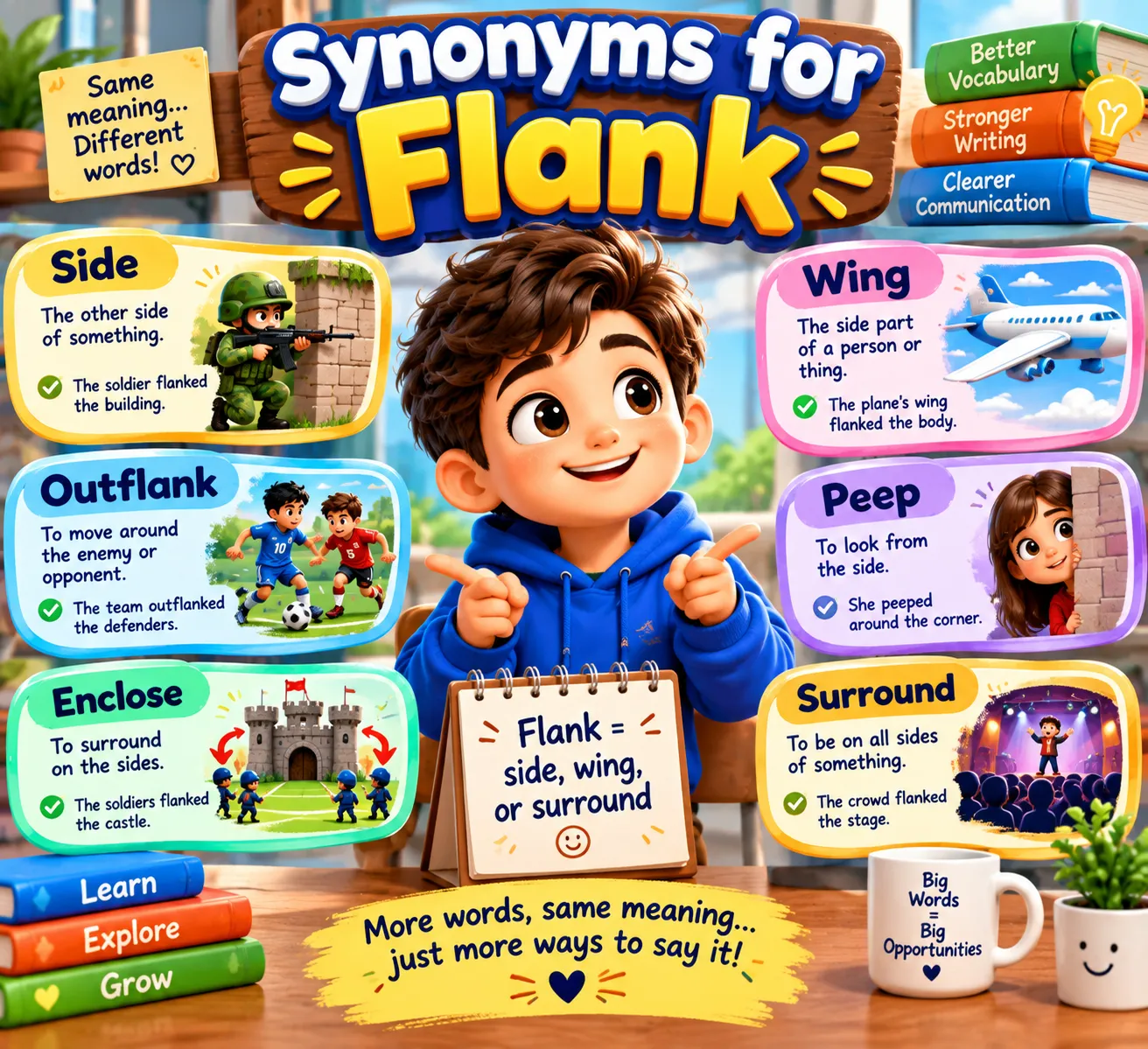
Synonyms for flank include side, edge, border, boundary, margin, and wing. Depending on the context, related verbs include surround, encircle, and outflank. These words describe sides, positions, or movements around a person, animal, object, or formation.
The word flank refers to the side of a person’s or animal’s body, or the side of something such as a building, hill, or army. Imagine standing beside a horse. The area between its ribs and hips is called its flank.
In another setting, soldiers may move around the flank of an enemy to approach from the side. This word is common in anatomy, cooking, sports, military writing, and everyday English.Learning synonyms for flank helps English learners and content writers describe positions, body parts, and movements with greater detail. However, not every synonym fits every situation.
Words such as side, edge, and border may work in some contexts, while surround, outflank, and encircle describe related actions. In this guide, we will explore the meaning, history, pronunciation, grammar, and 30 synonyms or related terms for flank, with simple definitions and examples.
Meaning of Flank
Definition
Flank (noun and verb):
- Noun: The side of a person’s or animal’s body, or the side of an object, place, or formation.
- Verb: To stand, be placed, or move along the side of something or someone.
Examples
- The horse had a small mark on its flank.
- Tall trees flank the entrance to the park.
- The soldiers moved to flank the opposing group.
Connotative Meaning
Connotation (the feelings or ideas linked to a word beyond its basic meaning).
- Positive tone: Can suggest protection or support, as when trees flank a beautiful walkway.
- Negative tone: Can suggest danger or attack in a military context.
- Neutral tone: Simply describes the side of a body, place, or object.
Etymology of Flank
The word flank entered English through French, with roots in Germanic languages. It has long referred to the side of a body or formation.
- Old English (450–1100): Flank was not a common established English word in this period. English used other words for the side of a body or object.
- Middle English (1100–1500): The word entered English through Old French flanc, meaning “side,” with Germanic roots.
- Modern English (1500–present): Flank developed as both a noun and a verb. It is now used in anatomy, cooking, geography, architecture, and military language.
Pronunciation (IPA)
- IPA: /flæŋk/
- Syllables: flank (one syllable)
- Part of speech: Noun and verb
Affixation Pattern of Flank
| Word Formation | Part of Speech | Meaning |
| Root: Flank | Noun/Verb | Refers to the side of a body, object, or formation, or to standing or moving beside something. |
| Prefix | — | No prefix appears in the basic word flank. |
| Suffix | — | No suffix appears in the basic word flank. |
| Flank | Noun | The side of a body, object, or formation. |
| Flank | Verb | To stand or move along the side of something. |
| Flanked | Verb | The past tense of flank, meaning to stand or position something beside another thing. |
| Flanking | Verb/Adjective | Standing or moving along the side of something. |
| Flanks | Plural Noun/Verb | Refers to multiple sides or the third-person singular form of the verb flank. |
| Outflank | Verb | To move around an opponent’s side or gain a strategic advantage over them. |
| Outflanked | Verb | The past tense of outflank, meaning to have moved around an opponent’s side or gained an advantage. |
| Outflanking | Verb | Moving around an opponent’s side or gaining a strategic advantage. |
30 Synonyms of Flank With Meaning and Examples
Note: Because flank has several meanings, this list includes close synonyms and related terms. Some fit the body or side meaning, while others fit the military or movement meaning.
1. Side (Noun)
Meaning: The part of something that is away from its front or back.
Examples:
- She stood at the side of the horse.
- A garden lies on the side of the house.
2. Edge (Noun)
Meaning: The outer boundary of an object or area.
Examples:
- We sat at the edge of the field.
- The path runs along the edge of the forest.
3. Border (Noun)
Meaning: The line or area that marks the limit of a place.
Examples:
- Flowers grow along the border of the garden.
- The soldiers guarded the border of the camp.
4. Boundary (Noun)
Meaning: A line that marks the limits of an area.
Examples:
- A fence marks the boundary of the farm.
- The river forms a natural boundary.
5. Margin (Noun)
Meaning: The outer part or edge of an area or surface.
Examples:
- The village sits on the margin of the forest.
- We walked along the margin of the lake.
6. Perimeter (Noun)
Meaning: The outer edge or boundary of an enclosed area.
Examples:
- Guards watched the perimeter of the building.
- The fence runs around the perimeter of the yard.
7. Sidewall (Noun)
Meaning: A side surface of an object, such as a tire or structure.
Examples:
- The tire’s sidewall had a small crack.
- The sidewall of the building needs repair.
8. Lateral Side (Noun Phrase)
Meaning: The side of something, especially in relation to its position.
Examples:
- The doctor examined the lateral side of the leg.
- The lateral side of the structure faces the garden.
9. Hip (Noun)
Meaning: The part of the body where the upper leg joins the trunk; it is near the flank but is not the same body area.
Examples:
- The rider rested a hand on the horse’s hip.
- He felt pain near his hip after the fall.
10. Torso (Noun)
Meaning: The main part of the human body, excluding the head and limbs.
Examples:
- The exercise strengthens the torso.
- The doctor examined the side of his torso.
11. Waist (Noun)
Meaning: The part of the body between the ribs and hips.
Examples:
- She tied a belt around her waist.
- The jacket fits closely around the waist.
12. Abdomen (Noun)
Meaning: The part of the body between the chest and pelvis.
Examples:
- The doctor examined his abdomen.
- The animal had a wound near its abdomen.
13. Flank Region (Noun Phrase)
Meaning: The side area of the body between the ribs and hips.
Examples:
- The nurse checked the flank region for tenderness.
- The horse had a sore spot in its flank region.
14. Side Portion (Noun Phrase)
Meaning: A part located along the side of something.
Examples:
- The side portion of the building has three windows.
- The mechanic inspected the side portion of the car.
15. Side Section (Noun Phrase)
Meaning: A section located at the side of an object or place.
Examples:
- The side section of the hall is reserved for guests.
- Workers repaired the side section of the bridge.
16. Wing (Noun)
Meaning: A side section of a building, group, or formation.
Examples:
- The hospital’s east wing is newly built.
- The army protected the right wing of its formation.
17. Line (Noun)
Meaning: A row or arrangement of people or objects.
Examples:
- The guards formed a line beside the entrance.
- The team held its line during the match.
18. Outer Side (Noun Phrase)
Meaning: The part facing away from the center or inside.
Examples:
- The outer side of the wall was painted white.
- The outer side of the group faced the road.
19. Approach (Noun)
Meaning: A way of moving toward or dealing with something; in military contexts, it may refer to a route toward a position.
Examples:
- The road provides an approach to the fort.
- The team planned a careful approach to the target.
20. Surround (Verb)
Meaning: To be or move all around someone or something.
Examples:
- Tall trees surround the house.
- The police surrounded the building.
21. Enclose (Verb)
Meaning: To close in or place a boundary around something.
Examples:
- A stone wall encloses the garden.
- The fence encloses the animal shelter.
22. Encircle (Verb)
Meaning: To form a circle around someone or something.
Examples:
- The crowd began to encircle the performer.
- The troops moved to encircle the camp.
23. Outflank (Verb)
Meaning: To move around an opponent’s side to gain an advantage.
Examples:
- The army tried to outflank its opponent.
- The team outflanked the defenders with a quick move.
24. Bypass (Verb)
Meaning: To go around something rather than pass through it.
Examples:
- The driver bypassed the busy town center.
- The troops bypassed the main road.
25. Outmaneuver (Verb)
Meaning: To gain an advantage over someone through clever movement or planning.
Examples:
- The players outmaneuvered their rivals.
- The commander outmaneuvered the opposing force.
26. Overrun (Verb)
Meaning: To spread over or take control of an area, often by force.
Examples:
- The invading army overran the border post.
- Weeds overran the neglected garden.
27. Beset (Verb)
Meaning: To surround or trouble someone or something from several sides.
Examples:
- Problems beset the project from the start.
- The castle was beset by enemy forces.
28. Flank Guard (Noun)
Meaning: A person or group that protects the side of a military formation.
Examples:
- The flank guard watched for approaching forces.
- The commander sent a flank guard to protect the unit.
29. Side Position (Noun Phrase)
Meaning: A location beside or to one side of someone or something.
Examples:
- The player moved into a side position.
- The guard took a side position near the gate.
30. Adjacent Side (Noun Phrase)
Meaning: A side that lies next to another object, area, or surface.
Examples:
- The adjacent side of the building faces the parking lot.
- A narrow path runs beside the adjacent side of the wall.
Prototype Meaning of Flank
The most common meaning of flank is the side of a person’s or animal’s body, especially the area between the ribs and hips. The word can also refer to the side of a building, army, or other formation. As a verb, flank means to stand beside something or move along its side. People often associate the word with body anatomy, side positions, or military strategy. The exact meaning depends on the context in which it appears.
Prototype Categorization of Flank
The 30 synonyms and related terms can be grouped into these semantic categories.
- Body Parts and Anatomy: Hip, torso, waist, abdomen, flank region. These terms help describe body locations, though they do not all mean flank exactly.
- Sides and Outer Areas: Side, edge, border, boundary, margin, perimeter, sidewall, lateral side, side portion, side section, outer side, adjacent side. These words describe the outer part or side of an object or area.
- Positions and Formations: Wing, line, side position, flank guard. These terms are useful in sports, military writing, and descriptions of groups.
- Surrounding and Enclosing Actions: Surround, enclose, encircle, beset. These verbs describe ways of closing in around a person, place, or object.
- Movement and Strategy: Outflank, bypass, outmaneuver, overrun, approach. These words describe movement, routes, or attempts to gain an advantage.
This grouping helps writers choose words that match their intended meaning. For example, use side for a general location, abdomen for a body area, encircle for surrounding something, and outflank for a strategic move. Remember that related terms are not always interchangeable.
Antonyms of Flank
- There is no single antonym for flank because it can function as both a noun and a verb. However, the following words express contrasting meanings in different contexts.
| Antonym | Part of Speech | Meaning |
| Center | Noun | The middle point of an area or object, opposite to its side. |
| Middle | Noun | The part of something that is equally distant from its edges. |
| Interior | Noun | The inner part of a place or object, rather than its outer side. |
| Withdraw | Verb | To move away from a place or position rather than approach or move alongside it. |
| Retreat | Verb | To move back from a position, often to avoid danger. |
| Abandon | Verb | To leave a place or position rather than remain beside or protect it. |
Short Questions and Answers
What does flank mean?
Flank means the side of a person’s or animal’s body, or the side of an object or formation. As a verb, it means to stand or move along the side of something.
When should flank be used?
Use flank when describing a body area, the side of a building or formation, or movement along someone’s side. It is common in anatomy, geography, cooking, and military contexts.
Is flank positive or negative?
The word is generally neutral. It may suggest protection when describing a position beside something, or danger when used in a military context.
How is flank different from similar words?
Flank usually refers to a side or a position beside something. Edge refers to an outer boundary, border marks a limit, surround means to be all around something, and outflank means to move around an opponent’s side to gain an advantage.
Conclusion
Learning synonyms for flank can improve your vocabulary and help you describe places, body parts, and movements more clearly. Words such as side, edge, and boundary work well for locations, while surround, encircle, and outflank describe different actions.
However, these words have distinct meanings, so it is important to choose one that fits your sentence.For English learners and content writers, understanding these differences can reduce repetition and make writing more precise. It can also improve speaking skills and build confidence when using English in everyday or professional settings.
Practice a few related words each day and use them in your own sentences. With regular practice, you will learn when to use flank and when another word expresses your meaning better.
Read More:
Synonyms for Autistic: 30 Respectful Alternatives

I’m Rubab, a content specialist at SameSynonym, focused on synonyms, antonyms, word meanings, and English vocabulary.
I create clear, well-researched content with accurate definitions and practical examples.
My goal is to help readers improve their vocabulary and writing with confidence.