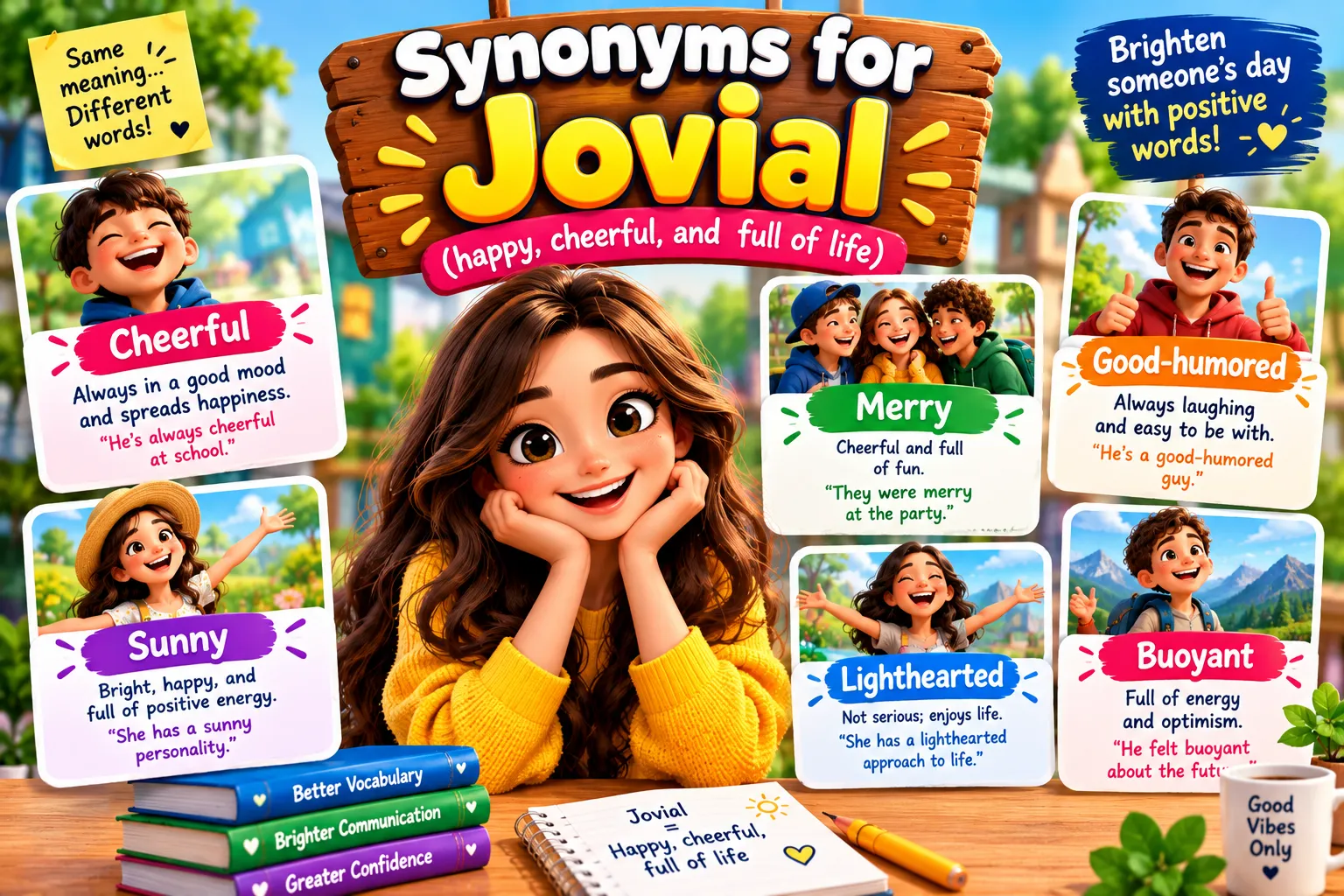
Synonyms for jovial include cheerful, happy, merry, jolly, joyful, upbeat, lighthearted, and good-humored. These words describe people who are happy, friendly, and full of good spirits.
Jovial means cheerful, friendly, and full of joy. I often use this word to describe someone who smiles, laughs, and makes others feel happy. For example, a jovial teacher can make a classroom feel warm and welcoming. A jovial friend can also make an ordinary day more fun.
Learning synonyms for jovial helps you express feelings in different ways. Instead of using happy in every sentence, you can choose words like merry, jolly, or buoyant to add variety to your writing. This is useful for students, English learners, bloggers, and content writers.
In this guide, you will learn the meaning, pronunciation, history, and word forms of jovial. You will also discover 30 synonyms with simple meanings and examples, along with antonyms and practical tips to help you choose the right word.
Meaning of Jovial
Definition
Jovial (adjective): Cheerful, friendly, and full of good humor. A jovial person often makes others feel relaxed and happy.
Examples
- Our jovial host welcomed everyone with a warm smile.
- Grandpa is jovial and loves telling funny stories.
Connotative Meaning
(Connotation: the feeling or idea a word brings to mind beyond its basic meaning.)
- Positive tone: Suggests warmth, friendliness, laughter, and happiness.
- Negative tone: Can sometimes suggest that someone is too playful or not serious enough for the situation.
- Neutral tone: Simply describes a cheerful mood or friendly manner.
Etymology of Jovial
| Historical Period | Word History |
| Old English (450–1100) | Jovial was not yet used in English. People expressed happiness and good humor with other words. |
| Middle English (1100–1500) | The modern word jovial had not yet entered common English use. Its Latin roots were associated with Jupiter, the Roman god. |
| Modern English (1500–Present) | The word entered English in the late 1500s through French, from Latin Iovialis, meaning “of Jupiter.” Astrology linked Jupiter with a cheerful nature, which helped give jovial its modern meaning. |
Pronunciation (IPA)
- British IPA: /ˈdʒəʊ.vi.əl/
- American IPA: /ˈdʒoʊ.vi.əl/
- Syllables: jo-vi-al (3 syllables)
- Stress: The first syllable.
Affixation Pattern of Jovial
- Root and origin: Latin Iovialis, meaning “of Jupiter,” borrowed through French.
- Prefix: None.
- Suffix: The ending -al forms an adjective expressing a relationship or quality in the word’s historical structure.
- Related word formations:
- Jovial adjective: cheerful and friendly.
- Jovially adverb: in a cheerful manner.
- Joviality noun: the quality of being cheerful.
- Jovialness noun: the state of being jovial.
30 Synonyms of Jovial With Meaning and Examples
The best synonym depends on the situation. Some words describe a happy feeling, while others focus on friendliness, laughter, or a lively social mood.
1. Cheerful (Adjective)
Meaning: Feeling or showing happiness.
Examples:
- She has a cheerful smile.
- Our cheerful teacher welcomed the new students.
2. Happy (Adjective)
Meaning: Feeling pleasure or joy.
Examples:
- He was happy to see his friends.
- We had a happy day at the park.
3. Jolly (Adjective)
Meaning: Happy, friendly, and full of fun.
Examples:
- The jolly man made everyone laugh.
- We enjoyed a jolly evening together.
4. Merry (Adjective)
Meaning: Cheerful and full of enjoyment.
Examples:
- The children sang merry songs.
- Everyone was merry at the party.
5. Joyful (Adjective)
Meaning: Feeling or expressing great joy.
Examples:
- She gave a joyful shout.
- It was a joyful family reunion.
6. Joyous (Adjective)
Meaning: Full of happiness and delight.
Examples:
- The wedding was a joyous event.
- They shared a joyous moment.
7. Gleeful (Adjective)
Meaning: Showing great excitement and happiness.
Examples:
- The children were gleeful about the surprise.
- He gave a gleeful laugh.
8. Mirthful (Adjective)
Meaning: Full of laughter and amusement.
Examples:
- Her mirthful voice filled the room.
- We enjoyed a mirthful conversation.
9. Lighthearted (Adjective)
Meaning: Cheerful and free from worry.
Examples:
- They had a lighthearted chat.
- His lighthearted jokes eased the tension.
10. Upbeat (Adjective)
Meaning: Positive, hopeful, and cheerful.
Examples:
- She remained upbeat during the hard times.
- His upbeat attitude inspired the team.
11. Lively (Adjective)
Meaning: Full of energy and activity.
Examples:
- The lively crowd danced all night.
- We had a lively discussion.
12. Spirited (Adjective)
Meaning: Full of energy, courage, or enthusiasm.
Examples:
- The spirited children played outside.
- She gave a spirited speech.
13. Animated (Adjective)
Meaning: Full of energy and expression.
Examples:
- He became animated while telling the story.
- They had an animated discussion.
14. Buoyant (Adjective)
Meaning: Cheerful and hopeful, even during hard times.
Examples:
- She stayed buoyant after the setback.
- His buoyant mood lifted our spirits.
15. Genial (Adjective)
Meaning: Warm, friendly, and pleasant.
Examples:
- Our genial host greeted every guest.
- The genial manager made us feel welcome.
16. Amiable (Adjective)
Meaning: Friendly and easy to like.
Examples:
- He is an amiable neighbor.
- Her amiable nature helped her make friends.
17. Affable (Adjective)
Meaning: Friendly and easy to talk to.
Examples:
- The affable coach spoke to every player.
- Our affable guide answered all our questions.
18. Sociable (Adjective)
Meaning: Enjoying the company of other people.
Examples:
- My sociable cousin makes friends easily.
- She is sociable at work events.
19. Gregarious (Adjective)
Meaning: Enjoying being with other people.
Examples:
- He is a gregarious person who loves parties.
- Her gregarious nature makes group work easy.
20. Convivial (Adjective)
Meaning: Friendly and enjoyable, especially in social gatherings.
Examples:
- We shared a convivial dinner.
- The convivial atmosphere encouraged everyone to talk.
21. Festive (Adjective)
Meaning: Cheerful and suitable for a celebration.
Examples:
- The room had a festive feel.
- Everyone wore festive clothes for the party.
22. Playful (Adjective)
Meaning: Full of fun and a desire to play or joke.
Examples:
- The puppy had a playful nature.
- His playful comment made us smile.
23. Humorous (Adjective)
Meaning: Funny or able to make people laugh.
Examples:
- She told a humorous story.
- His humorous remarks made the meeting enjoyable.
24. Witty (Adjective)
Meaning: Funny and clever with words.
Examples:
- He made a witty remark.
- Her witty reply made everyone laugh.
25. Jocose (Adjective)
Meaning: Fond of joking or making humorous comments.
Examples:
- His jocose manner entertained the guests.
- She made a jocose comment during lunch.
26. Jocular (Adjective)
Meaning: Playful and inclined to joke.
Examples:
- The jocular teacher kept the class laughing.
- His jocular tone made the news easier to hear.
27. Jocund (Adjective)
Meaning: Cheerful and lighthearted; often used in literary writing.
Examples:
- The jocund travelers sang along the road.
- A jocund mood spread through the village.
28. Blithe (Adjective)
Meaning: Cheerful and carefree.
Examples:
- She walked with a blithe smile.
- His blithe manner made the trip feel easy.
29. Sunny (Adjective)
Meaning: Cheerful, bright, and pleasant in mood.
Examples:
- She has a sunny personality.
- His sunny outlook helped the group stay positive.
30. Good-humored (Adjective)
Meaning: Usually cheerful, patient, and ready to laugh.
Examples:
- Our good-humored uncle enjoyed every joke.
- She stayed good-humored despite the delay.
The words jolly, merry, cheerful, and convivial are especially close to jovial. Words such as witty focus more on clever humor, while sociable focuses on enjoying other people’s company.
Prototype Meaning of Jovial
The typical meaning of jovial is cheerful, friendly, and full of good humor. When people hear this word, they often imagine someone smiling, laughing, sharing jokes, and making others feel welcome. A jovial person brings warmth to a conversation or social gathering. The word describes more than simply feeling happy; it often suggests a friendly nature and a desire to share that happiness with others.
Prototype Categorization of Jovial Synonyms
Grouping synonyms by meaning helps you select a word that fits your sentence rather than replacing jovial with any similar word.
| Semantic Category | Synonyms | Best Used When |
| Happiness and Joy | Happy, cheerful, joyful, joyous, gleeful | Describing a person’s feelings or happiness. |
| Laughter and Humor | Jolly, merry, mirthful, humorous, witty, jocose, jocular | Describing jokes, laughter, or funny behavior. |
| Energy and Excitement | Lively, spirited, animated, buoyant, upbeat | Showing enthusiasm, energy, or optimism. |
| Friendliness and Warmth | Genial, amiable, affable, sociable, gregarious, good-humored | Describing a friendly person who gets along with others. |
| Social Enjoyment | Convivial, festive, playful | Describing enjoyable gatherings, celebrations, or fun activities. |
| Carefree Cheerfulness | Lighthearted, blithe, sunny | Expressing a relaxed, positive, or carefree mood. |
| Literary Cheerfulness | Jocund | Creating a cheerful or poetic tone in literary writing. |
Practical tip: Use genial for a warm personality, convivial for a friendly gathering, upbeat for a positive attitude, and jocund for a literary style.
Antonyms of Jovial
Antonyms are words with opposite or contrasting meanings.
- Gloomy (Adjective): Feeling sad or showing little hope. He looked gloomy after the bad news.
- Sullen (Adjective): Silent and bad-tempered. She remained sullen throughout the meeting.
- Morose (Adjective): Unhappy and often unwilling to talk. His morose mood worried his friends.
- Melancholy (Adjective): Deeply sad or thoughtful. A melancholy song filled the room.
- Miserable (Adjective): Very unhappy or uncomfortable. He felt miserable on the rainy day.
- Grumpy (Adjective): Easily annoyed or bad-tempered. My grumpy neighbor complained about the noise.
- Solemn (Adjective): Serious and not cheerful. The room became solemn during the speech.
- Dismal (Adjective): Gloomy, depressing, or lacking cheer. The dismal weather kept us indoors.
- Joyless (Adjective): Lacking happiness or pleasure. The celebration felt joyless without music.
- Apathetic (Adjective): Showing little interest, emotion, or enthusiasm. He seemed apathetic about the results.
Short Questions and Answers
1. What does jovial mean?
Jovial means cheerful, friendly, and full of good humor. It often describes someone who enjoys laughing and making others feel comfortable.
2. When should jovial be used?
Use jovial when describing a cheerful person, a friendly conversation, or a happy social atmosphere.
Example: The jovial host welcomed everyone with a smile.
3. Is jovial positive or negative?
Jovial is usually positive. It suggests happiness, warmth, and friendliness. However, a jovial manner may seem unsuitable in a serious situation.
4. How is jovial different from similar words?
- Jovial vs. cheerful: Jovial often suggests friendliness and shared laughter, while cheerful describes a generally happy mood.
- Jovial vs. jolly: Both suggest happiness, but jolly can sound more playful and informal.
- Jovial vs. convivial: Jovial often describes a person, while convivial commonly describes a friendly social atmosphere.
Conclusion
Learning jovial and its synonyms can help you build a stronger English vocabulary. Words like cheerful, jolly, genial, and convivial allow you to express happiness and friendliness in different ways. Each word has its own meaning and tone, so choosing the right one can make your writing clearer and more natural.
You can also use these words in daily conversations, school assignments, stories, emails, and blog posts. Try learning a few synonyms each day. Write a sentence with each new word and use it in a real conversation. With regular practice, you can avoid repeating the same words, improve your speaking and writing, and feel more confident using English.
Read More:
Synonyms for Selective: 30 Powerful Alternatives to Know

I’m Falak Naaz, an SEO writer at SameSynonyms.com with 10 years of experience creating clear, engaging, and search-friendly English content. I specialize in synonyms, antonyms, vocabulary, and word usage. Through careful research and practical examples, I help readers choose the right words and improve their English with confidence.










