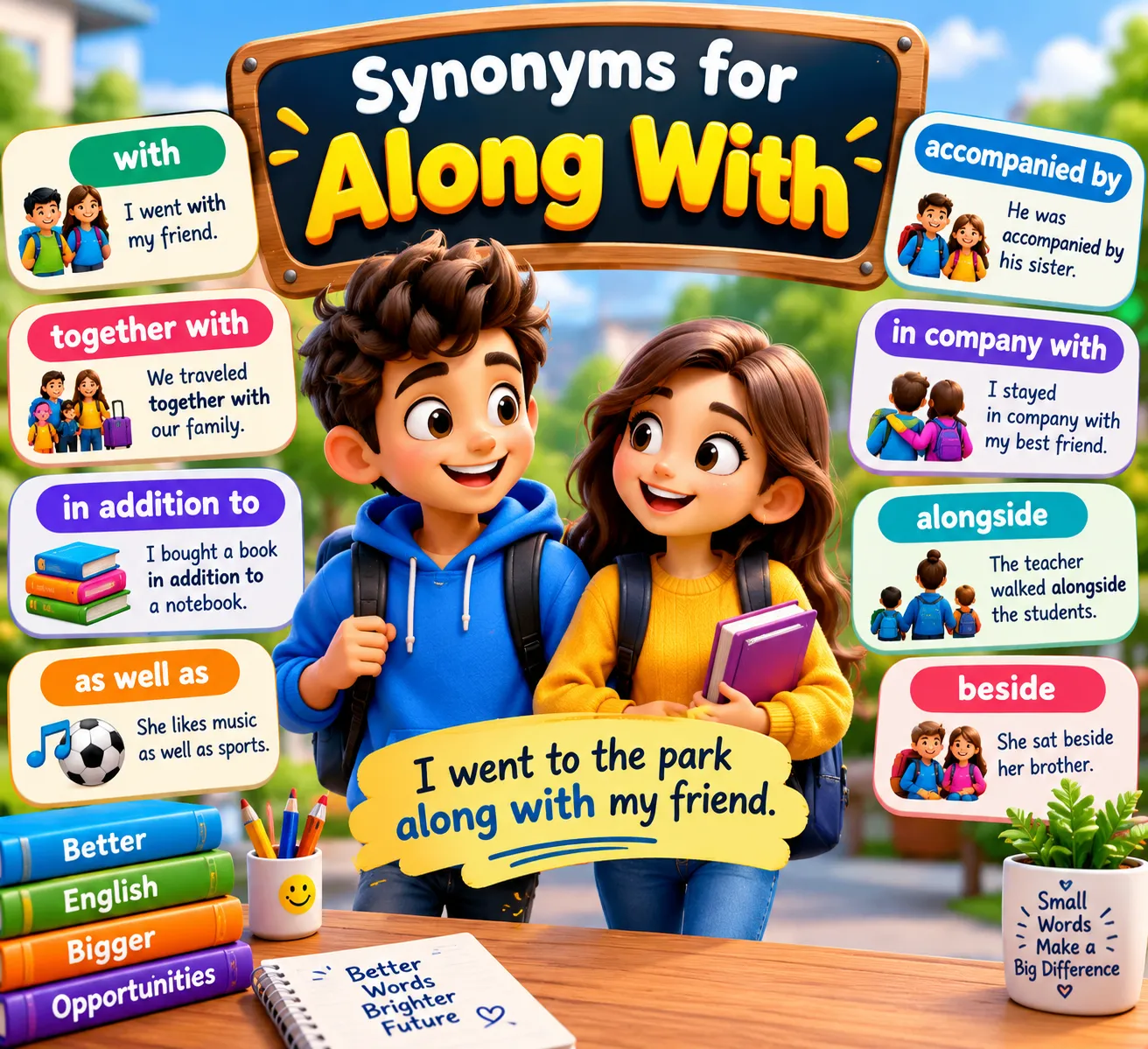
Synonyms for along with include together with, in addition to, as well as, accompanied by, plus, and besides. These phrases show that someone or something is included with another person or thing.
Along with is a common English phrase that means together with or in addition to something else. We use it in daily life, at school, and at work. For example, you might say, “I brought my notebook along with my books.” This means you brought both items.
Learning synonyms for along with helps you express your ideas in different ways. It also makes your writing clear and avoids using the same phrase too often. Students can use these alternatives in essays, while content writers can use them to make articles sound natural and engaging.
In this guide, you will learn the meaning of along with, its grammar, pronunciation, word history, and 30 useful alternatives. Each synonym includes a simple meaning and examples to help you choose the right phrase for your sentence.
Meaning of Along With
Definition
Along with (prepositional phrase): A phrase used to show that someone or something is included with another person or thing.
Examples
- I went to the park along with my brother.
- She submitted the report along with the required documents.
Connotative Meaning
Connotation (the feeling or idea a word or phrase suggests beyond its basic meaning):
- Positive tone: It can suggest teamwork, friendship, or inclusion. Example: “She arrived along with her best friends.”
- Negative tone: It can suggest an added problem or burden. Example: “Along with the delay, we faced extra costs.”
- Neutral tone: It can simply show that two or more things are included. Example: “Please send your form along with your ID.”
Etymology of Along With
The phrase along with developed from two older English words. Its history reflects the way English combines simple words to express relationships.
- Old English (450–1100): Along developed from older forms related to the idea of length or extending in a particular direction. With comes from Old English wiþ, which could mean against, opposite, or in relation to.
- Middle English (1100–1500): The forms along and with developed further in spelling and use. English speakers increasingly used combinations of words to express movement, association, and connection.
- Modern English (1500–present): Along with became a familiar phrase meaning in company with, together with, or in addition to.
Pronunciation (IPA)
- IPA: /əˈlɔŋ wɪð/ (common broad transcription)
- Syllables: a-long with
Affixation Pattern of Along With
| Category | Word or Element | Grammatical Category / Explanation |
| Root | Long | The main lexical element in along. |
| Separate Word | With | A preposition used to show association or inclusion. |
| Prefix | A- | An older element in along that developed from an earlier form. |
| Suffix | None | The phrase along with has no suffix. |
| Word Formation | Along | Adverb or preposition, depending on use. |
| Related Word | Long | Adjective, adverb, or verb. |
| Related Word | Length | Noun referring to how long something is. |
| Related Word | Lengthen | Verb meaning to make or become longer. |
| Related Word | Longer | Comparative adjective or adverb. |
| Related Word | Longest | Superlative adjective or adverb. |
| Separate Word | With | Preposition. |
Note: Along with is a phrase, not a single word. Most of its synonyms are also phrases, so they do not share one common affixation pattern.
30 Synonyms of Along With: Meaning and Examples
These alternatives have similar meanings, but they do not all fit every sentence. Choose one that matches your intended meaning and writing style.
1. Together With (Prepositional Phrase)
Meaning: In the company of someone or included with something else.
Examples:
- I traveled together with my cousins.
- Send your application together with your resume.
2. In Addition To (Prepositional Phrase)
Meaning: Besides something already mentioned, with another thing added.
Examples:
- In addition to English, she studies French.
- He received a bonus in addition to his salary.
3. As Well As (Conjunction Like Phrase)
Meaning: And also; used to add another person or thing.
Examples:
- She plays the piano as well as the guitar.
- He invited his friends as well as his neighbors.
4. Accompanied By (Participial Phrase)
Meaning: With someone or something present at the same time.
Examples:
- The singer was accompanied by a pianist.
- The letter was accompanied by a small gift.
5. Plus (Preposition or Informal Conjunction)
Meaning: With something added to another thing.
Examples:
- The package includes a book plus a notebook.
- We need two chairs plus a small table.
6. Besides (Preposition or Adverb)
Meaning: In addition to someone or something.
Examples:
- Besides math, I enjoy science.
- Besides her parents, her aunt came to the show.
7. In Company With (Prepositional Phrase)
Meaning: Together with another person or group.
Examples:
- He arrived in company with his colleagues.
- She traveled in company with two close friends.
8. In Conjunction With (Prepositional Phrase)
Meaning: Working or acting together with another person or group.
Examples:
- The school worked in conjunction with local charities.
- The team developed the plan in conjunction with experts.
9. Coupled With (Participial Phrase)
Meaning: Combined with another thing, often to create a stronger effect.
Examples:
- Her skill, coupled with hard work, brought success.
- Heavy rain, coupled with strong winds, caused damage.
10. Alongside (Preposition or Adverb)
Meaning: Together with or in cooperation with someone or something.
Examples:
- She worked alongside experienced teachers.
- The charity operates alongside local health services.
11. Including (Preposition or Participial Form)
Meaning: Having someone or something as part of a group.
Examples:
- Everyone attended, including our new manager.
- The price covers all meals, including breakfast.
12. Plus Also (Informal Phrase)
Meaning: With something else added; this expression is often redundant because plus already means an addition.
Examples:
- The package includes a pen, plus a notebook.
- She bought apples, plus some oranges.
Writing tip: Prefer plus alone in most formal writing.
13. Together With the Help of (Prepositional Phrase)
Meaning: With assistance from another person or group.
Examples:
- We finished the project together with the help of our teacher.
- She organized the event together with the help of volunteers.
14. In Partnership With (Prepositional Phrase)
Meaning: Working jointly with another person or organization.
Examples:
- The company launched the program in partnership with a university.
- The charity built a clinic in partnership with local residents.
15. In Collaboration With (Prepositional Phrase)
Meaning: Working with others to create or achieve something.
Examples:
- The artist designed the mural in collaboration with students.
- Researchers published the study in collaboration with doctors.
16. Accompanied With (Prepositional Phrase)
Meaning: Provided or presented with something else; often less natural than accompanied by.
Examples:
- The meal came accompanied with a fresh salad.
- The gift was accompanied with a handwritten note.
Writing tip: Accompanied by is generally the more natural choice.
17. Alongside of (Prepositional Phrase)
Meaning: Beside or together with someone or something; more common in some regional varieties.
Examples:
- She worked alongside of her older sister.
- A small garden stood alongside of the house.
Writing tip: In most standard writing, use alongside without of.
18. In Combination With (Prepositional Phrase)
Meaning: Used or joined with something else.
Examples:
- Exercise works well in combination with a healthy diet.
- The medicine was used in combination with other treatments.
19. Combined With (Participial Phrase)
Meaning: Joined with another thing to produce a result.
Examples:
- Her experience, combined with patience, made her a good leader.
- The flour was combined with water and salt.
20. Joined By (Participial Phrase)
Meaning: With another person or group added to those already present.
Examples:
- We were joined by our neighbors for dinner.
- The speaker was joined by two guest experts.
21. Added To (Participial Phrase)
Meaning: Put together with something that is already there.
Examples:
- New details were added to the original report.
- A little sugar was added to the tea.
22. Supplemented By (Participial Phrase)
Meaning: Made more complete or useful through the addition of something else.
Examples:
- The course was supplemented by online lessons.
- Her income was supplemented by weekend work.
23. Supported By (Participial Phrase)
Meaning: Helped or strengthened by someone or something.
Examples:
- The project was supported by local businesses.
- His argument was supported by strong evidence.
24. Involving (Verb Form)
Meaning: Including someone or something as part of an activity or situation.
Examples:
- The project involves teachers and parents.
- We planned an event involving students from several schools.
25. Featuring (Verb Form)
Meaning: Including someone or something as an important part.
Examples:
- The concert features local singers along with guest artists.
- She wrote a story featuring two brave children.
26. Not to Mention (Idiomatic Phrase)
Meaning: Used to add another fact, often one that makes a point stronger.
Examples:
- The trip was long, not to mention expensive.
- He is kind, not to mention very helpful.
27. Over and Above (Prepositional Phrase)
Meaning: In addition to what is expected or already included.
Examples:
- She worked extra hours over and above her normal schedule.
- The award came over and above his regular pay.
28. On Top Of (Prepositional Phrase)
Meaning: In addition to something, often an existing amount, task, or problem.
Examples:
- On top of his studies, he has a part-time job.
- We faced extra costs on top of the original price.
29. Inclusive Of (Prepositional Phrase)
Meaning: Including something as part of a total or group.
Examples:
- The fee is inclusive of breakfast.
- The price is inclusive of all taxes.
30. In Addition (Adverbial Phrase)
Meaning: Also; used to introduce another fact or item.
Examples:
- She is a skilled writer. In addition, she teaches English.
- The hotel offers free parking. In addition, breakfast is included.
Prototype Meaning of Along With
The most typical meaning of along with is together with or in addition to someone or something. People usually imagine two or more people or things being present, included, or connected in the same situation. For example, “Ali came along with his brother” shows that Ali and his brother came together. Similarly, “She submitted the form along with her documents” shows that the documents were included with the form. The phrase can describe company, added items, or connected actions. Its exact meaning depends on the sentence.
Prototype Categorization
The 30 alternatives to along with can be grouped by their meaning and use. This table helps writers choose the most natural synonym for each situation.
| Semantic Category | Synonyms | When to Use |
| Addition and Inclusion | In addition to, as well as, plus, besides, including, in addition, inclusive of | To add facts, items, or people. |
| Company and Presence | Together with, accompanied by, in company with, alongside, joined by, alongside of | To show that people or things are present together. |
| Teamwork and Cooperation | In conjunction with, in partnership with, in collaboration with, together with the help of | To describe joint work and shared goals. |
| Combination and Connection | Coupled with, in combination with, combined with, added to, supplemented by | To show that things are joined or used together. |
| Support and Participation | Supported by, involving, featuring | To describe contributions to an activity or result. |
| Extra Information and Emphasis | Not to mention, over and above, on top of | To add details or emphasize an extra benefit, cost, or problem. |
| Less Common or Context-Specific Forms | Plus also, accompanied with | These forms may be understood, but more natural alternatives are usually preferred. |
Understanding these categories helps you avoid awkward word choices. For example, in partnership with is suitable for a business project, while including works better when listing items.
Antonyms of Along With
There is no single perfect antonym for along with. The best opposite depends on whether you mean separation, exclusion, or absence.
- Without (Preposition): Not having or being accompanied by something. Example: She left without her umbrella.
- Apart from (Prepositional Phrase): Separate from something or someone. Example: He stood apart from the group.
- Excluding (Preposition or Verb Form): Leaving someone or something out. Example: The price is $20, excluding taxes.
- Instead of (Prepositional Phrase): In place of another person or thing. Example: She chose tea instead of coffee.
- Separately (Adverb): In a way that is apart from something else. Example: Submit the two forms separately.
- Alone (Adjective or Adverb): Without other people. Example: He traveled alone.
- Independently (Adverb): Without help or control from others. Example: She completed the task independently.
Short Questions and Answers
1. What does along with mean?
Along with means together with or in addition to someone or something. It shows company, inclusion, or an added item.
2. When should along with be used?
Use it when you want to show that someone is accompanied by another person or that something is included with another thing.
Example: “Please send your application along with your certificates.”
3. Is along with positive or negative?
It is usually neutral. The tone can be positive or negative depending on the sentence. For example, it can describe friendship or an extra burden.
4. How is along with different from similar words?
Along with often shows company or inclusion. In addition to emphasizes an extra item, accompanied by highlights presence or company, and in collaboration with emphasizes working together.
Conclusion
Learning synonyms for along with can improve your English vocabulary and help you express ideas clearly. Phrases such as together with, in addition to, as well as, and alongside give you more ways to connect people, things, and ideas. Each phrase has a slightly different use, so choosing the right one makes your writing more natural.
These alternatives also help students write better essays, content writers avoid repetition, and English learners speak with greater confidence. Try using one new synonym each day in a sentence. Read it aloud and check whether it fits the meaning you want to express. With regular practice, you can build stronger vocabulary skills and become a more confident English writer and speaker.
Read More:
Synonyms for Faced: 30 Useful Alternatives

I’m Falak Naaz, an SEO writer at SameSynonyms.com with 10 years of experience creating clear, engaging, and search-friendly English content. I specialize in synonyms, antonyms, vocabulary, and word usage. Through careful research and practical examples, I help readers choose the right words and improve their English with confidence.