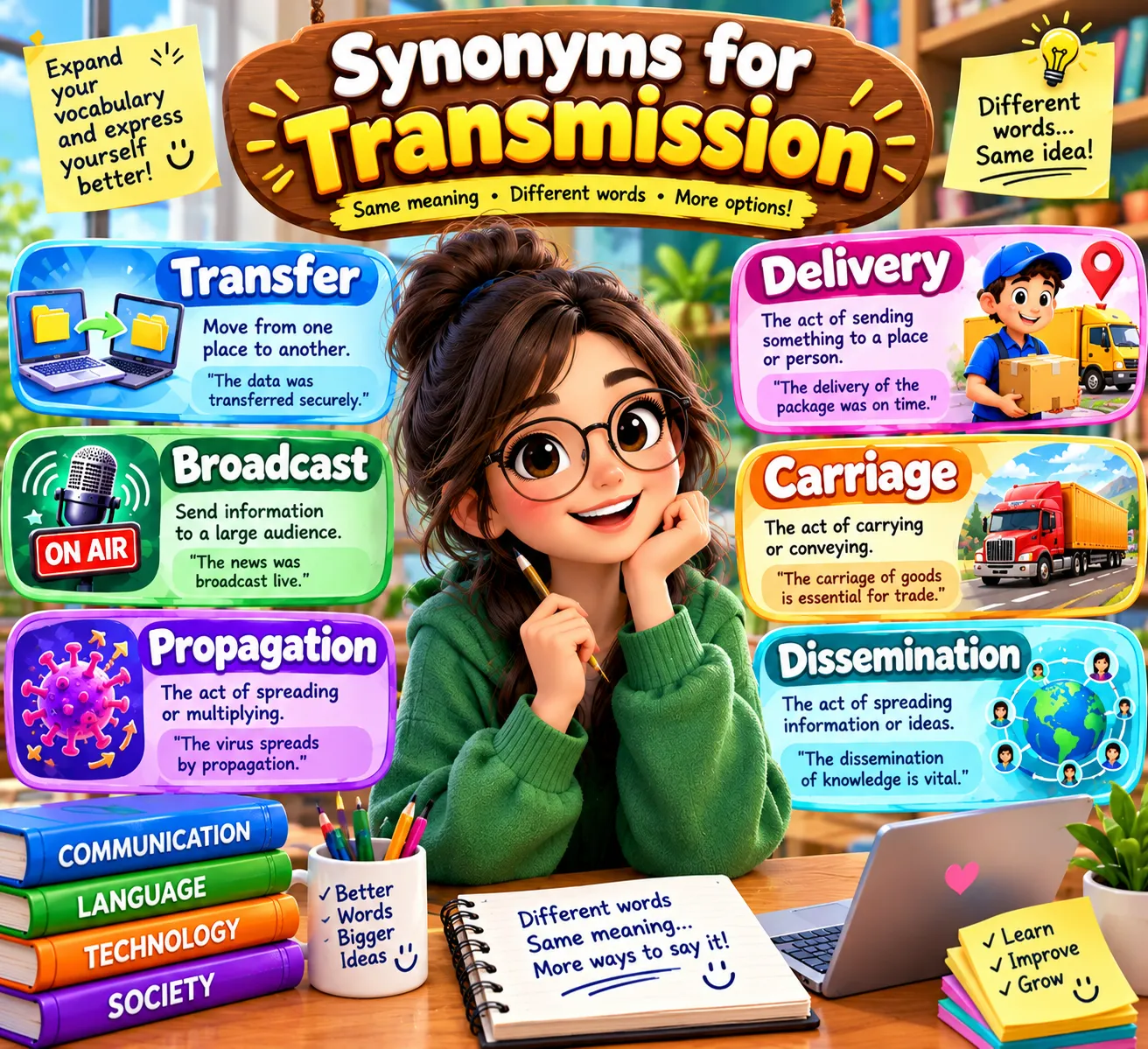
Synonyms for transmission include transfer, delivery, communication, broadcasting, distribution, and conveyance. The best choice depends on whether you mean sending information, spreading a signal, or moving something from one place to another.
I have often seen how a simple message, shared file, or live TV program connects people across different places. Each of these actions involves sending something from one person or place to another. This process is called transmission, a word commonly used in technology, science, medicine, communication, and transport.
Learning synonyms for transmission helps me explain ideas more clearly and avoid repeating the same word. It can also help students, English learners, and content writers improve their vocabulary. For example, transfer often describes moving data, while broadcasting refers to sending programs to a wide audience.
In this guide, I will explore the meaning, history, pronunciation, and grammar of transmission. I will also share 30 related words and expressions, along with their meanings, examples, antonyms, and semantic categories, to help you choose the most suitable word for each context.
Meaning of Transmission
Definition
Transmission (noun): The act or process of sending, passing, or spreading something from one person, place, or thing to another.
Examples
- The transmission of data takes only a few seconds.
- The disease can spread through the transmission of germs.
Connotative Meaning
(Connotation: the feeling or idea a word suggests beyond its basic meaning.)
- Positive tone: It may suggest the sharing of useful knowledge or important information. Example: The transmission of skills helps students learn.
- Negative tone: It may refer to the spread of disease or harmful information. Example: The transmission of the virus caused concern.
- Neutral tone: It may describe a technical or physical process. Example: The radio supports the transmission of signals.
Etymology of Transmission
The word transmission comes from Latin transmissio, meaning “a sending across” or “a passage across.” It is related to the Latin verb transmittere, meaning “to send across.”
| Historical Period | Time Frame | Development |
| Old English | 450–1100 | The modern word transmission was not part of regular Old English vocabulary. Speakers used other words to describe sending or passing things. |
| Middle English | 1100–1500 | Latin and French influenced English vocabulary related to sending, passing, and conveying things. |
| Modern English | 1500–present | Transmission developed from Latin and French forms and became common in science, communication, medicine, and engineering. |
Pronunciation (IPA)
- IPA: /trænzˈmɪʃən/
- Syllables: trans-mis-sion (3 syllables)
Affixation Pattern of Transmission
- Root: Transmit
- Prefix: Trans across or beyond.
- Suffix: -sion forms a noun describing an action, process, or result.
Word Formations
- Transmit (verb): To send or pass something on.
- Transmits (verb): Sends or passes something on.
- Transmitted (verb): Sent or passed from one place or person to another.
- Transmitting (verb): Sending or passing something on.
- Transmission (noun): The act or process of sending or passing something.
- Transmissible (adjective): Able to be passed from one person or thing to another.
- Transmissibility (noun): The ability to be transmitted.
- Transmitter (noun): A device or person that sends something.
- Transmittal (noun): The act of sending something, especially a document or item.
- Transmissive (adjective): Allowing something, such as light or energy, to pass through.
30 Synonyms of Transmission With Meaning and Examples
The best synonym depends on the context. Some words describe sending information, while others refer to physical movement, disease spread, or technical systems.
1. Transfer (Noun)
Meaning: The act of moving something from one person, place, or system to another.
Examples:
- The transfer of data took a few seconds.
- The bank confirmed the transfer of money.
2. Delivery (Noun)
Meaning: The act of bringing or sending something to a person or place.
Examples:
- The delivery of the message was delayed.
- The company offers fast delivery of documents.
3. Communication (Noun)
Meaning: The sharing or exchange of information between people or systems.
Examples:
- Clear communication helps teams work well.
- The device supports communication over long distances.
4. Broadcasting (Noun)
Meaning: The sending of audio or video programs to a large audience.
Examples:
- Broadcasting allows people to watch live events.
- The station began broadcasting the news at noon.
5. Distribution (Noun)
Meaning: The process of spreading or supplying something to different people or places.
Examples:
- The distribution of information began early.
- The company manages the distribution of digital files.
6. Conveyance (Noun)
Meaning: The act of carrying or passing something from one place to another.
Examples:
- The conveyance of data requires a reliable system.
- The document explains the conveyance of goods.
7. Sending (Noun)
Meaning: The act of causing something to go to another person or place.
Examples:
- The sending of the report took only minutes.
- Sending messages is easy with this app.
8. Relaying (Noun)
Meaning: The act of passing information from one person or system to another.
Examples:
- The relaying of emergency messages was essential.
- The device helps with relaying signals.
9. Broadcasting Signal (Noun Phrase)
Meaning: A signal sent out so that receiving devices can pick it up.
Examples:
- The broadcasting signal reached nearby towns.
- A weak broadcasting signal caused the problem.
10. Propagation (Noun)
Meaning: The spreading or movement of something, such as a wave, signal, or disease.
Examples:
- The propagation of radio waves affects reception.
- Scientists studied the propagation of sound.
11. Dissemination (Noun)
Meaning: The act of spreading information, knowledge, or ideas to many people.
Examples:
- The dissemination of research helps other scientists.
- The website supports the dissemination of public information.
12. Circulation (Noun)
Meaning: The movement or spread of something among people or places.
Examples:
- The circulation of the newsletter increased.
- The circulation of false information caused concern.
13. Passage (Noun)
Meaning: The movement of something through or across a place or system.
Examples:
- The passage of signals through the cable was smooth.
- The device controls the passage of electrical current.
14. Conveying (Verb, gerund)
Meaning: The act of communicating or carrying something to another person or place.
Examples:
- Conveying the message clearly was important.
- The system is useful for conveying information.
15. Forwarding (Noun)
Meaning: The act of sending a message or item onward to another destination.
Examples:
- The forwarding of emails was automatic.
- Forwarding the file saved time.
16. Dispatch (Noun)
Meaning: The act of sending something to a destination, often quickly.
Examples:
- The dispatch of the equipment was delayed.
- The office arranged the dispatch of the documents.
17. Emission (Noun)
Meaning: The release or sending out of energy, light, sound, or particles.
Examples:
- The emission of radio waves was measured.
- The device controls the emission of light.
18. Broadcasting Transmission (Noun Phrase)
Meaning: The sending of audio or video content through a broadcasting system.
Examples:
- The broadcasting transmission reached thousands of viewers.
- Engineers checked the broadcasting transmission equipment.
19. Spread (Noun)
Meaning: The movement of something across a wider area or among more people.
Examples:
- The spread of the infection worried doctors.
- The spread of information was rapid.
20. Transfer of Data (Noun Phrase)
Meaning: The movement of digital information between devices or systems.
Examples:
- The transfer of data finished successfully.
- Secure transfer of data protects private information.
21. Signal Transfer (Noun Phrase)
Meaning: The movement of a signal from one point or device to another.
Examples:
- Signal transfer improved after the repair.
- The system supports signal transfer between devices.
22. Conveying Information (Verb Phrase)
Meaning: The act of sharing facts, ideas, or messages.
Examples:
- Conveying information clearly prevents confusion.
- The report focuses on conveying information to staff.
23. Transference (Noun)
Meaning: The process of moving or transferring something from one person, place, or situation to another.
Examples:
- The transference of skills helped the new team.
- The study examined the transference of learning.
24. Transmission of Disease (Noun Phrase)
Meaning: The process by which an illness passes from one host or source to another.
Examples:
- The transmission of disease can be reduced by hygiene.
- Researchers studied the transmission of disease in crowded areas.
25. Propagation of Signals (Noun Phrase)
Meaning: The movement of signals through space or a medium.
Examples:
- The propagation of signals depends on the environment.
- Engineers measured the propagation of signals underwater.
26. Reproduction (Noun)
Meaning: The copying or recreation of sound, images, or information; it is a synonym only in certain technical contexts.
Examples:
- The reproduction of sound was clear.
- The device supports accurate reproduction of recorded audio.
27. Handing Over (Noun or Verb Phrase)
Meaning: The act of giving control, responsibility, or an item to another person.
Examples:
- The handing over of the files took place in the morning.
- The manager handled the handing over of responsibilities.
28. Handoff (Noun)
Meaning: The transfer of control, a signal, or responsibility from one system or person to another.
Examples:
- The mobile call continued during the handoff.
- The handoff between teams went smoothly.
29. Transmission Line (Noun Phrase)
Meaning: A system or cable that carries electrical energy or signals from one point to another.
Examples:
- The engineers inspected the transmission line.
- Damage to the transmission line caused an outage.
30. Passage On (Verb Phrase)
Meaning: The act of giving or communicating something to another person, especially information or knowledge.
Examples:
- The passage on of family traditions continued.
- Teachers help with the passage on of knowledge.
Usage note: Some entries are related expressions rather than exact synonyms. For example, transmission line names equipment, while handoff describes a specific type of transfer. Use them only when the context fits.
Prototype Meaning of Transmission
The most typical meaning of transmission is the process of sending or passing something from one point to another. People often think of data moving between computers, radio signals traveling through the air, or information being shared between people. The word can also describe the spread of disease and the transfer of power in a vehicle. Its central idea is movement or passage from a source to a receiver.
Prototype Categorization of Transmission
| Semantic Category | Synonyms and Related Expressions | Main Use |
| Sending and Moving | Transfer, delivery, conveyance, sending, passage | Describe moving an item, message, or resource. |
| Sharing Information | Communication, relaying, dissemination, conveying information, forwarding | Describe sharing news, data, or ideas. |
| Broadcasting and Signals | Broadcasting, broadcasting signal, signal transfer, propagation of signals, emission | Describe sending audio, video, or signals. |
| Spreading and Circulation | Propagation, circulation, spread, dissemination | Describe something spreading across people, places, or systems. |
| Technical and Digital Processes | Transfer of data, handoff, transference, transmission line | Describe data movement or the transfer of control and energy. |
| Health and Biology | Transmission of disease, spread, propagation | Describe how infections or biological agents pass between hosts. |
| Sound and Information Reproduction | Reproduction, passage on, conveying | Describe recreating sound or passing knowledge to others. |
| Sending Goods or Documents | Dispatch, delivery, forwarding, handing over | Describe sending items or passing responsibility. |
Grouping these words by meaning helps writers choose a suitable alternative for each situation. It also prevents confusion between the process of sending something, the content being sent, and the equipment used to send it.
Antonyms of Transmission
The best opposite depends on the context. These words describe stopping, blocking, or preventing movement or communication.
- Interruption (noun): A break that stops an ongoing process.
- Blockage (noun): Something that prevents movement or passage.
- Obstruction (noun): Something that blocks a route, signal, or process.
- Prevention (noun): The act of stopping something from happening.
- Suppression (noun): The act of stopping or limiting the spread or expression of something.
- Retention (noun): The act of keeping something instead of passing it on.
- Isolation (noun): The state of keeping something separate from others.
- Disconnection (noun): The state or act of breaking a connection.
- Severance (noun): The act of cutting off a connection or link.
- Reception (noun): The act of receiving something; it can contrast with sending, though it is not a true antonym in every context.
Short Questions and Answers
What does transmission mean?
Transmission means the act or process of sending, passing, or spreading something from one place, person, or system to another.
When should transmission be used?
Use transmission in contexts involving communication, technology, medicine, science, or engineering. For everyday writing, sending, transfer, or sharing may sound simpler.
Is transmission positive or negative?
The word is neutral. Its tone depends on the context. The transmission of knowledge may be positive, while the transmission of a disease may be negative.
How is transmission different from transfer?
Transmission often describes sending signals, information, energy, or diseases. Transfer usually emphasizes moving something from one person, place, or system to another.
What is the best synonym for transmission?
Transfer is a useful general alternative, but communication, broadcasting, spread, or delivery may be better depending on the context.
Conclusion
Learning synonyms for transmission helps you build a stronger vocabulary and express ideas with greater accuracy. Words such as transfer, delivery, communication, and broadcasting can make your writing more natural when used in the right context. Some alternatives describe sending information, while others refer to signals, disease, or physical movement.
I recommend practicing these words in short sentences. Think about what is being sent, where it is going, and how it moves. This will help you choose the best word and avoid repetition. Reading articles about technology, science, and communication can also show you how these terms work in real situations. With regular practice, you can improve your writing, speaking, and confidence in English.
Read More:
Synonyms for Thinking Outside the Box: 30 Creative Alternatives

I’m Falak Naaz, an SEO writer at SameSynonyms.com with 10 years of experience creating clear, engaging, and search-friendly English content. I specialize in synonyms, antonyms, vocabulary, and word usage. Through careful research and practical examples, I help readers choose the right words and improve their English with confidence.










