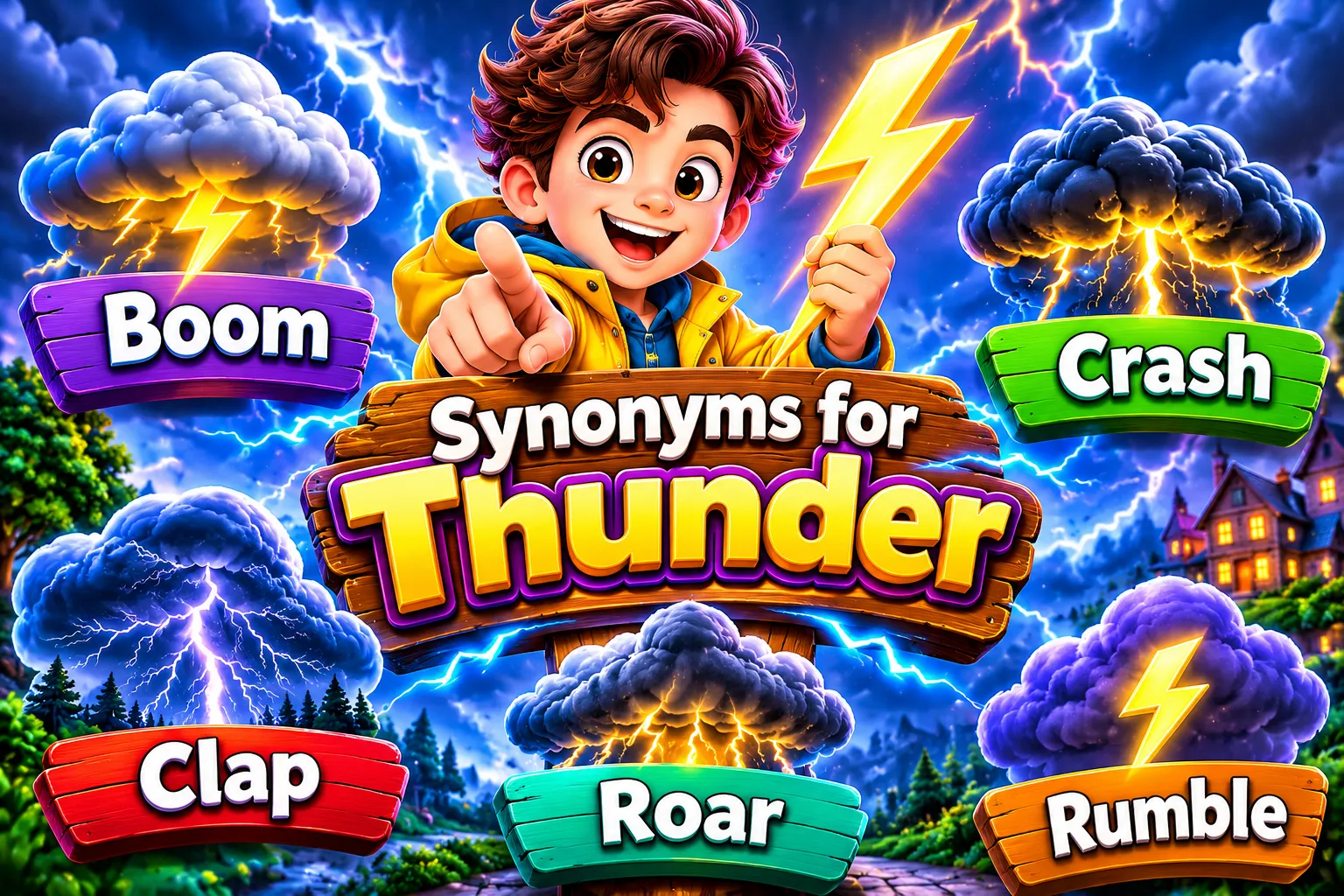
Synonyms for thunder include rumble, roar, boom, peal, clap, crash, crack, growl, reverberation, and thunderclap. These words describe loud, deep, rolling, or explosive sounds, especially those heard during a storm.
Thunder is the loud, rumbling sound that we hear in the sky during a storm. Imagine sitting at home on a rainy evening when a sudden loud boom shakes the windows. That deep sound is thunder. This word is commonly used in weather reports, daily conversations, books, and stories to describe powerful noises.
It can also describe loud speech, angry words, or heavy movements. However, using the same word repeatedly can make your writing less interesting. Learning synonyms helps English learners and content writers improve their vocabulary and express sounds more clearly.
In this guide, I will explain the meaning, pronunciation, history, grammar, and 30 useful synonyms for thunder, with simple definitions, examples, and semantic categories.
Meaning of Thunder
Definition
Thunder (Noun/Verb):
As a noun, thunder is the loud, deep sound that follows a flash of lightning during a storm. As a verb, it means to produce a loud rumbling sound, move noisily, or speak in a loud and angry voice.
Examples
- The loud thunder frightened the children during the storm.
- I heard thunder rolling across the sky last night.
Connotative Meaning
Connotation: The feelings, ideas, or emotions that a word creates beyond its basic meaning.
- Positive tone: Thunder can suggest power, strength, excitement, and natural beauty in creative writing.
- Negative tone: It may suggest danger, fear, anger, destruction, or an approaching storm.
- Neutral tone: It describes the natural sound produced during a storm without expressing a particular emotion.
Etymology of Thunder
The word thunder has Germanic roots and comes from Old English. It is related to words in other Germanic languages, including German Donner and Dutch donder.
| Historical Period | Etymology of Thunder |
| Old English (450–1100) | Thunder comes from Old English þunor, meaning thunder or a thunderclap. The related verb was þunrian, meaning to make a thunderous sound. |
| Middle English (1100–1500) | The word developed through forms such as thuner, thonder, and thunder. It continued to describe the loud, rumbling sound that follows lightning. |
| Modern English (1500–Present) | The spelling thunder became established. Today, it describes the natural sound of a storm and other loud, powerful noises. It is also used figuratively for loud speech and noisy movement. |
The word is related to Old Norse þórr, the name of the Norse god of thunder, and German Donner, meaning thunder.
Pronunciation (IPA)
- IPA (British English): /ˈθʌn.də(r)/
- IPA (American English): /ˈθʌn.dɚ/
- Syllables: Thun-der (2 syllables).
- Word stress: The first syllable is stressed.
Affixation Pattern of Thunder
The word thunder can form different words by adding suffixes and combining with other words.
- Root: Thunder
- Prefix: None in the basic word.
- Suffixes: -ed, -ing, -ous, -er, -y, -struck (in the compound thunderstruck).
Word Formations
- Thunder (Noun): The loud sound produced during a storm.
- Thunder (Verb): To produce a loud, rumbling sound.
- Thundered (Verb): Produced a loud, powerful sound in the past.
- Thundering (Verb/Adjective): Making or producing a loud rumbling sound.
- Thunderous (Adjective): Extremely loud, powerful, or forceful.
- Thundery (Adjective): Describing weather that is likely to produce thunder.
- Thunderer (Noun): Someone or something that makes a thunderous sound.
- Thunderclap (Noun): A sudden, loud burst of thunder.
- Thunderstorm (Noun): A storm with thunder and lightning.
- Thunderbolt (Noun): A flash or bolt of lightning, especially one associated with thunder in traditional language.
- Thunderstruck (Adjective): Extremely surprised or shocked.
27 Synonyms of Thunder With Meaning & Examples
The following 30 alternatives describe different types of thunder-like sounds, loud noises, echoes, and forceful speech. Some are direct alternatives, while others are suitable only when thunder is used in a broader or figurative sense.
1. Rumble (Noun/Verb)
Meaning: A deep, continuous sound that is often similar to distant thunder.
Examples:
- A low rumble came from the dark clouds.
- We heard thunder rumbling in the distance.
2. Peal (Noun/Verb)
Meaning: A loud, long burst of sound, especially one produced by thunder or bells.
Examples:
- A loud peal of thunder shook the windows.
- The first peal of thunder announced the coming storm.
3. Clap (Noun/Verb)
Meaning: A sudden, sharp burst of sound, especially a loud noise from thunder.
Examples:
- A sudden clap of thunder woke the baby.
- The loud clap echoed across the valley.
4. Thunderclap (Noun)
Meaning: A sudden and extremely loud burst of thunder.
Examples:
- A thunderclap broke the silence of the night.
- The sudden thunderclap frightened everyone in the house.
5. Boom (Noun/Verb)
Meaning: A deep, loud, and powerful sound that resembles thunder.
Examples:
- A deep boom came from the direction of the hills.
- The thunder boomed across the dark sky.
6. Roar (Noun/Verb)
Meaning: A loud, deep, and continuous sound.
Examples:
- The roar of thunder filled the quiet night.
- Heavy thunder roared above the village.
7. Crash (Noun/Verb)
Meaning: A sudden, loud, and powerful sound.
Examples:
- A crash of thunder shook the building.
- Thunder crashed above the mountains.
8. Crack (Noun/Verb)
Meaning: A sudden, sharp, explosive sound that can resemble thunder.
Examples:
- A sharp crack of thunder startled the birds.
- Thunder cracked loudly across the sky.
9. Roll (Noun/Verb)
Meaning: A deep, continuous, and repeated sound that seems to move across an area.
Examples:
- A roll of thunder echoed through the valley.
- The thunder rolled across the distant hills.
10. Reverberation (Noun)
Meaning: A sound that continues to echo after the original noise has stopped.
Examples:
- The reverberation of thunder filled the empty valley.
- We could hear the reverberation long after the crash.
11. Echo (Noun/Verb)
Meaning: A sound that repeats after bouncing off a surface.
Examples:
- The thunder produced a deep echo in the mountains.
- The loud sound echoed through the empty valley.
12. Explosion (Noun)
Meaning: A sudden, powerful burst of sound that resembles a thunderclap.
Examples:
- The explosion-like sound shook the windows.
- A loud explosion echoed across the distant hills.
13. Discharge (Noun)
Meaning: A sudden release of electrical energy that can produce a loud thunderous sound.
Examples:
- The electrical discharge produced a powerful flash of lightning.
- The discharge was followed by a loud rumble of thunder.
14. Report (Noun)
Meaning: A sudden, sharp, and loud noise, often similar to an explosion or thunderclap.
Examples:
- A loud report echoed through the countryside.
- The sudden report startled everyone nearby.
15. Blast (Noun)
Meaning: A sudden and powerful burst of sound or energy.
Examples:
- A powerful blast shook the surrounding area.
- The blast echoed like thunder across the hills.
16. Growl (Noun/Verb)
Meaning: A low, deep, rough sound that resembles distant thunder.
Examples:
- A growl of thunder came from the dark clouds.
- The storm growled in the distance.
17. Bellow (Noun/Verb)
Meaning: A loud, deep, and powerful sound, usually made by a person or animal.
Examples:
- The man’s bellow echoed across the room.
- The speaker bellowed angrily at the crowd.
18. Din (Noun)
Meaning: A loud, continuous, and unpleasant noise.
Examples:
- The din of the storm made it difficult to sleep.
- The loud din outside covered every conversation.
19. Racket (Noun)
Meaning: A loud and disturbing noise made by people, objects, or activities.
Examples:
- The thunder created a terrible racket outside.
- The heavy rain and wind made a racket throughout the night.
20. Clamor (Noun)
Meaning: A loud and confused mixture of sounds, often made by a group of people.
Examples:
- The clamor of the crowd filled the stadium.
- A sudden clamor interrupted the quiet meeting.
21. Uproar (Noun)
Meaning: A loud noise or disturbance caused by excitement, anger, or confusion.
Examples:
- The unexpected announcement created an uproar.
- The uproar in the hall sounded like thunder.
22. Tumult (Noun)
Meaning: A loud and confused disturbance involving noise, excitement, or disorder.
Examples:
- A great tumult spread through the crowded hall.
- The tumult outside continued throughout the evening.
23. Commotion (Noun)
Meaning: A noisy disturbance or situation involving confusion and excitement.
Examples:
- A sudden commotion began outside the house.
- The loud commotion disturbed everyone in the building.
24. Resound (Verb)
Meaning: To produce or fill a place with a loud, clear, or echoing sound.
Examples:
- The sound of thunder resounded through the valley.
- Loud cheers resounded across the stadium.
25. Reverberate (Verb)
Meaning: To produce a continuing or repeated sound by echoing from surrounding surfaces.
Examples:
- Thunder reverberated through the mountains.
- The loud noise reverberated inside the empty building.
26. Blare (Noun/Verb)
Meaning: A loud, harsh, and unpleasant sound, often made by a horn or loudspeaker.
Examples:
- The blare of the alarm interrupted the quiet night.
- The warning siren blared across the town.
27. Shout (Noun/Verb)
Meaning: To speak or call in a very loud voice to be heard.
Examples:
- The angry shout echoed through the hallway.
- The speaker shouted loudly above the storm.
Prototype Meaning
The most common meaning of thunder is the loud, deep, rumbling sound heard during a storm after lightning. People usually imagine dark clouds, flashes of lightning, heavy rain, and powerful rolling noises in the sky. Thunder can sound like a sudden clap, a deep boom, or a long rumble. The word also has figurative meanings. It can describe loud movements, powerful noises, or angry speech. For example, a train may thunder past a building, or a person may thunder out an angry warning. Understanding these different uses helps you choose the right synonym for each situation.
Prototype Categorization
Semantic Categories of Synonyms for Thunder
The 30 synonyms for thunder can be divided into five meaningful semantic categories. These groups help writers choose words according to the type, volume, and nature of a sound.
| Semantic Category | Synonyms | Description |
| Deep and rolling thunder sounds | Rumble, peal, clap, thunderclap, boom, roar, crash, crack, roll, growl | Describe the deep, sudden, continuous, or powerful sounds commonly associated with storms. |
| Sudden explosive sounds | Explosion, discharge, report, blast | Refer to sharp, powerful bursts of sound or energy that can resemble thunder. |
| Echoes and repeated sounds | Reverberation, echo, resound, reverberate | Describe sounds that travel, repeat, or continue after the original noise. |
| Loud and disturbing noises | Din, racket, clamor, uproar, tumult, commotion, blare | Refer to noisy, confusing, or unpleasant sounds made by people, objects, or activities. |
| Loud speech and forceful expression | Bellow, shout, yell, declaim, bluster | Describe powerful, angry, dramatic, or unusually loud ways of speaking. |
Choosing synonyms from these categories makes your writing more accurate and expressive. Instead of repeating thunder, you can select a word that describes a deep rumble, sudden crash, loud echo, or forceful voice.
Antonyms of Thunder
Antonyms describe sounds or situations that are quiet, peaceful, gentle, or free from noise.
- Silence (Noun): A complete absence of sound.
- Quiet (Noun/Adjective): A state or condition with very little noise.
- Hush (Noun/Verb): A quiet state or the act of making someone or something silent.
- Stillness (Noun): A calm state without movement or noise.
- Calm (Noun/Adjective): A peaceful condition without disturbance.
- Softness (Noun): The quality of producing a gentle or low-volume sound.
- Whisper (Noun/Verb): A very quiet way of speaking.
- Murmur (Noun/Verb): A low, soft, and continuous sound or voice.
- Tranquility (Noun): A peaceful state without noise or disturbance.
- Serenity (Noun): A calm and peaceful condition.
Short Questions and Answers
1. What does thunder mean?
Thunder is the loud, rumbling sound that follows lightning during a storm. It can also describe other powerful noises or loud speech.
2. When should thunder be used?
Use thunder when describing the sound of a storm, a loud and powerful noise, heavy movement, or a forceful way of speaking.
3. Is thunder positive or negative?
Thunder is generally neutral when describing weather. However, it can suggest fear, danger, anger, or power depending on the context.
4. How is it different from similar words?
Thunder usually describes the sound associated with lightning. Rumble refers to a deep, continuous noise, boom describes a powerful burst of sound, peal suggests a loud ringing burst, and crash describes a sudden, forceful noise.
Conclusion
Learning the meaning of thunder and its synonyms can improve your English vocabulary and communication skills. Words such as rumble, roar, boom, peal, crash, and reverberation help you describe different types of powerful sounds.
Each alternative has its own meaning, so choosing the right one makes your writing clearer and more interesting. Using different words also prevents repetition in essays, stories, articles, and everyday conversations.
For English learners, understanding these alternatives builds confidence in speaking and writing. Try learning a few new synonyms every day and use them in your own sentences. With regular practice, you can describe sounds and situations more accurately.
Read More:
Synonyms for priceless: 29 Powerful Alternatives

I’m Falak Naaz, an SEO writer at SameSynonyms.com with 10 years of experience creating clear, engaging, and search-friendly English content. I specialize in synonyms, antonyms, vocabulary, and word usage. Through careful research and practical examples, I help readers choose the right words and improve their English with confidence.











1 thought on “Synonyms for Thunder: 27 Powerful Words for Loud Sounds”