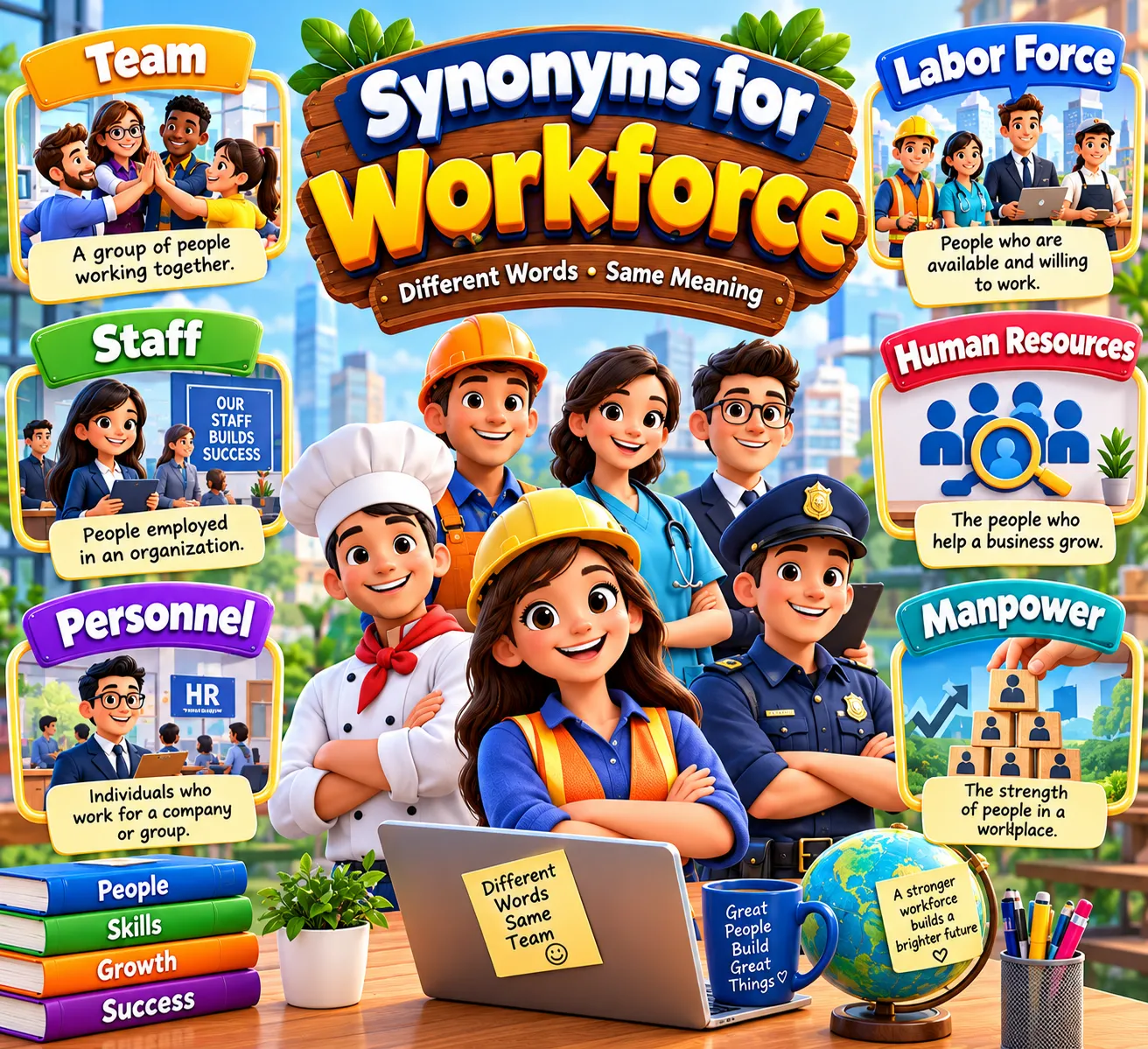
Synonyms for workforce include staff, employees, workers, personnel, labor force, team members, human resources, manpower, and working population. The best alternative depends on whether you are discussing a company’s employees, available workers, or the wider labor market.
The workforce is the group of people who work for a company, industry, or country. For example, a company may hire more workers to expand its workforce. The word is common in business, education, economics, and daily life.
Learning synonyms for workforce helps you describe workers and employees in different ways. It also helps English learners and content writers avoid repeating the same word. Some alternatives, such as staff and employees, fit everyday business writing, while labor force and human resources are more useful in economic or professional contexts.
In this guide, you will learn the meaning, history, pronunciation, grammar, and 30 synonyms for workforce, with simple definitions and examples. You will also explore semantic categories to help you choose the best word for each situation.
Meaning of Workforce
Definition
Workforce (noun): The group of people who are available to work or who work for a company, organization, industry, or country.
Examples
- The company plans to expand its workforce next year.
- A skilled workforce helps businesses grow and succeed.
Connotative Meaning
(Connotation: the feeling or idea a word suggests beyond its basic meaning.)
- Positive tone: Suggests skill, teamwork, productivity, and shared effort.
- Negative tone: May suggest labor shortages, worker pressure, or workforce cuts.
- Neutral tone: Refers to the people who work for an organization or within an economy.
Etymology of Workforce
The word workforce combines work, meaning an activity done to earn a living or achieve a task, and force, meaning a group of people or a collective body. Its modern use is linked to employment, industry, and economics.
| Period | Development |
| Old English (450–1100) | Work came from Old English weorc, meaning work, action, or effort. |
| Middle English (1100–1500) | Work developed into forms such as werk and work. Force entered English through French, with roots in Latin fortia, linked to strength or power. |
| Modern English (1500–Present) | Workforce became established as a term for the people who perform work, especially in business, industry, and economics. |
Pronunciation (IPA)
- IPA: /ˈwɜːrk.fɔːrs/ (US: /ˈwɝːk.fɔːrs/)
- Syllables: work-force (2 syllables)
Affixation Pattern of Workforce
- Root: work + force
- Prefix: None
- Suffix: None in the base word
Word Formations
- Workforce (noun): People who work or are available for work.
- Workforces (plural noun): Groups of workers in different organizations or regions.
- Work (noun/verb): An activity or the act of doing a task.
- Worker (noun): A person who does a job.
- Working (verb/adjective): Doing a job or operating.
- Workplace (noun): A place where people work.
- Work-related (adjective): Connected with a job or employment.
Note: These are related words and compounds, not all direct grammatical forms of workforce.
30 Synonyms of Workforce With Meaning and Examples
Not every synonym fits every situation. Staff often refers to people employed by one organization, while labor force can include people who are employed or actively seeking work.
1. Staff (Noun)
Meaning: The people who work for a company or organization.
Examples:
- The school has a friendly staff.
- Management thanked the staff for their hard work.
2. Employees (Noun)
Meaning: People who work for an employer in return for pay.
Examples:
- The company provides training for its employees.
- All employees must attend the safety meeting.
3. Workers (Noun)
Meaning: People who do a job, especially to earn money.
Examples:
- The factory employs hundreds of workers.
- Workers received new safety equipment.
4. Labor Force (Noun)
Meaning: People who are employed or actively looking for work.
Examples:
- The country’s labor force is growing.
- Many people joined the labor force after graduation.
5. Personnel (Noun)
Meaning: The people employed by an organization.
Examples:
- Only trained personnel may use this equipment.
- The hospital needs more medical personnel.
6. Team (Noun)
Meaning: A group of people who work together toward a shared goal.
Examples:
- The team completed the project on time.
- Our team works well under pressure.
7. Human Resources (Noun)
Meaning: The people working in an organization, or the department that manages employees.
Examples:
- Human resources arranged the staff training.
- The company invests in its human resources.
8. Labor Pool (Noun)
Meaning: A group of people available for work.
Examples:
- The city has a large labor pool.
- Employers searched the local labor pool for skilled workers.
9. Manpower (Noun)
Meaning: The people needed or available to perform work; a gender-neutral alternative is often preferred in modern writing.
Examples:
- The project requires more manpower.
- The agency lacks the manpower to finish the task.
10. Workforce Population (Noun Phrase)
Meaning: The people who make up a workforce in a particular area or sector.
Examples:
- The workforce population is changing as people retire.
- The report studied the workforce population in rural areas.
11. Employees’ Group (Noun Phrase)
Meaning: A group of people employed by the same organization.
Examples:
- The employees’ group met with management.
- An employees’ group raised concerns about working hours.
12. Labor (Noun)
Meaning: People who do physical or other work, or the effort involved in a job.
Examples:
- Skilled labor is vital to construction.
- The business depends on local labor.
13. Work Crew (Noun)
Meaning: A group of people assigned to complete a particular task.
Examples:
- The work crew repaired the road.
- A work crew arrived early to prepare the site.
14. Staff Members (Noun)
Meaning: Individual people who work for an organization.
Examples:
- Staff members attended a training session.
- The manager praised two staff members.
15. Associates (Noun)
Meaning: People who work with or for an organization, often in business settings.
Examples:
- Sales associates helped customers choose products.
- The company offered new training to its associates.
16. Colleagues (Noun)
Meaning: People who work with you in the same organization or profession.
Examples:
- My colleagues helped me finish the report.
- She shared the news with her colleagues.
17. Team Members (Noun)
Meaning: People who belong to a team.
Examples:
- Team members shared ideas during the meeting.
- Each team member had a clear role.
18. Employees’ Base (Noun Phrase)
Meaning: The group of employees that supports an organization’s daily work.
Examples:
- The company expanded its employees’ base.
- A strong employees’ base can support business growth.
19. Labor Supply (Noun)
Meaning: The number of people available and willing to work.
Examples:
- The region has a limited labor supply.
- Higher wages may attract more labor supply.
20. Talent Pool (Noun)
Meaning: A group of people with skills or abilities that employers can recruit.
Examples:
- The city has a strong talent pool.
- The company searched its talent pool for future managers.
21. Workforce Team (Noun Phrase)
Meaning: A group of workers who perform tasks within an organization.
Examples:
- The workforce team introduced a new process.
- Our workforce team supports customers across the country.
22. Labor Force Participants (Noun Phrase)
Meaning: People who are either employed or actively seeking employment.
Examples:
- Labor force participants completed a national survey.
- The report measured changes among labor force participants.
23. Operatives (Noun)
Meaning: Workers who perform practical or operational tasks, often in industry.
Examples:
- The factory hired more production operatives.
- Skilled operatives checked the machinery.
24. Workforce Members (Noun Phrase)
Meaning: People who belong to a particular workforce.
Examples:
- Workforce members received updated guidelines.
- The program offers support to workforce members.
25. Employees at Large (Noun Phrase)
Meaning: Employees considered as a whole rather than as individual workers or small groups.
Examples:
- The announcement was shared with employees at large.
- The policy affects employees at large.
26. Human Capital (Noun)
Meaning: The skills, knowledge, and experience that people bring to work.
Examples:
- Training helps build human capital.
- The company invests in human capital to improve productivity.
27. Labor Market (Noun)
Meaning: The system in which employers seek workers and people seek jobs.
Examples:
- The labor market needs more skilled technicians.
- Changes in the labor market affect wages.
28. Staff Body (Noun Phrase)
Meaning: The complete group of people employed by an organization.
Examples:
- The school has an experienced staff body.
- The staff body met to discuss the new rules.
29. Personnel Base (Noun Phrase)
Meaning: The group of employees available to support an organization’s operations.
Examples:
- The company strengthened its personnel base.
- A wider personnel base helped the service expand.
30. Working Population (Noun Phrase)
Meaning: People who are working or are generally considered part of the working-age population, depending on context.
Examples:
- The working population is aging in some countries.
- Training programs can help the working population gain new skills.
Prototype Meaning of Workforce
The most typical meaning of workforce is the group of people who work for a company or who are available for employment in a country, industry, or region. People often picture employees, skilled workers, managers, and other staff members who help an organization operate. The word is common in business reports, job discussions, and economic studies. It can refer to a small company’s employees or to a nation’s labor force.
Prototype Categorization
- Grouping synonyms for workforce by meaning helps writers choose the right word for each topic and audience.
| Semantic Category | Synonyms | Best Used For |
| Employees and Organization Staff | Staff, employees, personnel, staff members, associates, colleagues | Describing people who work for a company or institution |
| Jobs and Employment | Workers, labor, labor force, labor force participants, working population, labor supply | Discussing employment, jobs, and economic activity |
| Teams and Cooperation | Team, team members, work crew, workforce team, employees’ group | Describing people working together toward a shared goal |
| Skills and Recruitment | Talent pool, human capital | Discussing skills, experience, hiring, and professional development |
| Industry and Operations | Operatives, manpower | Describing practical work, staffing needs, and industrial jobs |
| Formal or Specialized Phrases | Workforce population, workforce members, employees at large, staff body, personnel base, employees’ base | Referring to specific groups of workers, though simpler terms are often more natural |
| Related Employment Concepts | Human resources, labor market | Discussing employee management, hiring, and employment conditions; these terms are related but not exact synonyms for workforce |
Antonyms of Workforce
Workforce has no exact opposite in every context. These words describe related contrasts:
1. Unemployment (Noun)
Meaning: The state of being without a job while seeking work.
2. Joblessness (Noun)
Meaning: The condition of not having paid work.
3. Labor Shortage (Noun)
Meaning: A situation in which employers cannot find enough workers.
4. Staff Shortage (Noun)
Meaning: A lack of employees needed to run an organization.
5. Inactivity (Noun)
Meaning: A state in which people are not engaged in work or activity.
6. Layoff (Noun)
Meaning: The removal of a worker from a job, often because an employer needs to reduce costs.
Short Questions and Answers
What does workforce mean?
Workforce means the people who work for an organization or who are available for employment in a country, industry, or region.
When should workforce be used?
Use workforce when discussing employees, staffing, hiring, workplace skills, or employment trends. It is common in business and economic writing.
Is workforce positive or negative?
Workforce is neutral. It can suggest strength and productivity in a positive context or staffing problems and job cuts in a negative context.
How is workforce different from similar words?
Workforce refers to a broad group of workers. Staff usually refers to people employed by one organization, employees means people hired by an employer, and labor force often includes employed people and those actively seeking work.
Conclusion
Learning synonyms for workforce helps you communicate more clearly in English. Words such as staff, employees, and personnel work well in business writing, while labor force and working population are useful in economic discussions.
Terms such as team members and work crew highlight cooperation and shared tasks. However, not every alternative has the same meaning, so always consider the context before choosing a word.
Using the right synonym can make your writing more precise, reduce repetition, and help you explain ideas with confidence. To build your vocabulary, practice one or two new words each day. Write simple sentences with them and use them in your conversations, reports, or articles.
Read More:
Synonyms for Trend: 30 Powerful Words to Know

I’m Noor Fatima, an English content writer at SameSynonyms.com, specializing in synonyms, antonyms, word meanings, and English vocabulary. I create clear, well-researched content with practical examples to help readers understand word usage, expand their vocabulary, and communicate more effectively.