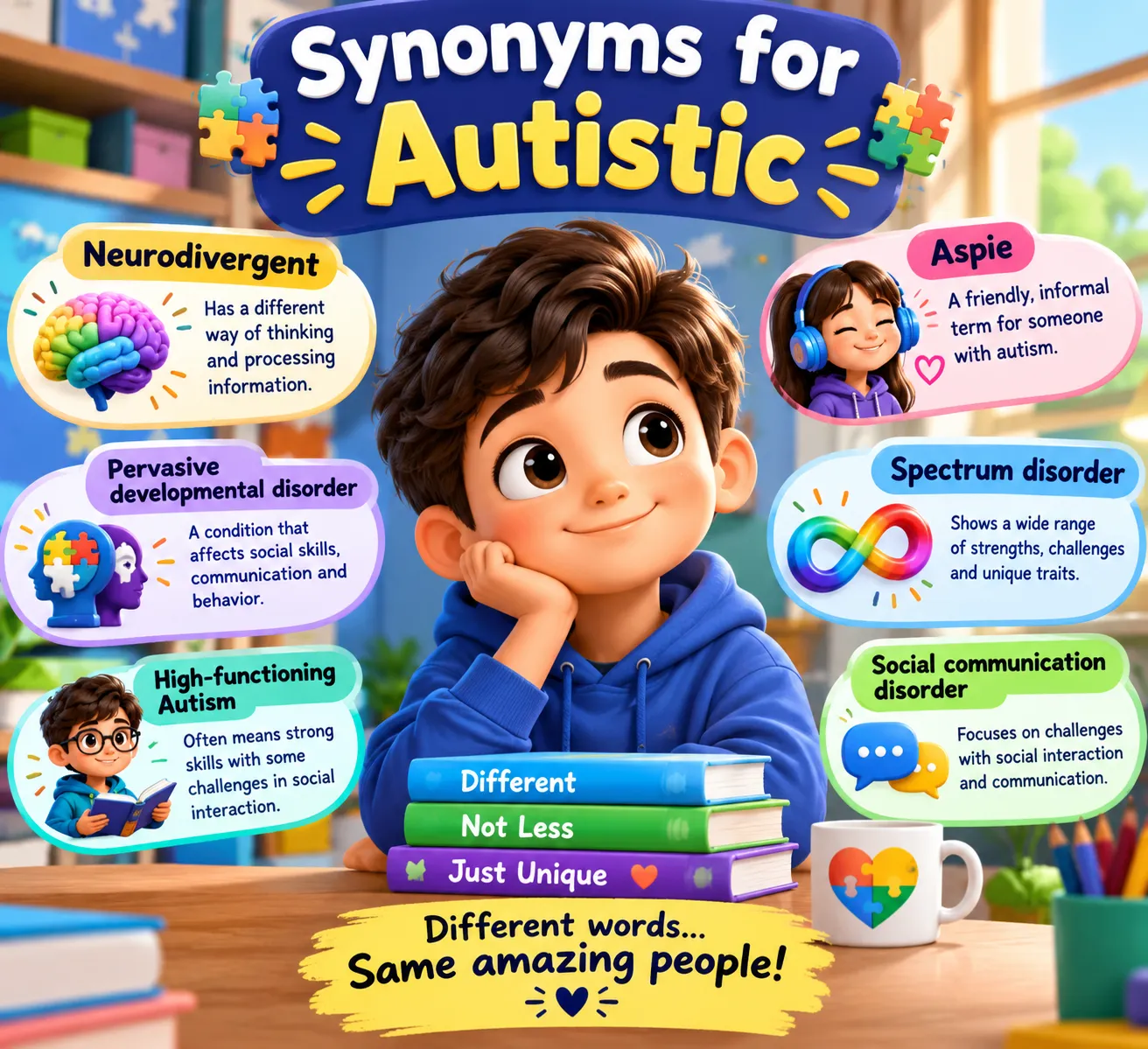
Autistic describes a person who is autistic, meaning they have autism, a neurodevelopmental condition that can affect communication, social interaction, sensory processing, and behavior. There is no exact synonym for autistic, but terms such as on the autism spectrum and person with autism may fit different contexts. The best choice depends on the person’s preference and the meaning you want to express.
The word autistic describes a person who is autistic. Autism is a neurodevelopmental condition that can shape how a person communicates, learns, experiences sensory information, and interacts with the world. For example, an autistic student may prefer clear instructions, quiet spaces, or a familiar daily routine.
People use this word in education, healthcare, family discussions, and everyday conversation. Learning related terms can help English learners and content writers explain autism clearly and respectfully. However, autistic does not have 30 exact synonyms. Some alternatives describe autism directly, while others refer to specific traits, support needs, or outdated labels that require caution.
In this guide, we will explore the meaning, pronunciation, history, related terms, and semantic categories of autistic. You will also learn how to choose language that respects individual preferences and avoids stereotypes.
Meaning of Autistic
Definition
Autistic (adjective): Describes a person who is on the autism spectrum. Autism is a lifelong neurodevelopmental condition that can influence communication, social interaction, sensory experiences, interests, and behavior. Every autistic person is different.
Examples
- My autistic brother enjoys quiet places and clear routines.
- The school provides support to autistic students based on their individual needs.
Connotative Meaning
Connotation (the feelings or ideas associated with a word beyond its basic meaning).
- Positive tone: Can reflect identity, acceptance, and pride when used respectfully.
- Negative tone: May sound insulting when used to mock someone or suggest that autism is a flaw.
- Neutral tone: Usually describes an autistic person or an autism-related topic in an appropriate context.
The word itself is not an insult. Its tone depends on how it is used and the speaker’s intent.
Etymology of Autistic
The word autistic developed from autism, which is based on the Greek word autos, meaning “self.” The suffix -istic helps form an adjective.
| Period | Development |
| Old English (450–1100) | The word autistic was not part of Old English. People used other words to describe behavior and personal characteristics. |
| Middle English (1100–1500) | The word was not established in Middle English. The modern medical term developed much later. |
| Modern English (1500–present) | Autism entered medical terminology in the early 20th century, and autistic developed as its related adjective. Today, the word is used in healthcare, education, research, and everyday discussion. |
Pronunciation (IPA)
- IPA: /ɔːˈtɪstɪk/ (one common British-style pronunciation); pronunciations vary by accent.
- Syllables: au-tis-tic
- Part of speech: Adjective
Affixation Pattern of Autistic
- Root: Aut- from Greek autos, meaning “self.”
- Prefix: None.
- Suffix: -istic forms an adjective related to a particular concept or condition.
- Related word formation:
- Autism (noun): A neurodevelopmental condition.
- Autistic (adjective): Relating to or describing a person who is autistic.
- Autistically (adverb): In a manner described as autistic; uncommon and often best avoided unless the context requires it.
- Autist (noun): A term used by some people, but it may sound unfamiliar or inappropriate to others.
- Neurodivergent (adjective): Describes a person whose brain functions or processes information differently from what is considered typical.
- Neurodiversity (noun): The natural variation in how human brains work.
Note: These words are related, but they are not all interchangeable. For example, neurodivergent covers a broader range of neurological differences than autism alone.
30 Synonyms and Related Terms for Autistic: Meanings and Examples
There are no 30 exact synonyms for autistic. The following list includes respectful alternatives, descriptive phrases, broader terms, and some historical or clinical expressions. The best choice depends on context, and a few terms are included mainly to explain why they should be used with care.
1. On the autism spectrum (Descriptive phrase)
Meaning: Describes someone who is autistic or whose experiences fall within the autism spectrum.
Examples:
- She is on the autism spectrum and enjoys creative projects.
- The program supports children on the autism spectrum.
2. Person with autism (Noun phrase)
Meaning: Describes an individual who has autism, using person-first language.
Examples:
- The workshop welcomes every person with autism.
- He is a person with autism who enjoys learning new skills.
3. Autistic person (Noun phrase)
Meaning: Describes a person who identifies as autistic or is described as autistic.
Examples:
- The autistic person shared their experiences.
- The group invited autistic people to discuss accessibility.
4. Person on the autism spectrum (Noun phrase)
Meaning: A person who is on the autism spectrum.
Examples:
- The teacher asked how to support a person on the autism spectrum.
- Each person on the autism spectrum may have different needs.
5. Neurodivergent (Adjective)
Meaning: Describes someone whose brain processes information or functions differently from what is considered typical; it includes, but is not limited to, autistic people.
Examples:
- The company aims to create a welcoming workplace for neurodivergent employees.
- Neurodivergent students may benefit from different learning approaches.
6. Neurodistinct (Adjective)
Meaning: Describes someone whose neurological traits differ from those of the broader population; usage varies.
Examples:
- The team values neurodistinct ways of thinking.
- The guide discusses ways to support neurodistinct learners.
7. Neurologically diverse (Descriptive phrase)
Meaning: Describes neurological differences among people, although the phrase is often more suitable for a group than for one individual.
Examples:
- The classroom includes students with neurologically diverse needs.
- The organization welcomes people with different neurological profiles.
8. Neurodiverse (Adjective)
Meaning: Describes a group containing different neurological types; neurodivergent is usually more precise for one person.
Examples:
- The neurodiverse team brings many perspectives together.
- The school recognizes the strengths of its neurodiverse community.
9. Autistic individual (Noun phrase)
Meaning: A more formal way to refer to a person who is autistic.
Examples:
- The study included several autistic individuals.
- Each autistic individual may have different preferences.
10. Individual with autism (Noun phrase)
Meaning: A formal, person-first expression for someone who has autism.
Examples:
- The clinic offers services for each individual with autism.
- The individual with autism requested written instructions.
11. Autism-spectrum individual (Noun phrase)
Meaning: A less common expression referring to an individual on the autism spectrum.
Examples:
- The report discusses the experiences of an autism-spectrum individual.
- The program considers the needs of autism-spectrum individuals.
Usage note: “Autistic person” or “person on the autism spectrum” usually sounds more natural.
12. Person with an autism diagnosis (Noun phrase)
Meaning: A person who has received a formal autism diagnosis.
Examples:
- The person with an autism diagnosis requested workplace adjustments.
- A person with an autism diagnosis may seek help with daily tasks.
13. Diagnosed autistic person (Noun phrase)
Meaning: An autistic person who has received a formal diagnosis.
Examples:
- The diagnosed autistic person shared their experience with the group.
- A diagnosed autistic person may choose whether to disclose their diagnosis.
Usage note: A formal diagnosis is not required for someone to use the word autistic to describe themselves.
14. Autistic adult (Noun phrase)
Meaning: An adult who is autistic.
Examples:
- The organization offers resources for autistic adults.
- An autistic adult explained the importance of sensory-friendly spaces.
15. Autistic child (Noun phrase)
Meaning: A child who is autistic.
Examples:
- The school provides individual support for each autistic child.
- An autistic child may communicate in a way that suits their needs.
16. Autistic student (Noun phrase)
Meaning: A student who is autistic.
Examples:
- The teacher gives the autistic student clear written instructions.
- The autistic student participates in class discussions in their own way.
17. Autistic learner (Noun phrase)
Meaning: A learner who is autistic.
Examples:
- The course offers flexible activities for autistic learners.
- An autistic learner may prefer visual instructions.
18. Autistic person with support needs (Noun phrase)
Meaning: An autistic person whose daily life includes particular support needs.
Examples:
- The service develops plans for autistic people with support needs.
- An autistic person with support needs may benefit from tailored assistance.
19. Person with sensory differences (Noun phrase)
Meaning: A person who experiences sensory information differently; this can describe some autistic people but is not specific to autism.
Examples:
- The museum offers quiet areas for people with sensory differences.
- A person with sensory differences may find loud music uncomfortable.
20. Person with social communication differences (Noun phrase)
Meaning: A person whose way of communicating or interacting differs from common social expectations.
Examples:
- The training supports people with social communication differences.
- A person with social communication differences may prefer direct language.
21. Person with a different communication style (Noun phrase)
Meaning: A person who communicates in a way that differs from what others expect.
Examples:
- The team respects each person with a different communication style.
- A person with a different communication style may prefer written messages.
22. Person with repetitive behaviors (Noun phrase)
Meaning: A person who displays repeated actions or patterns; this can describe one trait associated with autism but is not an alternative for autistic.
Examples:
- The therapist discussed ways to support a person with repetitive behaviors.
- Some people find repetitive movements calming.
23. Person with focused interests (Noun phrase)
Meaning: A person who has strong or focused interests in particular topics.
Examples:
- The project welcomes people with focused interests.
- A person with focused interests may develop deep knowledge of a subject.
24. Person with sensory sensitivities (Noun phrase)
Meaning: A person who responds strongly to certain sounds, lights, textures, or other sensory input.
Examples:
- The event provides quiet seating for people with sensory sensitivities.
- A person with sensory sensitivities may prefer soft lighting.
25. Person who experiences the world differently (Descriptive phrase)
Meaning: A broad, respectful description of someone whose experiences or perceptions differ from those of others.
Examples:
- The article celebrates people who experience the world differently.
- A person who experiences the world differently may offer a fresh perspective.
26. Person with a neurodevelopmental condition (Noun phrase)
Meaning: A person who has a condition related to brain development; autism is one such condition.
Examples:
- The center supports people with neurodevelopmental conditions.
- A person with a neurodevelopmental condition may benefit from tailored services.
27. Person with a developmental condition (Noun phrase)
Meaning: A person who has a condition affecting development; this is a broad term and does not specifically mean autistic.
Examples:
- The program supports people with developmental conditions.
- A person with a developmental condition may need individualized educational support.
28. Person with atypical social communication (Noun phrase)
Meaning: A person whose social communication differs from common patterns.
Examples:
- The guide discusses support for people with atypical social communication.
- A person with atypical social communication may prefer clear, direct conversations.
29. Autistic-spectrum person (Noun phrase)
Meaning: A less common phrase intended to refer to someone on the autism spectrum.
Examples:
- The writer interviewed an autistic-spectrum person about accessibility.
- The discussion included the experiences of autistic-spectrum people.
Usage note: Prefer “autistic person” or “person on the autism spectrum,” which are more natural expressions.
30. Person formerly described as having Asperger’s syndrome (Noun phrase)
Meaning: Refers to a person who may have received an Asperger’s syndrome diagnosis, a term historically used for a profile now generally included within autism spectrum disorder.
Examples:
- The speaker discussed being diagnosed with Asperger’s syndrome years ago.
- The article explains how autism terminology has changed over time.
Usage note: Do not assume every autistic person has this history. Ask which language an individual prefers.
Prototype Meaning of Autistic
The prototype meaning of autistic is a person who has autism, a neurodevelopmental condition that can affect communication, sensory processing, social interaction, and patterns of behavior or interests. People often associate autism with differences in social communication, focused interests, or a preference for routines. However, autism is a spectrum, and no single trait describes every autistic person. Some autistic people need substantial daily support, while others live independently. The word should describe a person respectfully, without making assumptions about their abilities, personality, or needs.
Prototype Categorization of Autistic Synonyms
| Semantic Category | Synonyms or Related Terms | Usage |
| Direct Identity Terms | Autistic person, autistic individual, autistic adult, autistic child, autistic student, autistic learner | Use when describing an autistic person or a specific group. |
| Person-First Terms | Person with autism, individual with autism, person with an autism diagnosis, person with a neurodevelopmental condition | Suitable for formal writing or people who prefer person-first language. |
| Spectrum-Related Terms | On the autism spectrum, person on the autism spectrum, autism-spectrum individual, autistic-spectrum person | Refer to the autism spectrum, although some expressions are more natural and widely used than others. |
| Broader Neurological Terms | Neurodivergent, neurodistinct, neurodiverse, neurologically diverse | Describe neurological differences more broadly; they are not exact synonyms for autistic. |
| Communication and Sensory Descriptions | Person with sensory differences, person with sensory sensitivities, person with social communication differences, person with a different communication style, person with atypical social communication | Use when discussing specific communication styles or sensory experiences rather than a person’s entire identity. |
| Behavior and Interest Descriptions | Person with repetitive behaviors, person with focused interests | Describe possible characteristics of some autistic people, not autism itself. |
| Support and Development Terms | Autistic person with support needs, person with a developmental condition, person with a neurodevelopmental condition | Useful in educational, care, or support-related contexts. These terms have broader or different meanings. |
| General Descriptive Expressions | Person who experiences the world differently | Offers a broad, respectful description but does not specifically identify autism. |
| Historical or Diagnosis-Related Terms | Person formerly described as having Asperger’s syndrome, diagnosed autistic person | Use when a person’s diagnostic history is relevant. |
Choosing the right term improves clarity and helps avoid stereotypes. Whenever possible, respect the individual’s language preference. Many people prefer identity-first language, such as autistic person, while others prefer person-first language, such as person with autism.
Antonyms of Autistic
There is no exact antonym for autistic. Autism is a neurodevelopmental condition, not a quality with a simple opposite. However, the following terms can express contrasts in specific contexts.
- Neurotypical (adjective): Describes someone whose neurological development and functioning fall within commonly expected patterns. It is not a direct opposite of every autistic trait.
- Non-autistic (adjective): Describes someone who is not autistic.
- Not on the autism spectrum (descriptive phrase): Refers to someone who is not on the autism spectrum.
- Typical (adjective): Describes something commonly expected or usual in a particular context; it should not be used to imply that autistic people are abnormal or less valuable.
- Neurotypical person (noun phrase): A person whose neurological development is considered typical within a given social or clinical framework.
Short Questions and Answers
What does autistic mean?
Autistic describes a person who is autistic. Autism is a neurodevelopmental condition that can affect communication, sensory experiences, social interaction, and behavior.
When should autistic be used?
Use autistic when discussing autism or describing someone who is autistic. In personal, educational, and professional writing, use respectful language and consider the individual’s preferred terminology.
Is autistic positive or negative?
The word is neutral when used accurately and respectfully. It can be positive when expressing identity and acceptance, but it can become hurtful when used to mock or stereotype someone.
How is autistic different from similar words?
Autistic specifically relates to autism. Neurodivergent covers a broader range of neurological differences, while neurotypical describes people whose neurological development is considered typical. Person with autism expresses a similar basic meaning to autistic person, but uses person-first language.
Are autistic and neurodivergent synonyms?
They are related, but they are not exact synonyms. Autism is one form of neurodivergence, while neurodivergence also includes other neurological differences.
Is person with autism better than autistic person?
Neither phrase is universally better. Many autistic people prefer autistic person, while others prefer person with autism. When possible, respect the individual’s choice.
Can I use autistic in academic writing?
Yes. Autistic is widely used in academic, educational, and clinical writing. Define relevant terms when needed, use them accurately, and avoid generalizations about all autistic people.
Conclusion
Learning the meaning of autistic and its related terms can improve your vocabulary, strengthen your writing, and help you communicate with greater care. Although there are many related expressions, they do not all mean the same thing. Some describe autism directly, while others refer to specific traits, neurological differences, or support needs.
For clear and respectful writing, choose terms that match your message. Use autistic person or person with autism when discussing autism itself, and choose more specific descriptions when discussing sensory experiences or communication styles. Avoid outdated or misleading labels unless they are relevant to a historical or personal context.
Practice using these words in everyday sentences. Over time, you can build confidence, reduce repetition, and express ideas more accurately while respecting the people you describe.
Read More:
Synonyms for Maverick: 30 Strong Words to Know

I’m Noor Fatima, an English content writer at SameSynonyms.com, specializing in synonyms, antonyms, word meanings, and English vocabulary. I create clear, well-researched content with practical examples to help readers understand word usage, expand their vocabulary, and communicate more effectively.










