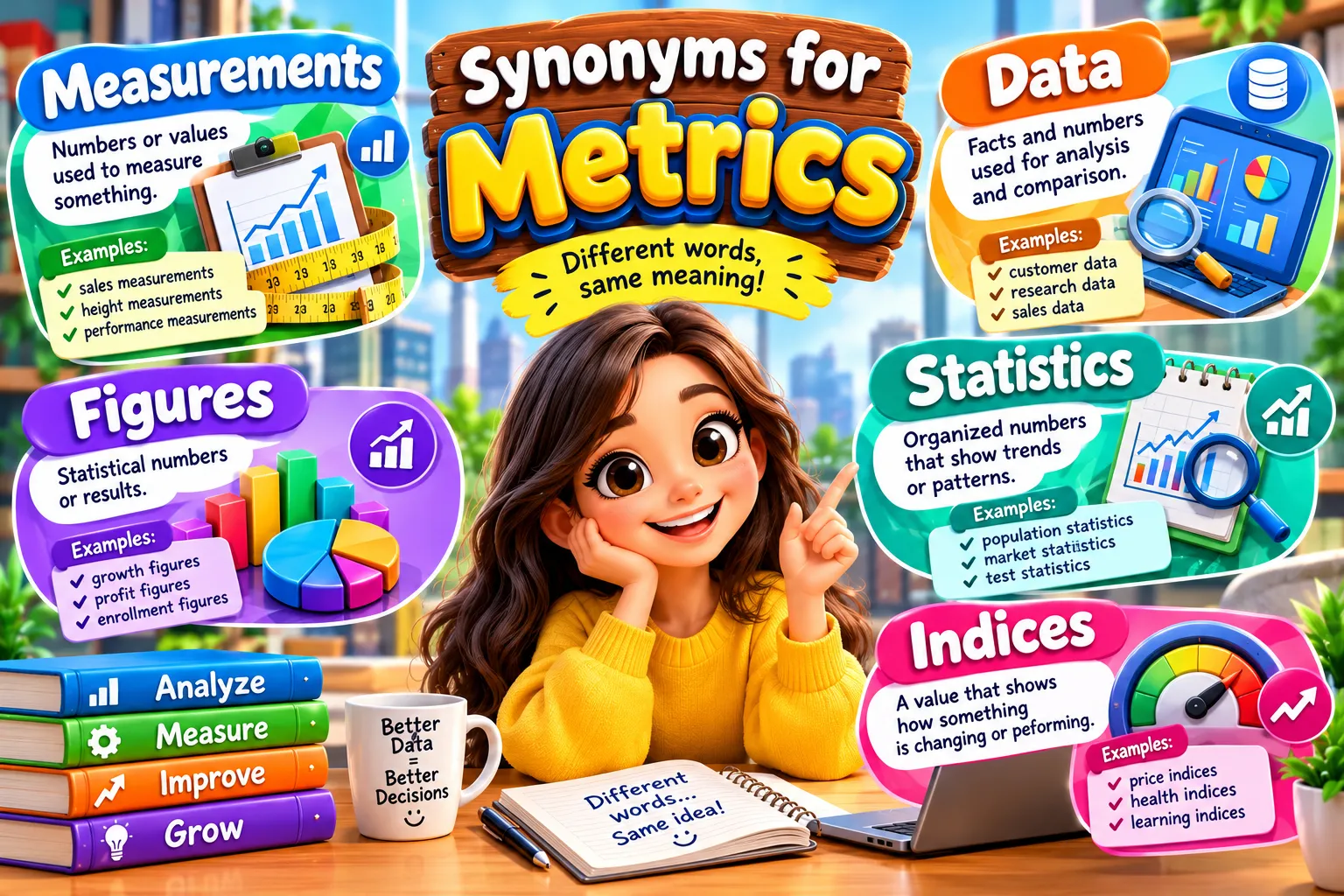
Synonyms for metrics include measurements, indicators, measures, benchmarks, statistics, data points, and performance indicators. The best choice depends on what you want to measure.
Metrics are numbers or measures that help us track progress and results. For example, a website owner may check page views, clicks, and sales to see how well a website performs. These numbers are called metrics. People use metrics in business, education, marketing, science, and daily life to make better choices.
Learning synonyms for metrics helps you avoid repeating the same word in your writing. It also helps you choose words that fit your topic. For example, measurements may suit science, while key performance indicators often fit business reports.
In this guide, you will learn the meaning, history, pronunciation, and grammar of metrics. You will also explore 30 synonyms with simple meanings and examples, plus related categories and antonyms to help you use each word with confidence.
Meaning of Metrics
Definition
Metrics (plural noun): Numbers or measures used to track, compare, or judge progress, performance, quality, or results.
Examples
- The company uses sales metrics to track its growth.
- Website metrics show how many people visit each page.
Connotative Meaning
(Connotation: the feeling or idea a word suggests beyond its basic meaning.)
- Positive tone: Metrics can suggest progress, success, and clear results.
- Negative tone: Too many metrics can suggest pressure, close monitoring, or a focus on numbers over people.
- Neutral tone: Metrics can simply refer to facts used to measure results.
Etymology of Metrics
The word metrics comes from metric, which is linked to the Greek word metron, meaning “measure.”
- Old English (450–1100): The modern word metrics was not used in Old English. People used other words and methods to describe measuring and counting.
- Middle English (1100–1500): English adopted terms linked to measurement through French and Latin. The word metric developed later from classical language roots.
- Modern English (1500–present): Metric became linked to measurement, especially in mathematics and science. Today, metrics commonly refers to figures used to track performance and results.
Pronunciation (IPA)
- IPA: /ˈmɛtrɪks/
- Syllables: met-rics
- Stress: The first syllable is stressed.
Affixation Pattern of Metrics
| Element | Word | Explanation |
| Root | Meter / metric | Linked to the idea of measuring. |
| Prefix | None | Metrics has no modern prefix. |
| Suffix | -s | Marks the plural form of metric. |
| Word formation | Metric | Noun or adjective, depending on use. |
| Word formation | Metrics | Plural noun for measures or indicators. |
| Related word | Metrology | Noun meaning the science of measurement. |
| Related word | Metrological | Adjective relating to the science of measurement. |
| Related word | Metrologist | Noun for a specialist in measurement science. |
30 Synonyms of Metrics With Meaning and Examples
These words have related meanings, but they are not all exact substitutes. Choose one based on what you are measuring and the context in which you are writing.
1. Measurements (Noun)
Meaning: Values that show the size, amount, or level of something.
Examples:
- The scientist recorded the measurements carefully.
- We use these measurements to compare the two objects.
2. Indicators (Noun)
Meaning: Signs or values that show a condition or level of progress.
Examples:
- Sales growth is an indicator of business performance.
- These indicators help us track customer needs.
3. Measures (Noun)
Meaning: Ways to assess or judge something.
Examples:
- Customer satisfaction is one measure of success.
- The school uses several measures to track progress.
4. Statistics (Noun)
Meaning: Facts or numbers collected and studied to understand a topic.
Examples:
- The report includes statistics on website traffic.
- Recent statistics show a rise in online sales.
5. Benchmarks (Noun)
Meaning: Standards used to compare performance or results.
Examples:
- The team uses industry benchmarks to assess its work.
- Last year’s sales provide a benchmark for this year.
6. Data Points (Noun)
Meaning: Individual pieces of information used in analysis.
Examples:
- Each survey response adds a data point.
- The analyst reviewed hundreds of data points.
7. Performance Indicators (Noun)
Meaning: Values that show how well a person, team, or system performs.
Examples:
- The manager reviews performance indicators every month.
- Delivery time is one of our key performance indicators.
8. KPIs (Noun)
Meaning: Key performance indicators used to track important goals.
Examples:
- The sales team tracks its KPIs each week.
- Customer retention is one of the company’s main KPIs.
9. Criteria (Noun)
Meaning: Standards used to judge or assess something.
Examples:
- Quality and speed are key criteria for success.
- The team set clear criteria for the project.
10. Variables (Noun)
Meaning: Factors that can change and affect a result.
Examples:
- The study examined several variables.
- Price and age were important variables in the research.
11. Quantifiers (Noun)
Meaning: Words or values that show quantity or amount.
Examples:
- The researcher used quantifiers to describe the amount of change.
- These quantifiers helped explain the size of the sample.
Note: This is a specialized term and is not a general synonym for business metrics.
12. Figures (Noun)
Meaning: Numbers that describe amounts, totals, or results.
Examples:
- The latest sales figures look promising.
- Please check the figures before sending the report.
13. Values (Noun)
Meaning: Numbers or amounts assigned to a variable or measure.
Examples:
- The system stores the values for each month.
- The values changed after the update.
14. Data (Noun)
Meaning: Facts or information collected for study or analysis.
Examples:
- The team uses data to make decisions.
- We need more data before drawing a conclusion.
15. Ratios (Noun)
Meaning: Comparisons between two amounts.
Examples:
- The report shows the ratio of sales to costs.
- We compared the ratios across several departments.
16. Rates (Noun)
Meaning: Amounts measured in relation to another amount or period of time.
Examples:
- The company tracks its customer return rate.
- The error rate fell after the update.
17. Scores (Noun)
Meaning: Numbers that show a result or level of performance.
Examples:
- The students improved their test scores.
- The website received a high quality score.
18. Totals (Noun)
Meaning: Final amounts found by adding numbers together.
Examples:
- The sales totals increased in June.
- Check the totals before approving the budget.
19. Counts (Noun)
Meaning: Numbers that show how many items or events exist.
Examples:
- The team tracks daily visitor counts.
- The final counts showed more responses than expected.
20. Benchmarks (Noun)
Meaning: Reference points used to judge progress or quality.
Examples:
- We compared the new results with past benchmarks.
- The company set benchmarks for customer service.
Note: This word also appears at number 5 because it is a common alternative in performance reporting. For a more varied list, you can replace this entry with yardsticks, meaning standards used to judge results.
21. Yardsticks (Noun)
Meaning: Standards used to measure or judge success.
Examples:
- Profit is not the only yardstick for success.
- Customer trust is an important yardstick for the brand.
22. Assessments (Noun)
Meaning: Judgments made after examining something.
Examples:
- The teacher used several assessments to track learning.
- The company completed an assessment of its service.
23. Evaluations (Noun)
Meaning: Careful reviews of quality, value, or performance.
Examples:
- Regular evaluations help improve the process.
- The team shared its evaluations at the meeting.
24. Readings (Noun)
Meaning: Values shown by a measuring device or system.
Examples:
- The sensor recorded temperature readings.
- The doctor checked the machine’s readings.
25. Outputs (Noun)
Meaning: Results produced by a process, system, or activity.
Examples:
- The team reviewed the system’s outputs.
- The new process increased daily outputs.
26. Outcomes (Noun)
Meaning: Results or effects of an action or process.
Examples:
- The program measures student outcomes.
- Better training led to stronger outcomes.
27. Results (Noun)
Meaning: Effects or achievements that come from an action.
Examples:
- The latest results show steady growth.
- We reviewed the results at the end of the project.
28. Statistics-Based Measures (Noun Phrase)
Meaning: Measures created from numerical data and statistical analysis.
Examples:
- The team used statistics-based measures to compare performance.
- Statistics-based measures helped reveal long-term trends.
29. Performance Measures (Noun)
Meaning: Values used to judge how well a task or system works.
Examples:
- The company reviews performance measures each quarter.
- Speed and accuracy are key performance measures.
30. Dimensions (Noun)
Meaning: Different aspects or features used to examine a topic.
Examples:
- The review considered several dimensions of service quality.
- Cost and reliability are two dimensions of performance.
Prototype Meaning
The prototype meaning of metrics is numerical measures used to track progress, performance, or results. When people hear this word, they often think of dashboards, charts, reports, and figures that show whether a goal has been met. For example, a business may track sales, profit, customer satisfaction, and website visits. These metrics help people compare results and make informed decisions. The word is common in business, marketing, education, technology, and research.
Prototype Categorization
| Category | Synonyms | When to Use |
| Measurement and Quantity | Measurements, measures, values, readings, counts, totals | For amounts, sizes, and numerical observations. |
| Performance and Goals | Indicators, performance indicators, KPIs, performance measures, scores | To track success, progress, or performance. |
| Comparison and Standards | Benchmarks, criteria, yardsticks, ratios, rates | To compare results or judge performance. |
| Data and Analysis | Data, statistics, data points, variables, statistics-based measures | In research, reports, and analytical writing. |
| Review and Judgment | Assessments, evaluations | When examining quality, progress, or performance. |
| Results and Effects | Results, outcomes, outputs | To describe what an activity, process, or system produces. |
| Aspects of a Topic | Dimensions | To discuss different parts of a complex issue. |
Some synonyms overlap across categories. Choose the word that best matches your meaning: a number, a standard, an evaluation process, or a result.
Antonyms of Metrics
There is no exact antonym for metrics, but these words describe ideas that contrast with numerical measurement.
- Subjectivity (Noun): Judgment based on personal feelings or opinions rather than objective measures.
- Guesswork (Noun): Making a choice without enough facts or reliable information.
- Intuition (Noun): Understanding or deciding something based on instinct rather than measured data.
- Impression (Noun): A belief or feeling formed without a full measurement.
- Qualitative judgment (Noun Phrase): An assessment based on qualities rather than numerical values.
- Uncertainty (Noun): A state in which something is not known or cannot be measured clearly.
These are contextual opposites, not direct dictionary antonyms.
Short Questions and Answers
What does metrics mean?
Metrics are numbers or measures used to track progress, performance, quality, or results.
When should metrics be used?
Use metrics when discussing measurable information, especially in business, marketing, education, technology, and research.
Is metrics positive or negative?
Metrics is a neutral word. It can suggest progress and success, but too much focus on numbers can also create pressure.
How is metrics different from similar words?
Metrics usually refers to measures used to track or assess something. Data means collected information, statistics refers to numerical facts or their analysis, and KPIs are measures tied to important goals.
Conclusion
Learning synonyms for metrics can improve your vocabulary and help you write with greater clarity. Words such as measurements, indicators, statistics, and performance measures have related meanings, but each fits a different situation. Choosing the right word makes reports, articles, and presentations easier to understand. It also helps you avoid repetition and explain data more precisely.
Practice using these words in short sentences each day. Try writing one sentence about business, one about education, and one about personal progress. Then choose the synonym that best fits each example.
Over time, you will become more confident when speaking about numbers, results, and performance in English.
Read More:
Synonyms for Albeit: 30 Powerful Alternatives to Know

I’m Rubab, a content specialist at SameSynonym, focused on synonyms, antonyms, word meanings, and English vocabulary.
I create clear, well-researched content with accurate definitions and practical examples.
My goal is to help readers improve their vocabulary and writing with confidence.