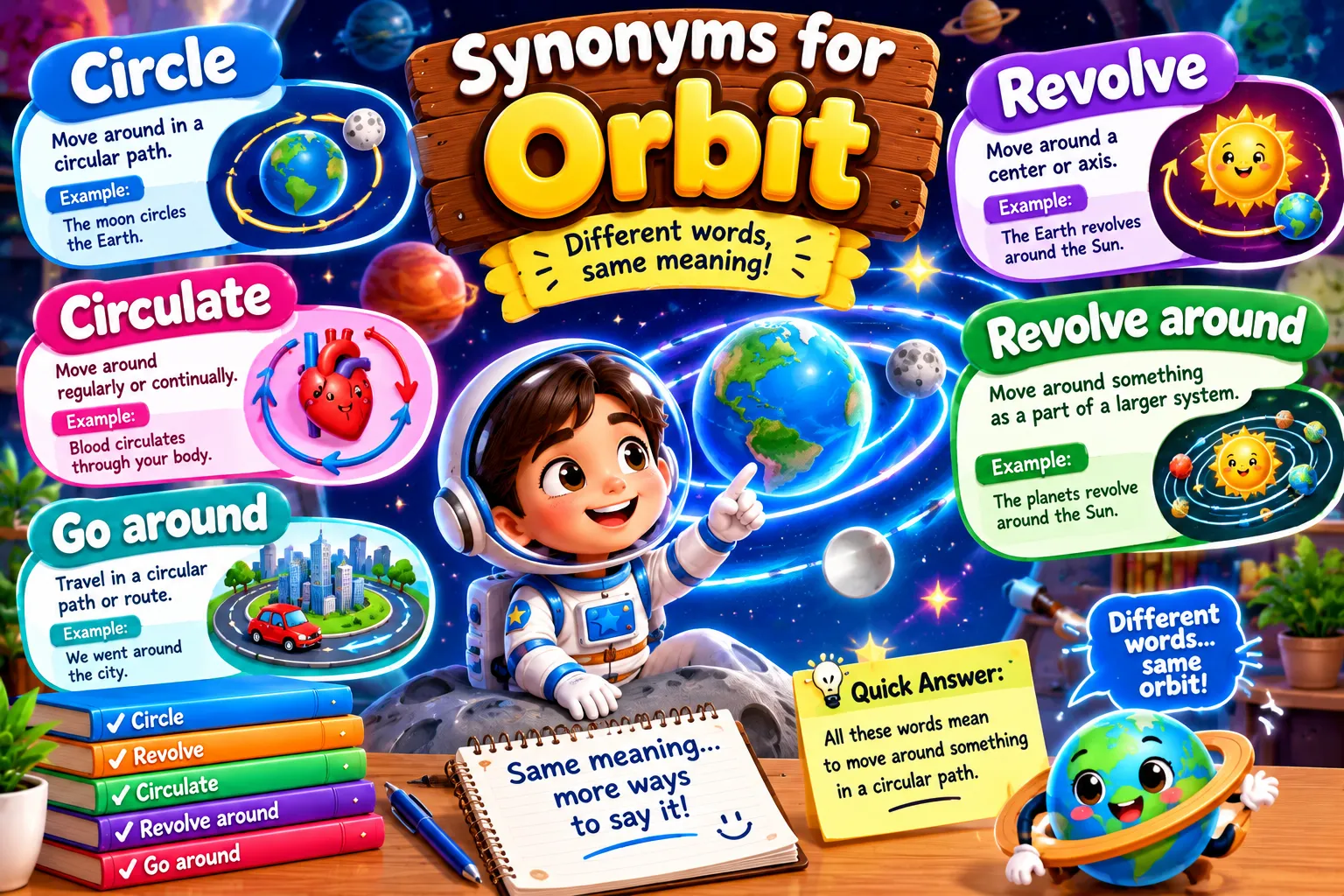
Synonyms for orbit include path, course, trajectory, circuit, rotation, revolution, route, and track. The best choice depends on whether you mean movement in space, a circular path, or a person’s area of influence.
Orbit means the path an object follows around another object in space. For example, Earth moves in an orbit around the Sun. You may also hear this word when people talk about planets, satellites, and space travel.
In daily English, orbit can also describe a person’s social circle or area of influence. A new student might say they are entering a new social orbit when they meet a different group of friends.Learning synonyms for orbit helps you explain ideas in more ways. It also helps English learners build vocabulary and helps writers avoid repeating the same word.
However, not every synonym fits every sentence. Some words describe movement, while others describe a path or a group of people. This guide explains the meaning, history, pronunciation, grammar, and 30 useful alternatives to orbit, with simple examples to help you choose the right word.
Meaning of Orbit
Definition
Orbit (noun): The path an object follows around another object, especially in space.
Orbit (verb): To move around another object in a path.
Examples
- The Moon travels in an orbit around Earth.
- The satellite will orbit the planet for many years.
Connotative Meaning
Connotation means the feeling or idea a word brings to mind beyond its basic meaning.
- Positive tone: Orbit can suggest discovery, progress, or the wonder of space. The spacecraft entered a stable orbit.
- Negative tone: It can suggest being stuck in a limited circle or under someone’s influence. He stayed in the orbit of a controlling friend.
- Neutral tone: It can simply describe a path or movement. Earth orbits the Sun.
Etymology of Orbit
| Period | History of the Word Orbit |
| Origin | Comes from Latin orbita, meaning “track,” “course,” or “wheel rut.” It is related to orbis, meaning “circle” or “disk.” |
| Old English (450–1100) | Orbit was not an established English word. People used other words to describe circles, paths, and movement. |
| Middle English (1100–1500) | The modern word orbit was not yet widely used in English. Other terms described circular paths and movement. |
| Modern English (1500–present) | Orbit entered English through Latin and became common in astronomy. Today, it describes paths in space and can also mean a person’s area of influence. |
Pronunciation (IPA)
- IPA: /ˈɔːrbɪt/
- Syllables: or-bit
- Stress: First syllable
Affixation Pattern of Orbit
- Root: Orbit, from Latin orbita, meaning a track or course.
- Prefix: None in the basic word.
- Suffix: -s can mark the plural noun orbits or the third-person verb orbits; -al forms the adjective orbital.
- Word formations:
- Orbit (noun): A path around an object.
- Orbit (verb): To move around an object.
- Orbits (plural noun): More than one orbital path.
- Orbital (adjective): Related to an orbit.
- Orbiting (verb/adjective): Moving around another object.
- Orbited (verb): Moved around another object in the past.
- Orbiter (noun): A spacecraft or object that orbits another body.
30 Synonyms of Orbit With Meanings and Examples
Some words below are close synonyms, while others fit only certain contexts. Choose one that matches the meaning you want.
1. Path (Noun)
Meaning: The way or course along which something moves.
Examples:
- The satellite follows a clear path around Earth.
- The Moon’s path can be tracked by scientists.
2. Trajectory (Noun)
Meaning: The course an object follows as it moves through space.
Examples:
- The rocket followed its planned trajectory.
- Scientists studied the spacecraft’s trajectory.
3. Course (Noun)
Meaning: The direction or route followed by a moving object.
Examples:
- The planet continued on its course.
- The spacecraft changed course during the mission.
4. Circuit (Noun)
Meaning: A route that goes around and returns to its starting point.
Examples:
- The satellite completed a circuit around Earth.
- The runner made a circuit of the track.
5. Revolution (Noun)
Meaning: One complete movement around another object.
Examples:
- Earth completes one revolution around the Sun each year.
- The Moon’s revolution around Earth affects its position in the sky.
6. Rotation (Noun)
Meaning: The act of turning around an axis or center.
Examples:
- Earth’s rotation causes day and night.
- The planet’s rotation is different from its orbit around the Sun.
Note: Rotation is not an exact synonym for orbit. Rotation usually means spinning, while orbit means moving around another object.
7. Route (Noun)
Meaning: The way taken to reach a place or destination.
Examples:
- The mission team planned the spacecraft’s route.
- The satellite followed its assigned route through space.
8. Track (Noun)
Meaning: A path followed by a moving object.
Examples:
- The space agency tracked the satellite’s movement.
- The spacecraft stayed on its planned track.
9. Course of Motion (Noun Phrase)
Meaning: The direction and path in which something moves.
Examples:
- Scientists measured the course of motion of the object.
- The telescope recorded the comet’s course of motion.
10. Ellipse (Noun)
Meaning: An oval shape that describes the path of many orbiting objects.
Examples:
- The planet follows an elliptical path around the Sun.
- The satellite’s orbit is shaped like an ellipse.
Note: An ellipse is a shape, not a direct synonym for orbit.
11. Loop (Noun)
Meaning: A curved path that returns toward its starting point.
Examples:
- The spacecraft appeared to follow a wide loop in the diagram.
- The plane made a loop during the air show.
12. Ring (Noun)
Meaning: A circular shape or band around something.
Examples:
- The diagram showed a ring around the planet.
- The moon’s path was drawn as a ring on the model.
13. Circle (Noun)
Meaning: A round shape or a path that returns to its starting point.
Examples:
- The child drew a circle to show the planet’s path.
- The object moved in a circle around the center.
14. Circuit Path (Noun Phrase)
Meaning: A route that follows a complete loop.
Examples:
- The model showed the satellite’s circuit path.
- The spacecraft followed a circuit path around the planet.
15. Orbital Path (Noun Phrase)
Meaning: The path an object follows around another object in space.
Examples:
- The satellite entered a stable orbital path.
- Scientists calculated the planet’s orbital path.
16. Flight Path (Noun Phrase)
Meaning: The route an aircraft or spacecraft follows while moving.
Examples:
- The rocket stayed on its planned flight path.
- Engineers checked the spacecraft’s flight path.
17. Flight Track (Noun Phrase)
Meaning: The recorded or planned route of an aircraft or spacecraft.
Examples:
- The team reviewed the satellite’s flight track.
- The flight track showed where the spacecraft had traveled.
18. Course Line (Noun Phrase)
Meaning: A line showing the direction or route of movement.
Examples:
- The chart marked the planet’s course line.
- The engineer drew a course line on the mission map.
19. Pathway (Noun)
Meaning: A route or way through or across an area.
Examples:
- The diagram showed the pathway of the satellite.
- The spacecraft followed a pathway around the planet.
20. Trackway (Noun)
Meaning: A route or track along which movement takes place.
Examples:
- The diagram marked a trackway around the central body.
- The model used a trackway to show the satellite’s movement.
Note: Trackway is uncommon in astronomy and is not a standard synonym for orbit.
21. Sphere (Noun)
Meaning: A round three-dimensional object; in some contexts, it can refer to an area of activity or influence.
Examples:
- The model used a sphere to represent Earth.
- Her work brought her into a new sphere of influence.
22. Domain (Noun)
Meaning: An area of knowledge, activity, control, or influence.
Examples:
- The scientist worked within the domain of astronomy.
- The artist entered a new domain of creative work.
23. Realm (Noun)
Meaning: An area of activity, interest, or influence.
Examples:
- Space exploration opened a new realm of discovery.
- She became known in the realm of science.
24. Sphere of Influence (Noun Phrase)
Meaning: The people or areas affected by someone or something.
Examples:
- The leader had a wide sphere of influence.
- The new project moved the company into a different sphere of influence.
25. Social Circle (Noun Phrase)
Meaning: A group of people who know and spend time with one another.
Examples:
- He joined a new social circle at college.
- Her social circle grew after she moved to the city.
26. Circle of Friends (Noun Phrase)
Meaning: A group of people who share a friendship.
Examples:
- She found a welcoming circle of friends.
- His circle of friends shared an interest in astronomy.
27. Network (Noun)
Meaning: A group of connected people or things.
Examples:
- The researcher built a network of space experts.
- Her professional network helped her find new opportunities.
28. Range (Noun)
Meaning: The area or limits within which something operates or has influence.
Examples:
- The topic falls within the range of planetary science.
- The manager’s range of influence grew over time.
29. Scope (Noun)
Meaning: The extent or area covered by an activity or subject.
Examples:
- The project expanded the scope of the research.
- The discussion moved beyond the scope of astronomy.
30. Orbiting Course (Noun Phrase)
Meaning: A path followed by an object as it moves around another object.
Examples:
- The satellite maintained its orbiting course around Earth.
- The diagram showed the spacecraft’s orbiting course.
Usage tip: For scientific writing, orbital path, trajectory, course, and revolution are usually more precise choices. For social or professional contexts, social circle, network, realm, and sphere of influence may fit better.
Prototype Meaning
The most typical meaning of orbit is the path an object follows around another object in space. When people hear the word, they often imagine Earth moving around the Sun or the Moon moving around Earth. An orbit may be circular or oval-shaped, and its shape depends on factors such as gravity and the moving object’s speed. In a broader sense, orbit can also mean a person’s circle of friends or area of influence. The context tells readers which meaning is intended.
Prototype Categorization
The synonyms for orbit can be grouped by meaning and use. This table helps writers choose the best word for each context.
| Category | Synonyms | When to Use |
| Paths and Routes | Path, course, route, track, pathway, flight path | To describe the way an object moves. |
| Space and Astronomy | Trajectory, revolution, orbital path, orbiting course | To describe objects moving around other bodies in space. |
| Circular Movement and Shapes | Circuit, loop, ring, circle, ellipse | To describe circular paths or shapes. Some refer to shapes rather than an orbit itself. |
| Movement and Direction | Course of motion, flight track, course line, circuit path | To explain or map an object’s movement. |
| Areas of Influence | Sphere, domain, realm, sphere of influence, range, scope | To describe a person’s area of activity or influence. |
| Social Connections | Social circle, circle of friends, network | To describe groups of people and relationships. |
| Related but Not Exact Terms | Rotation, trackway | Use carefully because these words have meanings that differ from orbit. |
Choosing synonyms by category helps you avoid mistakes. For example, revolution can mean one complete trip around a planet, while rotation means spinning around an axis. Similarly, network fits social or professional connections, but not the path of a satellite.
Antonyms of Orbit
There is no single exact antonym for orbit. The best opposite depends on whether the word describes movement, a path, or a social connection.
- Remain still (Verb phrase): To stay in one place without moving.
Example: The object remained still instead of moving around the planet. - Stop (Verb): To end movement or activity.
Example: The satellite did not stop moving during its orbit. - Depart (Verb): To move away from a place or point.
Example: The spacecraft departed from its original route. - Straight line (Noun phrase): A line without a curve.
Example: The object moved in a straight line rather than a curved path. - Isolation (Noun): The state of being separate from others.
Example: He left the social circle and chose isolation. - Separation (Noun): The state of being apart.
Example: The separation between the two groups grew.
Short Questions and Answers
What does orbit mean?
Orbit means the path an object follows around another object, especially in space. It can also mean a person’s social circle or area of influence.
When should orbit be used?
Use orbit when describing a planet, moon, or satellite moving around another object. You can also use it figuratively to describe someone’s social or professional circle.
Is orbit positive or negative?
Orbit is usually neutral. It can suggest wonder and discovery in astronomy, but in social contexts it may imply dependence or being under another person’s influence.
How is orbit different from similar words?
Orbit describes a path around another object. Trajectory refers to the course of movement, revolution means one complete trip around an object, and rotation means spinning around an axis.
Conclusion
Learning the meaning of orbit and its synonyms can improve your English vocabulary and help you write with greater clarity. Words such as path, trajectory, course, and orbital path are useful when writing about space.
Words such as network, social circle, and sphere of influence work better when discussing people and relationships. Choosing the right word helps you avoid repetition and express your ideas more clearly.
Remember that related words do not always mean exactly the same thing, so check how each one is used in a sentence. Try learning a few new words each day, write your own examples, and use them in conversation. With regular practice, you can build confidence in both speaking and writing.
Read More:
Synonyms for Metrics:30 Meanings and Examples

I’m Falak Naaz, an SEO writer at SameSynonyms.com with 10 years of experience creating clear, engaging, and search-friendly English content. I specialize in synonyms, antonyms, vocabulary, and word usage. Through careful research and practical examples, I help readers choose the right words and improve their English with confidence.