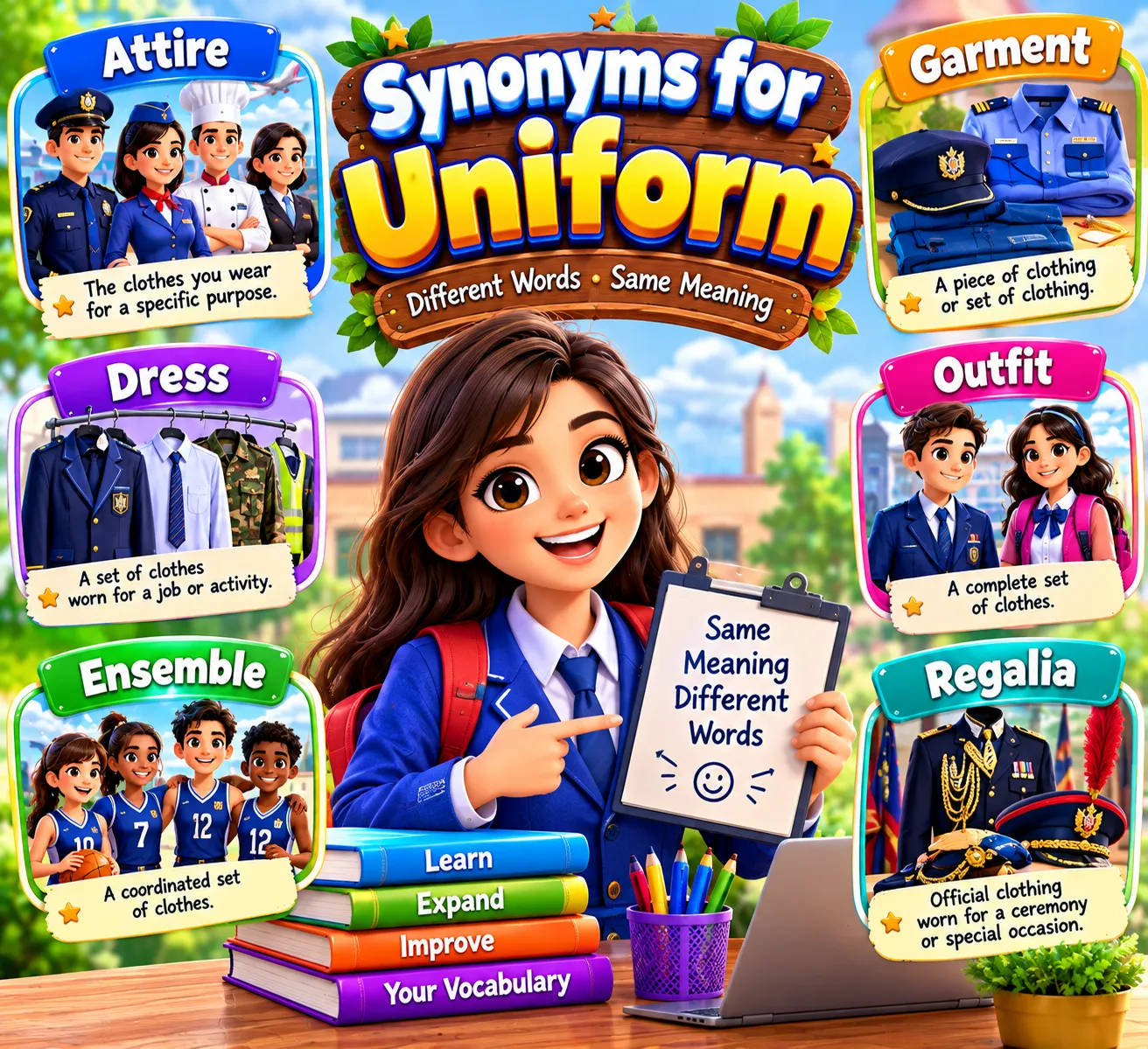
Synonyms for uniform include consistent, identical, similar, standardized, matching, regular, constant, equal, and homogeneous. For clothing, use outfit, dress, or livery. The best alternative depends on whether you mean matching clothes or something that stays the same.
A uniform is a set of clothes worn by people in the same group, such as students, nurses, police officers, or shop workers. For example, students may wear the same uniform to school each day. The word uniform can also describe things that stay the same in shape, size, style, or quality. A uniform color across a wall, for instance, has no major changes or patches.
Learning synonyms for uniform helps English learners and writers explain ideas more clearly. It also helps them avoid repeating the same word in essays, reports, and daily conversations. The best synonym depends on the meaning: standardized may suit a process, while consistent may describe quality or behavior.
In this guide, you will learn the meaning, history, pronunciation, grammar, and 30 related words with simple meanings and examples. You will also explore semantic categories and antonyms to help you choose the right word.
Meaning of Uniform
Definition
Uniform (noun/adjective):
- Noun: A set of clothes worn by members of the same group or organization.
- Adjective: Staying the same in form, appearance, amount, or quality.
Examples
- The students wear a blue uniform to school.
- The paint has a uniform color across the wall.
Connotative Meaning
(Connotation: the feeling or idea a word suggests beyond its basic meaning.)
- Positive tone: Can suggest order, unity, fairness, and consistency.
- Negative tone: Can suggest a lack of variety, creativity, or individuality.
- Neutral tone: Simply describes matching clothing or something that stays the same.
Etymology of Uniform
The word uniform comes from Latin uniformis, meaning “having one form.” It combines uni- (“one”) and forma (“form” or “shape”).
| Period | Etymology and Development |
| Old English (450–1100) | The modern word uniform was not commonly used in Old English. People used other words to describe sameness, shape, or matching clothing. |
| Middle English (1100–1500) | The word entered English through French and Latin influence, with usage developing around the idea of one form or a consistent pattern. |
| Modern English (1500–Present) | Uniform became common as both a noun for matching clothing and an adjective describing things that remain the same. |
Pronunciation (IPA)
- IPA: /ˈjuː.nɪ.fɔːrm/ (common American pronunciation)
- Syllables: u-ni-form (3 syllables)
Affixation Pattern of Uniform
- Root: Latin form, meaning “shape” or “form.”
- Prefix: uni- meaning “one.”
- Suffix: No productive suffix is added in the basic word uniform.
- Word formations:
- Uniform (noun): Matching clothes worn by a group.
- Uniform (adjective): The same throughout.
- Uniformly (adverb): In a consistent or equal way.
- Uniformity (noun): The state of being uniform.
- Uniformed (adjective): Wearing a uniform.
- Uniformness (noun): The quality of being uniform; less common.
- Uniformitarian (noun/adjective): Related to uniformitarianism, a principle used in geology.
30 Synonyms of Uniform With Meaning and Examples
Uniform has different meanings depending on context. Some alternatives describe matching clothing, while others refer to sameness or consistency.
1. Consistent (Adjective)
Meaning: Staying the same in quality, behavior, or result.
Examples:
- Her work is consistent every week.
- The team showed consistent effort throughout the season.
2. Identical (Adjective)
Meaning: Exactly the same in every important way.
Examples:
- The twins wore identical jackets.
- Both forms contain identical information.
3. Similar (Adjective)
Meaning: Almost the same, but not exactly alike.
Examples:
- The two schools have similar dress codes.
- Their answers were similar in meaning.
4. Standardized (Adjective)
Meaning: Made the same by following an agreed standard.
Examples:
- The company uses standardized forms.
- All students took a standardized test.
5. Regular (Adjective)
Meaning: Following a usual pattern or staying even.
Examples:
- The tiles were arranged in regular rows.
- The machine makes a regular sound.
6. Even (Adjective)
Meaning: Flat, balanced, or equal throughout.
Examples:
- Spread the mixture in an even layer.
- The wall has an even coat of paint.
7. Constant (Adjective)
Meaning: Staying the same or continuing without a major change.
Examples:
- The machine runs at a constant speed.
- She maintained constant pressure on the handle.
8. Stable (Adjective)
Meaning: Not changing suddenly or easily.
Examples:
- The system remained stable during the test.
- They need a stable supply of clean water.
9. Unchanging (Adjective)
Meaning: Not changing over time.
Examples:
- The mountain has an unchanging outline.
- His support remained unchanging through difficult times.
10. Equal (Adjective)
Meaning: The same in amount, size, value, or status.
Examples:
- The teacher gave each student an equal share.
- The two teams had equal chances of winning.
11. Homogeneous (Adjective)
Meaning: Made up of parts that are alike or similar.
Examples:
- The sample was a homogeneous mixture.
- The group shared a homogeneous set of basic skills.
12. Alike (Adjective/Adverb)
Meaning: Similar or the same in appearance or nature.
Examples:
- The uniforms looked alike from a distance.
- The rules apply alike to all members.
13. Matching (Adjective)
Meaning: Having the same or coordinated appearance.
Examples:
- The workers wore matching shirts.
- She bought matching curtains and cushions.
14. Corresponding (Adjective)
Meaning: Matching or having a close relationship with something else.
Examples:
- Each student received a corresponding ID card.
- The figures match the corresponding entries in the report.
15. Standard (Adjective/Noun)
Meaning: Following a usual or accepted level or pattern.
Examples:
- The school has a standard uniform.
- All products must meet the same standard.
16. Systematic (Adjective)
Meaning: Done in an organized way according to a clear plan.
Examples:
- The team followed a systematic process.
- She made a systematic check of every record.
17. Orderly (Adjective)
Meaning: Arranged neatly or following a clear order.
Examples:
- The students stood in orderly lines.
- The files were kept in an orderly manner.
18. Monotonous (Adjective)
Meaning: Repeating in a way that feels dull or lacks variety.
Examples:
- The work became monotonous after several hours.
- He disliked the monotonous pattern of the task.
19. Unvarying (Adjective)
Meaning: Not changing or varying.
Examples:
- The machine produced an unvarying tone.
- The region has an unvarying climate for much of the year.
20. Invariable (Adjective)
Meaning: Always the same and not likely to change.
Examples:
- Punctuality was his invariable habit.
- The process follows an invariable sequence.
21. Regularized (Adjective)
Meaning: Made more regular or brought into a consistent pattern.
Examples:
- The office regularized its reporting process.
- The company introduced a regularized schedule.
22. Coordinated (Adjective)
Meaning: Organized so that different parts work well together.
Examples:
- The staff wore coordinated outfits.
- The departments followed a coordinated plan.
23. Harmonized (Adjective)
Meaning: Made consistent or brought into agreement.
Examples:
- The team used harmonized procedures.
- The rules were harmonized across both offices.
24. Standardized-looking (Adjective)
Meaning: Having an appearance that follows a common pattern; an informal descriptive phrase.
Examples:
- The products had a standardized-looking design.
- Their standardized-looking outfits made the group easy to recognize.
25. Uniformed (Adjective)
Meaning: Wearing a uniform.
Examples:
- Uniformed officers stood near the entrance.
- A uniformed guard checked each visitor.
26. Attired (Adjective)
Meaning: Dressed in a particular type of clothing.
Examples:
- The performers were attired in matching costumes.
- The staff were formally attired for the event.
27. Clad (Adjective)
Meaning: Dressed or covered in a particular material or clothing.
Examples:
- The team was clad in blue shirts.
- The workers were clad in protective clothing.
28. Livery (Noun)
Meaning: A distinctive uniform or outfit worn by staff or servants, especially in formal or traditional settings.
Examples:
- The hotel staff wore traditional livery.
- The coachman appeared in formal livery.
29. Dress (Noun)
Meaning: A style of clothing worn for a particular role or occasion.
Examples:
- The officers wore formal dress for the ceremony.
- The school requires a specific style of dress.
30. Outfit (Noun)
Meaning: A set of clothes worn together.
Examples:
- Her work outfit included a white shirt and dark trousers.
- The team received a new outfit for the tournament.
Usage note: These words are not interchangeable in every sentence. Consistent, identical, and standardized often fit the adjective meaning, while outfit, dress, and livery relate to the clothing meaning.
Prototype Meaning
The prototype meaning of uniform is a set of matching clothes worn by people in the same group, such as students, police officers, or medical staff. People often picture a school uniform or a police uniform when they hear the word. As an adjective, uniform also describes something that stays the same throughout, such as a uniform color, size, or pattern. The shared idea is sameness: people or things follow one recognizable form or standard.
Prototype Categorization
Grouping synonyms by meaning helps writers choose the best alternative for clothing, consistency, or organization.
| Category | Synonyms | Best Used For |
| Sameness and Consistency | Consistent, identical, constant, stable, unchanging, unvarying, invariable | Describing something that stays the same over time |
| Equality and Similarity | Similar, equal, alike, homogeneous, even | Showing that things share qualities or have little difference |
| Standards and Rules | Standardized, standard, regularized, systematic | Describing procedures, rules, or methods that follow a set pattern |
| Order and Coordination | Orderly, coordinated, harmonized, corresponding | Showing that things are organized or work well together |
| Matching Clothing | Matching, uniformed, attired, clad, livery, dress, outfit | Describing clothing worn by individuals or groups |
| Lack of Variety | Monotonous | Describing something repetitive or dull because it lacks variety |
These categories help you choose words that fit the situation. For example, use matching for clothes, consistent for quality, standardized for procedures, and monotonous when sameness feels dull.
Antonyms of Uniform
- Varied (Adjective): Including different types or forms.
- Different (Adjective): Not the same as something else.
- Diverse (Adjective): Including many different kinds.
- Uneven (Adjective): Not level, equal, or consistent.
- Inconsistent (Adjective): Not staying the same in quality or behavior.
- Irregular (Adjective): Not following a fixed pattern.
- Variable (Adjective): Able to change or differ.
- Mixed (Adjective): Made up of different kinds or elements.
- Distinct (Adjective): Clearly different or separate.
- Nonuniform (Adjective): Not the same throughout.
For the clothing meaning, there is no single perfect antonym. Different clothing, varied outfits, or casual dress may work depending on the context.
Short Questions and Answers
What does uniform mean?
Uniform means matching clothing worn by a group or something that stays the same in form, quality, or appearance.
When should uniform be used?
Use uniform when talking about group clothing or describing something that remains consistent throughout.
Is uniform positive or negative?
It is usually neutral. It can suggest unity and order, but it may also suggest a lack of variety.
How is uniform different from similar words?
Uniform often means the same throughout or matching a group standard. Identical means exactly alike, consistent focuses on steady quality, and standardized means made to follow a common standard.
Conclusion
Learning uniform and its synonyms can improve your English vocabulary and help you express ideas with greater accuracy. Words such as consistent, identical, standardized, and matching each have a slightly different use.
Choosing the right one can make your writing clearer and more natural. When discussing clothing, words like outfit, dress, and livery may be useful. When describing a process or pattern, regular, stable, or consistent may fit better.
Practise these words in short sentences and notice how they are used in books, articles, and daily conversation. With regular practice, you can avoid repetition, strengthen your writing and speaking, and build confidence in English.
Read More:
Synonyms for Indignant: 30 Powerful Alternatives
I’m Noor Fatima, an English content writer at SameSynonyms.com, specializing in synonyms, antonyms, word meanings, and English vocabulary. I create clear, well-researched content with practical examples to help readers understand word usage, expand their vocabulary, and communicate more effectively.